Don’t be that person

yelling

The story you are about to read is true. Only the names have been omitted to protect the innocent.

The script of a friend of mine has had some positive results in the contest world, and the most recent venture was getting professional analysis on it, resulting in somewhat decent scores.

I’ve read this script, and it’s very, very good. It takes a classic story everybody knows, and then examines what happens AFTER the events of that story. There’s a lot to like about it, and my friend is doing what they can to get it out there.

Part of their effort is seeking advice from those with more experience. Sometimes it’s via social media, private online groups, or public community forums. We’re in several of the same groups, so I’ve seen a lot of my friend’s posts.

Not that I consider myself to be especially ‘experienced’, but since becoming connected with this person, I’ve done what I can to be supportive and helpful when applicable.

Earlier this week, my friend came to me with a dilemma.

They’ve been frequenting a community forum where one of the members regularly belittles or downplays any form or announcement of good news posted by another writer. Sometimes it’s along the lines of “”Look, this is a tough industry. If you can’t take the criticism, you’re totally in the wrong field, which it looks like you are.”

I also marveled at how much time people tend to spend on these forums. Many comments tend to be of the “I know better than you, so bow before my obvious superiority” sort. This was a big part of why I stepped away from them. I’d rather spend my time, y’know, actually writing.

Quick side note – the person claims to have representation, and some optioned scripts as well as a news release from a few years ago about their latest script being shopped around. Both my friend and I scoured IMDB Pro for any mention of them at all, but…bupkis. Take from that what you will.

As much as I consider every other writer to be my competition, I don’t think I’d ever actively try to dissuade somebody from trying. Would I remind them this is an extremely tough field to break into, let alone thrive in, and that their overall chances of success are very small? Yes.

I’ve also dealt with “professionals” who’ve talked down to me and told me my story ideas were stupid and worthless, using the reasoning “I’m just treating you the way somebody in the industry would. If you can’t take it, maybe you shouldn’t be trying.”

Not having as much experience as some, the people I have encountered were actually polite, helpful and supportive. If something didn’t work for them, I’d at least get “thanks, but no thanks.”

This does compel me to ask:  is that really how the industry treats most people?

This most recently came to a head when my friend asked about suggestions for how to use the positive results they received from a reputable script analysis service as a marketing tool.

The same person was the first to respond, saying the concept wasn’t that original, so the script didn’t have much of a chance, and marketing it would be a very tough sell. When asked what they would recommend, they seemed to just repeat the same things.

My advice to my friend was to ignore 99 percent of what that other person said, but keep in mind that yes, the field for potential interest in their script is limited, but that doesn’t mean they shouldn’t at least try. There’s no guarantee, but you never know who might say yes.

I made some suggestions of possible strategies, and summed it up with the standard “if they say no, you move on to the next one.”

As many of you probably already know, I’m a big believer not just in networking, but also in supporting the writing community. I try to help when I can any way I can.

This other person seemed to run completely counter to that. I just don’t see the point in why they would. To make themselves seem important? To show off their accomplishments? Wouldn’t they rather be seen in a positive light, rather than a negative one? I know I would.

I also mentioned to my friend that treating people like that could eventually backfire. Just because you might be a nobody today doesn’t mean you couldn’t be somebody important tomorrow.

And writers have long memories. We tend to remember those who leave bad impressions.

The best I could offer my friend was that I was there to help them and offer encouragement and advice when needed, and I hope other writers feel the same about their friends as well.

-The fine folks at Shore Scripts have a couple of deadlines coming up fast.

For all you filmmakers, tomorrow – 29 August – is the early deadline for their Short Film Fund 2 competition. Here’s a link to an article about Lindiwe Makgalemele, the winner of Short Film Fund 1.

And for writers of film and TV, this Monday – 31 August – is the final deadline for the Shore Scripts 2020 Feature & TV Pilot contest.

From out of the archives

speedreading

The latest draft of the horror-comedy is complete – clocking in at a respectable 102 pages. It’s out to my savvy readers, so now the focus shifts to some semi-overdue reads for a couple of colleagues.

So while I dive into those, here are a few classic posts from days gone by…

Enjoy.

May I be of some assistance?

More work now, better results later

I know the rules, and do not hesitate to break them

Same destination, different route

Send it. Forget it.

Q & A with Jim Vines

Jim Vines

A Beast Is Born COVER (High Resolution) (COMPRESSED)

Jim Vines has been a screenwriter and script consultant for a number of years. His first produced film was THE PERFECT TENANT (2000), and his latest, DARK HAVEN, was filmed in 2020. He has optioned several of his scripts and has also been commissioned to write or rewrite scripts for numerous producers. He has written a play (staged in 2009), a web series (2009), a book of interviews with screenwriters (2006), and “indie-published” his first novel in 2015. His latest book, A BEAST IS BORN, was released in 2019.

Jim, who was born in New York City but grew up in Los Angeles, and currently lives atop a hill that affords a truly inspirational view of the Hollywood sign.

What was the last thing you read/watched you considered to be extremely well-written?

I kinda hate to say this, but I don’t watch TV per se, so if you asked me to name two or three top TV shows, well, I probably couldn’t do it. But a few years ago, I thought MAD MEN was great. (I should point out the reason I don’t watch scripted TV is that I’m an avid watcher of documentaries and interview shows found on YouTube.) As for theatrical movies, I haven’t been to a new release in about eight years. Actually, that’s not entirely true. Tarantino’s ONCE UPON A TIME…IN HOLLYWOOD got me back into a theater. I had high hopes for that one. All I’ll say is: I didn’t care for it.

I do a decent bit of reading and tend to go through a lot of biographies. A recent one was of Stanley Kubrick written by Vincent LoBrutto, which was pretty fascinating. I just did a re-read of Jack Kerouac’s excellent THE TOWN AND THE CITY. A few months ago I read Donna Tartt’s THE GOLDFINCH which I really enjoyed. I also finally read the Daniel Keyes novel FLOWERS FOR ALGERNON, which was pretty amazing. I just finished reading Anne Tyler’s rather poignant novel A SPOOL OF BLUE THREAD and wrapped up the audio-book of the classic TRUE GRIT, written by Charles Portis (who passed away recently).

As you can probably ascertain by these titles, I’m drawn to stories about people and their plights, their struggles, where they’re trying to understand where they fit in with the rest of the world. This is what I find interesting.

How’d you get your start in the industry?

It was 1994 and I had been writing scripts with the intent to sell for four or five years. I knew this low-budget producer – she really liked a thriller script I’d written, so she optioned it. She never did get the script off the ground, but at least I knew my writing was solid enough to garner interest from producers. I kept sending scripts out. A couple of years later another opportunity came my way in the form of a script assignment from a budding producer who had read some of my work a year or so before. There was no up-front money but he was pretty certain he could sell the script to a production company where he had connections. So, I wrote the script (based on his story)—and he actually got it sold!

It was a bit of a roller-coaster ride for the next few years, but the script was eventually produced and the movie did quite well on the cable TV circuit. It played constantly on cable and broadcast stations here in the United States and also around the world (I know this because I’d received some pretty decent foreign royalty checks, which was nice). Having this credit on my resume made getting meetings, script assignments – everything from page one rewrites to doctoring scripts- and optioning original scripts a wee bit easier.

What do you consider the components of a good script?

You need to have interesting and/or compelling characters that people will feel something for. Even if it’s a bad guy, you have to give him (or her) at least a smidgen of humanity. Look at Hans Gruber in DIE HARD. Sure, he was a cold-blooded killer – but c’mon, he had such a great sense of humor! You should have a story that continually moves forward and doesn’t get bogged down. I can’t tell you how many novice scripts I’ve read where ten pages goes by and NOTHING happens. It’s just dialogue or superfluous actions that might seem cool or interesting while you’re writing it, but has virtually nothing to do with the story being told.

What are some key rules/guidelines every writer should know?

-Write screenplays because you love to write and love telling stories, not because you think you’re gonna get rich and famous. (Quick, who won the Best Screenplay Oscar last year?)

-Writing is work—and if you’re not willing to put your rear end in a chair and your fingers on the keyboard on pretty much of a daily basis, you probably need to find another career path.

-Rules were meant to be broken, but first know these rules before you break them.

-Rewriting is your friend.

-Formatting isn’t what makes a script sellable. Sure, you need to get it all looking nice and proper, but the actual words you put on those 100 pages—this is what you need to focus on.

-There is no one particular way to write a screenplay. Your job is to discover the method that works best for YOU.

-Don’t rush things. Send your scripts out only when they’re ready. As they say, you only have one chance to make a first impression. If you send an agent or producer a script that’s still pretty rough, chances are they won’t want to read any of your future work.

It’s my opinion—and I’ve done over 200 critiques/evaluations—that about 99% of all novice screenplays are nowhere near marketable shape, so please, don’t write your first two or three screenplays intending to sell them; write them merely for the purposes of learning the craft.

What was the inspiration/motivation for your book A BEAST IS BORN?

For a long time I’ve wanted to chronicle the writing, marketing, production, and afterlife of one of my projects. I just never got around to it. But as the marketing phase of my short horror SUSIE’S BEAST script ground on, I realized I had plenty to write about: all the ups and down, all the gut-punching disappointment. I had personal journal entries (I’ve kept a daily journal since 2004) and emails relating to SUSIE’S BEAST, so I figured it was now or never. I pieced it all together and—voilà—A BEAST IS BORN!

I don’t think most pre-pro (i.e., novice) screenwriters realize how long it can take for a script to finally end up in front of a camera. Whether you’re talking about a 15-page short (which is what SUSIE’S BEAST was) or a 120-page feature, the script-to-screen voyage can take years and years. Sadly, that’s the rule and not the exception. I wanted the reader of my book to get a sense of that journey.

It took 11 years for your script to be produced, which must have really tried your patience. What was it that made you keep going?

It’s not like SUSIE’S BEAST was my entire world. I had a lot going on a personal level. As for my writing life, I was working on my first novel, writing and producing a web series, and had been getting script assignments—so I was keeping busy. Aside from all that, I knew this was a solid script that absolutely had to get made.

What were some of the takeaways/lessons you learned from the whole experience?

I’m not sure I learned much of anything I didn’t already know, but it definitely reminded me that in order to be a screenwriter you need to have a certain doggedness and faith in your own writing. I also realized I might be a little too lenient with people, giving them too much time to get things done or make up their minds. If I hadn’t been so indulgent, I probably could’ve shaved a year or two off that 11-year timeline.

Despite everything you endured trying to get SUSIE’S BEAST made, is writing (and
potentially making) a short film something you’d recommend to writers?

Getting a short film made typically will not do a whole lot for a screenwriter’s career. If the finished film makes any kind of a splash at film festivals, it might do something for the director, the actors, maybe even the director of photography. But for the writer – well, hopefully they get a fun and creative experience. That’s pretty much all I wanted out of it. Luckily, that’s what I got! But having your name on a produced short – especially if it wins some awards – can’t do you too much harm. So, yeah, go for it!

You’ve also written another Hollywood-based book—your novel LUIGI’S CHINESE
DELICATESSEN. What was the inspiration for that?

I figured my first novel should be about something I knew, so I wrote about a young guy going to Hollywood with the dream of becoming a screenwriter. The story is loosely – very loosely – based on some experiences I’ve had in this town. As I’ve mentioned in previous interviews: “The book is 97% a work of fiction—and no, I’m not telling you which three-percent is true.” It’s a fun ride, it really is. One review referred to it as a “cautionary tale,” which I think is pretty accurate!

How can people find out more about you and your work?

A BEAST IS BORN is available on Amazon. Check out Jim Vines Presents which is my “creative page” on Facebook, and my screenwriting blog The Working Screenwriter.

Readers of this blog are more than familiar with my love & appreciation of pie. What’s your favorite kind?

This is a very silly question, but an excellent one. Let’s see…I’ll have to go with pecan. I love pecan pie. Pumpkin’s also pretty great, especially when it’s topped with whipped cream. But pecan pie on its own – sooooo good!

Q & A with Bob Saenz

BobNHS

TNIWIT cover1a

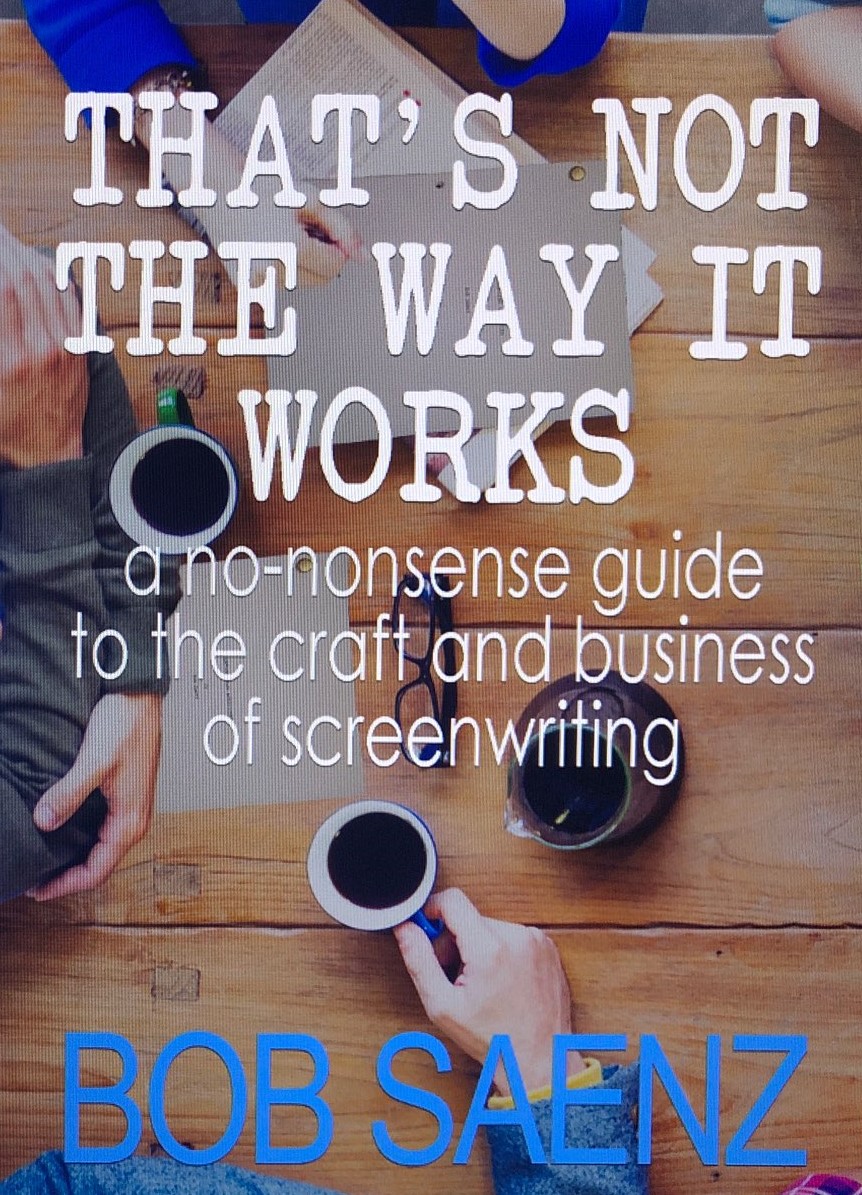
Bob Saenz is a screenwriter, actor and author. His produced works include Hallmark’s Help for the Holidays, Rescuing Madison, Sweet Surrender, On the Twelfth Day of Christmas, Sound of Christmas, The Right Girl, Christmas in Love,  the theatrical Church People, and the black comedy thriller Extracurricular Activities. He does rewrites and polishes on film and TV projects for Producers and Production Companies. His screenwriting book THAT’S NOT THE WAY IT WORKS was released in 2019.

His acting roles include a 6-year run recurring character run on the TV show Nash Bridges, Hallmark’s Valley of Light, Francis Ford Coppola’s Jack, David Fincher’s Zodiac, Finn Taylor’s Unleashed, Church People, and The Village Barbershop, among dozens of others. He was a radio DJ on KYCY-FM in San Francisco, played the last 10 years in the 60’s rock band The BSides, and has done voicework on video games, documentaries, and commercials.

Editor’s Note – I’ve had the pleasure of knowing Bob personally for a few years. His insight and advice has proven invaluable to helping me become a better writer, both in terms of craft and career.

What’s the last thing you read or watched that you thought was incredibly well-written?

A spec script by a writer named Rene Gutteridge called Where the Wind Comes. Maybe the best spec I’ve ever read. Just spectacular. Was emotionally affected by it. Stunning.

What was the inspiration/motivation for your book That’s Not The Way It Works?

Two things. One, I’ve been teaching and speaking at writers’ conferences all over the country the last few years and everyone who was there speaking had a book, except me. I complained to my wife about it and she said, “What’s stopping you from writing one?” So I did.

Two, there’s not a single one I could find out there that spoke plainly about the business of being a screenwriter.

With so many screenwriting books out there, what is it about yours that makes it unique?

The tone. It’s conversational. My experience. It’s filled with what I have learned actually succeeding at it. With more than a dozen films produced, I used all that experience to write about what I know. And, I talk first hand about the business of screenwriting. What the writer needs to know about that part of it, which is just as important as writing a script, and how to approach that.

While the first half of the book is about the actual writing of a script, the second half covers the not-as-discussed “what happens AFTER the script is written (i.e. the business aspects)”. What advice would you give to writers who want to learn more about this?

As I say in the book – find out that it’s not easy, it’s not instant gratification, and you have to work at it. Hard. You can succeed; it just takes time and a business plan. I think the book helps with that. Realizing that writing a script is only the beginning of your journey is a BIG eye-opener for most writers who dream of doing this.

Yes, the script needs to be something people would want to choose to see and has to be good, but that’s not the end of it.

The book has a great chapter about dealing with rejection. What are some key takeaways and advice you’d offer to writers?

The main takeaway is that rejection isn’t personal. Producers and reps don’t care enough about you to make it personal. It’s ALL about the content. Whether they love your script and not or can use it at that time or not. There are hundreds of reasons to reject a script… you have zero control and it’s not personal. Even the most famous screenwriters get rejected on a regular basis. It’s an everyday occurrence. You have to learn to live with it or it’ll destroy you.

Another important issue writers tend to overlook is the need to effectively market themselves in addition to their script. While the chapter about what NOT to do is entertaining (and a bit eye-opening), what are your suggestions about what writers SHOULD DO?

Use the avenues that producers and reps have opened to the writer. Querying. Something that is an art unto itself and something I delve into pretty deeply in the book with a whole section on query letters.

Networking. There’s a huge section in the book about this.  The dos and don’ts. One thing to always remember about networking: It’s about building relationships, not using people. People who can help you absolutely know the difference and will run away from you if you try and use them.

Contests. The Nicholl and Austin are the ones who will pretty much always get you reads in LA if you final or win them. I’ve had friends get their films made doing well in both of these. Neither are easy to do well in because of the sheer number of entries, but they can pay off.

The last way is through referrals, especially to get a rep. If you know a producer or director or star who will refer you… but again, this goes back to networking and having the great scripts to back it up.

What do you consider the components of a good script?

The most important thing is a great story. It also has to be lean and mean. Brevity and white space are your friend. You aren’t writing a novel. You want just enough in there to have the reader see the film in their head and to be able to fill in what they want to as they read, engaging them in the story that way. Again, a big section in the book about this.

I will say this: Producers are ONLY looking for STORY. Screenwriters can never forget this. Don’t over-complicate the read. You can write a complex story without making it hard to read. Oh… spelling and grammar are important, too.

What are some of the most common screenwriting mistakes you see?

The main one? Choosing the wrong story to tell. Telling a story no one wants to see. Whether it’s not sustainable, not interesting, ridiculous, something that’s been done a thousand times before, something you can see every day in TV reruns… there are a million reasons NOT to write this kind of story. You need to go through a pretty thorough checklist (in the book) and make sure it’s a viable story before you do the time consuming hard work it takes to write a good script. Why do all that hard work on a story that’ll be Dead On Arrival?

Another big mistake I see all the time is writers not doing their research about the topics they choose to write about. Writing things that would never ever happen. You have to ground your script in the reality of the subject matter before you take liberties with it.

What are some key writing guidelines every writer should know?

-AIS – Putting your Ass In the Seat. You have to be disciplined. Producers expect you to be disciplined. Good to start doing that at the beginning.

-Never give up. This is so hard to do, you’ll get discouraged on a regular basis. It’s a lot easier to give up than to stick with it because it takes years to succeed in. Notice I didn’t say it CAN take years, I said it TAKES YEARS, because in every case, it does. You aren’t going to be the exception.

-Don’t cheat on research. Take the time to actually learn about the things you’re writing about. Go out and learn them. A big section in the book about this.

-Again…. for emphasis…. choose a story that is viable for producers and audiences. Don’t just pull something out of the air and write it.

-You’re not writing a novel. Leave everything that isn’t directly hooked to your story or plot points out of your script. One rule of thumb? You know all those people listed in the credits of a film? It’s your job to do everything they don’t. You aren’t a costume designer or a casting agent or set designer…. or… any of them. They don’t ask to write the story, you don’t try and do their job.

You’ve managed to establish and maintain a writing career while living outside of Los Angeles. What are some of the pros and cons about it you’ve experienced?

Pros: I don’t live all that far away (400 miles) and can be at any meeting on a day’s notice, so it’s been fine for me. I am in LA multiple times a year, sometimes for more than a week at a time. It’s expensive… but also my choice. There’s a section is the book about moving to LA and when to pull the trigger and do it if you need to.

Con: I’m not in LA networking all the time. Out of sight, out of mind is a real thing. Not worth moving there for me, though.

Readers of this blog are more than familiar with my love/appreciation of pie. What’s your favorite kind?

Peach. Nothing else comes close.

peach pie

Q & A with Dominic Carver

Dom Carver

Dominic Carver is a screenwriter, script consultant, and script editor.

In 2008 his first short film, AGN, was produced by Split Edit in Norway and broadcast on Norwegian TV. His second short film written in 2010, the mystery thriller THE TRAVELLER, was a collaboration with Dubai-based director Musaab Ag. In June 2011, Dominic won the Prequel To Cannes Feature Screenwriting Prize for FAITH, a bleak unflinching look at the life of a London street prostitute.

Dominic has since been commissioned for seven feature screenplays and has also worked as a script editor on other projects, including the feature THE DYING EYE (2013).

Dominic continues to place highly in many competitions most notably the FINAL TEN of FINAL DRAFT’S BIG BREAK 2016 FEATURE COMPETITION – FAMILY/ANIMATED, the FINAL TEN of STAGE 32 TV WRITING CONTEST 2017 and the FINAL TEN of Idris Elba’s GREEN DOOR, GREEN LIGHT INITIATIVE 2017.

What’s the last thing you read or watched you thought was incredibly well-written?

DUBLIN MURDERS by Sarah Phelps. Utterly spellbinding, a haunting examination of loss set in and around the search for the murderer of a young girl. Sarah’s work is wonderfully paced and her dialogue frighteningly good. She writes beautifully dark, complex characters, and with THE ABC MURDERS she breathed new life into the well visited character of Poirot.

How’d you get your start in the industry?

I have always loved stories, often reading a novel a day during my teens. On one particularly slow and boring day at work, I decided I’d had enough and needed to do something other than rot away in a dead-end job, so I signed up to do the Scriptwriting for Film & TV degree at Bournemouth University. Skip forward a few years and I won the Prequel To Cannes Screenwriting Competition, and one of the judges recommended me to a producer, who offered me my first feature commission.

Is recognizing good writing something you think can be taught or learned?

A very interesting question. I believe that to be a truly great writer you have to have a certain amount of natural storytelling talent. You can be taught how to create characters, develop ideas, write characters and dialogue to a reasonable level and to recognise what works and what doesn’t, but if that natural storytelling ability isn’t there. you’re going to struggle and will only ever be average.

Good storytelling is instinct; getting to the emotional core of your characters and their journeys and being able to put that on a page to move and manipulate your audience in ways they weren’t expecting. It’s easy to spot a good screenwriter – they stand out from the crowd. From the hundreds of scripts I’ve read over the years, only four really made me sit up and pay attention and go, ‘This writer has real talent!’

What do you consider the components of a good script?

The characters and the journey they’re on. If your audience doesn’t feel for your characters or their journey, then you’ve lost them before you’ve even begun.

The film JOKER is the perfect example. He’s the most despicable character, a psychopath you would go out of your way to avoid in real life, but on the screen we understand and can empathise with the circumstances that made him. Even when he goes on a killing spree at the end of the movie, regardless of how horrifying and distasteful it is, we understand why and empathise with him. If, as a writer, you can make even the most despicable character sympathetic, that’s masterful writing.

What are some of the most common screenwriting mistakes you see?

Where do I start? Poorly developed characters. If you don’t know who your characters are, how can you expect your audience to? Generic storylines. A popular one at the moment seems to be the ‘mid-life crisis’ and the search for meaning in characters’ lives.

If you don’t approach it from a unique angle, give the audience something they haven’t seen before, then why bother as your screenplay will be lost amongst a sea of similar scripts. Static scenes where characters share their secret feelings around a table and a cup of tea. It’s a visual medium, people sitting around chatting about their feelings is boring to watch. Busy those static scenes up. And when have you ever opened up to a stranger and told them your inner most feelings? Never! People just don’t do that, unless verbal diarrhea is a character trait.

If new writers took more care in developing their characters and their stories, rather than copying what has come before and populating those tired stories with generic characters, there would be a lot more interesting stories out there.

What story tropes are you just tired of seeing?

The mid-life crisis. The hero whose family is murdered and they go on the hunt for revenge. And that’s just two. There are so many more, I’d be here all day listing them. Dig deeper, people!

What are some key rules/guidelines every writer should know?

-Spend time on developing your characters and ideas.

-Don’t write great chunks of dialogue or scene description. Less is more. You’re writing a screenplay, not a novel.

-Study people. Find out how people tick.

-Don’t try and write a Tarantino (or another writing hero) movie. Write your own, what appeals to you. Find and develop your own voice.

-Always, always, always have your work read by a professional screenwriter before you send it out into the wider world. Yes, it will cost you money, but you need to know if your story and characters work as it will save you a lot of time and effort. Far too many writers send work out before it’s ready and they wonder why they experience so much rejection.

-Write the first draft quickly without over thinking it too much. The following draft will be a lot better. Just get those ideas on the page and then worry about reworking them. A page of crap is easier to rewrite than a blank one.

-Don’t make a tit of yourself on social media. Be kind, be polite, be inquisitive but never ever pester others to read your work. If you are friendly, polite, respectful and get to know them as friends, people will start to ask to read your work or even recommend you to others.

-Rewrite! Rewrite! Rewrite!

-Network like your life depends on it… because it does.

-Never take rejection personally. It’s never about you, it’s just that your script isn’t a fit with that person at that time. If you get rejected, rework your screenplay and then send it out to two more people. Developing a thick skin is an absolute must for being a writer.

Have you ever read a spec script that was an absolute, without-a-doubt “recommend”? If so, what were the reasons why?

Yes, and it still puzzles me why it hasn’t been made. I don’t usually mention clients I read for, or their work, as it’s confidential, but in this case I’m going to name the script and the writer. It’s MINOTAUR by ADEWOLE ADEYOYIN.

I hate horror movies, I don’t see the point of watching something that you know is going to scare the poop out of you, but Ade’s script stood out because of its characters, story, themes and its depth. It took a well-explored genre and turned it into something original and compelling, a thrill ride from start to finish.

If any producer out there reads this and is looking for a cracking monster movie, get in touch and I’ll pass it on. It needs to be made!

How do you feel about screenwriting contests? Worth it or not?

Yes! Not only do they test your work, but if you do well they can help propel your career forward. A friend and I wrote a feature from conception to finished second draft in twelve days back in 2016. She wrote the first draft in seven days and I spent the next five rewriting. We entered it into Final Draft’s Big Break and made it through to the final ten in the family category. If it had been entered in the historical category, I think it would have gone even further. Every competition we entered this script into it made at least the quarterfinals, so we knew we had something special.

But which competitions to enter? Pick the well-known ones, the ones with an impressive lineup of judges or that offer access to industry players. Paying for feedback is a great idea, but how well your screenplay does in the competition will also be a great indicator of how good your writing is.

How can people find out more about you and the services you provide?

From my website at www.thescriptwriter.co.uk. It needs updating, but as usual I’ve been busy. I’m sure I’ll get around to it at some point. Maybe next year.

I’m also on Twitter – @DomCarver

Readers of this blog are more than familiar with my love/appreciation of pie. What’s your favorite kind?

Steak and kidney… nothing beats it!

steak-and-kidney-pie