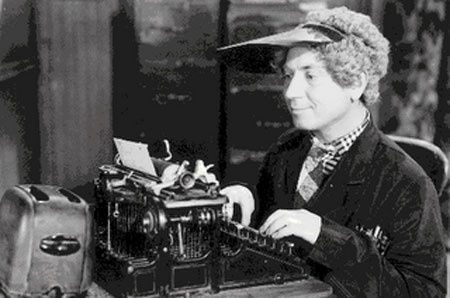
It’s only work if you’re not enjoying it

I had a great discussion on my podcast this week with an author who also works as a writing instructor. Among the many topics we covered was how a writer should look forward to actually writing, as opposed to seeing it as just another item on their to-do list.

Hopefully a majority of writers fall into the former group. I like to count myself as one of them.

It may be challenging and frustrating, but writing is somewhat of a vital component in this equation.

How often have you heard somebody say something like “I’ve got a great idea for a story. I just need to write it.” and then it stalls out or falls apart somewhere along the way?

If they’re that enthusiastic about it, why aren’t they putting that ass in a chair and doing the work?

Because that’s exactly what it is – work. And it ain’t easy. It’s how you approach it that makes a difference.

As much as I love coming up with the ideas, I’m just as excited to put all the pieces together. It always takes longer than I’d like, but that’s how it usually goes for me. Even if all I manage to write that day is one page or even just one scene, I’m glad I put in the effort.

I’ve always thought you can tell when a writer is excited about their material because you can see it reflected on the page. The writing is vibrant and descriptive; it draws you in and makes you want to keep going. But if the writing is drab, flat, and you quickly lose interest, then it’s pretty likely the writer probably wasn’t into it that much.

Who wants to read something like that? Nobody.

This isn’t to say that your writing needs to be jaw-droppingly amazing, but at least make an effort to entice the reader and hold their attention. When you read it, does it make you want to keep going or can you feel your eyes starting to droop?

Be willing to put yourself through the time and effort to write a script because you’re practically compelled to get that story out no matter what it takes. You get a real thrill out of figuring stuff out on paper or pounding away at the keyboard, all as your page count slowly increases.

Embrace the enthusiasm and excitement you get from creating and writing to enable your readers to experience the same electric sensation. Your material will be that much better for it, and your readers will appreciate and enjoy it that much more.


From the archives: One scene, three points

Lots of jumping around between projects this week, but focus has shifted back to the action-comedy. Even though it’s still the first draft, doing what I can to have each scene effectively advance plot, character, and theme.

With that in mind, here’s a post of a similar nature from August 2016.

Enjoy.

After some thorough self-imposed analysis, the revising of the comedy spec is underway. It’s getting easier to spot trouble spots.

There’s one scene in particular that’s giving me some trouble. It’s a pivotal scene involving the main character and offers a revealing glimpse into his backstory. The problem was in figuring out how to best do that.

After much drumming of fingers, rubbing of chin, and a whole lot of attempts, a potential solution may have presented itself. It’s still in the development phase, but for now, quite workable.

One of the first things I learned about screenwriting was what each scene needs to accomplish:  advance the plot, the character, and the theme.

Regarding plot, does the scene move things forward? Does it fall neatly into place in terms of how the overall sequence of events plays out? If you took it out, would it totally mess things up?

I’ve read a lot of scripts where something happens and I don’t know why. Maybe it’ll pay off later? Sometimes it does. Other times, well…

Another handy tip when it comes to advancing the plot in a scene: do it quickly. Get to the point of the scene as fast as you can, then get out. Don’t wait around. Just get out now. Too many times I’ve seen a scene drag on much, much longer than it needs to.

Regarding character, does each scene show them changing a little bit more from when they were first introduced? This doesn’t just apply to the main character. Every character needs to grow/develop. Wouldn’t it be kind of boring to read a story where nobody changes?

And tying it into the advancement of plot, every situation the character experiences should help move their own development along.

Which brings us to theme. The message of your story. This can be a little tricky.

Each scene should tie into the theme, or have it on display in some manner. I recently worked with a writer having trouble tying everything together. We discussed the story and the main character’s internal and external goals. What was the message they wanted to convey? Based on those discussions, we were able to come up with a theme that worked for both the story and as it applied to all of the characters.

One of my favorite examples of a theme in use is BACK TO THE FUTURE. Early on, Marty says “History’s going to change.” And boy, does it. We get a ton of set-up in the first act, and then everything does indeed change in the second act as all of those setups are paid off. Amazing.

Take a look at your latest draft. Does each scene advance the topics in question? If not, do you have a way to fix that so it does? The more you get in the habit of doing this, the easier it’ll get and the faster it’ll become second nature to do it all the time.

Don’t know why it works, but it does

The last few days have seen some decent progress regarding my action-comedy spec and the rewrite of my fantasy-comedy.

Both are still in the outlining stage, but it’s HOW I’m doing the outlining that seems to be especially helpful.

And also incredibly simple.

I write out the whole story scene by scene, with each scene a brief (i.e. 1-2 very short sentences) description of the scene.

But it goes way beyond what we’re seeing onscreen. Not just what’s happening, but everything below the surface.

This can include, but is not just limited to:

-what’s the conflict?

-does it advance the story, theme, and character?

-is it a good follow-up to the scene before it, and does it effectively lead into the one after it?

-is this where this should happen? (that can be a challenging one)

-does it pay off something that was set up earlier?

Naturally, answering all of these for each scene would take up a lot more space, but since it’s my story, what’s written down acts as a sort of shorthand for me. I know what’s supposed to be there, even if it’s not written out.

Another extremely helpful aspect of all of this is not all the blanks are filled in, so scattered among the scene descriptions are questions to myself in ALL CAPS (makes them easier to spot on a printed version). Most of the time these are seemingly small details but also important to the overall story.

That can be anything from DO THEY HAVE A NAME? to WOULD THIS WORK BETTER IN (EARLIER SCENE)? to TIGHTER!!

Then I print them out and mark them up, making fixes and corrections as I go. So far, each one is about 6 pages, single-spaced.

I don’t remember when I started doing this, but it continues to be a great way for me to figure it all out for each story and help it move along.

First hard part’s out of the way

Bit of a breakthrough for the action-comedy spec this week – I wrapped up the outline.

It’s done, but not totally done.

It still needs a ton of work, especially regarding the development/placement of several subplots, but the primary storyline is there, ready to be hammered into better shape.

Despite it all, I’m thrilled to have gotten here. There were many times over the past few months I’d get concerned (read: stressing out on a regular basis) I’d never figure things out.

But I stuck to it and eventually did, and am very happy with it.

Skimming through the whole thing in its current state, there are probably a lot of scenes and sequences that’ll get trimmed, cut, or drastically revised, but that’s expected. And that’s not even taking into account the aforementioned subplots.

I’ve written before about my astonishment at how other writers are almost assembly line-like regarding their output. It’s just not something I’m capable of, and the slow, slow progress for this latest project is just another example of that.

But I also realize that when somebody reads one of my scripts, they definitely remember that it’s mine – the story, the characters, the voice. If my taking the time to do that for each script means a smaller output than others, that’s fine by me. Same conditions apply this time around.

I was wavering between diving right back into this one or shifting to one of my two rewrites. I think I’m leaning towards the latter. I haven’t done as much with those two the last couple of months, so it’s probably better to let the new one simmer and work on those.

Then when I’m ready to jump back into this one, it’ll be with a mostly-all-there outline (and most likely a lot of “This is better than I remember” and “I don’t remember writing this”).

Helping > hindering

I got an email earlier this week from a writer I’ve never met or interacted with asking for some help/guidance in getting their script out there.

My first thought was “Why me? I’m pretty much in the same position as you are.” But decency won out and I offered up some suggestions of paths they could take, along with asking that very question.

They appreciated what I had to say, and explained they reached out because “I saw that you had interviewed people in the industry and wrote books about it, impressive! I watched you on a podcast and perceived that you were a sharp guy….”

I don’t know about sharp, but it was still nice to hear (along with a shoutout for my books).

As I’ve written here many times, establishing and maintaining your writing community are truly invaluable resources. A key factor is that being open to helping others, especially when you’re not looking for something in return.

It’s just about being a nice person that people enjoy and appreciate interacting with.

Here are a few posts from the archives about that very topic.

Enjoy.

Happy to help

Still happy to help

That’s me – the human flying buttress

Still flying, still buttressing

My brain’s helping hands are ready to go