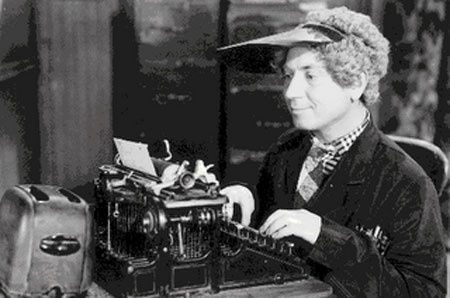
It’s only work if you’re not enjoying it

I had a great discussion on my podcast this week with an author who also works as a writing instructor. Among the many topics we covered was how a writer should look forward to actually writing, as opposed to seeing it as just another item on their to-do list.

Hopefully a majority of writers fall into the former group. I like to count myself as one of them.

It may be challenging and frustrating, but writing is somewhat of a vital component in this equation.

How often have you heard somebody say something like “I’ve got a great idea for a story. I just need to write it.” and then it stalls out or falls apart somewhere along the way?

If they’re that enthusiastic about it, why aren’t they putting that ass in a chair and doing the work?

Because that’s exactly what it is – work. And it ain’t easy. It’s how you approach it that makes a difference.

As much as I love coming up with the ideas, I’m just as excited to put all the pieces together. It always takes longer than I’d like, but that’s how it usually goes for me. Even if all I manage to write that day is one page or even just one scene, I’m glad I put in the effort.

I’ve always thought you can tell when a writer is excited about their material because you can see it reflected on the page. The writing is vibrant and descriptive; it draws you in and makes you want to keep going. But if the writing is drab, flat, and you quickly lose interest, then it’s pretty likely the writer probably wasn’t into it that much.

Who wants to read something like that? Nobody.

This isn’t to say that your writing needs to be jaw-droppingly amazing, but at least make an effort to entice the reader and hold their attention. When you read it, does it make you want to keep going or can you feel your eyes starting to droop?

Be willing to put yourself through the time and effort to write a script because you’re practically compelled to get that story out no matter what it takes. You get a real thrill out of figuring stuff out on paper or pounding away at the keyboard, all as your page count slowly increases.

Embrace the enthusiasm and excitement you get from creating and writing to enable your readers to experience the same electric sensation. Your material will be that much better for it, and your readers will appreciate and enjoy it that much more.
Two down, one to go

The past week has been really productive.

My goal for 2026 was to complete two rewrites and a first draft. The two rewrites can now officially be checked off. I really like how each turned out. Currently standing by for notes on both.

Now it’s all about getting this first draft of the action-comedy done. Target date: Dec 31. Pretty confident I can swing that. If things go the way I’d like them to, a second draft is not out of the question. But let’s not get too ahead of things.

I’d also forgotten I wrote about 32 pages a few months ago – before the rewrites took over – so those have already undergone a quick polish-edit. Now on to the next 70-80 pages.

Taking a look at the outline, the subplot front definitely needs some shoring up – especially in terms of having some. Rather than spend time on that now, I’ll stick with what I’ve got. Inspiration, ideas, and possibilities have a tendency to make themselves known along the way.

For the most part I’m keeping details about this one under wraps, but the small number of people I’ve pitched it to were very positive about it. I’m very much looking forward to when this draft is done and can start spreading the word.

Sidetracked, but in a good way (x2)

Much as I’d like to give a status/progress update on the first draft of the action-comedy spec, I can’t because there ain’t one. I didn’t work on it at all this week.

But what I did work on fulfilled one of my goals for 2026: a quick polish on my western.

While many readers have enjoyed it, more than a few said it was uneven in tone. Parts of it were a hard R, while others were more PG/PG-13. Since I’m going for a wider range of audience, I’m leaning more into the latter.

(This could also contribute to the script’s lack of success in the big contests, but that’s another issue)

One batch of comments had suggestions of more creative ways of having those scenes play out. It didn’t require as much overhauling as I thought. So I hit PAUSE on the action-comedy and dove in.

Wrapped it up a few days later with the page count still the same. Waiting to hear back from a reader.

Work was going to resume on the action-comedy, but I decided this might be the perfect opportunity to check off another 2026 goal: a light rewrite/polish on the fantasy-comedy. Figure once I got that out of the way, I could dedicate the rest of the year to the action-comedy.

Earlier this year I’d written out a brief scene-by-scene outline that hopefully addresses that which needs to be fixed. Armed with that and 3 previous drafts, I’ve been slowly working my way through it. Currently around p65, with a good chance I can wrap it up in the next week or so.

Once that’s done, it’s all about the action-comedy. With how these two rewrite/polishes have gone, feeling pretty confident about how that’ll go.

From the archives: One scene, three points

Lots of jumping around between projects this week, but focus has shifted back to the action-comedy. Even though it’s still the first draft, doing what I can to have each scene effectively advance plot, character, and theme.

With that in mind, here’s a post of a similar nature from August 2016.

Enjoy.

After some thorough self-imposed analysis, the revising of the comedy spec is underway. It’s getting easier to spot trouble spots.

There’s one scene in particular that’s giving me some trouble. It’s a pivotal scene involving the main character and offers a revealing glimpse into his backstory. The problem was in figuring out how to best do that.

After much drumming of fingers, rubbing of chin, and a whole lot of attempts, a potential solution may have presented itself. It’s still in the development phase, but for now, quite workable.

One of the first things I learned about screenwriting was what each scene needs to accomplish:  advance the plot, the character, and the theme.

Regarding plot, does the scene move things forward? Does it fall neatly into place in terms of how the overall sequence of events plays out? If you took it out, would it totally mess things up?

I’ve read a lot of scripts where something happens and I don’t know why. Maybe it’ll pay off later? Sometimes it does. Other times, well…

Another handy tip when it comes to advancing the plot in a scene: do it quickly. Get to the point of the scene as fast as you can, then get out. Don’t wait around. Just get out now. Too many times I’ve seen a scene drag on much, much longer than it needs to.

Regarding character, does each scene show them changing a little bit more from when they were first introduced? This doesn’t just apply to the main character. Every character needs to grow/develop. Wouldn’t it be kind of boring to read a story where nobody changes?

And tying it into the advancement of plot, every situation the character experiences should help move their own development along.

Which brings us to theme. The message of your story. This can be a little tricky.

Each scene should tie into the theme, or have it on display in some manner. I recently worked with a writer having trouble tying everything together. We discussed the story and the main character’s internal and external goals. What was the message they wanted to convey? Based on those discussions, we were able to come up with a theme that worked for both the story and as it applied to all of the characters.

One of my favorite examples of a theme in use is BACK TO THE FUTURE. Early on, Marty says “History’s going to change.” And boy, does it. We get a ton of set-up in the first act, and then everything does indeed change in the second act as all of those setups are paid off. Amazing.

Take a look at your latest draft. Does each scene advance the topics in question? If not, do you have a way to fix that so it does? The more you get in the habit of doing this, the easier it’ll get and the faster it’ll become second nature to do it all the time.

Focus: forward

Some good progress on cranking out the first draft of the action-comedy spec this week: reached the end of Act One.

One potential snag – my outline lists this as the p45(ish) plot point. This may be the start of more problems, but I’m not going to worry about it just yet. It’ll be added to the list of “Stuff requiring my attention”.

Primary objective: get the whole thing written.

When I started, I was taking a “just write it and DON’T go back and edit”. Naturally, I did a few little tweaks here and there at the start of each subsequent writing session, but nothing major. Maybe cutting a word or tightening a sentence. That was one rabbit hole in which I did not want to keep digging.

Now is all about completing this draft and then going back to figure out what needs to be fixed, added, cut, moved, etc.

Taking an approach of continuously asking myself “Does this scene advance the plot, theme, and character?” also helps. I may not have consistently solid answers every time, but even some kind of placeholder answer works – for the time being.

Still looking at 2-3 pages per day when possible. Anything more is a bonus.