A few points about plot points

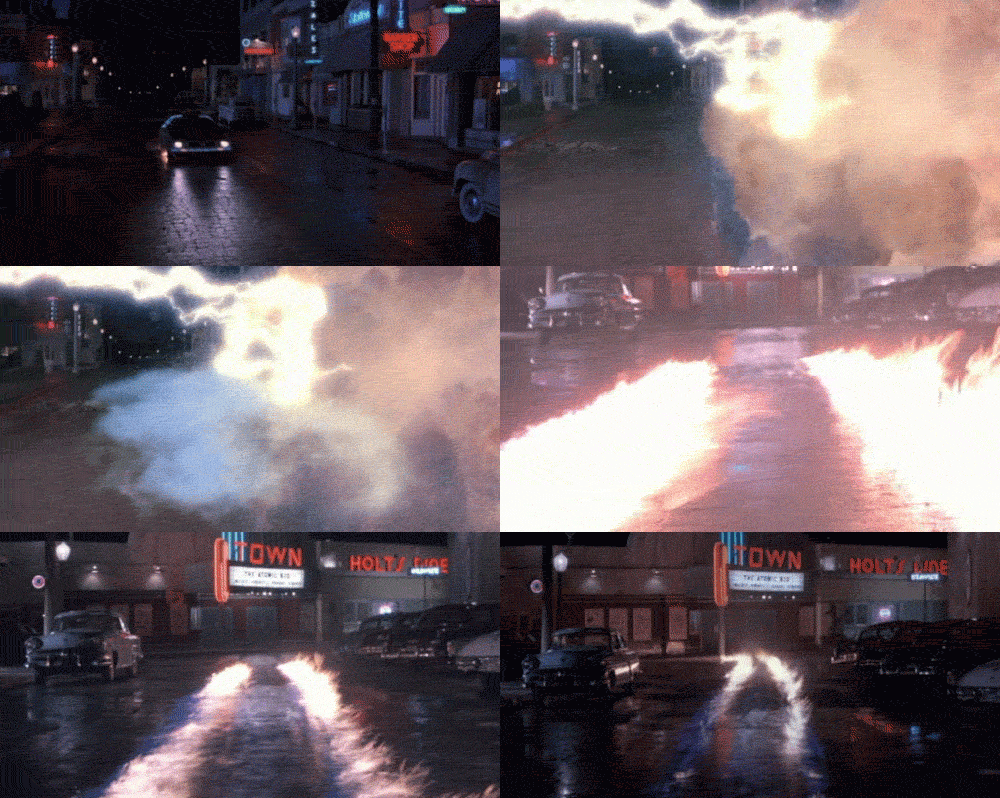
delorean

Time for a quick refresher course, chums.

Today’s topic: plot points. What they are and what they represent.

I’ve always seen plot points as pivotal moments in the story; events that change the situation for your protagonist, usually in a negative manner, and ask/reiterate the central question (Will your hero achieve their goal?).

Having solid plot points also helps establish your story’s structure. Without it, all you’ve got is a big convoluted mess, and who wants to read that?

Although this uses a 110-page script as an example, plot points don’t have to happen exactly at those pages. A few more or less is totally acceptable. I’ve also opted to use fairly recognizable examples to emphasize each plot point.

Pencils ready? Let’s begin.

Page 3 – statement of theme. What’s the overall message of your story? The theme should also be incorporated in some fashion into each scene throughout the course of the story. (“No McFly in the history of Hill Valley has ever amounted to anything!” “Yeah, well, history’s gonna change.”)

Page 10 – inciting incident. The event that shakes up you protagonist’s world, and asks the central question of the story. (Will Indy get the Ark before the Nazis?)

Page 17 – a twist to further complicate things for the protagonist. (“Alderaan? I can’t go with you to Alderaan!”)

End of Act One (page 25-30) – Your protagonist leaves behind their old world and enters a new one to achieve their goal. Also repeats the central question. (Marty arrives in 1955)

Page 45 – another twist to complicate things for the protagonist (Indy saves Marion, destroys her bar. “I’m your goddamned partner!”)

Midpoint/Point of No Return (page 55-60) – your protagonist becomes fully committed to achieving their goal (Brody decides to go after the shark after his son barely survives the latest attack)

Page 75 – yet another twist to really complicate things for your protagonist (Vader kills Ben as Luke & Co escape)

End of Act Two (page 90) – All is lost. Your protagonist is totally screwed with no apparent way out. Makes it seem like the answer to your central question is “no”. (The Nazis get the Ark).

Climax (page 95-100) – final showdown between your protagonist and antagonist. (Rebels attack the Death Star. Marty must hit the wire when the lightning hits. Nazis open the Ark. The shark attacks the Orca, eats Quint.)

Resolution (page 100-105) – Aftermath of the climax. Central question gets answered. (Rebels victorious. Marty returns to 1985. Brody & Hooper survive. Indy delivers the Ark.)

Denouement (page 105-110) – How your protagonist’s world is now different from what it used to be (but not necessarily better). (Marty’s family is successful. The Ark gets crated and goes into a warehouse. Luke & Han hailed as heroes. Brody doesn’t hate the water anymore.)

So there you have it. Do the plot points of your story match up with these? Just something to think about. And feel free to watch the movies represented here (or one of your own personal favorites, or one similar to yours) to see all those plot points in action.

It just might be some of the most fun homework you’ll ever have.

Let’s get those brains stimulated, people!

You mean movies can be smart AND good?

One of my favorite things to do as a parent is go to the movies with my daughter. It’s a nice feeling knowing I’ve instilled in her the appreciation of the whole moviegoing experience. It also helps that there’s a fantastic two-screen (one of a handful of similar small neighborhood theatres in San Francisco) a few blocks from us.

And as she’s getting older, our choices are growing in number. Strictly kid-based animation has given way to PG-13 fare, so we try to see what we can when possible.

Earlier this summer, we caught JURASSIC WORLD and INSIDE OUT within a week’s time. She really enjoyed the dinosaur flick. I thought it was fun, but felt it relied more on the nostalgia factor rather than smart storytelling (“Remember when we helped Grandpa fix that old car?”). I found the latest offering from Pixar to be pure genius, while she found it to be simply “okay”. I asked why she liked the first movie more than the second.

“I think I like movies where you don’t have to think too much.”

Gasp.

I won’t go so far as to say it was a dagger in my heart, but you can probably understand my being taken somewhat aback.

I could easily chalk it up to that she’s still relatively young and hasn’t latched on to my love of the movies to the extent that I have. Like I said, the list of what she’s seen is somewhat limited. I’ve done what I can, and hopefully can continue to contribute to it.

But as a writer, what’s my biggest takeaway from this?

Obviously I want to write scripts for films that will be embraced by the general public, which means they’d have to be simple enough that anybody could follow along, but also written in a way that the reader/audience doesn’t feel insulted or talked down to.

All this talk about needing to appeal to the lowest common denominator has always bothered me. It makes it sound like there’s no point in trying to write something smart.

I beg to differ.

Getting the reader/audience to really think about the story gets them more involved. You hooked with them with the beginning, kept them intrigued throughout the middle, and now they’re compelled to find out how it all ends. Isn’t that what it all comes down to?

I love it when I read a script where it’s obvious a writer knows what they’re doing when it comes to telling a story. Setups and payoffs. Multi-dimensional characters. Plotlines where I know what the endpoint is, have no idea how we’re going to get there, and am getting a real kick out of taking the journey.

This is the kind of writing we should all strive to create.

It’s easy to write something that doesn’t try to challenge the reader/audience, and the reaction will probably be similar. “Boring.” “Unoriginal.” “Meh.”

Push yourself to write something that offers up something new, or at least a new twist on an old standard. Give us something we haven’t seen before, or totally weren’t expecting. Not just one part. THE WHOLE THING. There’s something exhilarating about venturing into new territory. Take us there.

We’re writers. It’s what we do.

Something awfully familiar about this – OR – Already seen it

Not exactly the same, but mighty darn familiar
Whoa.

I was THIS CLOSE to being done with the latest version of the outline for the pulpy adventure spec when my writer’s sense starting tingling.

“Something’s still not right!” screamed out my internal editor.

What? That couldn’t be possible, could it? I’d spent the past few weeks being oh-so-meticulous in reorganizing sequences, working out subplots and connecting story points. How in the names of Walter Gibson and Lester Dent could there be a problem?

I looked at the outline with a more critical eye.

Opening sequence – check.
Intro of hero, establish his world – check.
Hero’s world drastically changes while raising central question of the story – check.
Complications ensue – check.
Midpoint where hero becomes fully committed to achieving his goal (accompanied by reminder of the central question) – check.

Wait. Back that up a little. To right between the “Complications” and “Midpoint” parts.

Hokey smokes, there it was. Cue the flashing red light bulb (with optional klaxon).

Two consecutive sequences just way too similar to each other. This is what’s been bothering me.

No doubt about it. One of ’em has to go. Probably the first one. You’d think it would be no big deal to just go in and change it.

And you’d be kinda/sorta wrong.

The events that happen during these two sequences are vital to the story, so the outcome needs to stay the same. The tough part now is figuring out how to change the “what happens” in that first one so not only is it unique enough unto itself, but also falls neatly into the overall structure of the story.

As always, a daunting task. For now. But potentially solvable given some time and exploration of possible alternatives.

I cannot stress enough the importance of why you should outline your story before even considering starting on pages, and being extremely thorough about it while you do. This is where you get all the heavy lifting done by figuring everything out. Where it’s a lot easier to identify the cracks in the foundation. Where it might take you a few passes to realize what works and what doesn’t.

Then again, this is how I do it, so your approach may be totally different. But speaking for myself, I prefer to go back in and fine-tune a couple of scene descriptions consisting of one to two sentences, rather than labor my way through several pages, then have to totally junk them because they’re not working.

So my focus for the time being is fixing this, then going through the whole outline a few more times, making adjustments where necessary, until I think it’s done/ready for conversion into pages.

-Got to see JURASSIC WORLD and INSIDE OUT last week. Both very enjoyable, but for very different reasons. Of the two, I’m more interested in seeing INSIDE OUT again, mostly for the writing and storytelling aspects.

Regrettably, still haven’t seen MAD MAX: FURY ROAD yet. Of all the summer releases, this feels like the one that must be seen on the big screen. Will do what I can to rectify that.

Ask a Proficiently Perceptive Script Consultant!

Sidney Stephens

The latest in a series of interviews with script readers and consultants who would be worth your while to work with if you want to get your script in shape. Today’s spotlight is on Sidney Stephens of Sidney Scripts Consulting.

1. What’s the last thing you read/watched that you thought was incredibly well-written?

One of my favorite things is when a novel is adapted to the big screen. That’s when the writer in me really comes out to play. I’ll first read the book, then the screenplay, and eventually I’ll get around to seeing the film. I did this about a year ago with the hit TV series “Under the Dome” by Stephen King (only read the pilot script, however), and I also did this with “Gone Girl” by Gillian Flynn. It’s very interesting to see how the story changes from one medium to the next. I enjoyed both of these the most of my recent reads.

2. How’d you get your start reading scripts?

While getting my Master’s degree in Creative Writing years ago, I read numerous scripts, mostly for my classmates, friends and co-writers, and mostly as a pay-it-forward kind of thing. Over a year ago, a friend of mine asked if I would like to start up a script consulting business together. I’d done so much ‘freelance’ work that it made sense. Three months later, my friend backed out of the whole thing. I, on the other hand, rarely back out of anything. So here I am, sole owner of Sidney Scripts Consulting.

3. Is recognizing good writing something you think can be taught or learned?

Absolutely. Part of learning to write a good screenplay is learning to recognize what that means. And there’s no better way to do that than to read tons of screenplays. Breaking them down into what makes them good and what makes them great. The real trick to recognizing a good screenplay is not finding one that reads smoothly and is error free, its finding one that reads smoothly, is error free, and will translate all its intended emotion to the screen in a way that will captivate its targeted audience.

4. What are the components of a good script?

Believable characters and natural dialogue are two very important components of any decent script. Good characters are what draw the audience into the situation; they are what the audience relates to. If they aren’t believable or their dialogue isn’t natural or strong, it will leave the audience asking themselves why they even care to finish the script/film. Yes, settings are awesome and a twisty plot is always a great way to ramp up a screenplay, but without relatable, believable characters, its not enough to make a good script great.

5. What are some of the most common mistakes you see?

Some writers, mostly new writers, try to dictate every inch of how the story will play out on film. With tons of camera angles, actor cues, and scene transitions it is hard to stay in the story. It’s important for the writer to know their part of the process and to do just that. Let the actors do their jobs, allow the directors and cameramen do their job, and just stick to writing a great story. Always remember to show, not tell.

6. What story tropes are you just tired of seeing?

End of the world stories are really starting to wear me out. I think I’ve read every possible way the earth could end, blow up, shatter, freeze, burn, etc. and yet, the surrounding stories are all the same. Man saves family only to stay behind and sacrifice himself for the future of the world. The entire movie is watching them attempt to stop the inevitable only to fail miserably. Until finally, at the last possible moment, the guy saves the planet and is reunited once again with his loved ones. Yawn.

7. What are the 3 most important rules every writer should know?

  • Writing is rewriting. No matter how great you think your draft is, it needs a rewrite. Deal with it.
  • Have a target audience and know exactly what it takes to reach them.
  • Write what you know.

8. Have you ever read a script that was an absolute, without-a-doubt “recommend”? If so, could you give the logline?

I’ve definitely read some worthy scripts in my days as a consultant. However, it is only after working closely with the writer on rewrites and such and knowing what producers were looking for at that particular time. I think finding any script that is “without a doubt” anything is a rare find that all consultants want that next script on their desk to be.

9. How do you feel about screenwriting contests? Worth it or not?

Screenwriting contests are a great way to get your screenplay read and possibly receive some fairly descent feedback. However, using these contests to “break into the business” or as a way of earning thousands on their scripts, they better be something spectacular. The reality is, hundreds of thousands of writers enter screenwriting competitions every year, and only a handful make it past the volunteer readers in the initial read. Can it be your screenplay? Of course. It is worth it? Well, that depends on the writer.

10. How can people get in touch with you to find out more about the services you provide?

My website: www.SidneyScriptsConsulting.com

My Facebook page: https://www.facebook.com/sidney.stephens.9465

Email me with any questions: SidneyScriptsConsulting@gmail.com

11. Readers of this blog are more than familiar with my love/appreciation of pie. What’s your favorite kind?

Sorry, I’m a brownie girl!*

(*Editor’s note: The blasphemy of this statement will not be held against Ms. Stephens.)

Ask an Inspiring-the-Aspiring Script Consultant!

Amanda Pendolino copy

The latest in a series of interviews with script readers and consultants who would be worth your while to work with if you want to get your script in shape. Today’s spotlight is on Amanda Pendolino.

1. What’s the last thing you read/watched that you thought was incredibly well-written?

I really liked THE SKELETON TWINS. It blended comedy and drama in a way that I think is very hard to do. It also got its plot moving in the very first scene, and brought out the humanity in characters who make terrible mistakes.

2. How’d you get your start reading scripts?

I first learned to write coverage while interning at a production company. Then I did more coverage when I worked as an assistant at an agency. After I left the agency, a former coworker of mine had moved onto a production company and hired me as a freelance reader. All my other reading jobs also came about through friends/contacts.

3. Is recognizing good writing something you think can be taught or learned?

Hmm, that’s hard. Your own personal taste isn’t really something that can be taught, but yes, I do think you can learn what it is that producers and studios are looking for.

4. What are the components of a good script?

A compelling concept and visual world, well-developed characters, an interesting plot with conflict and movement, authentic dialogue.

5. What are some of the most common mistakes you see?

Many writers don’t take enough time to develop their concepts. Is your idea enough to sustain a MOVIE or entire SERIES? Is it fresh and original and interesting – and is your concept clearly established? Other mistakes include boring characters (you need to be writing ROLES that can attract top actors) and plots that unfold without any twists or turns. New writers also sometimes write prose that fails to create mood/atmosphere/tone. Every moment of your script is an opportunity to show off your specific voice and writing ability.

6. What story tropes are you just tired of seeing?

Women who are sex objects; women who are too perfect/idealized; one woman in a script with twenty guys.

7. What are the 3 most important rules every writer should know?

-Writing is rewriting. Don’t send a script out until it’s ready.

-Read scripts and watch TV/movies voraciously.

-One single script probably won’t launch your career. Sometimes the best thing to do is move on and write a new script.

8. Have you ever read a script that was an absolute, without-a-doubt “recommend”? If so, could you give the logline?

I recommended the script IMOGENE by Michelle Morgan, which became the movie GIRL MOST LIKELY. The logline I wrote for it was “After getting dumped and losing her job, a desperate young woman gets banished to New Jersey. After she discovers that her father is still alive, she sets out to find him, hoping that he’s the impressive parent she’s always been looking for.”

9. How do you feel about screenwriting contests? Worth it or not?

Certain ones are reputable, like the Nicholl Fellowship – but in most cases, the people who win contests don’t really get anything as a result. Many people who run screenwriting contests don’t actually put you in touch with anyone, and most producers/agents/etc aren’t going to be impressed that you won some random contest. “Anybody can win a contest,” my old agency boss used to say. Go ahead and enter a contest if you can see actual evidence of previous winners launching careers, but don’t hinge all your career success on winning a contest. It would be a mistake to think that entering a contest is the only thing you need to do to get your work out there.

10. How can people get in touch with you to find out more about the services you provide?

You can check out my website at amandapendolino.com or email me at aspiringwriterblog@gmail.com.

11. Readers of this blog are more than familiar with my love/appreciation of pie. What’s your favorite kind?

I also love and appreciate pie! I’m going to have to go with classic apple pie – with vanilla ice cream on top, of course.