And it all starts with this guySomething just a little different and of a somewhat personal nature today.
In the summer of 1982, I went to see Star Trek II: The Wrath of Khan.
With my dad.
At a night-time show (probably the 7:30 one).
As a thunderstorm raged outside (typical south Jersey summer weather conditions).
It was a great night.
All of these elements combined to make what was one of the most memorable times I’ve ever had at the movies. What made it that way? I can’t say specifically, but it just was.
It’s still something I will truly never forget. If I ever get to meet Nicholas Meyer, I’ll make a point of telling him that.
Maybe someday a dad and his son or daughter will go to see a movie I wrote, and that child will experience the same sensation I did: the creation of a memory they cherish for the rest of their life.
(Whether or not they tell me about it in their adult years is beside the point, but I wouldn’t object.)
What writer wouldn’t want to have their work be the basis for something like that?
And now I’m a dad who enjoys going to the movies with my child. Could history repeat itself and we see a movie, and we have a great time, and it’s something she’ll remember for the rest of her life?
So far, it hasn’t happened yet (as far as I know).
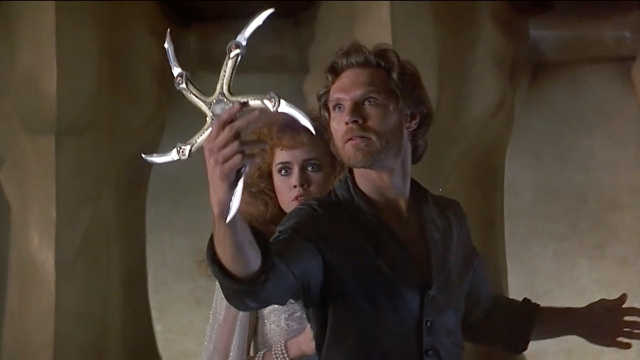
A definitive shining example (AND a prime candidate for a remake)
Since the screenwriter’s education is ongoing, there’s always something for you to work with or study to get a better grasp and understanding of what constitutes good writing, which can then be applied to your own.
Read scripts. Attend or take part in a table read. Watch movies.
While there are countless examples of exemplary writing and filmmaking to see it done properly and effectively, there are even more examples of crappy writing and lousy filmmaking to see it done poorly and ineffectively.
Nobody starts out with the intention of making a bad movie. What starts out as a great script can easily be messed up along the way to the point that there’s no salvaging it. It happens.
Is watching one waste of time? Not necessarily.
As enjoyable, informative and educational as the good stuff is, the bad stuff is actually just as good, possibly even more so. Because from these cinematic travesties you can learn what not to do with your own scripts. Lessons abound with all the glorious misfires regarding story, characters, and dialogue.
Regrettably, bad acting is a category all by itself and there’s nothing that can be done about it. Do what you can to ignore it (which can border on the impossible, depending on the quality of badness) and focus on the non-tangibles.
It’s especially helpful to work with something from the same genre as your script. See how they did it, then compare it to your own. Can you see why theirs didn’t work? Is it riddled with plotholes you could drive a truck through? Is the dialogue pure on-the-nose? Do the characters come across as unrealistic caricatures?
Look at it as a whole. Does it respect the reader/audience’s intelligence? Is the structure solid? Do you care about what happens to these characters over the course of the story?
Now bring your script into the equation – and be objective! How much of a similarity or difference is there between that story and yours? Did that other material open your eyes to some previously unforeseen flaws and potential problems within your script, so much that it made you realize “this needs work”?
Once you identify these problems, your writer’s mind goes to work, figuring out how to make sure your script doesn’t repeat the mistakes you just read or watched.
It may not be easy to endure having to watch a bad movie just for the educational experience, so just keep reminding yourself “It’s to help me become a better writer”.
Good luck!
Question time! What’s your favorite bad movie? Feel free to list it in the comments.
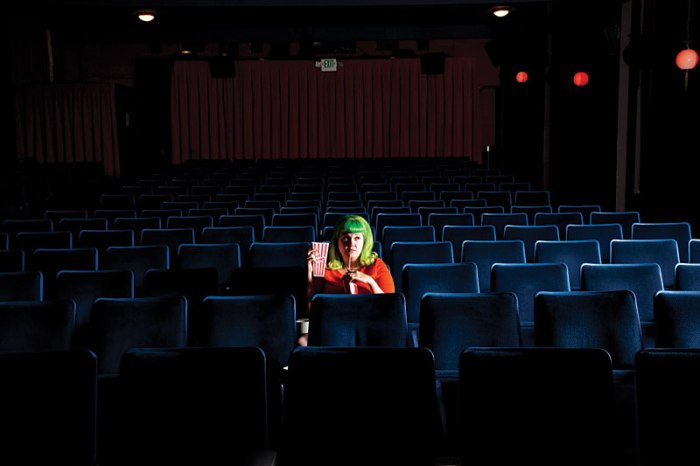
The next person who comes in will sit directly in front of me. Guaranteed.
I recently had the opportunity to revisit the outline for my pulpy adventure story after having not looked at it in several months, and wanted to see what was needed in order to get me a little closer to being able to start on pages.
Time was limited, so I was only able to get through the first half. It was a pleasant surprise to discover that a lot of it still held up, plus an added bonus of some small inspirations resulting in tweaks that strengthened a few of the subplots and tied a few them together in a better way.
And of course, some of these new developments were a total change from how I’d always imagined them. This happens a lot for me.
But what was really the most positive experience out of this was how easy it was to “see” the story play out. It was as if I was in a private theatre, watching my imagination come to life on the big screen, complete with surround-sound. It definitely reinforced the kind of story I’m trying to tell.
When you’re putting your story together, or writing it, or even just reading it, how easy is it for you to visualize it? Do you “see” it as if you’re watching it in movie form? Is it a smooth transition from coming up with the idea to putting it on the page so it reads how you originally imagined it?
And therein lies part of the challenge. It’s just not an easy task, or at least isn’t for a lot of writers. It takes time to find the right words.
You might know what you want to say, but can’t find the exact way to say it, so you tinker around with it, trying and trying until something takes hold. Or maybe after writing it down, actually seeing it on the page makes you realize “this might not have been the best way to do it,” so you jump back in to come up with something new.
Sometimes I even go so far as to narrate aloud while acting out what’s happening for that particular part of the story (or as much as I can while sitting at my desk), which really helps, despite how silly it might look to somebody else.
As writers, the gears of our imaginations are always turning. Always. You could be doing something totally ordinary or mundane, and then, like a bolt from the blue, come up with a solution so perfect and now-obvious that you can’t understand why you didn’t realize it before.
So you work and work, making your writing better to the point that anybody reading your story will eventually be able to “see” it the way you want them to.
Lots of resolutions and goals being bandied about today, but that’s just the first step.
All the things you want to accomplish this year as a screenwriter. What are you doing to make them a reality?
It’s going to take a lot of work. It’ll be frustrating at times, but isn’t this something you’re willing to put yourself through hell for in order to see happen?
Give yourself some goals, but be realistic.
Write. Edit. Rewrite. Polish.
Watch. Analyze.
Read. Study. Learn. Hone.
Network. Connect. Share. Support.
Enter contests. Attend conferences. Pitch.
Research. Query. Reconnect.
Keep trying.
Don’t give up.
Enjoy yourself.
Make 2016 the year you make something happen for you.
Don’t get your knickers in a twist. This isn’t about that.
Star Wars: Episode VII officially opens today, and my God, what an impact this is having. I’ve been a fan since way back in ’77, but not to the point of sleeping in front of a movie theatre for days on end.
I’m opting to wait a couple of days and let all the crazy hoopla die down. It’s not like it’ll play for a week and disappear. Even the neighborhood theatre up the street is playing it on both screens. That’s saying something.
Looking at this phenomenon from a screenwriting point of view, you can’t help but be impressed with the world that’s been created here. Count me among those inspired by the creativity on display in these films and who strive to achieve something similar with our own work.
I’ve written before how I’d love to write the next STAR WARS (as would a zillion other writers), but I don’t mean a sprawling epic space opera, although that would be kind of cool.
I’m talking about an entertaining story of memorable characters and situations that you never get tired of seeing. That thrills you with its overwhelming sense of wonder. The sheer joy of being swept away as this tale unfolds before your eyes and ears.
Do I have that ability? Hard to say, but I like to think so. Nobody thought STAR WARS was going to do well, and you know how that worked out.
So in the meantime, I’ll keep plugging away, telling my own stories the best way I can, and hope that someday I come close to accomplishing something similar. At the very least, it’ll be fun trying.


 Maximum Z