A very hands-on Q&A with Geoffrey Calhoun

7D25AB88A8B448A9ABA793263FCBF2F3

Geoffrey D. Calhoun of wefixyourscript.com is listed as a Top 100 Indie Writer in the World. He has optioned several screenplays and has worked as a writer on two features coming out in 2017: The Little Girl and Studio 5. His multi-award-winning thriller Pink Bunny is scheduled for a 2018 release. Geoffrey has won multiple screenwriting awards and has worked as a producer, an assistant director, and director on indie film productions. He has been sought out by studios as a script consultant and a re-writer for various stages of development and production.

1. What’s the last thing you read/watched that you thought was incredibly well-written?

The last thing I watched I couldn’t stop thinking about was Arrival. I loved this film. It had depth and really explored her character. I loved how they played around with the structure of the film in creative ways that really built up to a climax. It was fantastic. I could see how Eric Heisserer did over 100 drafts to make that story perfect.

2. How’d you get your start reading scripts?

I actually began writing on a bet. A friend of mine was an editor for a local kids show. He wanted to push himself to write a script so he challenged me to see who could write better. Personally, I wasn’t interested because I have dyslexia. I agreed to do it, and ended up really enjoying the process. Since then it became more than a passion, almost like a volition. I wanted to be the best screenwriter I could possible be, so I started studying and learning from the greats such as Syd Field, Robert McKee, Viki King and reading screenplays by modern legends as well like David Goyer, Jonathan Nolan, and Christopher McQuarrie.

3. Is recognizing good writing something you think can be taught or learned?

I think it can be learned. It comes with time. The average movie attendee can recognize a bad film. Now, some people prefer bad films, but that’s a whole different form of self- torture (wink). I like this question. It reminds me of the debate about raw talent vs. learned skill. Some teachers out there believe if you don’t have a modicum of innate talent with writing, then you’ll never be a good writer. I completely disagree with this. Their defense is that this is an art, and thus you must have a certain amount of “taste” in order to know the difference between what’s good and bad. I think what we do is more than an art. It’s a craft; a learned skill plain and simple. Something that can be mastered with just two things, time and practice. That’s all you need. We are craftsmen, like the blacksmiths of old. At first creating something small and simple like a horseshoe, then with time we master our skill and create compelling stories and works of art like the ornate armors of old.

4. What are the components of a good script?

It all starts with having something to say in your script. What are we trying to pass off to the audience? What do we want to tell them about life? Something that will open their eyes and help them see things from a new perspective? Or something that will reassure them and speak to the struggles they are going through? When we have a theme like this and we pair it with a sympathetic character, then we create a compelling story that’s unforgettable and emotionally moving. Take Arrival. It’s about a woman’s struggle with loss. That’s something that speaks to everyone, which is why it resonated so well with people.

5. What are some of the most common mistakes you see?

Wow, that’s a tough one. I see mistakes of all kinds from new screenwriters to professionals. One mistake I often see is having underdeveloped characters. They’re superficial and are around just to be a face. Sometimes they’re even described as pretty or handsome, which reinforces this. When I get hired for a rewrite, the first thing I do is take the characters and layer in depth to make them more human and sympathetic; give them reasons to do what they’re doing and why they make the choices they do. I create depth by adding to them traits that we all suffer from but never talk about such as secretly insecure, lonely, or lost, etc.

6. What story tropes are you just tired of seeing?

This is more a genre thing for me but I’m sick of the false ending in horror films. Here we spend at least 90 minutes emotionally involved with a character. If it’s a good one – Dawn of the Dead is a good example – then you’ll have me on my seat the entire film. Then at the end, the lucky few characters that have survived finally make it…until there’s a surprise jump scare right before the credits roll and we discover the characters we’d been rooting for this whole time never make it. I’m so frustrated by this. For me it feels like a waste of my time to discover they all die because of a dirty trope in the end.

7. What are the 3 most important rules every writer should know?

1) STEAL: Steal everything from everyone. Writers are the best thieves in the world. I’m not saying plagiarize, but when you find a technique or scene that really works for you, break it down and make it your own so you can add it to your toolbox.

2) STUDY: This goes with stealing. Learn from the masters. Writers like John August have a blog that you should be following. Don’t stop there. Learn from the masters that taught the master such as Aristotle. If you pay attention, all the great screenwriters will quote Aristotle. There’s a reason for that.

3) IGNORE THE BS: There’s a lot of flack out there towards aspiring screenwriters. I recently read an article where a Hollywood writer was bragging about telling screenwriters they’ll never make it. He tells them they should just give up because they aren’t talented. It’s BS. You can make it, but it takes time. A long time. If a dyslexic from Detroit can make it, then you can too. One of the reasons I founded wefixyourscript.com was exactly for that purpose: to give screenwriters that extra helping hand to not just  improve upon their screenplays, but to help them become better screenwriters. That’s why we include the one-on-one consultation.

8. Have you ever read a script that was an absolute, without-a-doubt “recommend”? If so, could you give the logline?

Definitely. In fact, I just did some coverage on a dramatic short that had a fantastic concept. I helped them tweak it, but only a little. I guarantee it won’t have a dry eye in the audience when it films. Unfortunately, that’s all I can say about it.

9. How do you feel about screenwriting contests? Worth it or not?

I think they’re great, and I strongly recommend contests in festivals. That’s where you can really make headway as a writer. You need to network and make connections to build up your reputation. You can meet other writers, producers, and directors that will eventually land you in a spot where you’ll be getting work. When you go to these fests you want to be the life of the party. Have fun. Get yourself out there. And make sure you’re handing out business cards. It will get you work.

10. How can people can get in touch with you to find out more about the services you provide?

They can contact us at info@wefixyourscript.com. They can also sign up for a free 15-minute consultation on our website. With our consultation, we offer ways to help your work or answer any questions about us or the industry in general. We’ve had some great feedback on this service.

11. Readers of this blog are more than familiar with my love/appreciation of pie. What’s your favorite kind?

I’ve got to go with mom’s pumpkin pie. There is one caveat though: it must be smothered with a big dollop of whipped cream.

Gosh, what a full plate!

primanti bros
It’ll take time, but feeling confident I’ll accomplish that which I set out to do. (In the meantime, anybody up for Primanti Brothers? (Pittsburgh shout-out!))

My projects over the next couple of months are shaping up nicely.

-Finish overhauling the outline for the comedy spec and convert it into pages

-Some more fine-tuning on the pulp sci-fi (courtesy of a steady influx of good notes)

-Maybe one more pass on the western. Yeah, I know. But I recently got some keen insight on a few parts which could do with a little improvement.

The potential is still strong for all three, both in terms of contests and queries.

I have to say that this time around, my analytical and editing/proofreading abilities feel a bit stronger. Not that they’re the pinnacle of perfection, but at least slightly more developed than, say, a few years ago. That’s a definite plus. Nor would I hesitate to take full advantage of the sage advice of my squadron of savvy readers.

I feel a bit more prepared now, as well as a little more confident about ending up with a triad of really solid scripts.

That’s the hope, anyway.

Another part of my enthusiasm comes from seeing the results of some of the major screenwriting contests, some of which I entered and didn’t fare as well as I’d hoped. I’ll work on these scripts, send ’em out and hope for the best.

On a brief side note, I recently read the comment on an online forum – “Waiting for notes. What should I do to occupy my time?”

I suggested “Start working on your next project.” It’s what I would do. Can’t think of a better way to get your mind off a finished script than starting a new one or digging into the archives and touching up an older one. Gets the creativeness pumped up and really does help pass the time.

Anything that lets you flex your writing muscles while adding to your arsenal of material can only be seen as a good thing.

I refuse to be complacent

runner
The road gets tougher, you run harder

First-round results for two of the biggest, high-profile screenwriting contests have been released within the past week, and the pattern for my western’s performance in both has once again repeated itself.

Total whiff for PAGE, and top 20 percent for the Nicholl. (I’m not doing Austin this year)

I didn’t get notes from the former, and based on the ones I got last year for the latter, am not that curious as to why it placed where it did.

My initial reaction was, naturally, disappointment, but this year is markedly different in what came immediately after.

There’ve been days where the agony, frustration and just plain shittiness of things not working out was so strong I’d seriously contemplate just walking away. After all, that would be one less member of the competition, right?

But that’s simply not an option – for any of us. Our desire to succeed as writers burns too bright.

I may not have done as well as I’d hoped with these contests, so instead of shrugging my shoulders and saying “Oh well. Better luck next year,” I plan on doing whatever I can to increase my chances. With a vengeance.

Gone is the wallowing in a blessedly brief mindset of “poor, poor pitiful me”.

In its place – a reinvigorated drive to buckle down, work even harder and write scripts so fucking amazing those readers won’t know what hit them.

I don’t think I can. I KNOW I CAN.

Damn the torpedoes and full speed ahead, chums.

-A new addition and a return appearance on the bulletin board this week:

-Filmmakers Caitlin Stedman and Kayla Ditlefsen have launched a crowdfunding project for their short film Unattainable. They’re around the 60 percent mark, so donate if you can!

-The crowdfunding for filmmaker Steve Davis’s No Glory continues, with about a month to go. Steve’s a talented guy, and this sounds like a fantastic project. Donate if you can!

The hazardous journey down Contest Road

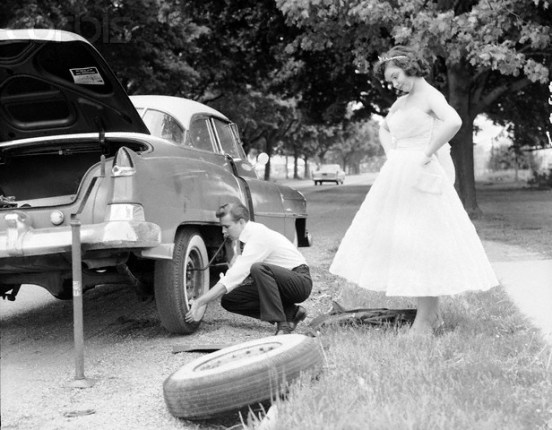
Flat tire in formal attire
A savvy driver is prepared, no matter what they encounter

I’ve lost count of how many screenwriting contests there are. A whole lot, I believe. But out of all of them, only a handful actually mean anything in terms of helping build one’s career.

The Nicholl. Austin. PAGE. There are others of high prominence, but these three are the ones that really matter.

This isn’t to slight the smaller or lesser-known contests, but someone who’s a finalist in the Nicholl probably has a better shot at being able to use that to their advantage than, say, the Greater Cedar Rapids Screenplay Contest (not that such a thing actually exists, but you get the idea).

As evidenced on my My Scripts page, I’ve done moderately well in some of the bigs, but have also totally fizzled out. I’ve also been fortunate to have done well in some of the second-tier competitions. Every year yields different results.

Sometimes the first thoughts that race through your head when you read that email from the contest organizer that includes the word “Regretfully” somewhere near the beginning makes you think “Does this mean my writing is lousy?”

No. It means it didn’t click/connect with the reader or readers from that contest. A lot of the contests give you at least two reads. Sometimes I’ll receive praise from the first reader, only to have the second one not like it, thereby stopping it in its tracks. Or both readers like it, but not enough to advance it to the next round. Nothing I can do about it. C’est la vie, and better luck next year.

And even if you win, or at least place highly, in a high-profile contest, that’s no guarantee to getting work. I know a Nicholl finalist who had zero traction with their script, as opposed to the PAGE winner who is now super-busy with assigments.

I know writers who’ve never won a contest, and they got work. I know writers who’ve never entered a contest at all, and they’ve gotten work. How? Because the writing wasn’t just good; it was really, really good. That’s what it comes down to. That and somebody liked it enough to want to do something with it or with the writer.

A few years ago, I was a lot more likely to enter almost any contest. And there weren’t even as many then as there are now. Time and experience has shown me that, yes, it’s a nice validation to get that certificate from that small contest you’d never heard of before you entered, but how much did it actually do to help you get your career going?

A lot of contests offer “industry exposure” to the winners, and you do get that – to a point, and it’s probably a safe bet not to the extent you imagine. Your script might get checked out by maybe a handful of reps and production companies, and even then there’s still no guarantee anybody will be interested. I’m speaking from experience on this one.

Contests are just one of the ways in. As someone who’s in it for the long haul, I’ll continue to try my luck with the big ones while also exploring other avenues. Whatever it takes.

And no matter what contest you may have entered this year, I wish you the best of luck. Except for the ones I did. Then all bets are off and it’s every person for themselves.

Proofreading Q&A panel – part 2

Tammy Gross
Tammy Gross
bill.and.puppy.girl.cropped (1)
Bill Donovan and friend (friend occupying Bill’s lap)

Here is the second of a two-part panel discussion with professional proofreaders Tammy Gross of proofmyspec.com and Bill Donovan of screenwritingcommunity.net about proofreading and its connection with screenwriting, along with some info about the proofreaders themselves.

Part one can be found here.

When you proofread a screenplay, do you also take on the role of story analyst?

Tammy Gross (TG): Not as a primary service, but yes. Since I’m reading it anyway, I do offer inexpensive add-ons if a writer wants some basic “coverage.” And even with proofreading, there are some story issues which may be addressed during the edit if there’s a problem with consistency and/or continuity.

Before I started my proofreading service, I took a course on story analysis and offered a coverage service. I soon learned how bad formatting and text were too distracting for my left brain. It’s agony for me to look past multiple errors/issues.

Bill Donovan (BD): To a limited degree, yes. However, I put these and other words at the top of every set of notes I give back with the proofread copy:

“These are not the words of an expert script analyst … I strongly hope not to hurt your feelings … To the extent that you find my comments on your story to be wrong-headed, pointless, or insensitive, you are hereby counseled and, with regret for any hurt feelings, encouraged to ignore them.”

What’s your writing background?

TG: The agony of trying to look past typos sent me down an editing path in my 20s. I read a book published through a major publishing house that had multiple errors in the soft-cover version. I sent my corrections to the publisher, and the author contacted me personally to thank me. Ever since, I’ve honed my editing skills.

My life plan was “sing while I’m young and write when I’m old.” I did write a couple of novels in my 20s and managed to have some sort of writing or editing responsibility in every “real” job I ever worked, whether at a church, a bank or Fortune 500 company.

In 2008, while taking a break from singing, I learned about a couple of female pirates. These historical swashbuckling stories fascinated me. I traveled the world researching pirates (including falling victim to real ones in the Bahamas) and learning about writing screenplays. I haven’t looked back.

So far, every script I’ve entered in contests has placed or won. In fact, my first script won the first contest I ever entered. Since then, I’ve realized that my ability to write in “the language of screenplay” was getting me further than better storytellers due to their weaker technical skills.

I’m currently writing an adventure story for a producer who found me because of one of my scripts (which I also turned into a YA book).

BD: -Screenplay contest judge (three contests)
-Screenplay contest executive (11 screenplay contests, 5 scene-writing contests, two logline contests)
-Two of my own screenplays won three first prizes equaling $30,104 in prize money in today’s dollars.
-Former Editor of Creative Screenwriting Magazine
-Author of three e-books for screenwriters to date; a fourth is upcoming
-USC Master of Fine Arts, Screenwriting and Filmmaking
-Copy desk chief at a daily newspaper, the Morristown, N.J., Daily Record
-Copy editor at the Associated Press
-Copy editor at another daily newspaper, The Record, Hackensack, N.J.
-Copy editor for several business-to-business trade publications
-11,200+ published pages and screenplays edited/proofread over the years
-News stories I wrote and/or edited won five national journalism awards.

How’d you get into proofreading?

TG: Totally by accident. I started a screenwriting group where we would table-read 10 pages of each writer’s script. I found myself making lots of corrections on everybody’s pages, and many of them asked me to proofread their entire scripts. It was a little overwhelming, due to also running a thriving music-arranging business at the time, so I put up a website to help me prioritize and charged a low but fair fee.

And it’s good that I did, because after the 2007 writers’ strike, followed by the recession, the spec-writing business boomed while music arranging fizzled.

BD: For an upcoming book, I surveyed and interviewed producers, agents, screenplay readers, directors, contest judges, and contest executives, asking them for their comments on the most common and the worst mistakes they see. Within the screenplay, proofreading and editing mistakes were named both the most common and most disliked by people in the industry.

How can people get in touch with you to find out more about the services you provide?

TG: The order page functions as a quote calculator, or send an email anytime: Proofreader@ProofMySpec.com

BD: Email me at Bill@screenwritingcommunity.net or use this form at my website.

Readers of this blog are more than familiar with my love/appreciation of pie. What’s your favorite kind?

TG: Humble. I should eat more of that and less Key lime.

BD: 1. Great pizza. 2. Pumpkin, my own homemade recipe. 3. Blueberry, Comstock filling, augmented.