They didn’t say no

champagne
If you’re going to look at the glass as half-full, why not have it at least be something worth drinking?

An encouraging bit of news from the ongoing quest for representation.

A new management firm had contacted me, and asked to read some of my scripts. I sent the western and the fantasy-adventure, then worked really hard on not thinking about it. Refocusing my attention on other scripts proved to be the most effective.

A few weeks went by, and I sent the obligatory follow-up. “Haven’t got to them yet,” was the response. “Check back in a few weeks.” Back I dove into gettin’ stuff done.

A few more weeks pass. Another follow-up inquiry. “Halfway through the fantasy. Really like it. Will be in touch.” Nothing wrong with that.

Another few weeks, and another follow-up. “Battling a nasty head cold. Hard to read and stay focused.”

At this point, you’d think common sense would have prevailed and I should accept that this was all building up to a rejection. But for some reason, it didn’t seem that way.

The person was still responding, and I was making a point of not being pushy. Even after relaying this story to a few writer chums, the general consensus was “You’re just wasting your time. They’re just letting you down easy.” Again, this felt different.

I’m a stubborn sort, especially when it comes to getting a career going, so I waited another week and sent one more follow-up.

They explained things had been taking so long because they currently didn’t have any solid connections with prodcos doing family movies (which this script could be considered), and weren’t sure where else they could take it – for now. They also asked me to keep them updated if anything happens with it somewhere else.

They had high praise for my writing and firm grasp of story and structure, and added that they still had a big pile of other scripts to get through, so it might be a while before they got to the western. The message ended with “thanks for your patience”.

I wrote back, thanking them for the update (adding that the writing for the western is stronger than that in the fantasy) and that I’d be in touch several weeks down the road. They were cool with all of it.

While this didn’t exactly yield the results I was hoping for, it also didn’t end like the many that have come before it. The person liked my writing, and always got back to me, which is definitely more than has happened with others.

There were lots of times throughout this whole process I was convinced I would receive an email with the inevitable “thanks, but no thanks”, but that never happened. After all this, I’d still consider what happened as a positive thing.

It may not be quite “back to the drawing board”, but it reinforces my belief that good things are fast approaching. In the meantime, I’ve got a few more scripts requiring my attention.

-On a semi-related note, screenwriting consultant Bill Boyle will be holding his workshop How To Sell Your Screenplay From Anywhere on Wednesday April 27 from 7-10pm at Fort Mason in San Francisco. Among the topics to be covered will be Industry Access, Marketing Tools, Script Protection, and Legal Aspects. Registration is $75, and at last check there were only 12 slots left, so don’t delay! For more details, email Bill at bill@billboyle.net

-One more thing. I ran the SF Rock & Roll Half-marathon this past Sunday. Many hills were involved. 1:58:09.

Working in a timely manner

train conductors
“Now that’s something you don’t see every day, Chauncey.” “What’s that, Edgar?” “A writer setting a schedule and sticking to it.”

Following the lead of some of my writing colleagues, I’m making more of an effort to establish a sense of order and structure when it comes to my writing and all things connected with it.

It used to be “Write when you can!,” which in a way it still is, but more layers and categories have been added to the mix.

-First and foremost, the setting aside of at least an hour a day to work on one of my own projects continues, be it outlining, writing, editing, rewriting, or polishing. This remains the primary objective.

-Networking. While connecting with people is easy, maintaining those relationships takes effort, and can quickly become time-consuming. As much as I enjoy conversing (albeit online) with people, I try to keep it to a minimum – unless it’s relevant to the project of the moment.

-Related to that is the reading and note-giving for other writers, especially those who were equally as generous with their time to do the same for me. I may not always be on schedule about it (something I’m trying to improve), but I make a point of getting it done.

-Career-building. This mostly involves researching potential recipients for pitching and queries, which means diving head-first into the scavenger hunt that is IMDB Pro. While most of the time the contact info is accurate, sometimes it’s out of date (people move on), or there’s no contact info whatsoever, or the person or company in question hasn’t existed for years.

*True story – researching an agent, I’d discovered they’d apparently died several years before but the email was still in operation. I opted not to query them.

-Overall stayin’ organized. I’ve started jotting down each day’s objectives and “must do’s” in a little notebook, and checking off items as they are accomplished. It’s been very helpful in making me stay focused on what needs to get done, rather than hoping I remember later on.

All of this is still somewhat early in the process, but so far, so good. That feeling of being in control helps make the whole thing seem a little easier, as well as feeling like stuff is actually getting done.

How about you? What steps are you taking to be more organized with your writing?

The unscientific term would be “gut reaction”

trust your feelings
Learn to trust your feelings. Even with the blast shield down.

I’ve had the experience of working with some writing, both my own and other people’s, that required a second opinion. For some of them, I was the second opinion, while the others involved my work being reviewed.

An experienced professional asked me to take a look at another writer’s script, accompanied with their excitement and enthusiasm about it. Upon reading it, I found it severely lacking in a lot of screenwriting fundamentals (bad structure, shoddy character development, etc.), and said so as part of my notes of what was needed to improve.

I like to read a script twice before giving notes on it, and it took a lot of effort to get through each one – especially the second time. That whole time I was wondering “Where is this enthusiasm coming from?” This person knows what a good script looks like, and this one, to me, didn’t meet any of the necessary criteria. And if they felt this way about this script, could I trust their judgment on others?

Last week I’d been given the offer to have my query letter reviewed. I put it together with the elements I considered vital: quick one-sentence pitch, logline, reputable contest results. As fast a read as possible.

The response read like something churned out by a machine. Their recommendation was to follow “their blueprint”, which involved a lot of fill-in-the-blanks, how it’s similar to successful films (the more recent, the better!), telling the story from only the main character’s point of view, and concluding with “why I think this will be a hit” OR the underlying theme. The end result is several big unappealing blocks of text.

All of this felt totally and absolutely wrong. If I were the intended recipient, I might start reading, but would most likely lost interest very quickly and be very hard-pressed to want to continue, let alone finish it.

(With no intention of ever actually using a letter written following their guidelines,  I put one together and submitted it for review, just to see what they would say. Their follow-up comments reinforced my doubts, but that is a topic for another day.)

As you probably guessed, I’ll be sticking with my original format.

The takeaway from both of these experiences is that a writer must not only develop their writing and storytelling skills, but also the ability to trust their instincts. Know what works, not only for you, but in an overall sense.

Don’t always assume the other person is in the right. Sometimes they’re not.

Everybody will have an opinion about something. You might agree wholeheartedly or think the other person has no idea what they’re talking about. It takes time to learn how to determine which is which. You will make mistakes and bad choices along the way, but make the effort to learn from them so you don’t do it again.

Like with writing itself, the more you work at it, the better at it you’ll become.


A few points about plot points

delorean

Time for a quick refresher course, chums.

Today’s topic: plot points. What they are and what they represent.

I’ve always seen plot points as pivotal moments in the story; events that change the situation for your protagonist, usually in a negative manner, and ask/reiterate the central question (Will your hero achieve their goal?).

Having solid plot points also helps establish your story’s structure. Without it, all you’ve got is a big convoluted mess, and who wants to read that?

Although this uses a 110-page script as an example, plot points don’t have to happen exactly at those pages. A few more or less is totally acceptable. I’ve also opted to use fairly recognizable examples to emphasize each plot point.

Pencils ready? Let’s begin.

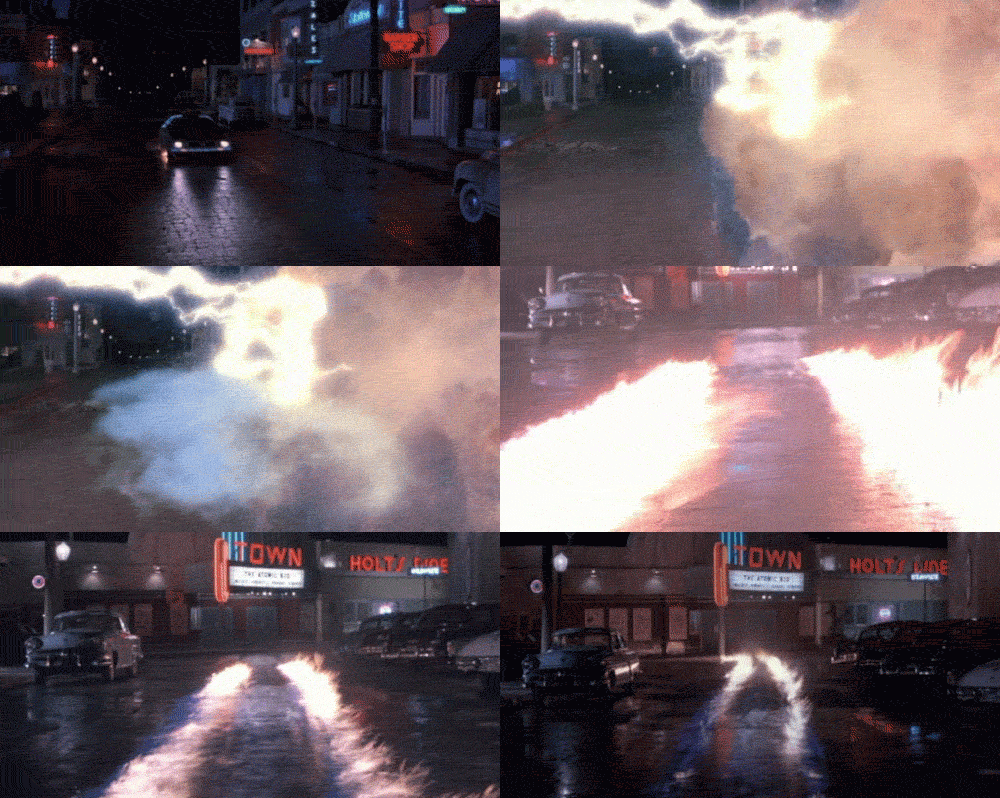
Page 3 – statement of theme. What’s the overall message of your story? The theme should also be incorporated in some fashion into each scene throughout the course of the story. (“No McFly in the history of Hill Valley has ever amounted to anything!” “Yeah, well, history’s gonna change.”)

Page 10 – inciting incident. The event that shakes up you protagonist’s world, and asks the central question of the story. (Will Indy get the Ark before the Nazis?)

Page 17 – a twist to further complicate things for the protagonist. (“Alderaan? I can’t go with you to Alderaan!”)

End of Act One (page 25-30) – Your protagonist leaves behind their old world and enters a new one to achieve their goal. Also repeats the central question. (Marty arrives in 1955)

Page 45 – another twist to complicate things for the protagonist (Indy saves Marion, destroys her bar. “I’m your goddamned partner!”)

Midpoint/Point of No Return (page 55-60) – your protagonist becomes fully committed to achieving their goal (Brody decides to go after the shark after his son barely survives the latest attack)

Page 75 – yet another twist to really complicate things for your protagonist (Vader kills Ben as Luke & Co escape)

End of Act Two (page 90) – All is lost. Your protagonist is totally screwed with no apparent way out. Makes it seem like the answer to your central question is “no”. (The Nazis get the Ark).

Climax (page 95-100) – final showdown between your protagonist and antagonist. (Rebels attack the Death Star. Marty must hit the wire when the lightning hits. Nazis open the Ark. The shark attacks the Orca, eats Quint.)

Resolution (page 100-105) – Aftermath of the climax. Central question gets answered. (Rebels victorious. Marty returns to 1985. Brody & Hooper survive. Indy delivers the Ark.)

Denouement (page 105-110) – How your protagonist’s world is now different from what it used to be (but not necessarily better). (Marty’s family is successful. The Ark gets crated and goes into a warehouse. Luke & Han hailed as heroes. Brody doesn’t hate the water anymore.)

So there you have it. Do the plot points of your story match up with these? Just something to think about. And feel free to watch the movies represented here (or one of your own personal favorites, or one similar to yours) to see all those plot points in action.

It just might be some of the most fun homework you’ll ever have.

Something awfully familiar about this – OR – Already seen it

Not exactly the same, but mighty darn familiar
Whoa.

I was THIS CLOSE to being done with the latest version of the outline for the pulpy adventure spec when my writer’s sense starting tingling.

“Something’s still not right!” screamed out my internal editor.

What? That couldn’t be possible, could it? I’d spent the past few weeks being oh-so-meticulous in reorganizing sequences, working out subplots and connecting story points. How in the names of Walter Gibson and Lester Dent could there be a problem?

I looked at the outline with a more critical eye.

Opening sequence – check.
Intro of hero, establish his world – check.
Hero’s world drastically changes while raising central question of the story – check.
Complications ensue – check.
Midpoint where hero becomes fully committed to achieving his goal (accompanied by reminder of the central question) – check.

Wait. Back that up a little. To right between the “Complications” and “Midpoint” parts.

Hokey smokes, there it was. Cue the flashing red light bulb (with optional klaxon).

Two consecutive sequences just way too similar to each other. This is what’s been bothering me.

No doubt about it. One of ’em has to go. Probably the first one. You’d think it would be no big deal to just go in and change it.

And you’d be kinda/sorta wrong.

The events that happen during these two sequences are vital to the story, so the outcome needs to stay the same. The tough part now is figuring out how to change the “what happens” in that first one so not only is it unique enough unto itself, but also falls neatly into the overall structure of the story.

As always, a daunting task. For now. But potentially solvable given some time and exploration of possible alternatives.

I cannot stress enough the importance of why you should outline your story before even considering starting on pages, and being extremely thorough about it while you do. This is where you get all the heavy lifting done by figuring everything out. Where it’s a lot easier to identify the cracks in the foundation. Where it might take you a few passes to realize what works and what doesn’t.

Then again, this is how I do it, so your approach may be totally different. But speaking for myself, I prefer to go back in and fine-tune a couple of scene descriptions consisting of one to two sentences, rather than labor my way through several pages, then have to totally junk them because they’re not working.

So my focus for the time being is fixing this, then going through the whole outline a few more times, making adjustments where necessary, until I think it’s done/ready for conversion into pages.

-Got to see JURASSIC WORLD and INSIDE OUT last week. Both very enjoyable, but for very different reasons. Of the two, I’m more interested in seeing INSIDE OUT again, mostly for the writing and storytelling aspects.

Regrettably, still haven’t seen MAD MAX: FURY ROAD yet. Of all the summer releases, this feels like the one that must be seen on the big screen. Will do what I can to rectify that.