Big net still at the ready

net
It’s all in the wrist

The current work slate involves a few story ideas, a fair mix of new and old, and all of them appeal to me as far as being “I’d want to see this” and “that sounds like fun” types of material.

As they should.

But it’s easy to forget that while you may be crazy about your story and totally get it, others might need a little more convincing.

It’s one thing to have a built-in audience already clamoring for your material, but what about trying to appeal to everybody else?

That can be a little tricky, but it’s not totally impossible.

This line of thinking reminded me of a post I wrote a little over two years ago, and I believe it’s still relevant.

Enjoy.

“As you work your way through the various stages of assembling your story, how much do you take the audience’s needs and wants into account?

You’re obviously writing something you would want to see, but do you ever consider the viewing tastes of someone who’s not like you whatsoever?

While I may write high-concept tales of adventure that would definitely appeal to 12-year-old me, it’s also my objective to try to craft those stories in such a way so they could entertain anybody of any age.

(Strong examples of this kind of storytelling? Most of the Pixar catalog.)

Here are just a few things to take into consideration:

-Are you treating the reader/audience the way they should be treated? Which means with intelligence. I’ve always hated when a story feels dumbed down, and suspect most other moviegoers do as well.

-That being said, is your story simple enough to the point that anybody could understand what’s going on, or at least have a general understanding of it?

-Regardless of what genre your story falls into, how much are you taking advantage of the elements of that genre? Since you’re most likely already a fan and probably have a good idea of what’s expected, this is your golden opportunity to show the rest of us what’s so appealing about it. Play on those strengths.

-With modern audiences more knowledgeable and movie-savvy than most writers realize, it’s more important than ever to come up with material that’s really new and original. What is it about your story that really sets it apart? What can you offer that we haven’t seen before?

As we start with an idea, develop it into a story that will eventually end up as a script, a lot of us daydream about the resulting movie, and how totally awesome it would be for it to be a big hit.

We can just picture the tremendous box office, rave reviews, non-stop awards, a king’s ransom of a paycheck, being begged to pick from a smorgasbord of new projects, all stemming from this story we cranked out with our own little hands, now practically guaranteed a place in the pantheon of pop culture.

“Everybody’s going to love it!” you imagine.

The reality is – they’re not, and a lot of that stuff won’t happen. But don’t let that stop you from trying.

The best we can do is write a solid, entertaining story populated with interesting characters who find themselves in unique situations, and hope people like it.”

What’s stopping you?

handyman
The ultimate DIY project (film division)

I had the recent pleasure of connecting with a screenwriter who’s working on a feature script, but is also investigating the logistics of developing a short out of it, which includes them having begun connecting with other writers and filmmakers in their area.

I thought that was a great idea, and tossed out the suggestion that maybe they try to make it themselves, as in “just you”. Especially now that most smartphones can double as camera equipment, and film editing software is easily accessible (if not already installed on your computer).

They’d considered this, adding “But I’m just not tech-savvy”.

But you can learn.

If you’re reading this, you’re more than likely interested in screenwriting and/or filmmaking. When you first started out, it’s probably a dead-on certainty that your early works were awful, right?  Looking at some of my first scripts makes me cringe from how bad they are.

But we kept at it, learning and improving along the way. How does your most recent effort compare to that first one? Worlds apart, I’d imagine. You try something, you make mistakes, you learn from those mistakes, and try again.

There’s no reason you couldn’t apply the same logic to making your own short. Sure, there’s a lot more to it than simply pointing your phone and hitting ‘record’, but you gotta start somewhere.

Give it a go and write yourself a short script. Nothing fancy (but do try to make it a good sample of the genre). Anywhere from one to five minutes, spread out over one, possibly two scenes. Two characters, three at best. Try to keep it limited to one location.

Now look at it from the filmmaker’s perspective. Could you feasibly make this yourself? Like how a first draft of a script reads, the end result will not be pretty. At first, you’ll be thrilled at having done it. Then reality sets in and the flaws become that much more obvious.

But you will have done it. A short film, written and produced by YOU.

What you do with it now is up to you. Hopefully, you’ll embrace the learning experience and know what not to do the next time around.

My friend mentioned that once the short got made, which it sounds like they are very intent on making happen one way or another, plans are already being discussed about next steps, which included posting it on YouTube and/or submitting it to some film festivals.

Even though our conversation was solely via email, there was a certain tone to their words that indicated they were quite psyched about jumping into this new venture. I wished them the best of luck and asked to be kept updated as to their progress.

I think they’re off to a pretty good start.

The silver lining of a bad movie

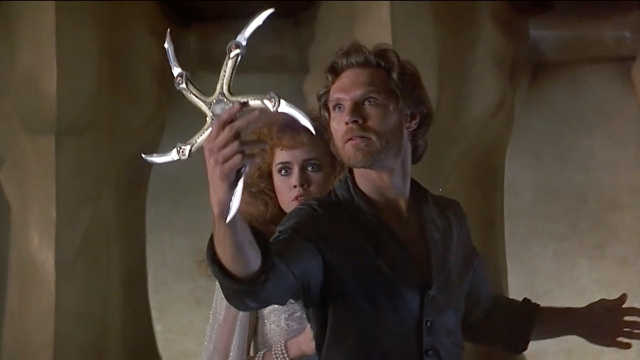
Krull
A definitive shining example (AND a prime candidate for a remake)

Since the screenwriter’s education is ongoing, there’s always something for you to work with or study to get a better grasp and understanding of what constitutes good writing, which can then be applied to your own.

Read scripts. Attend or take part in a table read. Watch movies.

While there are countless examples of exemplary writing and filmmaking to see it done properly and effectively, there are even more examples of crappy writing and lousy filmmaking to see it done poorly and ineffectively.

Nobody starts out with the intention of making a bad movie. What starts out as a great script can easily be messed up along the way to the point that there’s no salvaging it. It happens.

Is watching one waste of time? Not necessarily.

As enjoyable, informative and educational as the good stuff is, the bad stuff is actually just as good, possibly even more so. Because from these cinematic travesties you can learn what not to do with your own scripts. Lessons abound with all the glorious misfires regarding story, characters, and dialogue.

Regrettably, bad acting is a category all by itself and there’s nothing that can be done about it. Do what you can to ignore it (which can border on the impossible, depending on the quality of badness) and focus on the non-tangibles.

It’s especially helpful to work with something from the same genre as your script. See how they did it, then compare it to your own. Can you see why theirs didn’t work? Is it riddled with plotholes you could drive a truck through? Is the dialogue pure on-the-nose? Do the characters come across as unrealistic caricatures?

Look at it as a whole. Does it respect the reader/audience’s intelligence? Is the structure solid? Do you care about what happens to these characters over the course of the story?

Now bring your script into the equation – and be objective! How much of a similarity or difference is there between that story and yours? Did that other material open your eyes to some previously unforeseen flaws and potential problems within your script, so much that it made you realize “this needs work”?

Once you identify these problems, your writer’s mind goes to work, figuring out how to make sure your script doesn’t repeat the mistakes you just read or watched.

It may not be easy to endure having to watch a bad movie just for the educational experience, so just keep reminding yourself “It’s to help me become a better writer”.

Good luck!

Question time! What’s your favorite bad movie? Feel free to list it in the comments.

Shakin’ things up so much it registers on the Richter Scale

richter scale
Brace yourself

I recently took part in a group conversation with some other writers, and naturally, the topic came around to “So what else are you working on?” I always enjoy this sort of thing. So many great ideas out there.

When it was my turn, I mentioned some of what’s been occupying my time, which included the Christmas-themed mystery-comedy.

“A Christmas mystery-comedy? What’s that about?”

I launched into my 30-second elevator pitch. “LA Confidential with an all-elf cast.” The seedy underbelly of the world of Santa’s workshop. Guns. Sassy dames. Tough-talking gangsters. Intrigue. Double-crossings. The whole gin-soaked ball of wax.

While most thought it sounded like a lot of fun, one person looked absolutely horrified.

“Oh no!” they exclaimed. “My kids and I love Christmas. It’s supposed to be sweet and wonderful! I can’t believe you’d want to write something like that.” (All that was missing was them sprawled on a fainting couch, claiming to have the vapors while frantically fanning themselves.)

How could I not want to write this? Sweet and wonderful doesn’t make for good storytelling. I love this kind of story, and think it would make a great script.

This person makes it sound like trying something new is a bad idea because it messes with the comfort of the familiar. Yet one of the most common tenets is “Familiar, but different.” A story you’ve seen before, but told in an entirely new way. It’s what we should all work towards.

Everybody’s looking for something truly original and unique. Why in the world would you want to write something that doesn’t offer up anything new?

Every script you write is a golden opportunity to push your creativity to the limit so you really catch ’em off-guard. You know the story you want to tell, but it’s on you to truly surprise your reader/audience. Take things in an entirely different direction. They may think they know what’s coming, but you know better and look forward to how they’re going to react.

No matter what genre your story falls into, there will be certain expectations that come with it. The challenge of every writer is to not just meet those expectations, but toss them out the window and offer up a totally new and unexpected way of telling that story. Some people may not like it, but it’s most likely they’re in the minority, and therefore not your target audience.

Think about it. What kind of script are you more likely to take notice of and remember? One that goes for new and original, or one that plays it safe with the tried, true and predictable?

I know which one I’d pick, and will be waiting over by the window for your answer.

A multi-pronged approach

freeway
Lots of different ways to go, as long as you know where you’re going

Had another great lunchtime chat with a fellow writer yesterday. Among the many topics of conversation: the necessity of how a writer trying to break in must work towards achieving success from as many angles as they can.

Got a good script? How many others have you got that are ready to go? How many are you currently developing so as to increase that number? Are you sticking with one genre or trying several?

Are you actively seeking writing projects? There are a lot of smaller, not-as-prestigious projects out there in need of writers. You may not get a big paycheck, but you’ll gain experience (and maybe an onscreen credit). It could also help educate you about what goes on during production.

Think your script is good enough for one of the high-profile contests? What’s more important to you – the prize money, the prestige of winning (or at least placing), or how this could help get your career going?

Are you connecting with other writers? As introverted as a lot of writers are, social contact is a necessary factor of doing it professionally. It’s one thing to communicate electronically, so make a point of going to a social event in your area (you could even go so far as to arrange one!), or attend a conference where you actually talk to people. This will also come in handy when you reach that next level and start taking meetings.

You’ve done everything you can with this current script and are ready to start looking for representation. How much research have you done into who would be the most receptive to it? Does your script seem like a good match for them? Have you worked on that query letter to the point that it would be impossible for them to not want to read your script?

Naturally, these questions and situations are just the tip of the proverbial iceberg. Everybody’s path is going to be different from yours, but there will be similarities. Fortunately, you have time and a wide array of resources at your disposal to start preparing in your own way for all of them.

Good luck, and get to it.