A few other writings of relevance

pro-writer
Only sixteen more items to deal with and I can call it a day!

First, the good/positive news – the rewrite of the comedy spec is complete. However, at 88 pages, it’s a little shorter than I expected. Fortunately, adding in another 4-5 pages shouldn’t be too strenuous.

As part of the effort to recharge my creative batteries before jumping back in, I’ve stepped away from it for a couple of days.

From actually working on that script, anyway.

Since there are a lot of other avenues involved in getting your work out there, I’ve been focusing on some of those, including:

-got some great feedback on query letters, so revised one (along with updating a few lists of potential recipients – always works in progress) and sent a few out.

-submitting some pitches, and just about every one asks for a synopsis. Working on these tends to usually involve me putting in too much story info, then turning around and drastically editing it and shrinking it down to fit on one page. Despite how important this is, I’ve always disliked it.

-jotting down ideas for other scripts. While a nice reminder that I have these waiting in the wings, it’s also quite pleasant to take a look at stuff I haven’t seen in a while. Some are still in the development stage, and others are older scripts due for a massive overhaul.

-the maintenance and upkeep of connections with other writers and creatives. Like with the scripts, some are from the past, and some are brand new. Can’t go wrong with keeping your network healthy.

-reading scripts and watching movies. True, not necessarily writing, but definitely affiliated with it. It’s especially gratifying when the script comes from a writer who knows what they’re doing. As for the movies, that’s been a mix of the popular (Wakanda forever) and the Oscar nominees.

The point of all of this is that there’s much more to building a career in screenwriting than just writing scripts; it involves writing of all sorts for many other things. While I already dedicate a good portion of my available time to working on scripts, I also realize and accept that these other things are in just as much need of my attention.

And an added bonus – many of these things are not one time only. They’ll be done again and again, so the more I do them now, the easier they’ll be to do when the need arises.

Except for the one-pagers. I’ll always struggle with those.
Shifting from writer to editor

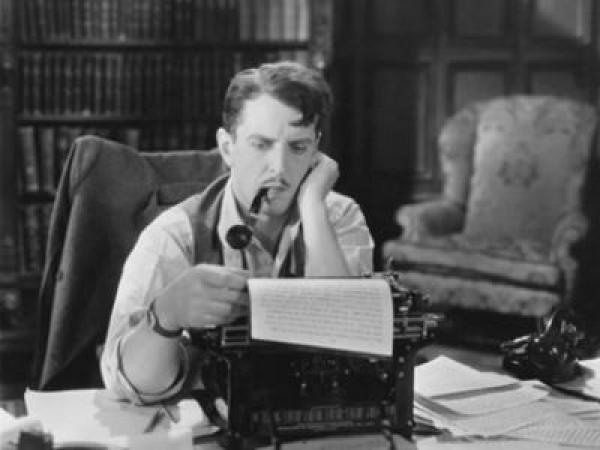
1930s typing
“Hey, this isn’t as unsalvageable as I thought.”

Most of this month has been all about working through the latest draft of a comedy spec. Averaging about 4-6 pages a day, so making some good progress, and hoping to wrap it all up by the first week of March.

Then, the cycle repeats itself with the next round of editing, rewriting, and polishing.

So as I focus on that, here are some older posts about the whole illustrious process, along with a few other related issues.

Fine-tuning in progress

I have written, therefore I will edit

Too much talkiness

Getting over overwriting


Respect your reader/audience

audience
Treat them the way you’d want to be treated

What we read on the page is what we would expect to see and hear on the screen. Pretty simple, right?

Sadly, not every writer gets it. As a result, some feel they have to explain what it is we’re seeing and hearing. Too many times I’ll read a spec script where a character does something, followed by WHY they’re doing it, or WHAT IT REALLY MEANS.

Maybe they think their writing isn’t getting the point across, so they feel the need to throw this additional info in – just to make sure you’re really getting it? It’s a practice I highly recommend not doing.

Imagine you’re reading your own script. How would you feel if there was a stop in the action to explain what just happened?

My initial thought is that this is how it’s done in books, so the writer figures they should do the same thing for a script. But I’d say that would have the opposite effect.

By laying everything out in front of us, the writer is doing themselves a disservice by not having faith in the intelligence of the reader/audience. They want your story to entertain them. People actually enjoy being able to figure stuff out and reaching their own conclusions.

Which do you think would be more effective and memorable? A script that spoon-feeds you everything, or one that makes you think and challenges you to pay attention?

Another part of this is when the writer includes WHAT A CHARACTER IS THINKING, to which I always ask “How do we know that?” Film’s a visual medium, so we can’t see what’s going on in their head (unless some kind of scene showing exactly that is actually part of the story).

One of the many jobs of the screenwriter is to show the character’s thoughts via their actions and words (or lack thereof).

(Please note the key word in that sentence – show. As in “Show, don’t tell.” Three little words every screenwriter should constantly heed. Make a sign of it and keep it near your designated writing area.)

I’d much rather reach these kinds of conclusions on my own through how the story’s told instead of the writer adding it into the mix. Including the WHY, WHAT IT REALLY MEANS or WHAT THEY’RE THINKING will highlight your abilities, but not the way you want.

Doing this is counteracting how a script should read, interrupts the flow of the story, and just comes across as lazy writing. You want to have every word on the page be there for a reason. Why have something there that doesn’t need to be?

A great piece of advice that’s always stuck with me is “Imagine the sound went out while you were watching the movie of your script. Would you still be able to follow the story?” I’d say yes, to a certain degree. While I may not have all of the specific story details, I’d definitely have a strong sense of what was going on based on what I see the characters  doing and how they’re doing it.

Two suggestions to see this in practice:

-read scripts. Focus on the storytelling. Pay attention to what’s on the page (and what isn’t).

-watch silent movies. Take note of how the actors convey emotion through their actions, gestures, and expressions.

You want your reader and audience to enjoy watching your story unfold as much as you enjoyed writing it. Believe me, they’ll be able to tell.

What you want VS what the story needs

838-02491755
Sometimes it takes a little more evaluation

Over the course of several drafts, the core elements of my scripts remain more or less the same. There might be a few changes here and there, but to me, the end result is pretty darn close to what I originally intended.

As part of the development of those drafts, I get notes from trusted colleagues and professional analysts. Everybody has their opinions, of which there were many, and I can pick and choose which ones to use.

I was still presenting my stories the way I wanted to tell them, but is that the way they should be told? Was I falling into the trap of “I’m the writer, so what I say goes! End of discussion!”?

I recently got notes on one of my scripts that offered up some keen insight regarding the antagonist’s storyline. This included the reader’s frustration about what they perceived as a lack of knowing the character’s goal and the reasoning behind it.

At first, that was pretty surprising to hear. But as is usually the case, I took a step back and looked at the big picture, trying to be as objective as possible. Was it really not as apparent as I thought?

And as is also usually the case, their comments were spot-on. I had never made any big changes to how that storyline was written because I saw it as being “just fine the way it is”, which also happened to be the way I wanted it to be.

Which was counterproductive to how the story needed it to be. It wasn’t working within the context of the story itself.

Was it my writer’s ego that prevented me from seeing this through all the previous drafts? Maybe a little. I’ve seen this kind of thing before in other scripts, but just couldn’t see it within my own material.

I knew the script wasn’t perfect, but there’d always been this nagging thought in the back of my mind that it still needed work. Something had to be changed, but I couldn’t identify what. This could also explain why I always felt compelled to keep working on it.

But with those notes, I now had a much firmer grasp of what the reader was talking about, and could begin to rectify the situation.

It took a little time to work through it, including some significant edits and rewrites. It  also entailed cutting some scenes that absolutely broke my heart to see them go, but were totally necessary. All part of the process.

I know I’ve said all of this before, but looking through the latest draft, the script really does seem different now – in a better and much stronger sense. The characters, especially the protagonist and antagonist, feel more developed. The story reads as more concrete. I’m very happy with how it turned out.

Once I was able to put what I wanted aside and focus on what was best for the story, it all came together a lot better than I expected. My hope is that this kind of self-analysis will be a bit easier for me to figure out for future drafts of other scripts.

Can’t wait to give it a try.

Characters are people!

soylent green
Go ahead. Say it like he would. You know you want to.

I’d always heard how your script should somehow reflect “the human condition”, but never really had a firm grasp of eactly what it meant or how you would accomplish that.

I mentioned the phrase in a discussion with another writer, to which they responded “I don’t care about that. I just want to tell good stories.”

But isn’t the story about the characters to begin with? And a story with under-developed characters won’t be as good as one where the characters feel like actual people.

Accomplishing that has always been one of my biggest challenges.

A comment I’ve received more than a few times in the past is that the reader finds my characters good, but somewhat incomplete. They’re established and believable, but only to a point. This isn’t saying they’re flat, one-dimensional caricatures (something I’ve unfortunately seen in many other spec scripts), but they don’t feel completely real.

Readers/audiences want to be able to relate to the characters in your script. They might feel they’re only getting a glimpse into what kind of person the protagonist is, or know there’s more to them, but that “more” isn’t there, and they want to see that. And this doesn’t just apply to the main characters; it’s everybody.

Digging a little deeper and offering up a few more details would help flesh them out, which in turn would make for a stronger story.

When I recently sent a script out for notes, the reader asked if there was anything specific I wanted them to focus on. Without a doubt, it was the protagonist and the antagonist. I felt while they were good, there was definitely a need to make them better.

The reader agreed and made some good suggestions about how that could be achieved. “We don’t know as much about these two characters as you might think,” they wrote. Since I was the writer, I had a little more insight into their respective backstories and what made them the people we see, but some of those details had stayed in my head, rather than been transferred onto the page.

So I went about adding in some small details here and there; a line of dialogue or a seemingly insignificant action. A few touches to give a little more insight into what makes them tick; why they are the way they are.

All of this, combined with a few alterations with the plot, makes this latest draft feel really different, and hopefully stronger, than its predecessors. I’m giving it a few more days to simmer, and will then give it another look to see if that vibe still holds.

What I’m also hoping is that from here on in, I’ll be able to apply this kind of approach to all future drafts, which would in theory, help achieve the same results but in a shorter amount of time.

Hope and ambition. Just two parts of the human condition, right?