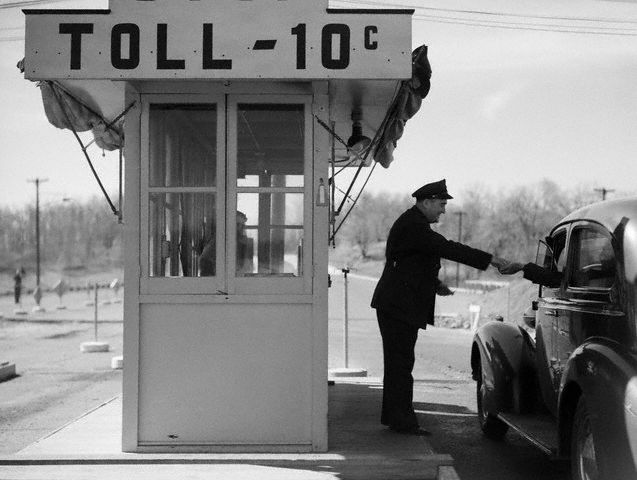
Just getting here is a story by itself

Toolbooth on Merit Parkway
Even better, the journey won’t cost you a cent

First, the good news: I wrapped up the rewrite/overhaul of the comedy spec (which seems more like a dramedy now.) Despite my dread and anxiety over whether or not it’s actually funny, it’s been sent out for notes. As I mentioned to one of my readers, as long as nobody says “What made you think you could write something funny?”, I’m good.

So, industrious scribe that I am, I find the best way to occupy my time while I wait to hear about a project is to redirect my focus and work on another one.

It was originally going to be a new take on the pulp sci-fi, but some story issues still need work, so that remains on hold.

But a few weeks ago, I was cleaning up around my office and found a hard copy of one of my earliest scripts: a horror-western. I don’t think I’d seen it or read it in about 15 years.

Wow, was it bad. Like “This first draft is going to sell for a million in no time!” bad.

But the idea behind it still worked, and was something I could definitely tweak and finesse into something a lot more coherent. I did mention how that old script was really bad, right?

So I started putting together ideas for the new draft. Let’s call this SCRIPT #1, or S1 to keep things simple.

Then another twist presented itself: a script with a low budget (the lower the better), a minimal number of characters and locations, and practically no visual effects has a much better shot of being produced than some mega-budget tentpole effects extravaganza.

With that in mind, there were aspects to this story I could use to create an entirely new and different one that met a lot of those criteria, so I jotted down some potential plot points in the same file. This is SCRIPT #2 (S2).

One file, two scripts. With me so far? It gets better.

After finishing the comedy, I decided I’d take on S1. I only had a vague recollection of all the story details, which I saw as a good thing. Although I’d still have the old draft available as a potential (albeit limited) resource, I don’t think I’ll use it all that much. This in turn, frees me up to go in whatever new direction I feel like.

As I thought up ideas for S1, some of the story elements from S2 started creeping in. Since I didn’t want the two to be too similar, more focus was put on developing S1. It’s still a work in progress, but coming along quite nicely. And so much better than that old draft.

Ah, but what of S2? Like I mentioned, there were story elements I really liked, and putting some of them into S1 forced me to come up with new ideas for it. There was one in particular that really stood out for me, and the more I thought about it, the more it felt like it would be able to be the basis for a solid story.

I combined that idea with the aforementioned low-budget approach and came up with what I really think is a great high-concept idea. Such to the point that I whipped up a logline for it, along with a title that feels very “that’s perfect!”

My belief and enthusiasm for both S1 and S2 is to the point that I’m now alternating between both; working on one, then the other. My objective now is to have at least a first draft done for both by the end of the calendar year. It’s already proven to be, and will no doubt continue to be, a most interesting process.

I’ll keep you posted.

If triple digits is how many it takes…

math lesson
“So you see, Billy, if you edited out 5 pages from the previous draft, that would put your new midpoint around page 54.”

I recently read in an interview with screenwriter Eric Heisserer that included him being asked how many drafts he wrote for ARRIVAL.

“Over one hundred.”

Sounds like a lot, doesn’t it? Keep in mind that this was also spread out over time, not all concentrated in one specific period. And that a new draft doesn’t necessarily mean a complete rewrite. It could be anything from that to a few words changed on pages 33, 52, and 88 through 89.

And ARRIVAL was also nominated for Best Adapted Screenplay at the Academy Awards, so looks like all those drafts Eric went through were worth it.

About two years ago, I had lunch with a writer friend. He was familiar with my western, and liked it very much. When I mentioned I was considering returning to it to work on it some more, he said “I think it’s fine how it is. If you keep messing with it, you run the risk of making it worse.”

At the time, I really took that to heart. I didn’t want to mess up the script, but deep down I also knew it could still be better.

As you probably already guessed, I eventually ignored his advice and dove back in. I got a few more rounds of feedback from trusted colleagues and professional consultants, always tweaking and fine-tuning with every draft.

There’s no way I could say exactly how many drafts I went through to get to where it is now, but it’s probably safe to say it’s at least over one hundred. That is definitely a lot, but reading the script now, the results of all that work are evident on the page.

Plus, all the notes and all the rewriting have combined to make a really positive impact on my writing. While the overall challenge of putting a script together is still pretty daunting, the whole process seems to move forward in a much smoother manner. And, to be honest, maybe a little faster too.

Even though someone may tell you your script is “good enough as it is”, the final product is all on you. Keep working on it as long as you think you need to, with as many drafts as it takes.

You might not get an Oscar nomination, but getting your script to where you want it to be will definitely make you feel like a winner. Yes, that’s a sappy and corny thing to say, but it’s still true.

Looking back, glimpsing ahead, and a minor adjustment

new year's eve
Just one more glass of champagne, then it’s back to work. Promise.

As 2017 wraps up, it’s only natural to engage in a little self-evaluation.

How many of your writing goals were you able to check off this year? Most of them? Some? A small-but-decent fraction? Hopefully you don’t need to mark the box labeled “None”.

One of mine was to complete at least three scripts. I managed two drafts, a revised outline, and one and a half rewrite/polishes (one still a WIP). Pretty solid results. A very hearty thanks to everybody who devoted the time and effort to give me notes. I hope my notes for yours were just as helpful.

Using those notes and the results of a few conversations, I think I’ve been able to up the quality of my writing a few notches. It still has a few levels to go, but it definitely seems better than it was. The next round of drafts should be really interesting,  both in terms of working on them and how the end results turn out.

I wanted to read more scripts, which actually happened, but not entirely in the way I expected. I didn’t do as much reading of scripts for the purpose of entertainment or gleaning some helpful guidance because I ended up reading over 100 scripts for several contests. Don’t know if I’ll do it again, but still glad I did it.

On the gaining representation front, lots of query emails were sent. Maybe one response out of ten expressed interest in reading the script, with each ending with a “thanks but no thanks” or “just not what I’m looking for”. A bit disappointing, but not totally unexpected. Along the way, I also worked on being more strategic about the process, researching potential recipients and re-drafting the query to (in theory) really sell the concept of the script.

And what would an ambitious screenwriter’s year be without contests? My western made it to the seminfinals of a few smaller contests and the top 20 percent for the Nicholl (not too shabby), but once again whiffed it for PAGE. I’ve become somewhat disillusioned regarding contests, so will most likely really cut back on them. Maybe just stick to the big three.

There was the most pleasant experience of going to Los Angeles to attend a table read for one of my scripts. I like the idea of doing one or two of them locally, so looking into that for 2018.

I hosted two screenwriting networking events, which connected me with some very talented writers from right here in the Bay Area. Definitely plan on doing that again at least once this year. Highly recommended, especially if you’re not in Los Angeles and want to expand your own personal network.

On the half-marathon front, I ran five races this year – the most ever in one year for me. Still averaging about two hours, which isn’t bad – for me, but the quest for 1:55 continues. Already signed up for three next year, with maybe one or two more expected to be added into the mix. Like with screenwriting, improvement takes time, effort and dedication. A good pair of socks and strong knees also come in handy, and that applies to both.

Finally, this blog. As always, a great experience doing what I can to offer advice to help other writers, recounting my experiences and the lessons I got out of it, and presenting some interviews with some truly interesting and amazing creative folks. I am truly grateful to everybody who’s stopped by to take a look, like a post and make a comment.

But it’s also been exhausting. Producing posts twice a week on top of dedicating time to write and make a career out of it has simply gotten to be too much. I still enjoy doing the blog, but want to refocus my energies. So as of January 1st, I’ll be reducing my weekly output to Fridays only, and sometimes even that might be iffy. It’ll most likely be on a week-by-week basis.

I hope you had a most productive 2017 and wish you all the best for an even better 2018.

See you in seven.

I see what you did there, Mr. Kasdan

Marion Ravenwood
A handful of lines + a solid right hook = insight into 2 key characters

Of all the notes I’ve received about my western, the ones that really stood out the most were about developing the characters a little more – especially the titular protagonist.

I’ve also been spending some time reading, watching and analyzing the scripts and films that influenced it. Namely, RAIDERS OF THE LOST ARK (along with its sequels) and a few others involving female leads who kick ass.

It’s a great opportunity to explore what makes a character tick. A lot’s been written about the “exposition without being blatantly expository” scene in RAIDERS with Indy and the government men, but I’ve been paying more attention to other scenes; the ones that offer up a bit more about what kind of person Dr Jones is as seen through his interactions with other characters.

-Indy discussing with Marcus the implications of finding the Ark.

-The reunion with Marion (see photo above)

-The encounter with Belloq in the cafe in Cairo.

All of these (and a few more) present an aspect of Indy’s character WHILE ALSO advancing the plot. It takes a lot of effort to do that and do it well.

I’ve also been working my way through the infamous story conference transcript, where Spielberg, Lucas, and Kasdan work out the story based on Lucas’ idea of a “swashbuckling archaeologist”. While you can easily find the memo itself, check out this phenomenal post that also analyzes some key points of what’s being discussed.

A lot of this is what I’ve been focusing on during this rewrite. More than a few of my notes highlight certain scenes and say something like “This would be a great place to show us more about her.” So that’s part of what I’ve been trying to do.

I originally thought it would be really tough to implement those kinds of changes, but using RAIDERS et al as guidelines and knowing my objectives for each scene, it actually hasn’t been as challenging. Sometimes all it requires is a few extra lines of dialogue or a modified action line. It’s not always easy, but it definitely feels a little less daunting. Also helping – working on one scene at a time.

In the meantime, progress on the rewrite/polish continues at a healthy pace and I really like how this new draft is shaping up. I suspect the end result will be a little more than just slightly different from previous ones, and hopefully the changes will really take the script to the next level.

A change for the better

gym
A struggle now, but worth it in the end

Ah, the sensation of liberation that comes from not holding back AT ALL when you really throw yourself into a rewrite.

That’s kind of how it’s been working out for the latest draft of my western.

What was originally anticipated as a nerve-wracking ordeal involving constantly second-guessing my choices has actually become quite a fun, thrilling, and surprisingly eduational experience.

Part of the initial objective was to flesh out the characters some more while keeping the story intact. The former seemed to pose the biggest challenge. Tough, but not impossible.

I figured the best approach was to take it scene by scene, starting with page one and the mindset of “what can change about these characters?”

I couldn’t say if it was having not looked at the script for several months, or just going into this with a “just have at it” attitude, but there was definitely something different about this time. Both for me and the story.

The words came, and I really like how it’s coming along so far. There are the expected slight modifications to the story, but nothing too drastic, and overall it feels a little more developed.

In the meantime, the “one scene at a time” approach seems to be working out just fine. I thought the script was pretty decent before, but now think there might actually be a chance the end result could be even better.