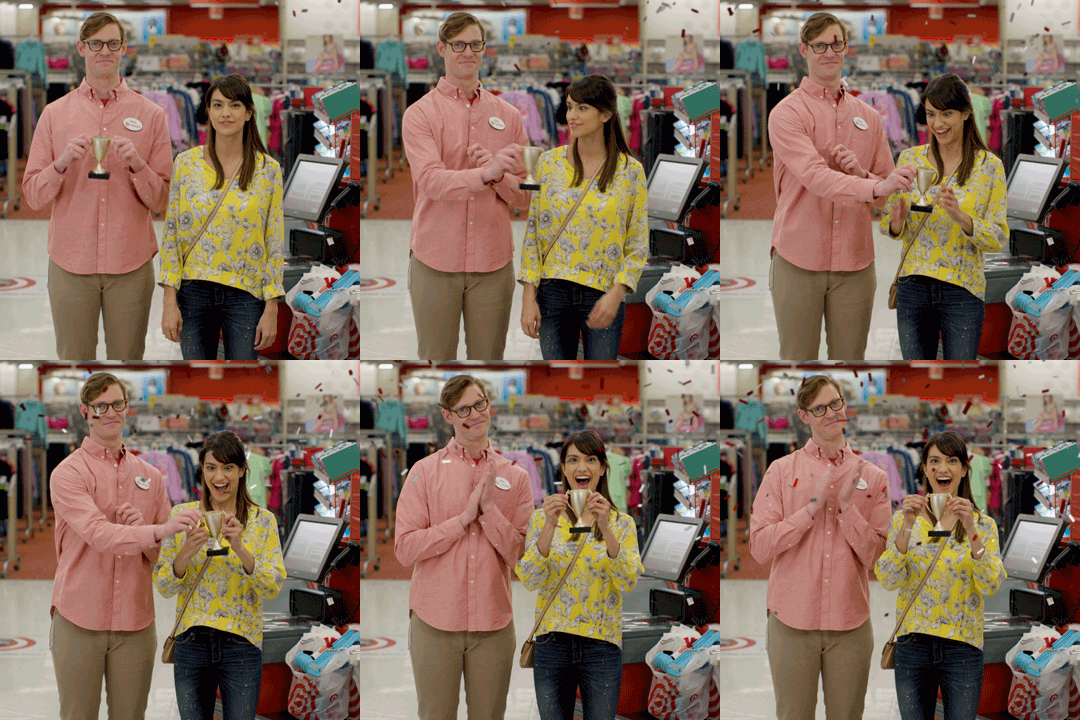
A win is a win is a win

This is a tale of two writers.

Both have recently achieved success, but of very drastic varying degrees.

The first writer has had some tremendous accomplishments over the past few weeks. Their work has placed very highly in some prestigious contests, resulting in sales, professional writing assignments, membership in the Writer’s Guild, and representation with a management company of significant importance.

The other writer had a script do well in a small contest, and had some nice things said about their writing during an online forum chat.

At first glance, the first writer definitely had the better results. Who’d complain about all of that? This is what we’re all working towards, right? That’s like a dream checklist with every box checked off. No doubt ones such as “script produced”, “film/TV show produced and released”, and “box office/ratings hit” still remain, but this is the initial phase.

Even the writer admitted they’re a bit overwhelmed by all of it.

Meanwhile, for the other writer, the contest win is nice, and while it may not be “makes the industry take notice”-level, it still fills them with a certain sense of pride. They sent their script out, hoping for something good, and that’s what happened.

Regarding the online forum chat, the moderator has raved in the past about the professional-level quality of the first writer’s material, so for the other writer to also receive similar praise was pretty uplifting and encouraging. Truth be told, it was just about the first page of a script, but why quibble?

While the first writer’s journey to success seems to be coming to fruition right before our eyes, the other writer continues to sit at their laptop, diligently plugging away and working on scripts that will hopefully garner some attention from reps and producers.

Also important – the other writer is thrilled for everything the first writer has accomplished. They’ve earned it. There might be a smidge of jealousy, but that’s expected, and the other writer can use that as motivation to do better.

The moral of the story is twofold:

First – be proud of anything you accomplish with your writing, no matter how big or small it might seem. This isn’t an easy thing we’re doing, so try to enjoy the journey and celebrate the high points whenever possible. Don’t hesitate to toot your own horn – within acceptable limits, of course.

And second – everybody’s path to success is going to be wildly different from everybody else’s. What works for one person might not work for another. It’s up to you to find your own path and keep pushing forward on it. It might take you longer than you want to reach that finish line, but it definitely feels worth it when you get there.

Q & A with Paula Sheridan of Page Turner Awards

Paula Sheridan is an award-winning entrepreneur and the award-winning author of The People’s Book Prize for her debut novel, The Grotto’s Secret, written under her pen name Paula Wynne. Harbouring a near-obsessive love of learning the craft of writing, Paula has been scribbling down the stuff in her head ever since she can remember.

Paula came up with the idea for the Page Turner Awards when she won The People’s Book Prize in 2017 and received her award from Sir Frederick Forsyth at a glittering awards ceremony in London.

When she’s not day-dreaming up plots for new historical thrillers while walking her Springer Spaniel in the Andalusian countryside, she’s helping Indie Authors to achieve their dream of seeing the novels in a reader’s hands, through her reading community on Book Luver. Paula also blogs about writing techniques and reviews writing books on Writing Goals.

What’s the last thing you read/watched you considered to be exceptionally well-written?

Last night I watched The Book Thief and the book has been on my reading list for ages so after watching the excellent film adaptation of the novel, I will definitely get the book and read it. I’ve also recently watched some cultural films from Australia and India with heart-warming stories and it brings back my mission on Page Turner Awards, which is to reach out to writers across all cultures, religions and interests, simply because they will have amazing stories to tell.

How’d you get your start in the industry?

My first book was published by Wiley. It was a non-fiction book called Pimp My Site. After that I published fiction novels and since then I’ve been learning more about screenwriting. I was also very lucky to win a Director’s Course through Screen South, which inspired me to continue my quest for learning more about writing screenplays. My debut novel, The Grotto’s Secret, won The People’s Book Prize which inspired me to set up Page Turner Awards.

Is recognizing good writing something you think can be taught or learned?

Yes, absolutely! For many years I’ve had an obsession with learning writing techniques and I’ve read hundreds of excellent writing guides, so many that I eventually started WritingGoals.com to showcase all the great writing guides which help writers to improve their craft of writing.

What do you consider the components of a good story?

Lots of elements make up a good story. For the first few pages, the character must hook the reader so they are compelled to continue reading. Beautiful prose is another good element and good writing is easy to spot. It shows the reader, or in the case of a judge on Page Turner Awards, that the writer has honed their craft. At the same time, it takes them deeper into the story. So, compelling characters with a great hook get readers and judges of a screenplay contest to want to know more about the story.

What are some of the most common writing mistakes you see?

Lots of grammatical errors, which are really easy to fix. For example, a writer can use a self-editing software, such as ProWritingAid, to help them spot these pesky gremlins which creep so easily into a piece of writing. You can take a free trial here.

What story tropes are you just tired of seeing?

Zombies! There was a stage where everyone and their aunt wanted to write a zombie story, but soon that will morph into writing about viruses and pandemics, if that hasn’t already happened!

What are some key rules/guidelines every writer should know? 

-We only accept the first ten pages. 

-Film producers and readers in a film production company normally would know by the first ten pages if they want to read further and if they are engaged with the story up to that point. 

-The same goes for literary agent and publishers. They also know very quickly if the story will make the grade. They can also tell if the writer has just thrown something together or if they have put precious time into the story’s first pages.

-Writers should know their premise or logline, and hone and tone it. This is to give the judges a good idea of what the story is all about and how it shows conflict and growth for the character in the story.

-We’re not concerned with spacing and formatting because our judges are looking for story and character and the words they read. Spacing and formatting comes when the agent or publisher asks to see more of the work.

-Screenplay entries, on the other hand, are very different. They need to be submitted in the industry standard format for the film producers to see the story as a screenplay script.

Have you ever read a script or manuscript where you thought “This writer gets it”? If so, what were the reasons why?

We had lots of entries last year where our editor, who was doing feedback, came back to us telling us that one writer in particular was very good and could write exceptionally well. Other judges had similar experiences and as a result, three writers won a literary agent to represent them, five writers won a publishing contract, six writers won a writing mentorship and thirteen independent authors won an audiobook production. We are thrilled with these fantastic successes from our inaugural awards.

Seeing as how you run a writing contest, what are the benefits for writers and screenwriters to enter the Page Turner Awards competition?

The benefits to screenwriters is that they will have the opportunity to put their scripts in front of our judging panel, who are all actively looking for scripts to option and produce. Thus, screenwriters will have the opportunity to get their work optioned for film if any of the judges like the writing. The same goes for the Writing Awards, where literary agents and publishers may want to publish the work if they like it. Success stories from 2020 include three writers won literary representation, six writers won a writing mentorship, five writers won a publishing contract, and thirteen independent authors won an audiobook production.

How can people find out more about you and the services you provide?

They need to go to https://pageturnerawards.com and follow the steps under our menu – Enter. It’s all done online so they will be asked to register an account, which will then send you an email to verify it. Then you can log in and follow the steps to submit your writing.

The early bird discount for Page Turner Awards ends this Sunday (28 Feb), so you can register now, and then have until the end of May to submit your script.

Readers of this blog are more than familiar with my love/appreciation of pie. What’s your favorite kind?

If you mean a baked pie, I can’t resist a pecan nut pie. Just thinking of it now makes my mouth water and I want to stop typing and go and bake one!

Q & A with Buzz McLaughlin

Buzz McLaughin photo

Buzz McLaughlin is a playwright and screenwriter, theatre and film producer, script consultant, and teacher. His plays have been produced throughout the U.S. and Canada and have won numerous awards including the National Repertory Theatre Foundation’s National Play Award for Sister Calling My Name, the most recent staging of which was at the Sheen Center, NYC in early 2020. With his wife Kris he has written several screenplays and teleplays.

He is co-founder/producing partner of the independent film company Either/Or Films (The Sensation of Sight), the Founding Director and former Artistic Director of Writers Theatre of New Jersey, and for many years was professor of Theatre Arts at Drew University. The author of The Playwright’s Process: Learning the Craft from Today’s Leading Dramatists, he holds a doctorate in theatre and dramatic literature from the University of Wisconsin, Madison and is a member of the Dramatists Guild and Writers Guild of America. Currently he teaches playwriting and screenwriting in New England College’s Creative Writing MFA program.

His website is www.buzzmclaughlin.com and he can be reached at buzzmclaughlin@gmail.com.

What’s the last thing you read or watched you thought was incredibly well-written?

THE TWO POPES, written by Anthony McCarten, based on his play. The film was directed by Fernando Meirelles and stars Jonathan Price and Anthony Hopkins. Nominated for best screenplay by the Academy Awards and Golden Globes as well as for best actor and best supporting actor. A wonderful example of excellent writing scene after scene with a script so real that you forget you’re watching a make-believe story as the actors really sink their teeth into the material.

Another film I must mention here is the indie PIECES OF APRIL, written and directed by Peter Hedges and co-starring Patricia Clarkson, who was nominated for Best Supporting Actress by the Academy Awards and Golden Globes. The film was also nominated for Best Screenplay by the Independent Spirit Awards. It was one of the first films shot on all digital and has become somewhat of a classic, especially in regard to its impeccable dramatic structure. I have used it for years as a teaching tool on how to construct a successful story for the screen. Well worth a close look.

How’d you get your start in the industry?

As a stage actor and director, then later I moved to writing because I started having my own ideas for scripts and felt I could do this, too (if not better than most).

What do you consider the components of a good script?

A well-constructed story with relatable characters that draws you in and keeps you engaged from start to finish. There are many ways to accomplish this, obviously, but that in a nutshell is what makes a good script. The main components are having one central character who wants something badly but who runs into road blocks preventing him or her achieving it. In the best stories, this central figure discovers along the way that what they think they wanted isn’t what they really need and as a result the character comes out a very different person at the end of the journey. And this gives the story its ultimate emotional power. My book The Playwright’s Process goes into the details of how you build or construct this kind of story one step at a time.

What are some of the most common screenwriting mistakes you see?

By far the biggest screenwriting mistake I encounter is faulty dramatic construction, scripts that wander too far away from some configuration of the three-act paradigm and as a result stall out and are unable to deliver the goods as all successful storytelling must do. Writing snappy and engaging dialogue is important, obviously, but if the story’s foundational structural underpinnings are faulty, the whole script comes tumbling down.

What story tropes are you just tired of seeing?

Formula and predictable action films and stories that are obviously agenda driven. In other words, stories that are primarily designed to thrill with violence and manufactured suspense or those that promote – sometimes quite heavy-handedly – a particular political or cultural persuasion.

What are some key rules/guidelines every writer should know?

-Determine who is your central character and what his or her primary external want and true internal need are going to be.

-Your central character should be a changed person by the end of the story.

-Take the time and effort to get to know your characters’ backstories well before plunging into your first draft. Burn into your brain that nine-tenths of the iceberg is under the surface. Remember that you are already writing your script when you engage in this pre-draft exploratory work.

-Make an initial attempt to define your dramatic premise up front – what the overall point of your story is going to be – and believe it fully yourself.

-Allow yourself to become the structural engineer and work out a three-act outline of your story with a well-defined beginning, middle, and end before starting your first draft. In other words, create a road map that will take you through your story’s journey so if and when you find yourself lost (which you most likely will) you still have that roadmap on the seat next to you and you have a way to get back on track.

-If at all possible, set your story in a world you know well.  Otherwise, research it to death.

-Train yourself to never listen to the negative voice as you develop your project.

-Never share a work in progress with anyone until you have a completed draft you think is ready to release to others. The creative process is precious and intimate and it should be shared between only you and your characters. This should be your private creative world. The time will come soon enough to get outside input, but it shouldn’t happen until you have something substantially complete to share. Otherwise your own personal vision for the script is contaminated and you risk having your whole project derailed prematurely. The only exception to this rule is when you’re working with a collaborator or a script consultant – folks whom you have invited into a creative partnership with you.

What would you consider are some key similarities and differences between writing for the stage and the screen?

The biggest similarity between a play and a screenplay is the structural design of the story itself. Both have a version of the three-act configuration: the set up, the struggle, and the solution.

The biggest difference is that plays are primarily verbal and films are primarily visual, meaning the stage play’s story is largely communicated through dialogue coupled with physical action and the film story is largely communicated through what the camera sees action-wise, coupled with dialogue as needed.

Another way to compare the two mediums is to look at the opportunity for theatricality in writing for the stage – inviting the audience to engage imaginatively with passages of time and shifts in settings and so forth – as opposed to the numerous cinematic devices available in writing for the screen such as using the dissolve, narrative voice-overs, etc. In a real sense, the two mediums are attempting to accomplish the same thing – inviting the audience to creatively enter into the unfolding story. And this is one reason why writers are often able to shift back and forth between writing for the theatre and writing for film or television.

A common recommendation to screenwriters is to take an acting or improv class. As someone who works with both writers and actors, do you agree or disagree?

I strongly agree. My experience has shown me that writers who are also actors (or have had some acting experience) are generally ahead in the game in terms of motivations and getting under the skin of a character.

As a producer, is it difficult for you to read a script without using your “reader’s eye”?

This is definitely difficult for me regardless if I’m experiencing a screenplay or play. And it starts on page one. Call it the curse of the producer. I’m so conditioned to look and wait for the inciting incident to grab me that if it doesn’t happen within the first ten pages the read often becomes an exercise in frustration.

How can people find out more about you and the services you provide?

Check out my website at www.buzzmclaughlin.com. Or email me at buzzmclaughlin@gmail.com. As a script consultant I can work with you on a finished draft or help you structure an idea into workable pre-draft shape. In other words, I can meet you where you’re at with your project.

Readers of this blog are more than familiar with my love/appreciation of pie. What’s your favorite kind?

Warm apple, with a slice of cheddar cheese.

apple pie w:cheese

Q & A with Barb Doyon of Extreme Screenwriting

BarbDoyon

Barb Doyon is the owner/founder of Extreme Screenwriting, a Los Angeles-based screenplay and TV pilot coverage service. She is well known among Hollywood producers as a skilled ghostwriter who is also a produced screenwriter, producer and award-winning documentary writer.

She’s a yearly keynote speaker at the Script-to-Screen Summit and has authored books on screenwriting including, Extreme Screenwriting: Screenplay Writing SimplifiedExtreme Screenwriting: Television Writing SimplifiedTurn Your Idea into a Hit Reality-TV Show, 10 Ways to Get a Hollywood Agent to Call You! and Magnetic Screenplay Marketing. Before opening Extreme Screenwriting, she worked at Walt Disney Studios writing press releases for the studio and Disney Sports.

What’s the last thing you read or watched that you thought was incredibly well-written?

Extreme Screenwriting’s client Larry Postel’s upcoming Netflix movie The Main Event was a solid, inspirational read. Larry captured the Follow Your Dreams theme and wove it into a compelling conflict that incited a hero to break through his flaws and become a champion. It’s the story of a little boy who takes on WWE Superstars and I love how the trailer states the theme.

How’d you get your start in the industry?

I worked at Walt Disney Studios in the press room where I wrote daily press releases for then-CEO Michael Eisner and the studio’s production companies. One day a producer asked if I had time to do coverages and he showed me how to spot the diamonds among the coal heap. This eventually branched into my company Extreme Screenwriting.

What do you consider the components of a good script?

Whether they realize it or not, audiences want to viscerally live through a hero and experience the types of change they can’t, won’t, or are too afraid to implement in their own lives. Regardless of genre, the writer should make sure that the external and internal conflicts are interlocked, resulting in an external conflict that forces change in a hero. Most writers are excellent at coming up with unique concepts, but fall short when it comes to the hero’s flaw and arc. A good script combines external and internal conflicts to solidify a hero’s arc.

What are some key rules/guidelines every writer should know?

-Interlock internal and external conflicts, as noted above.

-A producer should be able to remove all dialogue from a screenplay and still know what the movie is about. It’s called a ‘motion picture’ for a reason.

-Don’t take format for granted. Learn how to use it to create pacing, emotion and to help guarantee fewer scenes are rewritten or deleted during the development phase.

-Stop asking gurus to explain subtext and start listening. Learn to hear subtext in everyday dialogue. This is fastest, easiest way to learn how to write it and how to become a pro at lingo.

-Don’t toss in something because you think it’s interesting. If Mona’s red skirt doesn’t mean something to the story as a whole, then leave it out.

-Learn the genre rules! Producers buy screenplays based on genre.

-Start thinking of description as action and create moving picture. Don’t tell us the room’s filthy. Show John walk in, toss cigarettes into an overflowing ashtray and kick his feet up on a pile of yellow newspapers.

-Be able to state the screenplay’s theme in one line. Producers ask, ‘What is the theme?’ to weed out amateurs from pros. Amateurs can’t answer this question.

-Your hero should get the best lines, the last line, the big scene moments, a grand entrance, and the worst-case scenario should happen to them and they alone should resolve the main, external conflict.

What was the inspiration/motivation for your book Magnetic Screenplay Marketing?

It’s heartbreaking to see extraordinarily talented, aspiring screenwriters struggle for years to get a producer to read their material. Extreme Screenwriting does help writers promote their material in our monthly newsletter, but writers need to spend as much time marketing as they do writing. Most do not! Instead, they send out a few queries here and there, maybe attend a pitch festival every couple of years and that’s it.

The market is rapidly changing, and if aspiring screenwriters don’t change with it, they’ll be left behind with little hope of getting their material into the right hands. The change in the industry requires a new way of thinking and it does have a learning curve, so that’s why I decided to make a book detailing how to get ahead of the curve and beat the competition with this a marketing strategy.

This book is very different from other screenwriting books in that it focuses more on what a writer can do AFTER they’ve gained some experience and have market-ready scripts. Is what you describe a newer development for screenwriters, and what results have you seen from it?

The marketing technique I outlined in the book, related to getting a producer to call you, isn’t new to the industry. It’s been around for a long time, but until recently, this strategy hasn’t applied to screenwriters. However, there’s been a shift in the industry. Like any other product (yes, a screenplay is a product), the buyer (producer) wants social proof of its viability and is even hiring staff to find material with this ‘proof’ attached.

The Magnetic Screenplay Marketing book teaches the writer how to develop this marketing strategy and put it to use. Prior to publishing the book, I worked with 13 writers to beta test the strategy resulting in agent representation, three options, a television pilot deal and 362 combined read requests, averaging 27 per beta tester. A few did fail at the process, but they didn’t complete the steps, skipped steps, or simply quit before even giving it a try. Therefore, results will vary, but the bottom line is the fact that the industry is changing. I highly recommend aspiring writers get aboard this fast-moving train before they’re left behind.

One portion of the book is about writers obtaining “bread and butter assignments”. What does that mean, and why are they a potential avenue for writers?

This pertains to one of the strategies outlined in a section of the book on how to get an agent to call you. The first agent 99% of writers sign with will be from a boutique agency. These are the smaller agencies in town and while they do make sales, most of their commissions are generated from writing assignments, rewrites, and ghostwriting. It’s so prevalent that it’s literally become their ‘bread and butter’, in other words it’s the main moneymaker.

However, a lot of writers refuse to do this type of work. They’d rather wait around to sell their own screenplays. This sounds reasonable, but if it’s been a year (or 2) and a writer’s work hasn’t sold and the writer won’t do this lucrative work, they become dead weight for the agent. This creates an ‘opening’ for the aspiring writer who notes in queries that they’re open to all kinds of writing assignments! During the beta test, one of our writers gained representation using this strategy. A writer who isn’t open to doing assignments is leaving a lot of cash on the table and missing out on a golden opportunity to gain representation.

You mention sending in writing samples (when and only when requested). One of the options you suggest is to send the last 10 pages of a script. Why the last 10 as opposed to the first 10, and what results have you (or other writers who’ve done this) seen from this?

This is a strategy I decided to add to the book after several years of hearing of its success. Most agents, producers and story analysts agree that most writers know how to nail Act I, but then the material starts to fall apart. The result is an accumulation of story points that miss the mark.

Therefore, if a writer can still intrigue them with a strong ending that reveals voice, theme, solidifies a plot, and nails down pacing while intriguing them to want to know more, then the screenplay’s worth reading. This isn’t the preference for all agents and producers, but even those who start off requesting the entire screenplay often flip to the end first.

You also have a section of the book regarding writers creating teaser trailers for their scripts. What’s a teaser trailer for a script, and what’s the advantage in doing it?

This is part of the new marketing strategy that involves creating an audience for a screenplay via social media, primarily YouTube. This doesn’t involve a Hollywood-style trailer, but rather a simple teaser video that can literally be done for $0 cost (the book shows how) and all the writer has to do is write a 1-page script.

Think about it. For years, producers have purchased books and reality-TV concepts that got their start on social media, based solely on the fact they came with a built-in audience. When a writer sits down to pitch a script, I guarantee the producer is wondering if the story can draw an audience, but imagine the potential for a sale if the writer walks in the door with an audience already attached to the screenplay. It’s a huge advantage and can make the project a hot commodity!

How can people find out more about you and the services you provide?

Extreme Screenwriting invites writers to visit us at www.ExtremeScreenwriting.com. We offer coverage, a free monthly newsletter, and see the Bookshelf tab for the Magnetic Screenplay Marketing book (available for instant eBook download).

I also have three new books:

Screenplay Format: Learn How to Format Like a Pro

Teaches screenwriters industry format from basics to pro techniques, including how to use format to create emotion, suspense, etc.

Screenplay Notebook: Story Analyst’s Checklist

A workbook that includes Story Analyst’s Checklist for plot/execution, characters, dialogue and scenes with 26 blank pages for each section to work through problem areas. Makes a great keepsake.

Screenwriters World: Word Search Puzzle Book

Great for breaking writer’s block and having fun. Makes a great gift for screenwriters.

Readers of this blog are more than familiar with my love/appreciation of pie. What’s your favorite kind?

Homemade blueberry.

blueberry pie

Q & A with Mitchell Levin

red shirt

*note – Mitchell passed away in November 2021

Mitchell Levin was born in Detroit, Michigan. He received his BFA in Film from Columbia College, Chicago and his MFA in Dramatic Writing from New York University’s Tisch School of the Arts. He began his career as a Story Analyst at 20th Century Fox in Los Angeles, and as a development executive there worked with Arthur Miller on his screen adaptation of THE CRUCIBLE, which starred Daniel Day-Lewis.

Mitchell has worked, at one time or another, for every major Hollywood studio and has taught screenwriting at UCLA Extension. He recently left Steven Spielberg’s DreamWorks after 22 years as senior Story Analyst. There, he worked on films including GLADIATOR, ROAD TO PERDITION, THE RING, CATCH ME IF YOU CAN, THE HELP, BRIDGE OF SPIES, and more.

What’s the last thing you read/watched you considered to be exceptionally well-written?

It was a clip someone posted of a single scene from the TV show PEAKY BLINDERS, which I hadn’t watched but now will. So tense! Two male and one female gangster threatening a nun at an orphanage where a little girl had been abused. Masterfully written, performed and shot. Very still, but very edge of your seat, very heart in your mouth.

How’d you get your start in the industry?

While I was getting my MFA in Dramatic Writing at NYU back in the ‘80’s I did an internship as a reader for a producer named Martin Bregman, who made SERPICO and SCARFACE, among others. They hired me after the internship was over.

You were a Story Analyst at several major studios. What did that job entail and what were your responsibilities?

I started at 20th Century Fox when I moved out here. Not everyone knows this but the major studios are all signatory to the Story Analyst’s Union, which pays quite well, as opposed to freelance reader jobs. The union was very difficult to get into, even back then, and is virtually impossible now. I was then promoted to development executive and set up THE CRUCIBLE. I actually gave notes to Arthur Miller (he implemented all but two!) I told him, in our first meeting with then-president Roger Birnbaum, that we decided to set THE CRUCIBLE in space. Cute, huh?

After three years I realized being a corporate executive was not for me. I worked as a story analyst for every major studio at one time or another, but spent the past 22 years at DreamWorks. My job was to cover submissions, but also to help develop projects by doing in-depth notes from the time we acquired scripts or books to the time they either went into production or into turnaround.

When you’re reading a script, what about it indicates to you “this writer really gets it”?

Clear, coherent writing. Compelling premise and protagonist. Authentic sounding dialogue. Well-choreographed, not too-dense action if it’s an action piece. Clearly defined central conflict. An interesting world or a new spin on a familiar idea. And hopefully, a story behind the story, i.e., a bigger theme.

Follow-up – have you ever read a spec script that was an absolute, without-a-doubt “recommend”? If so, what were the reasons why?

The only script I remember giving a Recommend to was called THE ASSUMPTION OF THE VIRGIN, back around 2002. It wasn’t a spec, it was written by Anthony Minghella, based on a book set in the Renaissance. Sydney Pollack and Benicio del Toro were attached.

Readers shy away from Recommend because it sets off too many alarms. A Double Consider (for script and writer) is sufficient to let the exec know you’re excited. A Recommend is really sticking your neck out, and if the exec doesn’t agree with you, you worry you’ll be in trouble even if you’re told you won’t be.

Is recognizing good writing something you believe can be taught or learned?

To some extent, of course. Then again, it’s also subjective. One person’s cup of tea may be another person’s cup of swill.

What do you consider the components of a good script?

First of all, a great premise, but they are hard to come by. Beyond that, a compelling protagonist (who doesn’t have to be likable if he/she is fascinating), dialogue that pops, a clearly defined conflict, and always, escalating stakes and hopefully a sense of surprise.

What are some key rules/guidelines you think every writer should know?

– Know your logline. Often I get the sense a writer couldn’t tell me their logline if asked; not concisely, anyway. A one or two sentence synopsis of the story that tells me the inciting incident, who the protagonist is, who the antagonist is, what the central conflict is, what the stakes are, and gives me a sense of the possibilities within the story without giving away the ending.

– Leave plenty of white space on the page. Readers hate lots of dense black text. Don’t overwrite. That goes for dialogue and action.

– Don’t introduce too many characters at once that will be hard to keep track of.

– Don’t give character similar names (Jenny, Joanne, James)

– While the reader has to read and synopsize your entire script, the exec may not read past the logline on the coverage, or past the first 15 pages of your script. You have only that brief window to really engage him/her and let them know “what is” – who, what, where and why – and really grab them.

– Very important – Don’t be boring!!

Are they are any cliches or tropes you’re just tired of seeing?

I hate clichés always, and a trope isn’t necessarily a cliché. If by trope you mean a metaphor or archetype, they can always be done well or poorly, whether it’s “cross-cultural romance” or “reluctant hero”. Certain clichés bug me more than others, because they come up so frequently, like: “EMILY, 25, beautiful but doesn’t know it” or when the villain says to the hero “We’re not so different, you and I”. Or villains named DEVLIN because it sounds like DEVIL. Or when a character says “I just threw up in my mouth a little,” which makes me throw up in my mouth a little. It was funny the first time I heard it in a ‘90’s sitcom, but hasn’t been since. Likewise, the word “amazeballs,” which comes up a lot in comedy scripts, but I doubt anyone has ever actually said it in real life.

How can people find out more about you and the services you provide?

Mitchell passed away in November 2021. At the time of this printing, his website scripstrx25.com was still live.

Readers of this blog are more than familiar with my love/appreciation of pie. What’s your favorite kind?

When I was a kid I wasn’t fond of birthday cake and always asked my mom to make me a cherry pie. My tastes are more sophisticated now. Unfortunately, I’ve since been diagnosed with Type 2 diabetes. This surprised me, as I don’t have a weight problem. When I asked my mom about it, she said, “Oh, yeah, I forgot to tell you.” It seems it runs through the whole family on her side, but it skipped her.

cherry pie 2

So the only pie I tend to eat these days is humble pie, usually on those occasions, and there have been many, when I embarrass myself in front of famous people.