Why, and why now?

studying
A pair of questions to study thoroughly

An associate of mine is in the early stages of developing a low-budget film. Call it pre-pre-pre-production. The script is part of that (as in “about to be written”), and I was asked to take a look at the outline and offer up my two cents on it.

It wasn’t bad. The structure was a little wobbly, but not too far gone, and a few other minor issues, but overall, I’d call it a fairly solid attempt.

I totally got what kind of story they’re trying to tell, but reading this outline definitely raised some important questions.

Two, to be specific.

First: why is this happening?

I don’t mean this is in a negative way, like “why are you even bothering?” Quite the opposite.

More of a “does what happens in this scene adequately follow what’s come before it, and does it do an equally good job leading into what comes next?” sort of thing.

As it reads now, it felt more like a lot was happening because the story required it to, rather than letting it all unfold smoothly and organically. There wasn’t enough setting things up in order to pay them off later. Almost like each scene is saying “This MUST happen HERE, logic be damned!”

A should lead to B, which leads to C, and so on, but then you also find out that not only did A lead to B, but it also resulted in H.

Second: why is this happening now?

This applies more to the primary storyline. Things are taking place, but I never really got a sense of how or why it all started. A lot happens after whatever event triggered it all, but there’s no indication of exactly what that trigger was. When I asked the writer about it, even they admitted they didn’t know and were having trouble trying to come up with something.

A writer needs to know every part of their story; what things were like before it started, how it started, what happens, and how it ends. Sometimes you can even throw in what happens next. No matter what approach you take, all of these elements play a key role in the telling of that story. If one of those elements isn’t there, it just gums up the whole works and you’re left with an incomplete story.

The writer was very appreciative of my comments and was looking forward to finishing the latest draft in order to provide answers to the questions I’d raised. It’s probably safe to say we’re both quite interested to see how it all turns out (although I suspect I come in a close second).
 

Bursting at the seams – part 2

Image result for MARK RUFFALO HULK GIF

On one hand, progress for the pulpy adventure spec is moving along nicely. Still maintaining a daily output of about 3 pages.

But on the other hand, this thing feels like it’s growing exponentially, continuously getting bigger than I originally anticipated.

A lot bigger.

Like “rise out of the bay, tower over the skyline, ready to wreak havoc and terrorize the populace. Call the military!” big.

That’s pretty big.

Part of this stems from me having a one-sentence description of a scene in the outline, not really taking into consideration I’ll need at least a page, maybe two, to execute it. Hence the feeling of overstuffedness.

There have been times where I’d be in the middle of a scene, but then think “Too much!”. This would be followed by the immediate deleting of what I’d written so far and starting anew, but with a mindset of “Same, but a lot less this time.” It happens; just not all the time.

No problem whatsoever if you start with a scene that’s initially three pages long, because you know the next pass will involve whittling down to one (or a little more). Getting it written in the first place is the hard part; everything after that – much easier (for some, anyway).

I freely admit I tend to overwrite, but that’s usually limited to the first draft. Once that’s out of the way, the red pens are produced and much killing of darlings commences.

Sometimes it’s very frustrating that my initial effort isn’t what I want it to be, but isn’t that the point of a first draft? There’s a reason it’s also known as “the vomit draft”. You just throw everything on the page, and then go back for ongoing cleanup work. The guiding principle here – you do what’s necessary to get it to that desired end result.

Will there most likely be some drastic changes somewhere down the line? Undoubtedly. If that means starting with a first draft that’s way too big, so be it. It’s not like this is what the final finished project is going to look like. Better to have an oversized script ripe for editing than a scrawny one that needs to be bulked up.

So for now, the slog continues. Scenes may go on too long, but it’s cool. This is a fun story and I’m enjoying writing it. I know it’ll take a while to get it to where I want to be, and that’s fine by me. All part of the process.

But better have the military on standby, just in case.

Now it gets really interesting

desert
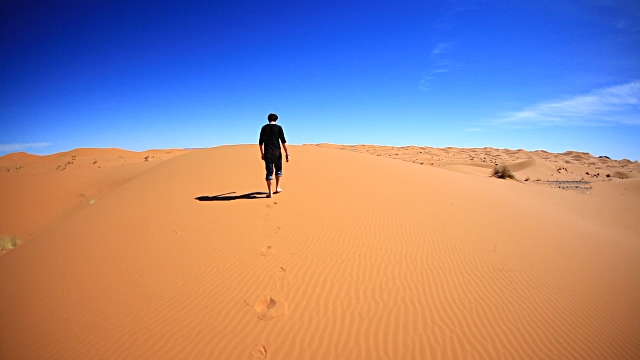
First few steps are always the toughest. Good thing I came prepared.

Let’s pause now for your humble blogger-in-residence to proudly proclaim that Act One of the first draft of the pulpy adventure spec is complete.

Whoopee.

But you know what that also means.

Yep. Time to buckle down even more, strap myself in, and jump feet-first into the intimidating arena commonly known as Act Two.

I’ll also admit it’s a little thrilling, too. There was a particular charge in working out the action sequences and story set-ups in Act One, so I’ve a strong suspicion the continuing build-ups for the former and the gradual development of the latter will be equally, if not more so, fun to write.

(and believe me when I say this is the kind of story that automatically requires a sense of fun)

Maybe it’s from continuously trying to improve as I go, but working on Act Two doesn’t seem as intimidating as it used to. Not to say that it comes easily; just slightly less insurmountable. I spent a lot of time on the outline, so confidence in that is pretty solid.

I read a lot about how a spec script might have a phenomenal Act One, but then things fall apart in Act Two for a myriad of possible reasons: the characters don’t do much/nothing really happens, or the overall story’s too thin, so a lot of Act Two is empty filler, and so on.

The only writing process I know is my own, and I always strive to make sure the story feels…complete? Full? It comes down to “I know what has to happen to tell this story,”, and while the first act is all about setting it all up, the second act is about fleshing everything out.

We get a closer look at the characters and how they’re progressing through the events of the story. We can see how they’re changing from when they were first introduced. Plot threads of all sizes get further developed. The central question is continuously asked (oh-so-subtly, of course).

It also involves steadily-mounting complications for your protagonist. They’ve got a goal, and it’s our job to throw all kinds of obstacles in their way that just keep making it harder for them to reach it. Again, a lot of it happens during our second act.

Act Two really is where the meat of the story takes place, so stuff needs to happen that not only holds our interest, but makes us want/need to know what happens next, and even that better be that much more intriguing.


As you’d expect, our work is cut out for us.

So off I go. Dispatches from this formidable excursion as they develop.

See you on the other side.

The “sound” of your writing

eavesdropping
No! Find your own style of writing. Don’t copy someone else’s.

When somebody reads your script,is there something about the writing that they can tell you’re the one who wrote it? Do you have a certain style or “voice” regarding how your material reads?

Each writer develops their own particular way of not only how they write, but how that material comes across on the page.

When you’re just starting out, maybe you play it safe and keep things simple and straightforward. Or you might try from the get-go to emulate a script or writer you really, really like, because if it worked for them, then it stands to reason that it will undoubtedly work for you in the exact same way. This is occasionally referred to as the Tarantino Syndrome.

There’s nothing wrong with appreciating a pro’s style, but for crying out loud, DO NOT try to duplicate it. That’s how they do it, which is not the same as how you do it. It also smacks of laziness. You want to make a name for yourself, right? So how are you going to do that by writing like somebody else?

Find a way that works for you and stick with it. Hone your writing skills with each draft until every script you offer up is undeniably identifiable as yours.

The more you produce, the more comfortable you’ll get with how you write, along with becoming more confident in your abilities. You’ve put in the work learning the rules, so now you feel ready to see how far you can bend them (but not too much! They can be very fragile at times.).

Soon you’ll have no hesitation to start putting your own spin on things; little touches here and there. Although the usual challenges and obstacles will still be there, you might discover that your overall process of writing has gotten just a little bit easier.

Bursting at the seams

homer-donuts
Have to be careful not to overdo it

Overwriting has always been an issue for me, at least when it comes to first drafts. I tend to put a lot more on the page than is probably necessary, which of course, increases the number of pages.

Case in point – while progress is moving along nicely for the pulpy adventure spec, and I’m faithfully adhering to the outline, scenes throughout the first act are running longer than expected, so the inciting incident will be occurring somewhere around 10 pages later than anticipated.

If things continue at this rate, I may end up with a script that’s somewhere in the neighborhood of 140 pages, which is way too long.

Keep in mind that I don’t make a point of strictly adhering to certain feline-influenced rules/guidelines of a “THIS MOMENT IN THE SCRIPT MUST HAPPEN ON THIS PAGE” nature; it’s really more of a suggestion.

The good thing is that I can just keep pushing forward, knowing there will be some major editing and rewriting in store when this draft is finished. It’s a lot easier to go in and cut, as opposed to scrambling and struggling to add in material. And as evidenced by past behavior, I’ll probably continue to occasionally go back and tweak something I don’t see as sitting right.

For now, the very-helpful process of plotting out the beats of a scene and writing them as such will, but it wouldn’t be surprising if a subconscious effort to tighten things up a little begins to develop.

One brief sidenote – I’ve been making a real effort to reduce the amount of time spent with casual netsurfing and replacing it with actual writing. It’s made quite a difference, and the results have been most productive. I heartily recommend it.