Trying to unlock a key moment

skeleton-keys
One of these HAS to be it

I was hoping to wrap up the polish/revision of the comedy spec this week. Everything was going quite smoothly until I hit a bit of snag when I got to the end of Act 2 – only one of the most important parts of the story. Where things are definitely at the lowest point possible for our hero.

The general consensus of my readers was that the hero was too passive, and therefore needed to be much more active and stand his ground, yet still end up failing. Some suggestions were made, and I’ve been working on making it stronger and more effective.

Which brings us back to right now. As it reads, it’s just not working.

And that’s kind of frustrating.

I know there’s a solution to this, and my creativeness has been working constantly to come up with one that not only works with the context of the story, but seems plausible and believable.

As I said to one of my readers, I tend to overthink this kind of thing. To which they responded with “Remember, this is a story that’s supposed to entertain.”

And that’s pretty important, too.

Hopefully when all is said and done, it’ll do all of it.

-I ran the Giant Race half-marathon on Sunday. Got a small rock in my shoe around mile 7 or 8, but opted to keep going rather than sacrifice the time to remove it. The rock eventually was a non-issue and I managed to just beat my ongoing goal of 1:55 by one whole second – 1:54:59.

Thank you for being better than me

fancy pie
Mine don’t look like theirs yet, but give me time…

Via a writing colleague, I recently found myself in the possession of a pair of scripts written by a pair of pros.

“Open one and read a few words and you’ll be in for the rest of the script,” I was told.

And you know what? They weren’t far off.

I only got a few pages in, but found the writing to be extremely vivid and descriptive. No problem at all in painting those mental pictures with a powerful brush.

My only complaint – all that dazzling wordsmithing got a little too distracting, making it slightly tougher to focus on the story. Nevertheless, I’m looking forward to reading both scripts.

But I totally got my friend’s point: the writing was exceptionally engaging. It really grabbed you and made you want to keep going.

Compared to it, my writing comes across as kind of dry and might even be considered sort of dull and lackluster. Not to totally disparage my own work, but these writers are professionals. I, as it has already been established, am not.

But reading these scripts and others like them are good reminders of what I and every other writer should be trying to do. You don’t want a stick drawing. You want a finely-crafted elaborate work of art.

Speaking from experience, this isn’t easy. It’s almost like learning a new way of writing. It requires a lot of work, nor will it happen overnight.

But don’t despair. The good news is you can start working on these improvements practically immediately.

Take the last scene you wrote. How does it read to you? Does it compel you to want to know what happens next? Feel free to tinker with it until it gets to that point. Then do the same with the scene after it. And the one after that. And so on, and so on.

Think of it this way – you want the reader to “see” the scene in the same way you imagined it. Therefore, your challenge is to write it so the actions, images and dialogue in it come as close as possible to matching your version AND that no other description would do it justice.

Reading these professional scripts was at first intimidating in a “I’ll never be able to write like that!” kind of way. But with a continuous effort and a lot of work, there’s no reason to think I couldn’t come mighty close.

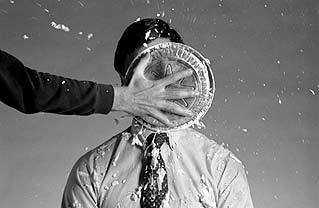
The dreaded ensuing of wackiness

pie-in-face
Done right, this is comedy gold

As part of my work on the low-budget comedy spec, I’ve made an effort to read other comedies to help get a better understanding of how it could be done and hopefully some guidance I could apply to mine.

It’s always been tough for me to read comedy because my sense of humor doesn’t always align with others. Many’s the time I’ve read a script that garners universal praise for being gut-bustingly hilarious, but doesn’t do anything for me.

There is, however, one detail I’ve noticed that keeps popping up:

Unrealistic situations.

Things that seem to happen only for the sake of a joke, and not much else. These often feel forced and inorganic to the plot. Almost as if the writer thought “Hey, wouldn’t it be crazy if ____?”

In theory, potentially a good idea, but in execution – not really.

Some might argue that since it’s comedy, things don’t have to be realistic as long as they’re funny.

I beg to differ. If I don’t think something could actually happen, I will most likely not find it funny.

**side note – this doesn’t necessarily apply to slapstick or absurdist fare, which are two entirely different discussions**

Sure, there are comedies where the entire premise isn’t all that realistic to begin with, but even the humor in those should stem from the situation, rather than being a crazy assortment of wacky gags.

Going for the easy laugh or cheap joke doesn’t take much skill and shows a lack of sincere effort. If a writer does it once, chances are they’ll do it a lot. It also doesn’t offer anything new. Who wants a joke they’ve probably seen or heard a thousand times before?

Looking at comedies that would be considered strong, there are a lot of instances where the joke is an integral part of the scene, rather than feeling like something tacked on.

You’ll hear that the best comedy is the kind that makes you think. I prefer comedy that shows the writer did a lot of the thinking.

Shakin’ things up so much it registers on the Richter Scale

richter scale
Brace yourself

I recently took part in a group conversation with some other writers, and naturally, the topic came around to “So what else are you working on?” I always enjoy this sort of thing. So many great ideas out there.

When it was my turn, I mentioned some of what’s been occupying my time, which included the Christmas-themed mystery-comedy.

“A Christmas mystery-comedy? What’s that about?”

I launched into my 30-second elevator pitch. “LA Confidential with an all-elf cast.” The seedy underbelly of the world of Santa’s workshop. Guns. Sassy dames. Tough-talking gangsters. Intrigue. Double-crossings. The whole gin-soaked ball of wax.

While most thought it sounded like a lot of fun, one person looked absolutely horrified.

“Oh no!” they exclaimed. “My kids and I love Christmas. It’s supposed to be sweet and wonderful! I can’t believe you’d want to write something like that.” (All that was missing was them sprawled on a fainting couch, claiming to have the vapors while frantically fanning themselves.)

How could I not want to write this? Sweet and wonderful doesn’t make for good storytelling. I love this kind of story, and think it would make a great script.

This person makes it sound like trying something new is a bad idea because it messes with the comfort of the familiar. Yet one of the most common tenets is “Familiar, but different.” A story you’ve seen before, but told in an entirely new way. It’s what we should all work towards.

Everybody’s looking for something truly original and unique. Why in the world would you want to write something that doesn’t offer up anything new?

Every script you write is a golden opportunity to push your creativity to the limit so you really catch ’em off-guard. You know the story you want to tell, but it’s on you to truly surprise your reader/audience. Take things in an entirely different direction. They may think they know what’s coming, but you know better and look forward to how they’re going to react.

No matter what genre your story falls into, there will be certain expectations that come with it. The challenge of every writer is to not just meet those expectations, but toss them out the window and offer up a totally new and unexpected way of telling that story. Some people may not like it, but it’s most likely they’re in the minority, and therefore not your target audience.

Think about it. What kind of script are you more likely to take notice of and remember? One that goes for new and original, or one that plays it safe with the tried, true and predictable?

I know which one I’d pick, and will be waiting over by the window for your answer.

The Force is strong with this one

galaxy
Don’t get your knickers in a twist. This isn’t about that.

Star Wars: Episode VII officially opens today, and my God, what an impact this is having. I’ve been a fan since way back in ’77, but not to the point of sleeping in front of a movie theatre for days on end.

I’m opting to wait a couple of days and let all the crazy hoopla die down. It’s not like it’ll play for a week and disappear. Even the neighborhood theatre up the street is playing it on both screens. That’s saying something.

Looking at this phenomenon from a screenwriting point of view, you can’t help but be impressed with the world that’s been created here. Count me among those inspired by the creativity on display in these films and who strive to achieve something similar with our own work.

I’ve written before how I’d love to write the next STAR WARS (as would a zillion other writers), but I don’t mean a sprawling epic space opera, although that would be kind of cool.

I’m talking about an entertaining story of memorable characters and situations that you never get tired of seeing. That thrills you with its overwhelming sense of wonder. The sheer joy of being swept away as this tale unfolds before your eyes and ears.

Do I have that ability? Hard to say, but I like to think so. Nobody thought STAR WARS was going to do well, and you know how that worked out.

So in the meantime, I’ll keep plugging away, telling my own stories the best way I can, and hope that someday I come close to accomplishing something similar. At the very least, it’ll be fun trying.

See you at the movies.