Ask a Wicked-Smart Script Consultant!

Rebecca Norris copy

The latest in a series of interviews with script readers and consultants who would be worth your while to work with if you want to get your script in shape. Today’s spotlight is on Rebecca Norris of Script Authority. She works with writers, producers, and directors to consult on feature-length screenplays, TV pilots, TV specs, webseries pilots and full series, and career direction and strategy.  

1. Whats the last thing you read/watched that you thought was incredibly well- written?

My current obsession is House of Cards. At first, I didn’t care for the show. I found the device of Francis talking directly to camera a bit odd, the plot lines confusing, and I didn’t like any of the characters! However, a friend encouraged me to keep watching, and I’m so glad I pushed through. The genius of the show is in the slow reveals—they don’t hand you anything up front—you earn carefully-placed insights into the characters over time. I ended up binge-watching all of Season Two and am now deprived of new episodes until January! I should have spaced them out more.

2. Howd you get your start reading scripts?

For my first internship, I worked at a state film office that held an annual screenplay competition. They had an entire room stacked with feature-length screenplays, and it was my job to read and recommend scripts to the higher-ups for the contest. When I moved to L.A., I was able to parlay that experience into reading for a production company and then another screenplay competition, and it snowballed from there. This has included reading for Sundance, QED Entertainment (DISTRICT 9, FURY), Screen Queensland, BlueCat, ScriptXpert, Script Reader Pro, and other contests/services, and I’ve worked in development at Southpaw Entertainment (AUGUST RUSH, THE SPACE BETWEEN US).

3. Is recognizing good writing something you think can be taught or learned?

I think anyone can be taught to do anything; whether or not they have a natural aptitude for it is another matter. The thing is, we are all storytellers. It’s engrained in our psyche. And reading is a personal, subjective experience for each individual. Some stories that bore the pants of me might be endlessly entertaining to someone else, and vice versa. That’s why a film can be rejected from one contest and then go on to win first place at another.

However, the technical aspects of a script can be judged in a fairly uniform way. Is the writing concise yet descriptive, or is it overly wordy? Are there misspellings and grammatical errors? Is the script formatted to industry standards? Is the page count a reasonable length? A writer can’t control whether or not a particular reader will judge their writing as “good”, but they can control the technical aspects of the script to give it the best possible chance of impressing a reader.

4. What are the components of a good script?

A good script has a solid premise, interesting characters, a well-conceived plot, tight narration and dialogue, and is technically up to par as far as typos, sentence structure, formatting, etc. It also must be ENTERTAINING. This is something I believe writers forget about sometimes, especially if they’re writing, say, a historical drama. Audiences don’t care about facts and figures and accuracy nearly to the extent that they want to have an emotional journey—a catharsis. It’s the writer’s job to provide that journey and entertain along the way—that’s why we’re in the Entertainment Industry. I think most readers would agree with me on this—the first question I ask myself after reading a script is, “Am I bored?” If I’m bored, then the script will not get a Consider or Recommend, no matter how true to life or historically accurate it is.

5. What are some of the most common mistakes you see?

By far, the most common mistake is spelling errors. Most scripts I read are chock-full of typos and glaring grammatical errors (including sentences with missing punctuation, missing words, or only parts of words.) It’s incredibly frustrating because this is something completely under the writer’s control. What writers may not realize is that every time I come across a typo, I’m taken out of the story. When a script has multiple typos per page, as some of them do, I’m taken out of the story dozens of times by the time I read the last page, which essentially ruins the experience. As writers, the written word is our only instrument. A pianist wouldn’t perform on an out-of-tune piano, and likewise, a writer should fine-tune his or her instrument and become a master of language. Having a typo-free and correctly formatted script says to the world: “I’m a professional, and I care about the quality of my work.” In my opinion, it’s the best way to control your first impression to a reader.

6. What story tropes are you just tired of seeing?

There has been a trend over the past several years of incredibly brutal, violent, and bloody dramas. (And I’m not talking about horror movies here.) I think it’s a reflection of the dark times we’ve gone through over the past decade and the current political landscape in the world. I’ve also programmed at some film festivals, and some films I screened were sickening to the point where I had to turn them off. I’m not a prude and I enjoy a good action or horror film just as much as the next person, but it’s gone a bit overboard lately. Some of the films had gratuitous violence toward women and children, which I find disheartening and painful to read. Sometimes I long to read a comedy or something lighter that ends on a positive note, and I hope the trends change in the coming years toward lighter (and less barbaric) fare.

7. What are the 3 most important rules every writer should know?

1) Don’ t get disheartened if you aren’t getting recommends or considers on your early scripts. Take the notes, learn from them, and keep writing. Your writing will improve greatly if you just keep at it.

2) It’s okay to struggle with writing. Some writers get disheartened and give up if writing isn’t the glorious, self-expressive, free experience they think it should be. Writing can be difficult and tedious. It’s courageous to be vulnerable and put your heart out on the page, and even more courageous to then send your work to total strangers. The best thing a writer can do is show up every day and write, and when the work is ready, keep sending out those ships. One day, a ship will come back in.

3) You are in total control of your very first impression on the reader. You do so through your mastery of language, spelling, formatting, brief yet descriptive narration, etc. You can’t control whether or not a reader loves your script, but you can control your presentation. Hire a professional coverage service to proofread and get feedback before you send your scripts out—it’s the best way to test the waters and see how your script will be received, since many coverage services employ readers who have worked at contests and production companies.

Even if your script doesn’t get a recommend, the writer themselves can. Scripts and writers are tracked by production companies, and if you as a writer make a bad impression, a company is less likely to be willing to read another one of your scripts. If you made a good impression as a writer but they just passed on that particular script, a company will be much more willing to read future work from you.

8. Have you ever read a script that was an absolute, without-a-doubt “recommend”? If so, could you give the logline?

Since most of my work deals with newer writers, I have not yet personally come across a script that was an absolute Recommend with no doubts in my mind. Most scripts I read have a solid concept but need work to get them industry-ready. I have read many scripts that I would recommend if the writer made adjustments and changes, and those scripts might receive a Consider.

9. How do you feel about screenwriting contests? Worth it or not?

Absolutely worth it. They’re a great way to build up credibility and provide the ‘pitching points’ writers need to become interesting to agents, managers, production companies, etc. You don’t have to win. Even being a quarter-finalist in larger contests or fellowships can make you attractive and garner interest in your work. And if you do win or place in a major contest, it can open doors for you very quickly if you take advantage of the opportunity.

Submitting to contests also provides built-in deadlines. If you know you have regular submission deadlines you have to meet, it puts a fire under you to write every day. It’s not that expensive–you can take $400 and submit to most every major screenwriting competition and a couple of smaller ones. Think about all the things most people waste $400 on in a year (like coffee!). It’s a small investment that can have a big payoff, if even just to get you motivated to write.

10. How can people get in touch with you to find out more about the services you provide?

Contact FreebirdEntertainmentLA@gmail.com for availability and pricing.

11. Readers of this blog are more than familiar with my love/appreciation of pie. Whats your favorite kind?

Pumpkin! I’m thrilled that it’s Fall and we’re just a few weeks away from Halloween, my favorite holiday. I’m going to have to binge on all the pumpkin products over the next couple of months before they’re gone!

Ask a PAGE-winning Script Consultant!

Scott Parisien

The latest in a series of interviews with script readers and consultants who would be worth your while to work with if you want to get your script in shape. Today’s spotlight is on Scott Parisien, a mentor, analyst and writer with Script Reader Pro. He wrote the feature FOXTER & MAX in 2019, and his script INCISION was a Bronze Prize Winner in the 2013 Page International Screenwriting Competition.

1. What’s the last thing you read/watched that you thought was incredibly well-written?

There have been many movies this year I felt were actually quite well written. Sadly, most fell outside of the studio system or did not come to the big screen, and if they did, it was barely a blip on the radar. Movies like The Way Way Back, The Spectacular Now, Out Of The Furnace… these really focused on the characters and their journeys, and were filled with touching moments and emotional beats I really identified with. They had characters that were rounded and dimensional and deeply layered. This is what we don’t really get in the studio system any more. But two films that really hit that nerve in the system were The Fault In Our Stars and If I Stay, which were both adaptations, which explains why the characters were more able to be identified with. For me, it’s all about connecting with the characters on a deeper field. As far as the blockbusters, the only one I felt was well written, due to the intelligence of the script and the overall theme of the story, was Dawn Of The Planet Of The Apes. It had such heart, such an identifiable father/son struggle, and themes that worked on both the human and ape sides of the story. I found it quite powerful because of this, and the effects and action really did accent it rather than overwhelm it for me. I wish more blockbuster studio films managed to achieve the same.

2. How’d you get your start reading scripts?

Many years ago, I received a grade of Recommend on two scripts through what was then Script PIMP (now Script Pipeline). I began a great relationship with the guys who ran it and when they had a spot come open they gave me a chance to show what I could do, as I was working on my own consultant service on the side and had experience with this. I then went on to work quite successfully with them and was a senior story analyst, being there for over 5 years. I’ve been running my own service all along as well, and now work with ScriptReaderPro.

3. Is recognizing good writing something you think can be taught or learned?

I’m not sure it can be taught, or even learned. I believe certain people have an inert skill for identifying good stories and good writing, much like Simon Cowell has a knack for recognizing talent and potential in a singer’s voice. Certain people can see that special spark on the page, within that voice and writer. I don’t think just anybody can be a screenwriter. Not only does it have certain areas of craft that must be mastered and manipulated to a person’s style and form, but there’s also a very special art to it. Some people don’t believe there’s an art to screenwriting, that it’s just a blueprint for a movie, but the great writers truly do put together a masterful piece of art in their screenplays. Not everyone can do it, and that’s why 99% of screenwriters tend to fall short of becoming that professional writer we all strive to become.

4. What are the components of a good script?

This is tough because there are so many things that need to be in a script to make it really stand out and resonate above the piles of not so great stuff. Writers tend to focus so much on their “rules” like format and saving the cat: exact page beats and such. But the greats, they worry about layers and nuance and emotional connection. Things like character development, flaws, obstacles. For me, it’s all about the flow of the story, the pace at which it pulls me through the basic structure all screenplays have. That will really make me sit up and take notice. The best screenplays are the ones you never stop to see what page they’re on, or what act you may be in, because it has seamlessly pulled you deep into that world. And that happens very, very rarely.

5. What are some of the most common mistakes you see?

For me it’s not about spelling or grammar, or whether something should have been in CAPS or not. The biggest mistake I see is screenwriters not doing all they can to suck every last drop out of a scene. They are too soft, or too vague, or talking heads with no real substance. These screenwriters lay down the surface and don’t seem to take the time to really dig in and crack the surface to see what is really happening underneath.

6. What story tropes are you just tired of seeing?

I’m actually sick and tired of the main character’s motivation being a dead wife. So many scripts these days and pitches rely on the protagonist being driven toward his goal by the death of the woman he loved. Of course this creates a strong emotional connection as we’ve all lost a loved one in some way or another, but it’s now so cliché it just comes off flat and not interesting in any way.

7. What are the 3 most important rules every writer should know?

1) Take your time. If you’re writing a spec, you have all the time in the world, as well as only one chance to impress. Too many writers rush and don’t let a script really simmer and breathe before they stamp it complete.

2) Find your voice. Don’t write in every single genre because you have an idea you think is good. Choose your style and your voice. It’s hard to make your mark as a horror writer if you submit and they want more, and all you have is a children’s Christmas movie, a western and an emotional drama.

3) Choose your concepts and stories carefully. It’s hard to get read in this business as it is, but even harder if the idea you have isn’t something that will get people excited. The best way to think of it before you write your story is if you can see a movie poster. If the concept you can pitch will elicit a movie poster in our minds, we can see it as a movie. If it doesn’t, you may want to see what other ideas you plan to put 6-12 months into.

8. Have you ever read a script that was an absolute, without-a-doubt “recommend”? If so, could you give the logline?

I’ve only read one script I wish was my own. It was so good, so layered, so character-rich, and it was a heist movie as well about two bank robbers on their last run who steal a getaway car with a pregnant woman asleep in the back, so it had commercial appeal. But it had a deeper theme about human connection that ran through the entire story. The writer had a very special voice that was undeniable.

9. How do you feel about screenwriting contests? Worth it or not?

It all depends on the contest. Everything is so subjective. I won a midlevel contest and didn’t get a single request. I was a winner in one of the top 3 and the requests flooded in. It all depends on how a writer capitalizes on those wins or placements. Using them to pump up your credibility in a query can help it get noticed.

10. How can people get in touch with you to find out more about the services you provide?

https://www.scriptreaderpro.com/our-script-coverage-services/

11. Readers of this blog are more than familiar with my love/appreciation of pie. What’s your favorite kind?

Saskatoon Berry Pie. These little dark blue berries, like a blueberry but totally different, grow in central Canada and into Montana and North Dakota. These are little gems if you can ever get your taste buds on them, in a crust with a gratuitous pile of whipped cream on top.

Ask Two Savvy Script Consultants For the Price of One!*

ScriptChix_Logo copy

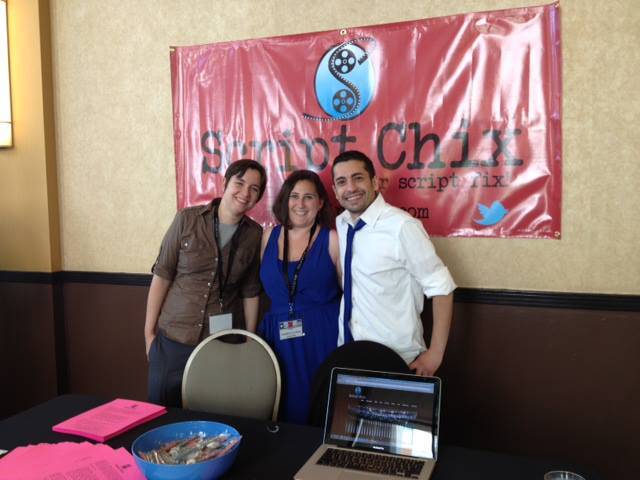
(L-R) Miranda, Sandra & budgeter/scheduler extraordinaire, Hosam, who is not part of this interview
(L-R) Miranda, Sandra & budgeter/scheduler extraordinaire Hosam, who is not part of this interview

*And considering this doesn’t cost you anything to begin with, that’s the best deal you’ll get today.

The latest in a series of interviews with script readers and consultants who would be worth your while to work with if you want to get your script in shape. Today’s spotlight is on Miranda Sajdak and Sandra Leviton of Script Chix.

1. What’s the last thing you read/watched that you thought was incredibly well-written?

WINTER’S BONE

BUTCHER HOLLER by Daniel Shea

2. How’d you get your start reading scripts?

M – Started off as an intern in Hollywood doing the typical script-reading duties. Moved on to being an assistant and continued to do coverage there. Eventually found myself reading for friends and family on the side, and realized (around the same time as Sandra did) that it was a good idea to monetize some of this so as not to just be doing it in my free time. Ended up simultaneously being asked to read for various studios/companies, and turned all that experience around into Script Chix!

S – I believe I read my first script in college, though as a kid, I liked to watch movies and transcribe them. It took hours, but I loved it. The internet wasn’t really a thing yet, so there was no easy access to them. However, professionally, I started reading as an intern doing short coverages for executives during staffing season. My subsequent jobs at an agency and a cable network had me reading all of the time – for potential clients, development, and show staffing. Giving notes to clients, friends, and others who needed feedback was part of my daily life. When I decided to leave my network gig and go out on my own, doing it professionally seemed like a natural transition. As soon as friends at another cable network heard my news, they offered me a spot as one of their book readers. Around the same time, Miranda and I teamed up, and the rest is Script Chix history.

3. Is recognizing good writing something you think can be taught or learned?

M – Somewhat. The biggest thing here is to read as much as possible. We see scripts from writers who clearly don’t read screenplays regularly. The more you read, the more you’re able to recognize. Some of it is likely innate – and it should start early, before you get to Hollywood and decide you want to make movies – but, sure, recognizing what works just comes from reading more.

S – Reading is both objective and subjective. When we give notes, we try to focus on the objective. Even if we personally don’t like a character, a plotline, or concept, we can recognize that it written well, and it’s just not our personal taste. So yes, being able to recognize good writing can be taught; some things are obvious like formatting. However, it takes years of learning and practice to be able to both identify what is good and to be able to separate your own opinions/ taste from it.

4. What are the components of a good script?

S & M – There’s a number of things, but most importantly, a compelling story with multi-dimensional characters. Believable moments that still feel fresh. Strong narrative voice. Imagination and marketability. We would also include formatting in this list. It’s not a sexy component, but it is an important one. The story can be amazing, but if the formatting is off, it’s distracting, and most readers won’t be able to pay attention to greatness of the script.

5. What are some of the most common mistakes you see?

S & M – The biggest one we see, by far, is lack of formatting and proofreading. Bad character introductions. Lazy concept. Writing from experience, but instead of dramatizing the “true story that really happened” to the writer, it’s a regurgitation. Not understanding the difference between edgy and outright offensive or mean. One-dimensional or non-existent women and minorities. Some of these are not necessarily mistakes, but they’re all definitely problems we encounter often.

6. What story tropes are you just tired of seeing?

M – Refrigerator women. Lack of women and minorities. One-dimensional women.

S – Stories about Hollywood, writers, and nights out with the boys. Every writer at some point writes a script about being a struggling writer in Hollywood or their lead male protagonist is a sensitive writer that gets their heart broken. Also behind the scenes of reality TV – this is starting to become a thing. People tend to write what they know and unfortunately, all they know is trying to make it in Hollywood. Unfortunately for them, no executive wants to read this and no audience wants to see it. So if a writer must write this story, do it, get it out of your system, and move on to something more original. Draw from life experience – get out there and enjoy the world, feel heartbreak, and get into trouble (but not too much). The “night out/ retail job with the boys picking up women” is also the most common one we see in fledgling comedy writers. It’s another case of writing what you know. These stories don’t work because they are usually re-tellings of actual experiences that are not particularly dramatic or funny to anyone outside of the people who experienced it. Additionally, the humor only comes from insulting women. Just because making fun of a woman was hysterical to you and your boys in the moment doesn’t make it funny or appealing to anyone else.

7. What are the 3 most important rules every writer should know?

M – Write. Read. Revise.

S – Persistence, practice, and patience.

8. Have you ever read a script that was an absolute, without-a-doubt “recommend”? If so, could you give the logline?

M – Yes! And it just finished shooting! “A teenage con artist tricks a desperate mother into hiring her as a live-in companion for her autistic daughter.”

S – I agree with M. That script is amazing. Honestly, it’s tough to give a blanket “recommend” because each company and client we work with has their own specific mandates of what they are looking for, so it needs to be tailored to their needs. A script that I loved recently, like goosebump-inducing loved is “With the help of a crotchety old neighbor and his garden, a young woman’s world comes alive.” It sounds a bit generic, but it was beautifully written and full of magic with a hint of surrealism.

9. How do you feel about screenwriting contests? Worth it or not?

S & M – Absolutely worth it, but not all of them. Do your research. See which contests have a track record of success for the writers who’ve won. Look at what the prizes are. If the only prize is that you won the contest, it’s probably not that worthwhile (unless it’s a big name like Nicholl or Page). And look at things like fellowships, as well. If they want you to pay but aren’t giving you anything WORTHWHILE in return, it’s not worth it.

That said… if you’re starting out and still sending out queries and you haven’t won anything or been published or produced – enter contests. Get some prestige next to your name, even if it is just “winner of miscellaneous contest.” It helps in general, but it mostly helps if the contest is considered reputable.

10. How can people can get in touch with you to find out more about the services you provide?

www.scriptchix.com/services or drop us a line at info@scriptchix.com

We also blog about writing, life in Hollywood, and host networking events, so be sure to poke around a little: www.ScriptChix.com.

11. Readers of this blog are more than familiar with my love/appreciation of pie. What’s your favorite kind?

A man after our own hearts!

M – Boston cream

S – Apple or chocolate cream

Ask a Book-Writing Script Consultant!

howard casner

The latest in a series of interviews with script readers and consultants who would be worth your while to work with if you want to get your script in shape. Today’s spotlight is on Howard Casner, who has written an e-book about his experiences – More Rantings and Ravings of a Screenplay Reader, and also hosts the podcast Pop Art.

1. What’s the last thing you read/watched that you thought was incredibly well-written?

Right now, screenwriting and moviemaking in the U.S. are at a crisis point. Very little is being done that is interesting or exciting. Most of it is bland, boring, or even if entertaining, falls short of a real success when it comes to quality. I feel we are treading water, waiting for a group of filmmakers and writers to come rescue us. We are in need of a new wave.

The film with the strongest screenplay this year so far has been BORGMAN, a movie from the Netherlands about someone who is pure evil worming himself into the household of an upper middleclass family. It is what I call a WTF film, strange and imaginative with strong characters and fascinating story.

However, my favorite movie of the year so far is UNDER THE SKIN, a sci-fi movie made in Scotland about an alien who seduces men to a house where they are then killed for fodder for another planet. Both are highly original, something that I feel is often missing from American films.  Right now, the two countries producing the most interesting and exciting movies are South Korea and Romania.

2. How’d you get your start reading scripts?

Before I moved to L.A. in 2001, I was in the theater and read scripts constantly. But once here, I met someone in a coffee shop who let me use him as an intro to the person in charge of the Slamdance Screenplay Competition.

After doing a sample coverage (which worried me because I didn’t like the screenplay, but it had won an award the year before), I was taken on. That year I discovered the first place screenplay, Song of Silence by Miranda Kwok, at the last minute and for a few years after that kept discovering the first place winner.

This then gave me the background to get work, also through connections, at Here! Networks and Final Draft Big Break Screenplay Contest.

3. Is recognizing good writing something you think can be taught or learned?

You can be taught to find screenplays that whoever is paying you wants to find. They give you a list of criteria and you can probably get by on that.

Recognizing good writing has some element of instinct to it. You need the ability to create a vision inside your head of whatever is described and hear the voices of the characters, which to some degree, is something you either can do or you can’t.

You also need to have as large a background in seeing movies and reading screenplays as you can. The more you read, the more movies you’ve seen, the easier it is to recognize what is new and original, and you can weed out what is formulaic and has been done many times before. And, of course, you really need to be able to do this and be a fast reader (some people are slower readers than others and that can be a problem).

4. What are the components of a good script?

One problem is that what “good” means can vary from person to person. I see the words “great” and “good” often used to describe screenplays and I’m not quite sure what they mean in the context of the person writing.

If you mean “good” in that commerciality is irrelevant and the screenplay has inherent quality apart from box office and other practical considerations (which is how I use the term), then the most important component nine times out of ten are characters (there are always exceptions). Without strong and vibrant characters, almost nothing else matters. You can have the most original high concept in the world, but with flat and uninteresting characters, I won’t care.

But after that, you need a screenplay that is readable and clear with an interesting plot (though, again, interesting is ambiguous; what is fascinating to one person is a bore to another).

But perhaps even more important, a good screenplay is one written by someone who has a vision, a voice, something to say, who writes from the heart, from a need to get a story out there.

5. What are some of the most common mistakes you see?

Besides the obvious, which is a screenplay that is horrendously formatted, or is almost unreadable, a story that is hard to follow and understand, with novelistic and literary narrative rather than focused and to the point narrative, and screenplays by people who don’t seem to understand the basic concept as to how to write a screenplay in the first place…

I would first have to say that it would include screenplays written according to formula, to a structure they got from a book or guru, screenplays written by people who have nothing to say and don’t have a real, interior reason to write a screenplay. That’s why the first of my ten commandments for screenwriters is to not read a book, or take a class, or use a guru in writing a screenplay until after you have written two or three first.

Beyond that, it’s screenplays that are concept and plot driven rather than character driven; overcomplicated plots; and screenplays written about a subject matter (like crime and espionage thrillers) where the writer hasn’t done the research.

Some of my pet peeves: characters not going to the police when the opportunity presents itself; cell phones lost, conveniently destroyed or losing power; not using social media when it would resolve a situation in no time; female roles that are underdeveloped, or in which women are humiliated for no reason; using lack of insurance as a plot motivator (by the time the movie gets made, the ACA may make many of these plot turns outdated). I could go on.

6. What story tropes are you just tired of seeing?

The romcom where a woman just feels her life is incomplete unless she is married, or at least in a serious relationship and that is her main goal; as a corollary to that, women characters who can only be defined by their emotional relationship to men; a group of people, especially teens or young adults, getting stuck in the middle of nowhere attacked by country folk; screenplays that are about being gay, rather than have a central character who just happens to be gay (especially coming out stories).

As a corollary to this, stories that start with grabber scenes (they are a cliché and they almost never really intrigue me), especially if the grabber scene is a dream or someone being chased through some woods.

7. What are the 3 most important rules every writer should know?

-That the quality of the script might not help you in and of itself and the better quality it is, the harder it might be to ever get the screenplay produced.

-As a corollary to the above, it’s who you know, not how well written your screenplay is, that can make the difference (though your screenplay has to have some modicum of skill to it, or just about nothing matters).

-The way movies are getting made (at least in the U.S.) is changing. You may have to do your first screenplay yourself, and if so, do something new, original and with a vision.

I will add one additional rule: learn how to format a screenplay and learn how to write a screenplay that is a smooth and easy read. This last is far more important than new writers ever seem to want to admit. I don’t know why, but they’ll often be open to any other suggestions, but bristle when I mention their formatting and narrative.

That is why my second commandment for writers is that the exception to reading a book on playwriting is that you must read a book on formatting; no exceptions.  Your narrative can always be reduced by 10 to 20% and will not only not hurt the screenplay, but probably benefit it.

8. Have you ever read a script that was an absolute, without-a-doubt “recommend”? If so, could you give the logline?

Many. Every year I read quite a few of those. I can’t really comment on any I’ve read for current contests, since the contests are still ongoing, but one that I still don’t understand why it hasn’t ever been made is “The most successful television personality that a Middle Eastern country has ever seen has to flee the country after a revolution; years later, working in a bar in Germany, he is given the chance to reclaim his glory if he will just publicly apologize for every negative thing he has ever said about the new regime”.

9. How do you feel about screenwriting contests? Worth it or not?

It’s not so much whether they are worth it. Based on the way things work in the U.S. right now, and the way the economy is working, they are sort of a necessary evil.

This may sound odd coming from someone who makes a living doing coverage and reading for contests, but if you can bypass contests and readers for companies and agencies completely, and get to the sources themselves, to the immediate people who can make a film and get those persons to read your script, do that.

But getting to the position where you can do that takes a lot of time and in the meanwhile, you need to find ways to get some sort of resume and approval of your writing, and screenplay contests are a place to start.

At the same time, there’s little point in entering a contest unless you have a screenplay that has been honed and worked on and is getting positive responses from others. Otherwise, you’re just throwing money away.

10. How can people get in touch with you to find out more about the services you provide?

For more detailed and full information about myself and my coverage services, go to my blog Rantings and Ravings.

I’m also offering a new service: so much emphasis has been given lately to the importance of the opening of your screenplay, I now offer coverage for the first twenty pages at the cost of $20.00 USD. For those who don’t want to have full coverage on their screenplay at this time, but want to know how well their script is working with the opening pages, this is perfect for you. I’ll help you not lose the reader on page one.

And of course, my e-book More Rantings and Ravings of a Screenplay Reader can be purchased on Amazon.

11. Readers of this blog are more than familiar with my love/appreciation of pie. What’s your favorite kind?

When I was young, my family would make Lemon Chiffon and Chocolate Pie, which were my favorites. I’m not a big fan of hard crust pies. I prefer things like cheesecake.

Ask an Ubiquitous* Script Consultant!

Danny Manus
*Seriously. The guy’s, like, everywhere. Podcasts, social media, online articles, you name it.

The latest in a series of interviews with script readers and consultants who would be worth your while to work with if you want to get your script in shape. Today’s spotlight is on Danny Manus of No Bullscript Consulting.

Danny Manus is the former Director of Development for Sandstorm Films (The Covenant, 8MM2) and Clifford Werber Productions (Cinderella Story, Just Add Water), where he sold “To Oz” to United Artists. He’s the author of “No B.S. for Screenwriters: Advice from the Executive Perspective” and was ranked one of the Top 15 “Cream of the Crop” script consultants in CS Magazine. He was also named one of Screencraft’s “25 People Screenwriters Should Follow on Twitter.”

1. What’s the last thing you read/watched that you thought was incredibly well-written?

The best written things I’ve watched lately have been on TV. There are movies I’ve really enjoyed – Chef, Planet of the Apes, Guardians of the Galaxy, Fault in our Stars, Bad Words, etc. – but none this year yet that I thought were OMG fantastic writing. To be fair, I haven’t seen Boyhood yet. But for me, TV is where the best material is these days. My favorite new comedy is You’re the Worst on FXX. I also really enjoyed The Last Ship on TNT and Masters of Sex on Showtime this summer. I’m sure there are wonderfully written books out there, but I don’t get to read them.

2. How’d you get your start reading scripts?

My first start was as an intern about 13 years ago at Columbia Tri-Star in TV Development and 20TH Century Fox Feature Casting. I was charged with reading everything that came in and doing coverage on them. But I used to go through their archive library and just read as many as I could, especially at Tri-Star. My coverage was liked by the VPs I worked under so much that they loaned me out to the SVP (Sarah Timberman at the time, who would not remember me if you paid her) and then the President at the time. Those gigs gave me enough coverage samples to land my first assistant job after I graduated.

3. Is recognizing good writing something you think can be taught or learned?

Recognizing bad writing is something anyone can do. Recognizing great writing is something that can be taught and learned with time and experience. As a first year assistant and intern, I could tell you what was written poorly. But it took a few years of reading hundreds and hundreds of scripts to TRULY understand good writing. And many thousands of scripts later, I’m still learning.

You can’t read a book on screenwriting and think you’re suddenly able to be a professional consultant or reader or writer. There is no checklist given to new readers, it’s learned on the job – that’s why it’s SO important for writers to READ. Though I actually did develop a checklist I used to give to my interns. It was 110 items long. But if you’re a great reader, they are all just in your head and you notice them naturally.

4. What are the components of a good script?

There are basic elements everyone agrees on – a concept and hook that sparks a reaction and has potential to lead somewhere intriguing; compelling, three-dimensional characters who make you want to follow them; dialogue that feels sharp and precise yet natural and flows; enough growing conflict and high enough stakes to keep ones interest; and a plot that progresses throughout the script in interesting ways. Every script should have strong setups, executions and payoffs. But to make it go from good to great, it’s about the X-factor. Some of that is voice, but some of it is just the right writer writing the right story in the right way at the right time. That’s when true brilliance strikes. And it doesn’t happen often.

5. What are some of the most common mistakes you see?

I see them all. I mean, the biggest mistakes are that writers are writing stories that aren’t MOVIES. They’re just not strong enough ideas or hooks to be movies in the current studio or indie marketplace. Or that the writer doesn’t know the hook of their idea. Or that the writer uses too many COINCIDENCES or serendipitous moments to create plot.

Actually, you know what the #1 mistake I see is? The use of YOU’RE and YOUR! I mean, WTF people – it’s not that hard to know the difference. Thinking that typos and grammar and format don’t matter – they do!

The biggest non-craft mistakes writers make is not doing their research and not knowing ANYTHING about the actual business. And secondly, submitting projects LONG before they’re ready to be submitted. Querying and pitching on a first draft or before a script is even written, entering contests with a first draft, posting their second drafts on websites. The biggest mistake I see is desperation and impatience outweighing common sense and good judgment.

6. What story tropes are you just tired of seeing?

I could go the rest of my life without seeing another Geek to Chic Teen story. Or the Christmas tale of someone losing their Xmas spirit until X happens. Or the story of the struggling writer trying to break into Hollywood and X happens. The Screenwriter protagonist CAN work – but 98% of the time it doesn’t and I like to play the odds. In terms of character, if I never have to read about another female rape victim or domestic abuse victim, I’d be okay with that too. Those are so common in scripts it’s lost its meaning. But in the end, what I always say is – Don’t run from the cliché, just make it seem NOT cliché. That’s a writer’s job.

7. What are the 3 most important rules every writer should know?

-It’s not called the artist colony, it’s called the Film Business. So treat it like one. And if you want this to be a career, treat it like one.

-Writing is rewriting and if you can’t take notes and really truly rewrite, you’ll never have a lasting career.

-Your first draft and first script is SUPPOSED to suck. If you think your first script is going to sell and make you rich, you’re living in a dream world. Just. Keep. Writing.

8. Have you ever read a script that was an absolute, without-a-doubt “recommend”? If so, could you give the logline?

Absolutely. But most were already projects in development written by top notch writers. I have had a number of clients whose projects were Recommends – but none were like that on the first draft. I can’t really divulge the loglines though.

9. How do you feel about screenwriting contests? Worth it or not?

There are about 15 contests out there that are completely worth it that I highly recommend, and about 250 contests out there that aren’t. If you win a major, prestigious contest it can definitely start your career and get you noticed. But if you’re continuously a quarterfinalist or not even making the quarters, then you’re not ready yet. Or your script isn’t. Contests are absolutely worthwhile IF your script and writing is at a level where you can be in the top 100 writers out of 8,000. If you can’t say that, then you’re probably wasting $40. Keep in mind – the Top 10 contests get about 45,000 submissions total. And they give out about 150 prizes to finalists and winners. So, those are your chances. Your script has to be REALLY fucking good. But as someone who has had multiple major contest winners and finalists as clients, that’s what I’m here for.

10. How can people get in touch with you to find out more about the services you provide?

You can always check out my website and services at www.nobullscript.net and follow me on Twitter @Dannymanus (I was named one of Screencraft’s 25 People Screenwriters Should Follow on Twitter).

And if interested, I’m running a 4-week online course “Creating More Compelling, Castable Characters” which starts Sept 26th and it’s going to be a great class. So, I encourage everyone to check out details at www.compellingcharacters.eventbrite.com

11. Readers of this blog are more than familiar with my love/appreciation of pie. What’s your favorite kind?

I’m an apple pie guy, though a good chocolate cream pie with the chocolate mousse and whipped cream…nom nom nom.