How does “gamut” make you feel?

emotions
Somewhere in here

No matter what your screenplay is about, or what genre it is, it really comes down to one thing: telling a story about the characters and what happens to them.

While some may put more emphasis on the latter part with its vast number of variables and possibilities, it’s equally important to put a lot of effort into developing the former.

You want your characters to be relatable. Let us see ourselves, or at least part of ourselves, in them. How they act and interact. What they do. Even if it’s within a completely ridiculous or unbelievable scenario.

A good example: the works of Judd Apatow. “Comedies with heart,” is often used to describe them. By injecting emotion into what might otherwise be just something silly, he adds that extra layer of humanity. Notice you never heard the phrase “wacky hijinks ensue”? Because it’s about the emotion within the comedy, not just going for the cheap laugh.

Nobody only experiences one emotion, and neither should the fictional population within your pages. If a character’s happy, sad, or angry, show us why. Don’t hold back. Put it there for us to see.

Do they act like a real person? Is this how they would act in this kind of situation? Is it a real reaction or a “movie” reaction? Getting your characters to act using their emotions makes them come across as more realistic, which makes for a better story.

“The characters are too one-dimensional,” or “He/She’s just a one-note character.”  Heard those before? If your character only acts one way, or remains static and never changes, or doesn’t even react accordingly, that’s what the response will most likely be. And you don’t want that.

A savvy writer knows how to use emotion without being blatant about it. Maybe it’s a subtle action, or a turn of phrase, or the subtext within a line of dialogue.

Find the way that works best to develop and advance the character both within their own story and the story overall.

All that on a single piece of (digital) paper?

bad 1st impression
It can only go downhill from here

You only get one chance to make a good first impression. And that also applies to a screenplay. If your first page doesn’t make us want to keep going, why should we? Chances are the rest of it is exactly the same.

The first page is your golden opportunity to start strong straight out of the gate. Show us from the absolute get-go you know what you’re doing. A lot of the time, I’ll know by the end of the first page what kind of ride I should be expecting.

Just a few items to take into consideration.

-First and foremost, how’s the writing? No doubt you think it’s fine, but face it. You’re biased. You want a total stranger to find it fault-free, so look at it like one. Is it easy to follow and understand? Does it flow smoothly? When I read it, do I get a clear mental image of what you’re describing? Does it show, not tell?

-Is there a lot of white space? Are your sentences brief and to the point, or do they drone on and on with too many words?

-Do you point the reader in the right direction and let them figure things out, or at least get the point across via subtext, or do think it’s necessary to explain everything, including what a character is thinking or feeling? Yes, that happens on the first page.

-If your protagonist is introduced here, are they described in the way you want me to visualize them for the next 90-110 pages? Does a notable physical characteristic play a part in the story? Are they behaving in such a way that it establishes the proper starting point for their arc? Are they doing something that endears them to us, making us care about them?

-If your protagonist ISN’T on the first page, does it do a good job in setting up the world in which the story takes place? Do the characters introduced here play any kind of role later on in the story?

-Are there any mistakes regarding spelling or punctuation? Are you absolutely sure about that? SPELLCHECK IS NOT YOUR FRIEND. A team does not loose a game, nor do I think they should of won either. Two glaring errors that your software will not recognize. But a reader will.

-Does it properly set up the genre? If it’s a comedy, should I be prepared to have my sides ache from laughing too hard? If it’s a horror, should I make sure the lights are on, even if it’s 12 noon? If it’s a drama, should I have a box of tissues within arm’s reach to dry the expected river of tears?

-Do your characters sound like people saying actual things, or are they spouting nothing but exposition and overused cliches?

Not sure about any of these? Read it over with as critical an eye as you can muster, or get help from somebody within your network of savvy writing colleagues. DO NOT go to somebody who doesn’t know screenwriting.

Think I’m being overly critical? Ask any professional consultant or reader, and I bet 99 out of 100 will say they know exactly what kind of read they’re in for by the end of the first page. And number 100 might also agree.

Then again, there’s also the possibility that the first page could be brilliant and it stays that way until FADE OUT.

Or the wheels could fall off anywhere between page 2 and the end.

Your mission, and you should choose to accept it, is to make that first page as irresistible as you can, grab us tight, and not let go. Make us want to keep going. Then do the same for page 2, then page 3, page 4, etc.  Make us totally forget what page we’re on.

Take a look at the first page of your latest draft. Does it do what you and the story need it to?

-Didja notice the spiffy new look? Had to make some behind-the-scenes changes, and this is the result.

The reason why

sunset-holden
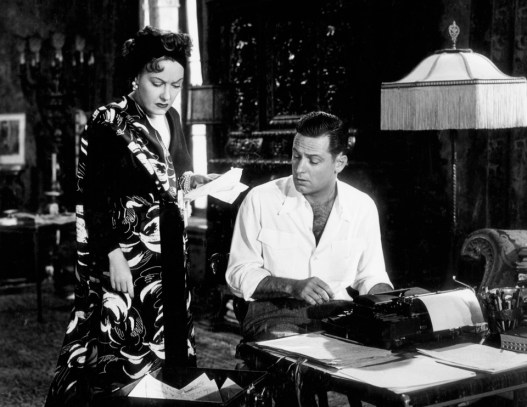
Only a slight connection here. I just like referencing this movie.

The busy times never stop around Maximum Z HQ. Among the latest tasks being undertaken:

-Rewrite/overhaul of the low-budget comedy

-Sporadic rewrite work on the pulp sci-fi spec, with initial sets of notes being carefully scrutinized

-Crafting together some pretty solid query letters, along with researching the best places to send them

-Jotting down notes for several future projects, including a comedic take on one of my favorite genres

-Providing scriptnotes to patient writer colleagues

You’d think with all of this going on, plus the non-writing normal life, I’d be exhausted.

Actually, I am, but it’s cool.

The way I see it, keeping busy like this helps me be a better writer; continuously working on something helps me be productive and further develop my skills.

Sure, sometimes the amount of actual writing is bare minimum, or maybe even not at all, but that’s okay too. All work and no play and all that.

Most importantly, I’m just getting a real kick out of doing it. If I wasn’t, I’d be a lot less likely to want to keep going.

And there are also days where it all gets so frustrating that I want to just walk away from it all. But I like doing it to much to even consider that.

Some recent interactions I’ve had with other writers have included more than a few of them expressing frustration about their diminishing hopes of making headway with breaking in and getting a writing career going.

I feel for them. I really do. As just about any writer will attest, this is not an easy undertaking. “It’s a marathon, not a sprint,” right?

Even though all of our chances are somewhat slim, I suggested they keep at it, if only for the sheer joy of writing. Isn’t that what got us all started?

When I asked one writer how their latest project was going, the response was “Really enjoying working on this, even though I know nobody else will ever see it.”

I totally get that. We all have our reasons for deciding whether or not to put our work out there, but the important thing was that they were having a good time with it. And you can tell if they were by what’s there on the page. It it was a chore for you to write, it’ll be that much more of a chore for us to read. Is that really the route you want to take?

So no matter what it is you’re working on right now, I sincerely hope that it’s bringing you as much joy and pleasure as you’re hoping to provide to your reader/audience.

Not exactly “Kryptonian under a yellow sun…”

alex ross superman
…but yeah, kind of like that

As has been much documented ’round these parts, trying to make it as a screenwriter is a long, tedious slog. For anybody. And that includes me.

It is a slog into which I have voluntarily cast myself.

There has been, and probably will continue to be a lot of disappointment and frustration along the way.

It’s the nature of the beast. Nothing I can do about it.

Well, actually there is.

More on that in a minute. But first, an anecdote!

I was digging through my binder of notes and documents, some of which span back a few years.

Among them, the printout of an email from an “industry insider” totally trashing me and my idea after I’d revealed the idea for what would eventually become one of my low-budget comedy specs. There was not one encouraging sentence in this entire communique. “Give up.” “You’re wasting your time.” “You don’t have a chance.”

And that was some of the nicer stuff.

The person who sent it likes to talk the talk, but in my opinion, falls a bit short on walking the walk. I printed out the email as a reminder that if an asshole like this can establish a career (if you can call it that), then there’s no reason I can’t either.

Funny thing about me is that I’m quite the stubborn cuss. I may get annoyed, upset, distraught or even full-blown depressed about how lousy my situation may be at that particular moment, but sometimes you gotta hit bottom before you regroup, reorganize, and resume the climb, more determined than before to get a little higher.

Which sums me up right now.

I’m not there yet, but it feels imminent. While it would be great if something happened in the immediate future, I’ll remain realistic and at least work towards “something soon”.

I’d say I’m in a pretty interesting place right now. I’ve got some quality scripts to show, several in various stages of development (and much further along than expected), and a growing network of connections, many of whom are more than willing to do what they can. When more than one professional says to me “I can’t understand why you don’t have a manager/more interest in this script!”, then I guess I’m doing something right.

Even though there’s been a steady and gradual progress in “making things happen”, this is still all on me. This long, tedious slog will eventually come to a most satisfying conclusion – for the best possible reason.

So until that forthcoming day when fortune finally smiles down on me, I’ve no plans to give up and will continue to push forward. It’s getting close. Mighty close.

Up, up, and away, chums.

A big stove with lots of burners

jayne
Always something cookin’ in this kitchen

Thanks to a big, determined push, I managed to wrap up the initial edit of the pulp spec last night. Amazingly, it’s still 116 pages. Much as I’d love to take another pass on it, a better option is to gently nudge it aside and let it simmer for a few months.

In the meantime, my attention now turns to a few other items, including providing some script notes and a major overhaul of one of the low-budget comedies.

To some, it might seem I’m taking on too much. Others might think it’s great to be so busy. No matter which opinion you have, it all comes down to how the individual (i.e. yours truly) sees it.

Me, I enjoy the diversity and variety. I like to work on my own material AND read other people’s stuff. All that mental stimulation helps me in the long run; the equivalent of maintaining a regular workout schedule at the gym. Or in my case, a steady regiment of training runs.

Always working on something, or even adding some reading and watching into the mix, not only helps your creativeness, but your actual output. Wouldn’t you say your writing skills are significantly better today than they were, say, a year ago? How about compared to when you just started out? I know mine are. Especially in terms of the latter.

All that being said, I think there’s a big difference between being a productive writer and just being a non-stop writing machine. A productive writer definitely produces material, but they also take the time to have a life outside of writing. The machine is just full speed ahead and don’t let up. Granted, there are some who can do both, and kudos to them. I prefer to be the former.

I also don’t have any problem with transitioning to a new project once one is completed. Even though I haven’t directed all attention on the new one, it’s always been in the back of my mind. Maybe an idea about it would pop, which would then be added to an always-handy list, then brought back out later. You might have a different approach, but this is what works for me. Everybody writes in their own way.

In the meantime, my nimble little fingers will now get a bit of a rest while I dive into the aforementioned giving of notes. And once all of those are done, the dust gets blown off the keyboard and the cycle repeats.