Good or fast? Pick one.

hurdles
Careful! All too easy to end up flat on your face.

As some of you may recall, earlier this year I had to get a script done in order to send it to somebody who’d requested to read it. Seeing as how I had all of eight pages written, I wanted to finish it and sent it out as soon as possible.

It took a grueling 10-day writing marathon, but somehow I managed to do it. I got a draft written, polished it up and sent it out.

It was quite an experience, and the end result could best be described as…adequate. I’ll be the first to admit the script still needs a ton of work.

My sole objective was simply to get it done to the best of my ability in as short a time as possible. Would I have benefited from more time? Of course, but at the time, it wasn’t an option.

Fast forward to the beginning of November. My goal: have a completed draft of the latest project by the end of the month. Sadly, I wasn’t able to get as much writing done as I’d hoped, so I’m heading into December with a script that’s right at the halfway point and the intention to have the whole thing done by the end of the year.

Sure, I could push myself through that exhausting process of cranking it out just to get it done, but by working with a slightly longer timeframe, I can take it slow and spend more time fine-tuning the script. In theory, this increases the likelihood the end result will be more acceptable and not require as much extensive follow-up (i.e. rewrites).

Would I love to be done with this draft sooner rather than later? Again, of course. But I’m also willing to be patient and focus on a few pages at a time. If that means it takes me until the end of the month/year to have a quality script ready to go, so be it.

Everybody writes at their own pace. Some are extremely prolific, some aren’t. It doesn’t matter how many pages you write. The important thing is that you’re actually writing.

This whole process can seem excruciatingly long at times, and we all want to produce lots and lots of quality work. But it already takes time to learn how to do it properly, let alone effectively. Patience is one of those things that gets easier the more you work on it.

There’s nothing wrong with churning out a draft in record time, but be aware that focusing on quantity rather than quality will definitely be reflected in those pages. I went through this firsthand, and definitely see it as a positive learning experience. I know I can write something quickly, but also know it’ll require a lot of cleanup work.

But given my druthers, I prefer to take my time. It’s less exhausting.
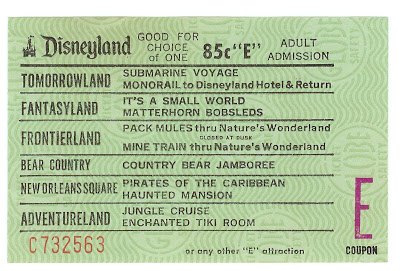
Finding my forte. Mining my milieu. Spelunking my specialty.

e-ticket
A reference only a select few will get. (85 cents?? Truly a bygone age)

While engaged in a very engaging conversation about screenwriting earlier this week, the person with whom I was conversing with asked the simplest and most straight-forward of questions:

“What do you like to write?”

Without a moment’s hesitation, I proudly stated, “Adventures.”

You can’t even say the word without implying the thrills and excitement it entails. Hands on hips, chest out, shoulders back, and a firmly-set jaw are automatically included.

I’ve enjoyed dabbling in other genres (such as drama and comedy), but nothing really grabs me like thinking up and writing out some sort of heart-pounding, edge-of-your-seat rollercoaster ride of a scene or sequence.

Those really never get old.

They say “Write what you know,” and although I’ve never actually fought monsters, manned a runaway train, or flown a space-faring vessel, years of reading and watching material of that type and nature has taught me an effective way of how to effectively inject adrenaline into what I’m writing.

More than a few readers have commented that my love and appreciation of the material and genre are boldly evident on the page, which is what I’m hoping  to accomplish every time.

My mantra has always been “Write something I would want to see”, and my list of future projects is jam-packed with numerous ideas and concepts that neatly fall into that category; each one a variation on the topic of discussion.

If these are the kinds of stories I was meant to write, you’ll get no complaints from me. I get a real kick out of cranking this stuff out. There’s no reason to think this can’t develop into what I build a career on and eventually become known for (he said, his fingers firmly crossed). My scripts. Rewriting someone else’s. Contributing to another. It’s all cool as far as I’m concerned.

Until then, all I can do is keep writing and making my readers feel their pulses quicken as they eagerly turn the page, absolutely spellbound to find out how the hero gets themselves out of this particular pickle, and, more importantly, what happens next.

Strap yourselves in, chums. This is going to be one helluva ride.

Quit them or queue them up?

q
As long as we’re emphasizing Qs today…(Yes, it’s a terrible joke. But that’s how we operate around here.)

Today is all about query letters.

I read about other writers who’ve gotten reads, representation, options and even production. There must have been something quite special about those letters (and scripts) to get those machines in motion.

There are also a select number of writers who’ve never had to use a query letter. Bully for them, I say. But I’ve never fallen into that category, so I’m firmly planted in the “those who send” group, which is still fine.

Taking a look at the somewhat limited results of my past efforts and reading about others’ experience makes me wonder in a “big picture” way about the nature and concept of the query letters themselves.

Are they worth the effort?

Naturally, if something happens as a result, of course they are. But even that appears to be a needle-in-a-haystack kind of scenario.

(Incidentally, any tales of query success are more than welcome in the comments section.)

There are so many factors to take into account, including but not limited to:

-who you’re sending to
-what kind of material they want
-they’re intrigued enough to want to read the script
-your script is a good match (or at least close enough) to what they want
-they think your writing’s strong enough
-they think they can make something happen with your script

Several years ago, an agent who’d struck out on their own (along with a sole assistant) told me that their office received approximately 75-100 queries a week. From around the world. Some were good, most were awful. A significant part of each morning was spent sorting through them. As you’d imagine, finding one, possibly two, that clicked seemed to be the norm.

Remember, this was a two-person operation. If they were getting that many, imagine how many the mega-agencies were getting, and still are. Possibly in the thousands.

The chances of success are minuscule, and grow smaller with each progressive step. Those not exactly in the know are more likely to think they’re the exception, but those of us who’ve been down this road before know better.

This isn’t to say that queries never work, but the odds definitely appear to be not in our favor. Luck and timing seem to also play significant parts. Maybe the person you’ve sent to just happens to be looking for a script exactly like yours. I’ve heard it does happen; just not very often.

But the dedicated, persistent and determined among us, including yours truly, will keep at it.

Even though my success rate hasn’t been the best, I’ll continue to do the research, find potential recipients, craft what I believe is a solid query, and send it out.

All that’s left is to wait, hope for the best, and keep busy working on other scripts, each of which will probably also have its own respective query letter get sent out sometime in the near future.

What’s stopping you?

handyman
The ultimate DIY project (film division)

I had the recent pleasure of connecting with a screenwriter who’s working on a feature script, but is also investigating the logistics of developing a short out of it, which includes them having begun connecting with other writers and filmmakers in their area.

I thought that was a great idea, and tossed out the suggestion that maybe they try to make it themselves, as in “just you”. Especially now that most smartphones can double as camera equipment, and film editing software is easily accessible (if not already installed on your computer).

They’d considered this, adding “But I’m just not tech-savvy”.

But you can learn.

If you’re reading this, you’re more than likely interested in screenwriting and/or filmmaking. When you first started out, it’s probably a dead-on certainty that your early works were awful, right?  Looking at some of my first scripts makes me cringe from how bad they are.

But we kept at it, learning and improving along the way. How does your most recent effort compare to that first one? Worlds apart, I’d imagine. You try something, you make mistakes, you learn from those mistakes, and try again.

There’s no reason you couldn’t apply the same logic to making your own short. Sure, there’s a lot more to it than simply pointing your phone and hitting ‘record’, but you gotta start somewhere.

Give it a go and write yourself a short script. Nothing fancy (but do try to make it a good sample of the genre). Anywhere from one to five minutes, spread out over one, possibly two scenes. Two characters, three at best. Try to keep it limited to one location.

Now look at it from the filmmaker’s perspective. Could you feasibly make this yourself? Like how a first draft of a script reads, the end result will not be pretty. At first, you’ll be thrilled at having done it. Then reality sets in and the flaws become that much more obvious.

But you will have done it. A short film, written and produced by YOU.

What you do with it now is up to you. Hopefully, you’ll embrace the learning experience and know what not to do the next time around.

My friend mentioned that once the short got made, which it sounds like they are very intent on making happen one way or another, plans are already being discussed about next steps, which included posting it on YouTube and/or submitting it to some film festivals.

Even though our conversation was solely via email, there was a certain tone to their words that indicated they were quite psyched about jumping into this new venture. I wished them the best of luck and asked to be kept updated as to their progress.

I think they’re off to a pretty good start.

If only you could eat a bad script

pineapple upside down cake
Let the metaphors commence!

Before we get to the gist of today’s post, let’s address the elephant in the room: my western did not advance to the quarterfinals of the PAGE contest.

Honestly, I was a little surprised; I thought it would have done better. After a brief wallow in disappointment, I shrugged my shoulders and moved on. It’s just another one of those things over which I have no control. I still have a ton of confidence in this script and might submit again next year. Also waiting to see how it fares in Austin and the Nicholl.

True, it was a rather lousy way to start the weekend, but over the next couple of days, I managed to redirect my focus, which included a nice long run that involved traversing the Golden Gate Bridge, and attempting something I’ve always wanted to try:

Making a pineapple upside-down cake (from scratch, naturally).

Guests were coming over for dinner, and I’d made pies for them before. But this time,  I wanted to try something entirely new and preferably a little challenging. I’d say this falls into both categories.

I scoured the internet for an ideal recipe, found one to my satisfaction, and followed the directions to the letter. The result? It looked like it was supposed to, and that’s where the similarities end. A little too sweet and the center was still kind of goopy. Nevertheless, my guests still liked it, and K & I split the last piece after they left. Not bad for a first attempt.

Why did it not turn out the way I expected? A lot of reasons. The oven’s a piece of junk. It didn’t bake long enough. The ingredients and the amount of them probably need to be tweaked. No matter what, I know now that I can adjust all of these next time and get closer to the results I seek.

Except for the oven. It will forever remain a piece of junk until it dies. Which can’t happen soon enough. But I digress.

Notice all of the comparisons you could make between baking and writing a script? Trying something new and long-sought-after. Seeking advice and guidance. Following the guidelines. Doing what I was supposed to. An okay-but-was-hoping-for-better initial result. Planning ahead on what to fix/adjust for next time.

If a less-than-determined baker ended up with the cake I made, they’d probably denounce the whole process, give up entirely and probably buy pre-made stuff at the supermarket. But we’re made of sterner stuff. We hit a snag or some kind of unforeseen development, and we compensate as best we can. We learn what not to do next time. Sometimes you end up with something jaw-droppingly amazing, and sometimes you end up with something totally inedible.

With this whole experience behind me, I can now focus on projects of the immediate future, which includes another round of editing and revising a script, and making a pie or two for a dinner party this coming weekend.

It’s my intention to have the results of both of these undertakings be totally and utterly irresistible when they’re done and ready to serve.