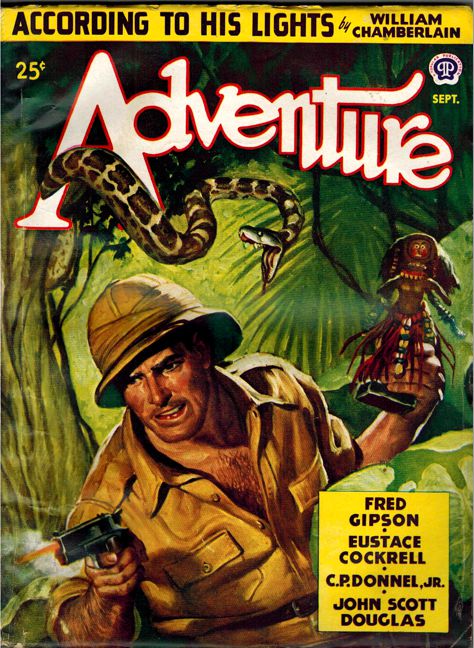
A whole lot of something out of an almost-nothing

An apt metaphor if ever there was one

A bit of a snag had developed in the rewriting of outline for the pulpy adventure spec. A certain aspect of the story had proven to be too simple, as in “not complicated enough” or “lame half-assed, last-second placeholder”.

It was also falling short in terms of overall pulpy-ness.

Seeing as how this is supposed to be a rousing tale sprinkled with elements of mystery and intrigue, it just wasn’t happening.

I won’t totally jettison a story, but rather see what changes, small or drastic, can be implemented in order to get things back on track.

I don’t know how it is for other writers, but sometimes I’ll go over a previous draft, hit a word or phrase that originally didn’t hold much significance, and all of a sudden it triggers a whole new realm of possibilities. Call it the “How did I not see that before?” syndrome.

In this case, it was a character’s name. This set off the auto-immediate response of “Hmm. What if…?”

Cue the heavenly chorus.

Suffice to say, now it’s back for yet another take on the draft, but this time going into it armed with a whole new batch of ideas.

-Time for a couple of book plugs!

Friend of the blog Justin Sloan has a new book coming out this weekend – Military Veterans in Creative Careers: Interviews with our Nation’s Heroes. Some great stuff in there, including quality interviews with men and women who’ve served in the armed forces and are now working in creative fields.

If you’re looking for a little guidance on your journey to becoming a working writer, then take a look at Notes to Screenwriters by Vicki Peterson and Barbara Nicolosi, who also run the Catharsis script consulting service.

Ask a Decidedly Ingenious Script Consultant!

Ryan Dixon

The final installment in a series of interviews with script readers and consultants who would be worth your while to work with if you want to get your script in shape. Today’s spotlight is on Ryan Dixon.

Ryan Dixon is a writer, producer and the founder of Tartan Valley Ventures,  a Los Angeles-based creative development consulting firm that works with writers, producers and financiers. As a screenwriter, Dixon has written projects for studios including Disney, Amazon, Universal and WWE Films. Dixon has also worked in film/TV creative development at such companies as Paramount, MGM/UA, IMAX,  Good in a Room, The New York Times and Tribune Media.

1. What’s the last thing you read/watched that you thought was incredibly well-written?

EX MACHINA’s screenplay was masterful. It reminded me of a sci-fi version of those great meta-thriller plays of the 1970s, like DEATHTRAP and SLEUTH. P.T. Anderson did an extraordinary job with INHERENT VICE. His adaptation added a layer of depth and Los Angeles historicity that was missing in Pynchon’s fun, but flawed and rather juvenile novel.

2. How’d you get your start reading scripts?

As a movie-obsessed child, I used to buy shooting scripts at the late and belated Suncoast: The Movie Store. In college at Carnegie Mellon’s School of Drama, reading scripts was part of the curriculum. My first job in Hollywood was interning for Tom Cruise’s former company CW Productions, so from that point on, I’ve been reading and covering scripts professionally in one form or another.

3. Is recognizing good writing something you think can be taught or learned?

I think it’s a matter of taste. Of course, one must have a certain degree of training and skill in order to fully recognize and appreciate any craft. A classically trained musician or a fine arts scholar is better able to pinpoint the minutiae of Beethoven or Picasso. At the same time, taste is a separate sort of knowledge and instinct. A layman can find beauty if they’re a person who can digest and appreciates art for art’s sake. Nickelback’s members are studied musicians, Lisa Frank is a trained artist, and both are wildly successful in their fields. Study can hone and illuminate the elements of a craft but that can only take you so far.

4. What are the components of a good script?

The basic elements (structure, character, theme) must be superiorly executed. Next, there should be something special in the piece. Even if it’s basic genre fare, the script should include elements that make the reader sit up and say, “Wow! I haven’t seen that before.”

5. What are some of the most common mistakes you see?

From young writers it’s always basic mistakes: mechanics, too much dialogue and/or scene direction. Sadly, these mistakes are also the easiest to avoid. What they reveal is that that writer hasn’t bothered to learn the fundamentals. This is fascinating because I can’t think of any other vocation where a similar incident would occur. If one were serious about learning to cook, a cookbook would be the first purchase. If you wanted to scuba dive, you’d take lessons before jumping head first into the ocean. While all the fundamentals are usually outstanding in the work of veteran writers, there is often a lack of courage and conviction in terms of content, as if they’re afraid to try something different for fear of being tossed out of another development meeting. If you are going to make the huge time commitment needed to write a spec script, swing for the fences. The creative dilution process can come later, once the script’s been optioned.

6. What story tropes are you just tired of seeing?

One is when characters (particularly female characters) are described solely on their looks. It tells you nothing about who a character is and often times a bit too much about the writer’s psyche.

Another is the oversaturation of beautiful people playing everyday characters. Even if you look at a movie from as recently as the 90’s, a man could be a regular guy with full chest and back hair and a woman could do a nude scene with a soft, everyday body. In contemporary films, everyone is sculpted, plucked and dyed to perfection. In this renewed Golden Age of Television, character actors are able to once again shine and it really strengthens the storylines and characters (Breaking Bad and Mad Men are obvious examples).

My wife is a screenwriter as well (and very opinionated to boot), so for better or worse, this is a constant discussion and analysis in our household. A big one for her is that men can have high-risk jobs and a strong drive, but if it’s a woman is in the same position, she needs a tragedy or a backstory. GRAVITY most recently did this—George Clooney is an astronaut because of his skill but Sandra Bullock is an astronaut because her kid died.

7. What are the 3 most important rules every writer should know?

-The believability of characters is often more dependent upon the execution of other elements in the script (e.g., plot, theme, dialogue) than anything else. A trap writers (myself included) often fall into is to confuse “believable” with “realistic.” Thus the ever-present tendency to write characters who are mill workers, teachers, office drones, etc. While there’s nothing wrong with this if that’s what your script dictates, it’s also important to remember that some of the most believable characters in cinematic history were also some of the most unrealistic: E.T., Yoda, Kermit the Frog, Mickey Mouse, Bugs Bunny, etc. They’re believable not because you could see them walking down the street, but because the creators of those characters did an amazing job of creating the world in which they existed.

-Master the art of writing a “skimmable” script. We all dream of studio execs, producers, agents, etc sitting down in a quiet space and focusing fully on our script, but the truth is that they are often read in a rush during limited time frames. This is why it’s important to craft your script in a way that a decision maker can easily understand it if they are forced to skim it. You want your script to FEEL like a movie. That means, a reader should be able to zip through it in about 90 minutes. If a first time reader can’t do that, they won’t be able to envision you script as a movie no matter its other strengths.

-This is stolen but golden: “Amateurs sit and wait for inspiration, the rest of us just get up and go to work.” (Stephen King, a favorite author, from ON WRITING). Lightning doesn’t just strike and no one will just hand you anything in Hollywood. Nothing comes easy in writing and you have to work yourself to the bone to get success. I track my time using my iPhone timer and a writer’s log. I make sure to always get in 6 to 8 hours of writing a day. If I’m blocked, I take a brainstorming walk. I’m not perfect. I can procrastinate with the best of them and it took a few years to build to that point. But like any exercise, it works if you keep working at it and pushing yourself.

8. Have you ever read a script that was an absolute, without-a-doubt “recommend”? If so, could you give the logline?

Elizabethtown by Cameron Crowe. I read the script while it was in development and was never so moved or in awe of a piece of screenwriting. In the end however, the final lesson I gained from the experience was that great scripts don’t always make great movies. For whatever reason, the alchemy needed to successfully transform material from page to screen failed. This specific incident was doubly disappointing since the writer directed the piece himself and has shown time and again that he’s an immensely talented director.

9. How do you feel about screenwriting contests? Worth it or not?

There are only a handful of contests that will have an impact on your career if you are a top finisher. I’m hesitant to state that all the others aren’t worth it if only because placing high can be a great confidence boost to any young writer (if they have the money to spend). But if you are cash-strapped, go for the big guns and ignore the others.

10. How can people get in touch with you to find out more about the services you provide?

Go to my website for Tartan Valley Creative Ventures.

11. Readers of this blog are more than familiar with my love/appreciation of pie. What’s your favorite kind?

Boston Cream. As a writer and eater, I like synergy and mixing genres. There’s no pie that does this better.

Working well within my wheelhouse

Hang on. This is going to be quite a ride.

Hard as this may be to believe, but I’m actually surprised at my progress with the outline for the pulpy adventure spec.

It’s coming along much faster than I expected, and the more I work on it, the more I see things that can be tweaked/adjusted/modified so as to improve on the overall story. I’m definitely not saying it’s easy; just easier than it used to be.

Having previous drafts to work with has been a significant plus, and once I fully embraced the notion of “anything can change”, it just took off from there.

But the biggest boon to this whole thing has simply been the pure enjoyment of working on it.

I don’t make any attempt to hide my love and appreciation of the pulp style of writing, so when I work on these kinds of stories, I make a sincere effort to really put it on the page.

The swashbuckling-ness of the fantasy. The rootin’-tootin’-ness of the western. And now the spectacle and wonder of science fiction.

I really do live for this stuff. One of my mantras since the beginning has been “Write something I would want to see,” and all of these definitely fall into that category.

Some may argue that writing material like this is counter-productive to getting a career going. “Nobody’s going to take a chance on something like this from an unknown writer!”, that sort of thing. If all I end up getting out of this is a solid writing sample, that’s fine by me.

Is it wrong to think somebody could read it and say “There’s no way I could get this made, but I really like the writing. Would you be open to working on ____?”? Hopefully not.

I’m taking my time with this, and in no rush to finish. All the work I’ve done on previous scripts is paying off in terms of knowing what to do, figuring stuff out and making the story (and the eventual script) better.

I’ve said it many times before: I am having an absolute blast writing this story, and hopefully those who read the end result will too.

Ask a Significantly Astute Script Consultant!

Laurie Ashbourne

The latest in a series of interviews with script readers and consultants who would be worth your while to work with if you want to get your script in shape. Today’s spotlight is on writer-producer-consultant Laurie Ashbourne.

After seeing Who Framed Roger Rabbit in an old theater in Philly, Laurie knew that she had to be a part of that process.  Within 6 months she was in Disney Feature Animation‘s new studio in Florida working on a Roger Rabbit short and The Little Mermaid, and stayed on through the production of Lilo and Stitch. Leaving that cocoon to create and own her work, she quickly segued to live action and documentaries as a writer, producer and script supervisor.

With four features she wrote as work-for-hires in production, a dozen ghost- writing films and pilots in development, an independent animated feature in pre- production, an original story she wrote (10-31) was recently announced on the fast-track to production with acclaimed producers Eli Roth and Roger Birnbaum and a bio-pic she wrote is in early stages with Bohemia Group Originals.

Laurie is also longstanding story analyst for the likes of Amazon Studios Feature Films and Austin Film Festival.
In addition, she oversees several projects in development via her company, LA Story Studio. Her documentary work continues as well, as a producer for iconic director Robert Greenwald’s Brave New Films banner where she just co-
produced, SUPPRESSED – the fight to vote (2020), and RACIALLY CHARGED (2021), featuring two-time Oscar winner, Mahershala Ali.

1. What’s the last thing you read/watched that you thought was incredibly well-written?

I recently read a screenplay for a competition that was amazing. It was so well-paced and had such a perfect economy of words, twists and great characters – I wish I could share it with you, but I have no doubt that sooner than later everyone will have a chance to see it on screen.

For watching, the film LITTLE BOY. About 4 years ago the casting director asked my son to read for the part, so I was sent the script. It was such an emotional story that read really well, even though it broke some traditional pet peeves of mine, I completely overlooked them because I was so engrossed in the story. My son ended up sending in a video read because I was on a job in Virginia AND he had just lost his 2 front teeth so we knew the read wouldn’t go over at its best. Regardless, we went to see it (and I have to say the boy they had for the lead did a great job). I immediately could see where they had to change some things but it mostly stayed true to the script. I enjoyed the film and it was completely emotional, but I could definitely see how it read better than it played.

2. How’d you get your start reading scripts?

My first job in the industry was with Walt Disney Feature Animation, and as a department head I was in on a project from development through to final reels. But I didn’t start reading them professionally until I left the company to work in independent film, over ten years ago.

3. Is recognizing good writing something you think can be taught or learned?

The tenements of the craft can be taught easily but if a sense of story isn’t there then those ‘guidelines’ become hard and fast rules that can overlook a good story and what it needs to be brought up to industry standards. Learning story is possible, but it’s not for everyone, those that it is for can’t let it go. I’ll use my son as an example again. He will watch a movie until he knows it by heart and then pick apart the structure and characters, all by his own will. He said to me the other day, “When a movie does well, they automatically make a number two, and they do it quickly, and when that doesn’t do well they spend more time working out number three. Number twos always stink.” He’s 10, so I think it’s safe to say that a sense of story is ingrained in his psyche with no teaching other than immersing himself in something he enjoys.

4. What are the components of a good script?

Characters with an emotional want that comes across as genuine – in this case it’s the difference between a homeless person holding up a sign that says “will work for food” and one that holds up a sign that says “hungry, broke please give”. The audience is much more likely to attach themselves to a character who is willing to do what it takes to survive – the character that is willing to work for his food.

Craft contains a lot of things that get a bad name as hard and fast rules, and it’s true that if you are trying to break in you have to look like you are willing to adhere to industry standards, truth is your craft demonstrates mastery of cinematic story SOME formatting issues can be overlooked. So at the top of the mastery of cinematic language is, giving the actors something interesting to do that advances the plot and peels back the layers of their character. This does not mean writing verbose prose; that is not cinematic. Cinematic is thinking like a director in your mind, but conveying that action in words that do not include camera direction.

5. What are some of the most common mistakes you see?

-Misuse and abuse of parentheticals and exclamation points

-Typos and poor formatting

-A misunderstanding of scene headings in content and purpose

-A great idea poorly executed, usually in character and pacing

-A poor balance of dialogue and action (which is usually because of way too much dialogue)

6. What story tropes are you just tired of seeing?

It seems to be cyclical; every year there is more of one than another, so I guess that falls into chasing trends. Right now, there seems to be a lot of smaller character pieces, which is good for independent film, but with specs that are trying to break in (rather than going out and producing the indie on your own), it’s really difficult to get behind a moody character wandering the town or country instead of facing an uncomfortable truth. So it goes back to the homeless analogy – why do I care about this person, and please make it interesting without a having a diary in voiceover.

I admit it’s a bit of a catch-22, it’s also very difficult for an unknown to break in with a tentpole, but there is a happy medium where there are just enough elements to give the audience and producers something worth the investment of time and money.

7. What are the 3 most important rules every writer should know?

-Your material will not resonate with everyone, but if it’s not resonating with anyone, it’s time to analyze those notes you thought were shit.

-Write because you have to get a story out of your system, not because you want to strike it rich or win a contest.

-Let the audience (or reader) get to know your character through the action we see them take on screen, not via a laundry list of their traits.

8. Have you ever read a script that was an absolute, without-a-doubt “recommend”? If so, could you give the logline?

Sure. I’ve had the pleasurable honor to move a lot of scripts forward and nothing makes me happier than to see writers I worked with or read be working in the industry. Frankly, most scripts that come to me don’t have a logline, and I craft one for the coverage – most contest scripts don’t come with loglines. Loglines when done well are a craft unto themselves and contests are won on these concepts, but a great logline does not make a great script. This goes back to one of my top three: Most great ideas fall short on execution and again, I really think that comes down to sense of story. I personally write a logline before (during and after) I write a script. Writing it out at the start helps shape your outline. But just as the outline will change as you write, the logline should too, by becoming tighter.

I recently read a logline on LA Screenwriter called The Muffin Men – it was really brilliant. But who knows if the script is?

9. How do you feel about screenwriting contests? Worth it or not?

Yes, but do your homework. There are more scams than legitimate career changers. It’s worth it to get your script in top-level shape and submit to the top-tier contests (which there are less than 10) the odds are tougher due to the number of submissions but if you seriously want to advance your career, there’s no use in wasting money on the Podunk USA’s screenplay competition.

10. How can people get in touch with you to find out more about the services you provide?

My company at LA Story Studio, my blog 1st 10 pages, or via Stage 32 – https://www.stage32.com/LAstory.

11. Readers of this blog are more than familiar with my love/appreciation of pie. What’s your favorite kind?

I’m not much for desserts, but I like apple if it’s fresh and not overly gooey, or key lime. When I was a kid I was all about Tastykake cherry pie.

The name’s Piphany. E. Piphany

If it weren't for that whole possible electrocution thing, I'd write in the tub too.
If it weren’t for that whole possible electrocution thing, I’d write in the tub too.

Progress on the first draft of the low-budget comedy spec has been slow but steady; averaging about 2-3 pages a day. It’s a smart move to accept the fact that the first draft of anything you write is going to suck, because it always does. And this one’s no different. Several cogs within this machine in drastic need of retooling have been identified.

So there I am, working on a scene, having the ongoing internal discussion of “Is this the funniest way to do this bit?” The scene as originally conceived is pretty straightforward, but the comedy part still needs something. A line of dialogue just won’t cut it. While I’m quite adept at witty conversation in person, putting it on the page is an entirely different animal.

Overall, it felt like things were slowing down and becoming tougher to work through.

No matter how hard you look, sometimes you can’t find the answer you seek because you don’t realize it’s just staring you in the face.

There was a scene much earlier in the script where, for no reason in particular, I used a joke of a particular nature just for the hell of it. Some might consider it a dumb joke, but I’m still in first draft mode, so it might not stick around for very long.

But there was something about it that really stuck with me. I thought it was pretty funny, and the more I thought about it, the more it seemed like exactly something I would come up with.

And there it was. The floodgates had opened, and my much-needed solution came gushing forth. These jokes would work perfectly throughout the whole thing.

Added bonus – it’s the kind of comedy I’ve known and loved my entire life. I’d been trying to write this in a way or style that’s not exactly me, whereas this rediscovered approach is practically spot-on. Coming up with these kinds of jokes is almost second nature. Hopefully I can successfully transition them onto the page.

But now I was presented with a new problem: stop here (around pg 48) and start over, or hammer my way forward?

Tempting as it was to start over, I’m opting to keep going forward (and start implementing the new jokes), mostly so I can just get this draft finished. The sooner I get to the end, the sooner I can start on the rewrite.

As I said, progress continues to be slow and steady, but it’s still progress.

-One week to the Great American Pitch Fest, so you still have time to register. Use code MaximumZ20 at checkout for a whopping 20 percent off!