Time very well spent

finish line
Yeah. It felt just like that.

And…I’m back. Didja miss me?

To say the past week and a half has been a little hectic would be a slight understatement*. And of course, it involves writing and the opportunities that come with it.

Long story short – Somebody wanted to read one of my scripts. But I hadn’t finished writing it yet. So I wrote, edited and polished it. In ten days. Without taking time off from work.

As you can probably guess, I’m equal parts exhausted and exhilarated at having done it.

While I catch my second wind, here’s the extended version:

A little over three weeks ago, I connected with somebody who works for a production company. They mostly do TV, but are looking at expanding into features.

Emails and pleasantries were exchanged. They took a look at the blog, liked what they saw, and asked for a list of my loglines “to see if my boss might be interested.” So I sent it. This was on a Friday afternoon.

A vital piece of the puzzle to keep in mind – just before all of this occurred, I’d gotten the outline of a long-dormant comedy spec to the point where I felt ready to start on pages. Which is what I was doing while all of this interaction was occurring.

The following Monday morning, the response came in. “Do you have scripts for X and Y? Would love to request if so.”

Naturally, X was the long-dormant comedy spec that so far I had written all of 8 pages, and Y was still in outline form (which I’d already been considering producing in another medium).

My initial thought was panic. Neither script was available, but I didn’t want to blow the opportunity; I wanted to be able to send them SOMETHING. Sooner, rather than later. What to do, what to do?

After a little evaluation and weighing all my options, I wrote back that I was still working on the latest draft of X (which was true), and could have it for them the following week. I’d considered saying a few weeks or a month, but that seemed too long. Regarding Y, I said pretty much what I mentioned above – it was an outline, but they could take a look at it if they wanted to.

They were cool with both options, and were looking forward to reading them.

I’d just thrown the gauntlet in my own face. What had I gotten myself into? Was I totally insane for thinking I could pull this off? Would I be able to pull it off?

Only one way to find out.

I had a script to write, and had to do it faster than I’d ever done it before. I had no intention of sending them a first draft, so I had to crank that out and do a major polish on it. In about a week and a half. Taking time off of work was not an option, so I’d have to be as productive as possible in the off-hours that didn’t involve sleeping.

I explained my plan to my understanding family and got to work.

I produced as many pages as I could per day, averaging 8-10. Those would then be edited & polished during all available downtime at work (it being summer vacation season was a godsend – traffic’s much lighter, so that really helped). I’d get home, incorporate the changes, then move on to the next set.

Write, edit/polish, rewrite, repeat. A seemingly never-ending cycle.

A few things I discovered during all of this:

-Having a solid outline made it so much easier. I knew exactly what had to happen in each scene, and how I wanted it to happen, so there was no time wasted trying to figure it out.

-I sincerely think my joke-writing’s gotten better.

-I’ve gotten much more proficient at coming up with solutions to last-minute script-related problems.

-I seriously wondered if this is what it would be like if I were doing this for a living. I’d actually be pretty cool with it.

After ten days of non-stop effort, I had what I considered a somewhat decent 97-page comedy script. Both it and the outline have been sent.

Of course, they may not like either one. But at this point, I don’t care. Simply having accomplished this is my victory. I set an intense short-term goal and did it.

The script could definitely benefit from at least another rewrite, but that’s not a priority at this juncture. I wrote it in the time I said I would, and that’s the important thing.

Others may scoff at my feeling of accomplishment, claiming it’s no big deal or that they’ve done it or even done it in less time. But their words will fall on deaf ears because it’s a big deal to me. This is something I did, and am extremely proud of having done it.

So what now? I’m taking the weekend off, which will include going for a much-missed and much-needed training run.

But come Monday, I’ll be right back at it, hard at work on whatever project I opt to do next.

Hopefully, I’ll be able to take my time with it.

*I really appreciate everybody’s patience, and hope you enjoyed the throwback posts. And K wanted to thank everybody for the kind comments about her guest post. Yes, I am a very lucky guy to have somebody like her.

Q & A with Rick Ramage of The Screenplay Show

Rick Ramage

Rick Ramage is a writer, director and producer with numerous credits on major motion pictures and television shows. During his 25-year career as a screenwriter, he has set up or sold over 40 scripts in Hollywood.

Rick’s latest project is The Screenplay Show, a new 10-part online series to educate about the art, craft and business of screenwriting and storytelling.

What is The Screenplay Show, and what inspired you to do it?

The Screenplay Show is an actual show about writing, presented in a fun, narrative style. It’s a ten-part webseries that will focus on the trade secrets I’ve developed (and learned) from Hollywood’s most talented writers, directors and producers during my 25-year career.

As to what inspired it, a few years ago, a buddy of mine started a writer/actor group called, “Write to Act” and he asked me to put on a seminar for his people in Denver. I was reluctant to say the least. For the last 25 years, my only job has been writing and producing film and television. Speaking in public? Not so much. He kept twisting my arm and after about a year of hounding me, I finally gave in and promised him I would do a one-day seminar. Then reality hit me: What could I possibly say for six hours that would interest other writers and actors? In an effort to alleviate the poor souls who would be stuck looking at my ugly mug all day, I pulled in my editor and we put together a long list of writing samples and clips covering every element of screenwriting so they could actually SEE what I was talking about – instead of listening to me pontificate as I clumsily tried to explain it.

For instance, using stills from The Shining, I put every moment of Jack’s character arc into a still photo sequence. You can actually visually track his descent into madness. I then put the page number from the script beside each expression. The audience literally gasped, because it was the first time they had actually seen a character arc moment by moment. I did the same thing for all the other elements of storytelling. As screenwriters, we have to write visually – so I figured it would work for seminars, too. But one thing really surprised me: the audience had as many questions about the writing experience as they did about the nuts and bolts. Personally, I’ve always been fascinated by the methods of actors, athletes, and other writers, so I guess it’s fair that they wanted to know about my method – and how a life and career in the film business actually works.

What sets The Screenplay Show apart from other online seminars?

One look at the teasers we’re putting out there will let people know this isn’t your father’s seminar. I can’t honestly say I had an epiphany and The Screenplay Show was suddenly born. But doing the seminars over the next year or two, it definitely evolved into a rolling narrative; my personal Hollywood experience merged into describing actual methods that have worked for me and many of my colleagues. So far, I’ve set up or sold over 40 scripts. But I have to give credit where credit is due: I didn’t learn how to survive the biz, or sell scripts from books. I learned from working closely with tremendously gracious agents, managers, producers, directors, executives and actors who were generous enough to share their knowledge with me for one purpose – to get the story right.

My goal with The Screenplay Show is to share what they’ve taught me with other writers and storytellers. And when I say storytellers, I mean anybody involved in the film and television business. Directors, actors, producers, cinematographers, and even executives. They are storytellers because they impact the script and help bring it to life.

Tell us a little about your writing background. How did you get started?

I didn’t finish my degree. Instead I went into business with my dad, selling tractors. But I wanted to be well-read and well-spoken, so I sat down with 100 of the great novels and voraciously read them back-to-back. In the process, I began to see how the authors worked the elements. The storytelling process fascinated me. So when I was out covering my sales territory, I began to daydream about becoming a writer. Eventually, I tried to write a novel. Long story short – it sucked. But the person who told me it wasn’t very good also told me I was a good writer. That seemed like a contradiction, but it wasn’t. He told me I had a very visual style, and suggested I write a screenplay. So I turned my bad novel into a bad screenplay! (But that process lit a fuse in me, and I’ve never looked back.)

What have you recently read or watched that you thought was incredibly well-written?

When I’m deep into writing one of my own scripts, I don’t usually watch or read much. By the end of the day, more words and plot lines are the last thing I need to relax. But two shows I try not to miss are Game of Thrones and House of Cards. From their production values, to the great characters, to the tight, well structured scripts, I admire them both a great deal. In fact that’s how I can tell when I’m in the hands of great storytellers – they make me forget I’m a writer. I become a fan.

Is recognizing good writing something you think can be taught or learned?

Definitely. Recognizing good writing can and certainly should be taught and learned. I’ve known some executives who were by no means writers, yet they learned to identify good writing and write smart notes. Their jobs depend on it. I’ve learned to recognize good writing by the way it makes me disappear into it.

What do you consider the components of a good script?

For me, the single most important component of a good script is simply this: It must have soul. I need to feel what the writer is trying to say through his or her characters. If that happens, I know the other elements are working.

What are the three most important rules a writer should know?

-Dialogue:  When to shut up and let the subtext play.

-Action:  When not to overwrite. (more often than not, you’ll lose your reader.)

-Characters:  We write in search of ourselves. (makes them real.)

How can people find out more about The Screenplay Show?

We’re really encouraging people to go to their most comfortable social media site and follow us. Also, we’re really hoping they go to www.thescreenplayshow.com and sign our landing page. We won’t bombard you with trivial junk, but we do want to build a steady audience so we can let people know about events and new material.

Readers of this blog are more than familiar with my love/appreciation of pie. What’s your favorite kind?

My grandmother made the best pie I’ve ever had. Golden, flaky crust made from scratch, crisp green apples sliced thin, and lots of cinnamon! I do miss that woman.

Returning to the sprucing-up stage

painting
It’s going to take just a little bit more than a new coat of paint

It all started with a “Scripts Wanted” listing.

A small prodco with an even smaller budget was looking for a particular kind of script. I felt that one of my earlier efforts was a perfect match, so I sent it in.

A few days later came the response “Just not what I’m looking for.” A bit disappointing, but that’s the way it is. No big deal. I’ve moved on.

It was at this point I realized it had been quite a while since I’d actually read the script. As far as I could remember, it was in good shape.

So I read it.

The result? It’s better than I remember, and a lot of the jokes still work. But what it really needs is just a good, solid edit/polish. There’s definitely some fat in need of trimming, and a lot of that is just extra and/or unnecessary words.

The draft I’d been using for years was 109 pages, which is a little excessive for a comedy. I’ve completed the initial edit, which brought it down to 105. A more thorough red pen edit is underway, and after going through the first third, another page has been cut out, bringing the current total to 104. The hope is to cut out at least another 2-3 pages.

There are at least two sequences (so far) that need rewriting to accommodate some of this editing, and the solution to one of them (a key part of the story) came to me a lot faster than I was expecting. That’s always nice. There’s no reason I couldn’t be done with a much more presentable draft in a week or less, which is also nice.

Since this script is from way back when, it was quite the experience to look at how I used to write with the advantage of having all the knowledge and skill I’ve acquired since then.

Go through your own catalog of completed scripts. Almost-completed and first drafts are allowed. When was the last time you looked at one of your earliest efforts? How does it compare to your most recent project?

I bet it’s super-easy for you to spot the differences between then and now. You might be surprised at how much you’ve improved, or possibly even laugh at how bad you used to be. Happens to everybody.

Whenever I would pass this script along to another writer, I would always precede it with the caveat “This is one of my earlier scripts, so the writing’s not as good.”

After this edit/polish, I don’t think I’ll be saying that anymore.

Take us along for the ride

roller coaster.jpg
Hang on tight.

Here’s a two-part question for you. Pencils at the ready, please.

Up first – Are you enjoying the actual process of writing your script?

Sure, we all like “having written”, but what about getting there?

Do you get a thrill from figuring out your story? Mapping out the plot? Developing characters and crafting dialogue?

Do you get so engrossed and involved in your writing that when you check the time, you discover a lot more time has passed than you thought?

If you’re really excited and enthusiastic about your script, you’re going to feel that way even before you start writing it.

Now for the second part of the question:

Is all the aforementioned excitement and enthusiasm evident on the pages of your script? Could someone read it and think “Wow, they really like this stuff.”?

While it’s often said that you can gauge a writer’s grasp of the craft just by looking at the first page, you can also tell if they’re really into their story by how it reads.

Does it grab you from the get-go? Is the tone of the writing a solid match for the tone of the genre? This is not a case when “good enough” will cut it. What would you think if you read a horror that was “sort of” scary, or a comedy where all the jokes fall flat?

Exactly.

You want the reader to be as thoroughly entertained as you were in putting it together. You want them to be as compelled to keep turning the page as you’d be if you were reading it yourself.

A lot of the time you’ll hear a writer wrote something because “they had a story they had to tell”. That story was so strong and powerful inside them, they had no alternative but to write it out.

As creative types, that level of excitement and enthusiasm exists in all of us. We’re all eager to tap into it, but need to take the time to learn how to do it properly so it can be done in the most effective way possible.

Pencils down.

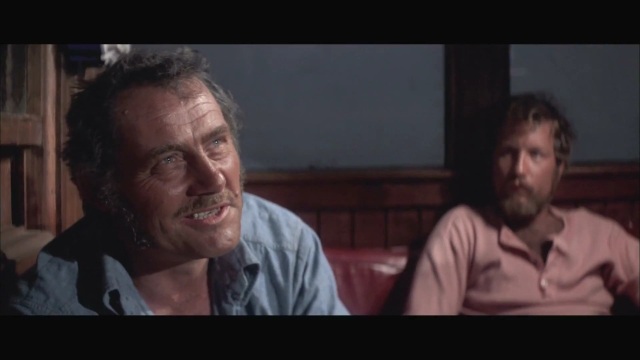
It was good enough for Spielberg…

quint
“Eleven hundred men went in the water. Three hundred and sixteen men come out. The sharks took the rest.”

There’s a pivotal scene in my western where my main character reveals why she does what she does and what made her the person she is. Nothing too complicated. Just a couple of lines of dialogue.

It took a few passes to whittle it down so it got to the point fast and in as few words as possible. I think it works quite nicely.

It’s been suggested how this was a great opportunity to apply the “show, don’t tell” rule and make it a flashback. The logic being that since it’s such an important moment, showing it, rather than just her talking about it, would have a greater impact.

I’m not so sure about that.

I don’t have a problem with flashbacks, but have always tried to avoid using them. I guess I see them almost as a cheat; possibly even lazy writing. Like you can’t weave that information into what’s happening now, so you stop the action to show it. But once you interrupt the momentum of your story, it’s not easy to get things back up to speed.

And sometimes a flashback just isn’t necessary.

Consider the scene from JAWS pictured above with Quint’s story about the Indianapolis. Should we actually see what he’s describing? Highly doubtful. Part of why that speech works so well is how it’s delivered. You can see and hear what that experience did to him. How you’re imagining it is much more terrifying than anything they could show. The speech would lose its impact if we were concentrating on the action, rather than what Quint is saying.

Sometimes just a line of dialogue or two can be just as effective, if not possibly more so, as pausing the action for a flashback. This isn’t to say you shouldn’t use it. If you think it’s the most effective way to make your point, then by all means do it.

Just make sure it’s a solid fit.