Take us along for the ride

roller coaster.jpg
Hang on tight.

Here’s a two-part question for you. Pencils at the ready, please.

Up first – Are you enjoying the actual process of writing your script?

Sure, we all like “having written”, but what about getting there?

Do you get a thrill from figuring out your story? Mapping out the plot? Developing characters and crafting dialogue?

Do you get so engrossed and involved in your writing that when you check the time, you discover a lot more time has passed than you thought?

If you’re really excited and enthusiastic about your script, you’re going to feel that way even before you start writing it.

Now for the second part of the question:

Is all the aforementioned excitement and enthusiasm evident on the pages of your script? Could someone read it and think “Wow, they really like this stuff.”?

While it’s often said that you can gauge a writer’s grasp of the craft just by looking at the first page, you can also tell if they’re really into their story by how it reads.

Does it grab you from the get-go? Is the tone of the writing a solid match for the tone of the genre? This is not a case when “good enough” will cut it. What would you think if you read a horror that was “sort of” scary, or a comedy where all the jokes fall flat?

Exactly.

You want the reader to be as thoroughly entertained as you were in putting it together. You want them to be as compelled to keep turning the page as you’d be if you were reading it yourself.

A lot of the time you’ll hear a writer wrote something because “they had a story they had to tell”. That story was so strong and powerful inside them, they had no alternative but to write it out.

As creative types, that level of excitement and enthusiasm exists in all of us. We’re all eager to tap into it, but need to take the time to learn how to do it properly so it can be done in the most effective way possible.

Pencils down.
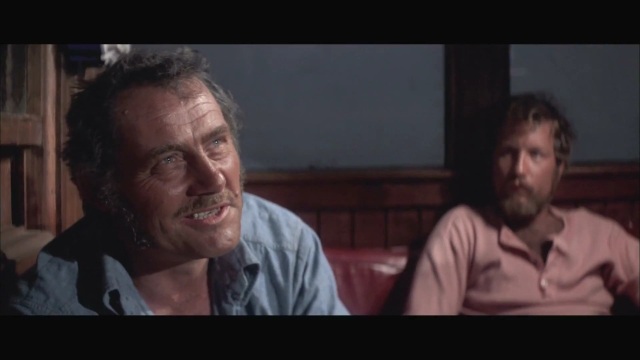
It was good enough for Spielberg…

quint
“Eleven hundred men went in the water. Three hundred and sixteen men come out. The sharks took the rest.”

There’s a pivotal scene in my western where my main character reveals why she does what she does and what made her the person she is. Nothing too complicated. Just a couple of lines of dialogue.

It took a few passes to whittle it down so it got to the point fast and in as few words as possible. I think it works quite nicely.

It’s been suggested how this was a great opportunity to apply the “show, don’t tell” rule and make it a flashback. The logic being that since it’s such an important moment, showing it, rather than just her talking about it, would have a greater impact.

I’m not so sure about that.

I don’t have a problem with flashbacks, but have always tried to avoid using them. I guess I see them almost as a cheat; possibly even lazy writing. Like you can’t weave that information into what’s happening now, so you stop the action to show it. But once you interrupt the momentum of your story, it’s not easy to get things back up to speed.

And sometimes a flashback just isn’t necessary.

Consider the scene from JAWS pictured above with Quint’s story about the Indianapolis. Should we actually see what he’s describing? Highly doubtful. Part of why that speech works so well is how it’s delivered. You can see and hear what that experience did to him. How you’re imagining it is much more terrifying than anything they could show. The speech would lose its impact if we were concentrating on the action, rather than what Quint is saying.

Sometimes just a line of dialogue or two can be just as effective, if not possibly more so, as pausing the action for a flashback. This isn’t to say you shouldn’t use it. If you think it’s the most effective way to make your point, then by all means do it.

Just make sure it’s a solid fit.

Is it that time already?

pocket watch
Land sakes. Where has the time gone?

Yes, that’s right. Because you demanded it.

Well, not really, but it has been a while.

So without further ado, time once again for the much-heralded and talked-about Project Status Update Time!

For those unfamiliar with the concept, which I would imagine is pretty clear from the name alone, this is your opportunity to give a quick mention regarding the latest on your latest project, no matter what it is.

Doesn’t have to go into too much detail. Just what you’re currently working on, and how it’s going.

Hit your page quota for today? Got to a pivotal scene or significant plot point? Finished that rewrite? Feeling stuck? Seeking the right wording for that logline?

In search of help/guidance/suggestions of any sort? All you gotta do is ask.

Did a little networking and connected with another writer? Signed a deal? Had a good meeting? Packing up the car and heading for LA?

Got something to crow about? Want to vent any pent-up frustration?

Don’t hold back. You’re among friends here.

Real quick for me. Just about done with the 2nd draft of the low-budget comedy. One sequence needs revising, followed by maybe one more quick polish, and then it’s off to some of my reliable readers.

Also have some reciprocal reading to do for some of those aforementioned readers. Quite excited about diving into these.

How about you?

The dreaded ensuing of wackiness

pie-in-face
Done right, this is comedy gold

As part of my work on the low-budget comedy spec, I’ve made an effort to read other comedies to help get a better understanding of how it could be done and hopefully some guidance I could apply to mine.

It’s always been tough for me to read comedy because my sense of humor doesn’t always align with others. Many’s the time I’ve read a script that garners universal praise for being gut-bustingly hilarious, but doesn’t do anything for me.

There is, however, one detail I’ve noticed that keeps popping up:

Unrealistic situations.

Things that seem to happen only for the sake of a joke, and not much else. These often feel forced and inorganic to the plot. Almost as if the writer thought “Hey, wouldn’t it be crazy if ____?”

In theory, potentially a good idea, but in execution – not really.

Some might argue that since it’s comedy, things don’t have to be realistic as long as they’re funny.

I beg to differ. If I don’t think something could actually happen, I will most likely not find it funny.

**side note – this doesn’t necessarily apply to slapstick or absurdist fare, which are two entirely different discussions**

Sure, there are comedies where the entire premise isn’t all that realistic to begin with, but even the humor in those should stem from the situation, rather than being a crazy assortment of wacky gags.

Going for the easy laugh or cheap joke doesn’t take much skill and shows a lack of sincere effort. If a writer does it once, chances are they’ll do it a lot. It also doesn’t offer anything new. Who wants a joke they’ve probably seen or heard a thousand times before?

Looking at comedies that would be considered strong, there are a lot of instances where the joke is an integral part of the scene, rather than feeling like something tacked on.

You’ll hear that the best comedy is the kind that makes you think. I prefer comedy that shows the writer did a lot of the thinking.

Best seat in the house

alone in theatre
The next person who comes in will sit directly in front of me. Guaranteed.

I recently had the opportunity to revisit the outline for my pulpy adventure story after having not looked at it in several months, and wanted to see what was needed in order to get me a little closer to being able to start on pages.

Time was limited, so I was only able to get through the first half. It was a pleasant surprise to discover that a lot of it still held up, plus an added bonus of some small inspirations resulting in tweaks that strengthened a few of the subplots and tied a few them together in a better way.

And of course, some of these new developments were a total change from how I’d always imagined them. This happens a lot for me.

But what was really the most positive experience out of this was how easy it was to “see” the story play out. It was as if I was in a private theatre, watching my imagination come to life on the big screen, complete with surround-sound. It definitely reinforced the kind of story I’m trying to tell.

When you’re putting your story together, or writing it, or even just reading it, how easy is it for you to visualize it? Do you “see” it as if you’re watching it in movie form? Is it a smooth transition from coming up with the idea to putting it on the page so it reads how you originally imagined it?

And therein lies part of the challenge. It’s just not an easy task, or at least isn’t for a lot of writers. It takes time to find the right words.

You might know what you want to say, but can’t find the exact way to say it, so you tinker around with it, trying and trying until something takes hold. Or maybe after writing it down, actually seeing it on the page makes you realize “this might not have been the best way to do it,” so you jump back in to come up with something new.

Sometimes I even go so far as to narrate aloud while acting out what’s happening for that particular part of the story (or as much as I can while sitting at my desk), which really helps, despite how silly it might look to somebody else.

As writers, the gears of our imaginations are always turning. Always. You could be doing something totally ordinary or mundane, and then, like a bolt from the blue, come up with a solution so perfect and now-obvious that you can’t understand why you didn’t realize it before.

So you work and work, making your writing better to the point that anybody reading your story will eventually be able to “see” it the way you want them to.