Q & A with Naomi Beaty of Write+Co

Naomi Beaty is a screenwriting teacher and consultant who works with writers, producers, and directors at all levels to develop their film and TV projects. Naomi has read thousands of scripts and worked with hundreds of writers, first as a junior development exec at Madonna and Guy Oseary’s Maverick Films, and currently through group workshops and one-on-one coaching.

She also wrote the short, actionable guide Logline Shortcuts: Unlock your story and pitch your screenplay in one simple sentence.

What’s the last thing you read/watched you considered to be exceptionally well-written?

I’ve been bingeing a lot of series over the past several months (who hasn’t?) and the three I absolutely fell in love with have been The Great, Mrs. America, and The Queen’s Gambit.

And I was blown away recently by a script I read for a client, but I haven’t asked if it’s okay to mention him here, so I won’t. But if anyone’s looking for an amazing boxing movie, I’d be happy to connect you!

How’d you get your start in the industry?

Like a lot of people, I went the assistant route. I worked for a producer-manager, which was a great introduction to how the industry works. And then moved into development at a larger production company, which was a real education. 

Is recognizing good writing something you think can be taught or learned?

We all have gut reactions that tell us whether a story moves us, right? But being able to read a screenplay and understand whether or how it’s working takes some experience. So there’s obviously something to be said for whether a screenplay gets an emotional response from you, but we shouldn’t stop there. It takes time and effort and a lot of reading analytically in order to truly understand what makes writing “good.” 

What do you consider the components of a good script?

A strong concept, structure that delivers a satisfying experience, characters we care about and invest in who are transformed by the events of the story, clear, meaningful stakes, dialogue we actually want to hear. And all of those things working together in a way that makes us feel something.

What are some of the most common screenwriting mistakes you see?

There are a bunch that I think fall under one big umbrella, which is: forgetting that you’re a storyteller. We want you to guide us through the story, direct our focus, tease out the tension, all to achieve the effect you want. It’s easy to overlook when there’s so much that goes into just figuring out how to put a story together, you know? But the delivery of it can separate good from great.

What story tropes are you just tired of seeing?

The clumsy hot chick comes to mind. It’s right up there with “beautiful but doesn’t know it.”

What are some key rules/guidelines every writer should know?

I often joke that there are no rules in screenwriting… except these three:

1. Don’t confuse us.

2. Don’t bore us.

3. Make us feel something.

Other good guidelines:

– Know what story you’re writing. That doesn’t mean you have to know on the first draft – sometimes it takes time to figure it out – but until you know, that script is going to be a struggle.

– Make sure you share that story with the audience. We need to clearly understand who wants what, why they want it, what they’re doing to get it, and what’s stopping them. It sounds basic, but you’d be surprised how few scripts really nail all of those pieces.

– Start with the strongest concept you can. It’s something that’s tough to correct for later on.

– Learn how to build and escalate emotional stakes! I don’t think I’ve ever read a script that wasn’t better for it.

– Finish your screenplays whenever possible. Abandoning something halfway through because it doesn’t seem to be working means you never get the chance to learn why it isn’t working, how you could fix it, or what you should do differently next time.

Have you ever read a script where you thought “This writer gets it.” If so, what were the reasons why?

Yes! The script doesn’t have to be perfect, but when it’s clear that the writer knows how to put a story together and can convey it in a way that it feels like a movie – then I know that writer gets it.

How do you feel about screenwriting contests? Worth it or not?

Some are, most are not, but in the end it really depends on what you mean by “worth it.” If you’re just looking for a reaction from a fresh set of eyes and a sense of how your script stacks up against others, there are a number of contests that can offer that.

If you’re looking to actually move the needle in your career, there are very few contests that are worth the cost of entry.

How can people find out more about you and the services you provide?

The best place to find information about my services and workshops is my website! writeandco.com. I also have a short ebook that’s available for free on Amazon, called Logline Shortcuts.

Readers of this blog are more than familiar with my love/appreciation of pie. What’s your favorite kind?

If I’m allowed a savory choice, I’ll take a chicken pot pie. But for dessert, chocolate cream pie with graham cracker crust, please.

Q & A with Bob Saenz

BobNHS

TNIWIT cover1a

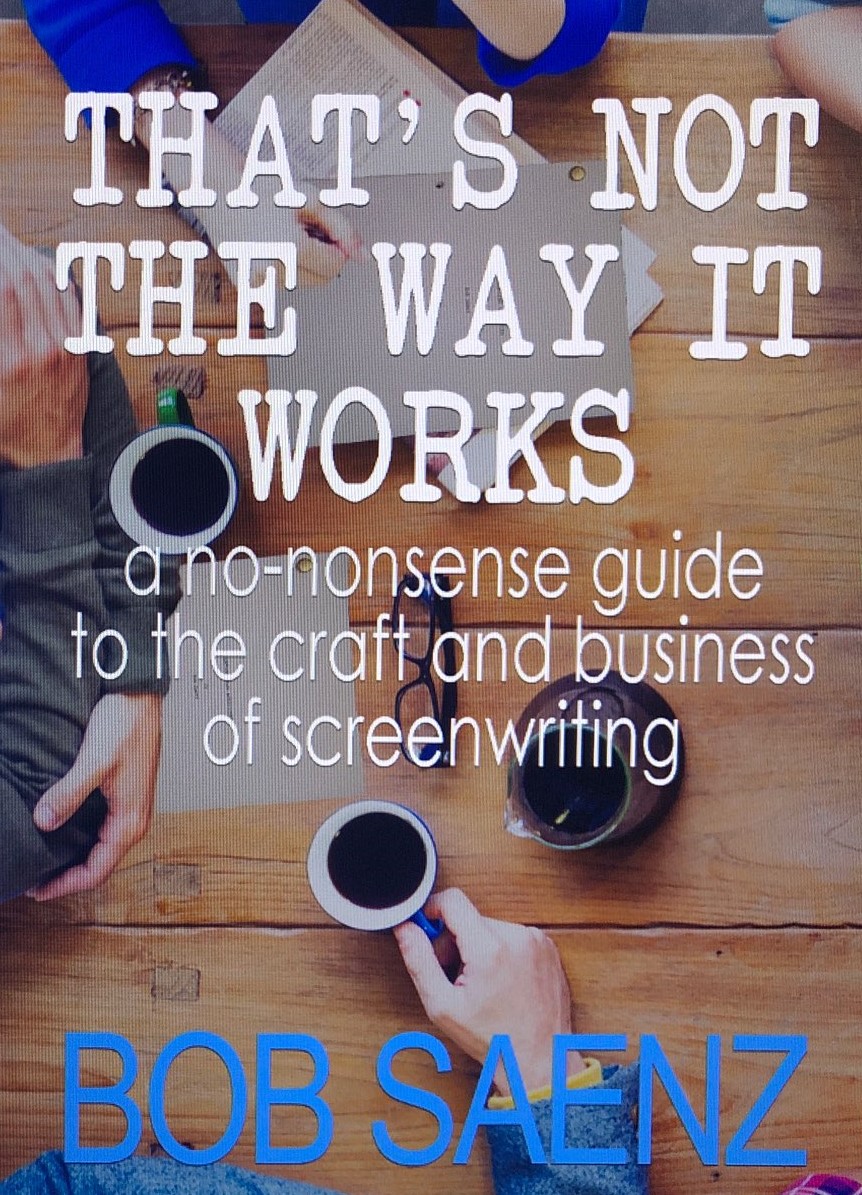
Bob Saenz is a screenwriter, actor and author. His produced works include Hallmark’s Help for the Holidays, Rescuing Madison, Sweet Surrender, On the Twelfth Day of Christmas, Sound of Christmas, The Right Girl, Christmas in Love,  the theatrical Church People, and the black comedy thriller Extracurricular Activities. He does rewrites and polishes on film and TV projects for Producers and Production Companies. His screenwriting book THAT’S NOT THE WAY IT WORKS was released in 2019.

His acting roles include a 6-year run recurring character run on the TV show Nash Bridges, Hallmark’s Valley of Light, Francis Ford Coppola’s Jack, David Fincher’s Zodiac, Finn Taylor’s Unleashed, Church People, and The Village Barbershop, among dozens of others. He was a radio DJ on KYCY-FM in San Francisco, played the last 10 years in the 60’s rock band The BSides, and has done voicework on video games, documentaries, and commercials.

Editor’s Note – I’ve had the pleasure of knowing Bob personally for a few years. His insight and advice has proven invaluable to helping me become a better writer, both in terms of craft and career.

What’s the last thing you read or watched that you thought was incredibly well-written?

A spec script by a writer named Rene Gutteridge called Where the Wind Comes. Maybe the best spec I’ve ever read. Just spectacular. Was emotionally affected by it. Stunning.

What was the inspiration/motivation for your book That’s Not The Way It Works?

Two things. One, I’ve been teaching and speaking at writers’ conferences all over the country the last few years and everyone who was there speaking had a book, except me. I complained to my wife about it and she said, “What’s stopping you from writing one?” So I did.

Two, there’s not a single one I could find out there that spoke plainly about the business of being a screenwriter.

With so many screenwriting books out there, what is it about yours that makes it unique?

The tone. It’s conversational. My experience. It’s filled with what I have learned actually succeeding at it. With more than a dozen films produced, I used all that experience to write about what I know. And, I talk first hand about the business of screenwriting. What the writer needs to know about that part of it, which is just as important as writing a script, and how to approach that.

While the first half of the book is about the actual writing of a script, the second half covers the not-as-discussed “what happens AFTER the script is written (i.e. the business aspects)”. What advice would you give to writers who want to learn more about this?

As I say in the book – find out that it’s not easy, it’s not instant gratification, and you have to work at it. Hard. You can succeed; it just takes time and a business plan. I think the book helps with that. Realizing that writing a script is only the beginning of your journey is a BIG eye-opener for most writers who dream of doing this.

Yes, the script needs to be something people would want to choose to see and has to be good, but that’s not the end of it.

The book has a great chapter about dealing with rejection. What are some key takeaways and advice you’d offer to writers?

The main takeaway is that rejection isn’t personal. Producers and reps don’t care enough about you to make it personal. It’s ALL about the content. Whether they love your script and not or can use it at that time or not. There are hundreds of reasons to reject a script… you have zero control and it’s not personal. Even the most famous screenwriters get rejected on a regular basis. It’s an everyday occurrence. You have to learn to live with it or it’ll destroy you.

Another important issue writers tend to overlook is the need to effectively market themselves in addition to their script. While the chapter about what NOT to do is entertaining (and a bit eye-opening), what are your suggestions about what writers SHOULD DO?

Use the avenues that producers and reps have opened to the writer. Querying. Something that is an art unto itself and something I delve into pretty deeply in the book with a whole section on query letters.

Networking. There’s a huge section in the book about this.  The dos and don’ts. One thing to always remember about networking: It’s about building relationships, not using people. People who can help you absolutely know the difference and will run away from you if you try and use them.

Contests. The Nicholl and Austin are the ones who will pretty much always get you reads in LA if you final or win them. I’ve had friends get their films made doing well in both of these. Neither are easy to do well in because of the sheer number of entries, but they can pay off.

The last way is through referrals, especially to get a rep. If you know a producer or director or star who will refer you… but again, this goes back to networking and having the great scripts to back it up.

What do you consider the components of a good script?

The most important thing is a great story. It also has to be lean and mean. Brevity and white space are your friend. You aren’t writing a novel. You want just enough in there to have the reader see the film in their head and to be able to fill in what they want to as they read, engaging them in the story that way. Again, a big section in the book about this.

I will say this: Producers are ONLY looking for STORY. Screenwriters can never forget this. Don’t over-complicate the read. You can write a complex story without making it hard to read. Oh… spelling and grammar are important, too.

What are some of the most common screenwriting mistakes you see?

The main one? Choosing the wrong story to tell. Telling a story no one wants to see. Whether it’s not sustainable, not interesting, ridiculous, something that’s been done a thousand times before, something you can see every day in TV reruns… there are a million reasons NOT to write this kind of story. You need to go through a pretty thorough checklist (in the book) and make sure it’s a viable story before you do the time consuming hard work it takes to write a good script. Why do all that hard work on a story that’ll be Dead On Arrival?

Another big mistake I see all the time is writers not doing their research about the topics they choose to write about. Writing things that would never ever happen. You have to ground your script in the reality of the subject matter before you take liberties with it.

What are some key writing guidelines every writer should know?

-AIS – Putting your Ass In the Seat. You have to be disciplined. Producers expect you to be disciplined. Good to start doing that at the beginning.

-Never give up. This is so hard to do, you’ll get discouraged on a regular basis. It’s a lot easier to give up than to stick with it because it takes years to succeed in. Notice I didn’t say it CAN take years, I said it TAKES YEARS, because in every case, it does. You aren’t going to be the exception.

-Don’t cheat on research. Take the time to actually learn about the things you’re writing about. Go out and learn them. A big section in the book about this.

-Again…. for emphasis…. choose a story that is viable for producers and audiences. Don’t just pull something out of the air and write it.

-You’re not writing a novel. Leave everything that isn’t directly hooked to your story or plot points out of your script. One rule of thumb? You know all those people listed in the credits of a film? It’s your job to do everything they don’t. You aren’t a costume designer or a casting agent or set designer…. or… any of them. They don’t ask to write the story, you don’t try and do their job.

You’ve managed to establish and maintain a writing career while living outside of Los Angeles. What are some of the pros and cons about it you’ve experienced?

Pros: I don’t live all that far away (400 miles) and can be at any meeting on a day’s notice, so it’s been fine for me. I am in LA multiple times a year, sometimes for more than a week at a time. It’s expensive… but also my choice. There’s a section is the book about moving to LA and when to pull the trigger and do it if you need to.

Con: I’m not in LA networking all the time. Out of sight, out of mind is a real thing. Not worth moving there for me, though.

Readers of this blog are more than familiar with my love/appreciation of pie. What’s your favorite kind?

Peach. Nothing else comes close.

peach pie

Q & A with Jeff Buitenveld of ScriptArsenal

Jeff Photo

Jeff Buitenveld of ScriptArsenal is an independent producer and former development executive with over 15 years of experience on some of Hollywood’s biggest films. He is currently a producer on the upcoming thriller The Kimberlite Process. After graduating with an MFA from UCLA’s Producers Program, Jeff worked in various capacities on numerous productions for Tom Cruise and Paula Wagner including The Last Samurai, Mission Impossible 3, Jack Reacher, Valkyrie, Lions for Lambs starring Robert Redford and Meryl Streep, Ask the Dust starring Colin Farrell and Salma Hayek, Death Race starring Jason Statham, The Eye starring Jessica Alba, Suspect Zero starring Aaron Eckhart and Ben Kingsley and many more.

What’s the last thing you read or watched that you thought was incredibly well-written?

Spider-Man: Into the Spider-Verse was a blast. HBO’s Barry is a funny and oddly haunting series. I recently re-watched/re-read Hell or High Water, which is a deceptively simple, sad, and suspenseful story with rich, complicated characters. Netflix’s The Haunting of Hill House delivered the goods on scares and family dysfunction for me. Issa Rae (“Insecure,”) Jill Soloway (“Transparent,”) Amy Sherman-Palladino (“The Marvelous Mrs. Maisel,”) and Andrea Savage (“I’m Sorry,”) all have unique, exciting, and powerful voices.

How’d you get your start in the industry?

I didn’t know anyone in LA when I first moved here but developed a sci-fi project that was quickly optioned by an Academy Award-winning producer (and never made). During that time, I was also accepted into UCLA’s Producers Program where I took Meg Le Fauve’s (“Inside Out” “Captain Marvel”) Development class, which was instrumental to my growth and understanding of cinematic storytelling and how to work effectively with screenwriters. I started cold-calling various companies for internships and was lucky enough to land positions at both Artisan Entertainment and Mike Medavoy’s Phoenix Pictures. Back then, Artisan had a deal with Marvel and I was immediately thrown into pitch meetings with various notable writers/directors on properties like Thor, Hulk, The Punisher, Black Widow, and Iron Fist, etc. I was also taking pitches at Phoenix – it was an incredible learning experience. I eventually became an assistant briefly to a Hong Kong action director and then used those experiences to land a job with Tom Cruise and Paula Wagner once I graduated from UCLA.

Is recognizing good writing something you think can be taught or learned?

Though having an eye for quality material can be a natural instinct, it needs to be honed. I ultimately feel that recognizing good writing can be learned and taught.

What do you consider the components of a good script?

Generally speaking, a good script maintains a captivating concept, and a flawed but likeable hero with a concrete objective attached to grave stakes (whether intimate or epic). The hero’s emotional flaw is often rectified as a result of him/her achieving their practical goal (he/she should also be active, resourceful, and exhibit a range of change). It’s helpful if the hero’s goal is time-sensitive and somehow socially relevant. Lastly, if the script is a feature, it should adhere to a three-act structure.

What are some of the most common screenwriting mistakes you see?

Too much description, on-the-nose dialogue, flimsy structure, and the lack of a flawed hero with a concrete objective, attached to grave stakes.

What story tropes are you just tired of seeing?

I’m not at all opposed to writers using things like “one last job,” “a reluctant hero who can save the world,” “a family in peril,” or “a fish out of water,” etc. The familiar can be very accessible and., if used effectively, can lure a reader into the story. The trick, however, is to infuse that story with other unique and complex qualities so that it unfolds in fresh and unexpected ways. What can make your story different or set it apart? I always urge writers to challenge the reader’s expectations or preconceived notions as to what type of story they’re entering!

What are some key rules/guidelines every writer should know?

-Use Final Draft.

-Study the most notable screenwriting books and authors.

-Read every script you can get your hands on whether good, bad, or mediocre.

-Have conviction but be open to ideas – ultimately this is a collaborative industry.

-Don’t be afraid of genre and don’t be afraid to push the boundaries on the tenets of said genre (but know what those tenets are).

-Actively seek feedback and don’t be precious.

-Strive to be both clear and complex in your writing and understand the difference between the two.

-Don’t be a hater – watch all kinds of movies and TV shows, and be mindful of those that are both commercially and critically successful as well as those that aren’t.

-Read the trades to better understand the marketplace.

-Don’t chase trends – write from the heart.

Have you ever read a spec script that was an absolute, without-a-doubt “recommend”? If so, what were the reasons why?

“Recommends” are a rare breed. Those that do qualify show a master of the craft, are usually somewhat familiar but also somehow unique, tend to maintain complex characters, rich themes, and have an easily identifiable position in the marketplace (you can visualize the poster, trailer, audience, etc.) That being said, most of the scripts I’ve read, even from the most notable A-list writers in the industry, still needed some further development.

How do you feel about screenwriting contests? Worth it or not?

I think it can be incredibly important and worthwhile, particularly for young writers, to enter screenwriting contests. However, I would also encourage writers to do some homework on which ones are notable and relevant so as to not waste too much money and time.

How can people find out more about you and the services you provide?

Go to www.scriptarsenal.com and follow us on FaceBook and Twitter to get updates on upcoming sales and weekly helpful screenwriting tips.

Readers of this blog are more than familiar with my love/appreciation of pie. What’s your favorite kind?

Given my mid-section I generally try to stay away from sweets, but a few years ago, I had some homemade pecan pie (numerous pieces actually) for Thanksgiving and it was an absolutely transformative experience…a chemical portal to another dimension that somehow transcended the time-space continuum…okay, maybe I’m being a bit dramatic but damn, it was good!

pecan 2

Resources at your fingertips

kent

Becoming a professional screenwriter is an incredibly difficult goal that takes a very, very long time to achieve.

This doesn’t mean it’s impossible. Just know what you’re getting yourself into.

One goal, lots of strategies

The me business – a 24/7 operation

Apart from writing, what are you doing to help yourself get there? There’s only one person who can be the most effective in helping you move forward. And you already know who it is.

A support staff of one

Are you networking? Trying to meet other writers? Offering to give notes or swap scripts?

When a writer meets a writer…

Are you entering contests to see how your script holds up under scrutiny?

The hazardous journey down Contest Road

Are you sending queries? Researching reps and producers?

Quit them or queue them up?

Part of every writer’s journey is the inevitable frustration and disappointment. Some days it will be very powerful, and learning how to survive and endure it is all part of the process.

How low can you go? Quite, apparently.

Expiration date: NEVER!

A most informative Q & A with Andrew Zinnes

andrew zinnes

Andrew Zinnes is a UK-based screenwriter, screenwriting consultant and producer who’s worked for production companies, read for contests, and co-author of The Documentary Film Makers Handbook: The Ultimate Guide to Documentary Filmmaking and The Guerilla Film Makers Pocketbook: The Ultimate Guide to Digital Film Making. He currently holds the position of Teaching Fellow at the University of Portsmouth.

What’s the last thing you read/watched you thought was incredibly well-written?

I have small children so I don’t get to the theater as much as I’d like, but I recently saw I, TONYA and thought it was fantastic – a real pleasant surprise! I remember the Nancy Kerrigan incident vividly and, at the time, there wasn’t a bigger villain than Tonya. Yet Steve Rogers managed to make her sympathetic by focusing on her relationship with her mother and other aspects of her home life. Then you add breaking the fourth wall and other stylistic choices, and the characters became self-aware in a manner that added to their depth and relatability. BABY DRIVER was great, too. Loved the way they used music to tell the story. Very Edgar Wright.

How’d you get your start in the industry?

I became a script reader for a small production company based at Sony. I read for free as I wanted anyway into the machine. I would go in on off days or they would messenger me scripts, back when that was a thing, and I would write up coverage and fax it back to them, when that was a thing. I became friends with the assistants in the office and when I said I wanted to do development, they put me up for other assistant gigs.

Is recognizing good writing something you think can be taught or learned?

From my experience, recognizing good writing is innate. Many years ago, I went home for Thanksgiving and took my weekend read with me. My sister got curious and started reading some of them. She read one that was a spec from an unknown writer and she was surprised at its mediocrity. She stopped reading after 40 pages and picked up another. This time she started laughing straight away and continued through the whole 100 pages. That script turned out to be AMERICAN PIE. She knew the difference between the two scripts quality-wise with no training, but what she wasn’t able to do was tell me what was wrong with them via screenplay/story theory or how she would have fixed any issues. That part needs to be learned and practiced as one would with any craft.

What do you consider the components of a good script?

The biggest component revolves around making the story or premise personal to you, the writer. If it’s not something you’re passionate about then how are you going to put 100% effort into it? If you can’t connect to the premise, then how can the reader or the viewer? John Truby says this issue leads to generic, unoriginal work and I have seen this first hand with my college/university students. Just recently, one wanted to do a crime thriller that had an okay hook, but was otherwise unremarkable. I asked why he wanted to do this project and he said it was because he loved those kind of movies and this sounded cool. I told him my doubts and he got frustrated. He said that he has trouble making decisions about writing because he doesn’t want to make mistakes that can’t be undone easily. When I pressed, he said he felt that way about many things in life, not just writing. I told him he should write about that concept. His eyes lit up!

The other key component are the forces of antagonism. I don’t just mean the villain. I mean everything that holds back the protagonist(s) from their goals. The better they are, the better the tension, drama and comedy become.

What are some of the most common screenwriting mistakes you see?

Because I work with many writers in the development of stories from early in their conception, impatience reigns the king of mistakes. Often times writers want to rush into the actual writing before they’ve explored a premise fully. They don’t want to do enough research to make the story richer or come up with alternative character motivations and story points that might make their project surprising and original. They don’t want to take hard looks at their structure because they have something in their head and want to get it out. I get it. I’ve felt the rush of getting something down in Final Draft, too. However, whenever I’ve let a client or student get on with it despite my objections, it always goes wrong. They create a story and/or characters that are generic or derivative. They come to the point where the structure doesn’t work and either get stuck or plow forward anyway and there’s structure or story flaws. Now for some writers, this is the process they need to go through. This is how their brains process information. That’s fine, but whether that is the case or they are just steadfast, we end up going back to the drawing board to pull everything apart as we should have done originally.

Aside from that, overwriting tends to be an issue, especially with newer writers. Screenplays are meant to be quick reads and having a lot of black on the page slows that down. Learning economy of writing is essential. I realize that many people, myself included, like Wes Anderson or Quentin Tarantino’s style, which creates these dense, epic screenplays and, that further, feel they should follow suit. However, one, that’s being derivative; two, they’re directing the work so they probably doing it partially because they don’t want to forget anything; and three, they’ve earned it as they had to fund their first films in this style mostly themselves and became successful with it.

What story tropes are you just tired of seeing?

Tropes don’t bother me. It’s what is done with the tropes that matters. Whenever a superhero movie comes out social media garners a a lot of eye rolls and hate from various creative or general public communities and then WONDER WOMAN, DEADPOOL or BLACK PANTHER comes out and shakes things up. Teen horror films are another one that gets a lot of grief, and then HAPPY DEATH DAY hits the screens and all of a sudden cyberspace is hit with short memory syndrome. Take tropes and tell them in unique ways.

What are some important rules every writer should know?

-Observe people, places, things and ideas.
-Observe by asking questions and listening to what people say and don’ t cut them off to speak about yourself.
-Travel and observe what’s around you.
-Write down what you observe and think about what universal truths of the human condition emerge that matter to you.
-Read good scripts and watch good movies so you know what works.
-Read bad scripts and watch bad movies so you can recognize problems to avoid.
-Notes are opinions. They aren’t personal.

Have you ever read a script that was an absolute, without-a-doubt “recommend”? If so, what were the reasons why?

I haven’t read many. TRAINING DAY may have been one. THE SIXTH SENSE may have been one, too. The reasons are for the usual hallmarks: great voice, original take on a premise, explored some kind or large idea, writing that moved my emotions (tense, scary, etc) and structured well. Then the other side of the equation, the business side, it had great roles for movie stars to play, was something my company might do, and had general commercial appeal.

How do you feel about screenwriting contests? Worth it or not?

That’s a tricky one. On the one hand, if you can win one or at least become a finalist, it can get you noticed. The bigger the competition the better your chances, obviously. If you live outside of Los Angeles or don’t have a friend that works in the industry, it may be one of the only ways that you can garner attention. On the other hand, if you enter many of them, it can get expensive. Also there is a fundamental truth about screenplay competitions: there has to be a winner. It’s the best of what a competition gets that year, not necessarily the best written thing that would attract an agent or manager and that sometimes makes Hollywood impatient with competitions. But all in all, I say they are worth it. Especially if there’s some sort of networking attached to winning or placing.

How can people can get in touch with you to find out more about the services you provide?

I’m very easy to find: andrewzinnes.co.uk. You can message me from there. I live in the UK, but work with writers all over the world. Thank you FaceTime, Skype and WhatsApp!

Readers of this blog are more than familiar with my love/appreciation of pie. What’s your favorite kind?

Blueberry! I make a mean one, too.

blueberry pie