Plodding to the next finish line

VeneratedFlimsyCapeghostfrog-size_restricted

Well, one tough part’s out of the way. Got the latest draft of the sci-fi adventure done, clocking in at a respectable 118 pages. (And accomplished in just under a month, so – yay.)

Now it’s time to move on to the next tough part – the initial wave of cleaning it up, which will include cutting at least 7-10 pages.

It’s been a while since the last time I did this sort of editing, and it always seemed to be more problematic than expected. The best way I can describe it is “I couldn’t really see the forest for the trees”. The problems and their prospective fixes were there, but it would be difficult for me to identify them.

This time around, I’m taking a different approach.

I printed out a hard copy of the script, and went through it, scene by scene, and wrote down a very brief summary – a snippet or two of what was happening in each one. No frills. No dialogue. Just “here’s what happens here”.

Along the way, questions would constantly insert themselves into the discussion. Was there a way to still have this happen, but in a fraction as many words? Is this scene really necessary, or could it be combined with another? How can I describe what’s happening so it’s easier for a reader to “see” what’s happening? Everything geared towards telling a story in the most effective ways possible.

Additionally, new ideas and approaches would spring up when they were least expected. A scene or sequence I thought was just fine would suddenly feel totally out of place, or seem like it needed a drastic overhaul. With this still being a work in progress, any and all new ideas are welcome.

Another new development is how I’d initially type something like “MAYBE X DOES THIS” as a potential new part/development of a scene. Then while working on a later scene, see how that suggestion could be incorporated into it. This would then result in me going back and deleting “MAYBE” from the original. Sometimes your gut reaction really is the best one.

Didja also notice how those last-minute inserts are written in ALL CAPS? Just my little way of having a note stand out a little more so it’s easier to spot when I come back to it later on. Simple, but effective.

Even as this draft steadily grew, there were always sections of the story I knew would need some extra attention in the next draft. Rather than spend time going back and trying to fix things, it was just easier to leave it as it and keep pushing on.

Current focus is all about going through the pages and being as analytical as possible. A few minor story problems have been dealt with. Some unanswered questions are no longer unanswered. Opportunities to throw in a small dash of character and story development are opening up.

The strongest takeaway from this latest effort is that the overall process of putting a decent script together, while still quite challenging, is becoming slightly more manageable and somewhat less insurmountable.

An overabundance of words

word pile
First on the agenda – get them in order. Second – get rid of the ones that don’t belong.

April has been a most productive month for working on the new draft of the pulpy sci-fi adventure spec. This week saw me reaching the midpoint – page 73, which is about 18 pages more than it should be. (Not to mention that a spec script of approximately 150 pages is just ludicrous to begin with.)

Part of me wants to put the writing on hold and go back to page 1 to start editing and clearing away the excess, but I sort of like the idea of just pushing forward, finishing it. and THEN going back armed with the Red Pen of Doom.

When it comes to a first draft, I always tend to put in too much. More “kitchen sink draft” than “vomit draft”. Even taking a look at some previous pages, it’s easy to see where I’ve written more than what’s needed – of practically everything.

The silver lining here is that when it comes to rewriting and editing, there’s a lot to work with. Stuff thought necessary during that initial phase might prove otherwise, and out it goes.

My storylines can be a bit complicated – too many moving parts, so to speak. A combination of “I really want to wow you with this” and “there needs to be more here”. While the first definitely rings true, the second runs the risk of overdoing it and bogging things down – something I don’t want.

It used to be a lot tougher for me to kill my darlings, but time and experience have shown me it’s all about doing what you need to to achieve the end result. As much as I might like a particular something, if it can be cut (or at least drastically shortened) without any significant impact to the rest of the story, that’s fine by me.

If I can maintain my current pace of page output, there’s no reason to think I couldn’t be done with this draft by the end of the month, or maybe the first week of May. While I usually take a little break after completing a latest draft, the always-developing ideas for potential fixes and such may cause me to forego that and just jump right back in.

In the meantime, I’m just having a good time spinning what I can only hope will be an entertainingly ripping yarn.

Working my way forward

billion_dollar_limited

The process of writing actual pages for my pulpy sci-fi adventure is fully underway, averaging about 3-4 pages a day, which is just a smidge above average for me. I’m making a real effort to stick to this kind of output, and am hoping to keep it up for the duration.

There’s a lot of setup in the first act, and I was really concerned things would somehow get drastically out of hand and go on for too long , resulting in a script running something like 150 pages, but so far I’ve managed to keep it all in check. It’s all going according to plan. Still feeling confident to be able to keep it in that ideal target range of 110-120 pages.

And this is before any of the real editing begins. That comes after FADE OUT.

Speaking of editing, even though I was trying not to fall back into my habit of “write, edit, write some more”, there’ve been a few times when a few impulse decisions had to be made regarding whether or not something should be included. Since I was already concerned about too much material, many of them were cut.

In retrospect, they weren’t as necessary as I initially thought, so after they were cut, their absence had barely an impact on the story – if at all. Turns out they were in there more for my own benefit. I saw them as building up the key scene to which they were connected. I tend to overwrite during the outlining process anyway, so no big loss.

Working on both the outline and the pages has also made me realize that my talents seem to be a lot more suitable for this kind of thing. As much as I’d love to be a solid comedy writer, I feel much more at ease producing thrilling tales of adventure with some comedic moments thrown in.

They say you can tell a writer enjoyed writing the script because of how it reads. Like with all of mine that came before, that’s exactly what I’m hoping for with this one as well.

Q & A with Craig Kellem & Judy Hammett of Hollywoodscript.com

Hollywoodscript.com LLC was founded over a decade ago by former Universal and Fox development executive Craig Kellem, who was soon joined by business partner, Judy Hammett (M.A. English/Creative Writing). This family-based, boutique script consultation service is internationally known, serving writers from every corner of the world.

I had the pleasure of talking with Judy about their new book Get It On The Page: Top Script Consultants Show You How.

What’s the last thing you read or watched that you thought was incredibly well written?

Without a doubt, HBO’s most recent season (#3) of TRUE DETECTIVE. It is truly impressive every week. The writer has an incredible command of dialogue and the structure employed is beautiful. The writer has interwoven various timelines in a very clever and elegant way, wherein the plotline is consistently advanced, yet at the same time, the existential themes being explored are made exceptionally dramatic and emotionally charged as a result.

How’d you get your start in the industry?

We are father and daughter and come from a family that made their living in TV and music, so we both got our first breaks through family/friends. Craig started out as an assistant at a talent agency and worked hard up the ranks to become a talent agent himself. He eventually became a development executive at Fox and Universal, and in time a TV Producer as well. I started as a researcher on a TV series, then did freelance work providing studio coverage on scripts & books while in graduate school for English/Creative Writing. Eventually, Craig founded our company, Hollywoodscript.com LLC and I joined him soon thereafter. We’ve worked together for more than fifteen years.

Were you always a writer, or was it something you eventually discovered you had a knack for?

We’ve always tended to “think” like writers, and have loved writing just for the sheer pleasure it provides! But neither of us chose to “become” professional writers, or pursue careers as such. We both love working with writers, supporting their craft and analyzing content. This has been our true vocation. We wrote our book together from the standpoint of wanting to reach out to writers everywhere and share what we have learned after almost two decades of consulting with writers the world over. I provide writing services/ghostwriting on occasion, but consulting is my main work.

What inspired you to write your book Get It On The Page: Top Script Consultants Show You How?

Over the years we had clients comment that we should write a book, stating that our general feedback and approach was constructive, inspired and very helpful. So a few years ago, we decided it was time to give the book idea a green light and started putting the chapters together – with the sole purpose of sharing observations and approaches to writing, which have proven the most helpful to writers we’ve worked with to date.

With so many screenwriting books out there, what is it about yours that makes it especially unique?

We hope to offer something which is more intuitive, less “left brain” – a book that invites the writer to stay close to their own experiences, their own strong feelings and their own instincts so that the storyteller inside of them can more easily come to the fore.

Follow-up: having read a lot of screenwriting books, I found this one to be very different in that it’s not so much about “how to”, but more of a “here’s something to consider as you work on your story/script”. Was that your initial intent, or did it gradually develop that way?

Many thanks for your feedback! Yes, that is a wonderful way to describe it. We didn’t set out to compete with the screenwriting greats who’ve written comprehensive “how-tos” beautifully and exhaustively. Instead, we wanted to contribute to the conversation from the hands-on perspective of our day-to-day work with a very diverse range of writers – some of whom have studied the gamut of how-to books, yet continue to struggle with actually realizing their own visions on the page. We wanted to offer a book that helps writers get closer to  “hearing” their “own voice” so to speak – to accessing the vivid, original stories and characters that live inside of them.

One of the chapters that really resonated with me was the one about the practice you call “sandboxing”. Could you explain what you mean by that, and how it could benefit a writer?

Inspiration, ideas and the desire to write often come out of writers having creative shards and glimmers that have emerged from their minds. They get an idea for a scene late at night and jot it down on scrap paper. They encounter some person they think would make a great character type and make a note of it on a napkin. They hear an anecdote that suggests a story and scribble it on an envelope. All these pieces of creative inspiration are wonderful fuel for writing a screenplay, but a few glimmers and shards aren’t enough to justify starting at page one of a one-hundred-plus-page three-act film. Yet zealous writers will often do just that. They plow forward on the faint fumes of too few ideas and assure themselves the rest will come as they write. This approach rarely makes the cut, for the writer hasn’t given enough time and thought to what it is they are actually writing.

Rather than starting a screenplay prematurely, we therefore recommend “sandboxing,” which is a simple method wherein the writer slows down in order to create a much bigger arsenal of ideas from which to choose. Each day they jot down additional possibilities for scenes, character angles, key plot lines etc. – adding to their original seeds of inspiration. It thoroughly preps the writer to eventually sit down to page one of their new script armed with a truckload of ideas from which to write.

What do you consider the components of a good solid script?

A clear, strong story is key. Characters who are relatable and believable. A hero with whom the audience can empathize and who breaks into a serious sweat as much as possible. Dialogue that rings true. Lots of suspense, urgency, and conflict that keep the audience riveted and the pacing clipped.

What are some key rules/guidelines every writer should know?

-Writing IS rewriting, even when you’re a pro, so best to embrace this notion and learn to enjoy the process of writing, revising and polishing your script before declaring it “done”.

-Getting a script sold, or made, doesn’t happen on any predictable timeline. Just keep writing and derive your pleasure from the creative process, rather than focusing on it as a means to an end.

-If you are cloudy about any part of your script, stop and take the time to fully explore that cloudiness, addressing it head-on. Don’t try to finesse it, or gloss over it, or avoid it in order to deal with the parts of the script that are clearer to you. Otherwise, your audience may get stuck in those foggy sequences and then start detaching from your content as a whole.

-Never lose sight of the fact that a film is a visual art form. As you write, always ask yourself if there’s a way to dramatize the story development through images, cinematic sequences and visual cues first and foremost.

What are some of the most common screenwriting mistakes you see?

-Writers who tend to overwrite and hence interfere with needed momentum. Setting a strong, galloping pace is essential.

-Scripts that are confusing because the writer hasn’t maintained consistent continuity in the plot line or in terms of the character trajectories.  

-Scenes that don’t build the story or move narratives in the film forward.

How can people find out more about you and the services you provide?

We can be found at hollywoodscript.com and are on Twitter, Facebook, and Linked In – Craig and Judy. And of course, check out our book Get It On The Page: Top Script Consultants Show You How.

Readers of this blog are more than familiar with my love/appreciation of pie. What’s your favorite kind?

HA! I’ll take pie over cake any day – especially coconut, chocolate, vanilla or banana cream. Craig likes ice cream too much to think about any other type of dessert.


banana cream piesoda jerk

Making it not what it was before

spiderverse
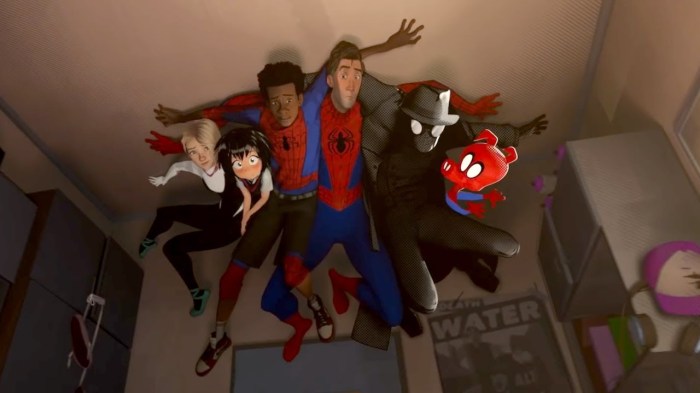
Well-known material, executed in an entirely new and original way

The key word for this overhaul of the pulpy sci-fi spec is exactly that: an overhaul.

And a really big one at that.

One of the notes I got on the previous draft was “It’s a fun story, but there’s still a feeling of ‘we’ve seen this before'”.

What a powerful motivator to really shake things up. The last thing a writer wants to hear is that their work is predictable or just filling in the blanks for a template with this kind of story. Readers and audiences want originality, so that’s what we need to give them.

Regarding this story, while the overall concept and primary plotline are still the same, a good majority of the rest of the details have changed in some way or another, with no doubt more to come.

Even though I’ll jot down ideas for particular moments, scenes or sequences occurring throughout the story, I gather them up and then write/develop them in a linear manner – working my way through the story from start to finish. A leads to B, which leads to C, and so on and so on. Not everybody’s style, but it work for me.

It’s probably safe to say I worked my way through at least four or five versions of Act One before arriving at its current version – the one I felt was the strongest. And even that’s been tweaked here and there since then.

Despite having a hard copy of the previous draft readily available – more as reference material than anything, a key part of this process has been for me to NOT look at it – especially when I was feeling stuck. My objective is to keep trying something really different, and sneaking a peek at what I’m trying to avoid won’t help. If anything, it would probably point me in a wrong direction.

I’ve written before about a writer should do what they can to avoid having the reader/audience know what’s going to come next. Such is the case for this rewrite.

As I work my way through, it’s with a mindset that looks at a scene or sequence as a whole, along with “what’s the most likely thing to happen here?”

That’s followed immediately by “what would be the total opposite of that?” or “what would be completely and totally unexpected here, but still works within the context of the story?” Really striving towards taking a new approach is yielding some positive results. It’s quite a thrill when an idea pops out of nowhere, and it works even better than expected.

Added bonus – by forcing myself to come up with new ideas, there’s less need for me to keep the hard copy of the previous draft nearby. The more I avoid looking at it along with figuring things out for this draft, the more changes it produces. All that being said, I’ll still hold onto it, since there’s always a chance I might need something in there, but with the story constantly changing, even that’s becoming less likely.

The whole point of overhauling this story is to take what I had before and put an entirely new spin on the initial concept. I have a pretty good idea of what needs to happen, what I’d like to happen, and that big nebulous category of what could potentially happen (still working out the kinks on that one).

The road between what I started with and what the end result will be is without a doubt one that’s going to be very long, very twisted, fraught with hazards of numerous kinds, and might, at times, seem to go on forever.

Sounds like quite a hellish journey. And I’m loving every step of the way.