As the rewrite/polish of the mystery-comedy continues, it suddenly hit me that while I knew the backstory of what came before, somebody reading it for the first time would have no idea what was going on, or at least how we got here.
A little exposition was in order.
But among the many problems with writing exposition is when it’s out-and-out obvious.
“You mean your brother John, who went through a terrible divorce, ran off to join the circus and became a cross-dressing serial killer?”
Sometimes it’s done very effectively, but unfortunately, a lot of the time it isn’t, resulting in a blast of information crammed into one scene.
No thanks.
Rather than go down that road, I’m exploring the potential of doling out the details over several scenes. A sentence or two casually placed here and there so as to not draw attention to itself, all for the purpose of helping you learn where everything is coming from and how we got here.
It’s a work in progress, so we’ll see how it goes.
Interesting discussion the other day with a professional hyphen (writer HYPHEN director HYPHEN script consultant) about my western.
They wanted me to pitch them the story, but without notes. Pretty much without any preparation whatsoever.
This way, they explained, it comes across as “more natural” and “less rehearsed”. I don’t necessarily agree, especially because I despise those momentary pauses which make you rely on saying “um” while your brain races to come up with the next words out of your mouth.
Despite not really having thought about the story that much over the past few months, I did my best to work my way through it and think I did okay. Maybe B-plus/A minus territory. Not fantastic, but not bad operating with pretty much no prep time whatsoever.
I made sure to include key story points and not go into too much detail, and tried to sound excited and upbeat while describing the high-octane action.
After I’d finished, there was a dread-inducing silence that grew with each passing second (maybe 3 in total, but felt more like neverending).
“Hmm,” came the reply. “Not bad.”
Not exactly a standing ovation, but I’ll take what I can get.
They listed what they liked and what could use a little work. Surprisingly, they felt the ending was a little ‘soft’ and their explanations why, to which I calmly disagreed and gave my explanation why.
Even more surprisingly, they then revealed they’d only read up to page 15 and wanted to hear my pitch to see if the rest of the story warranted continuing.
(Just to set things up, this person claims to have given 3 pages of notes just on the first page alone for other scripts. Apart from a few comments about the dialogue, they didn’t really have any for mine, and that when they usually get to around page 10, they jump ahead to the middle, then to the end. But mine they wanted to keep reading. Make of that what you will.)
After hearing my rationalization for the ending, they admitted that they should “probably read it to see if they agree.” In theory that will be happening this week, but we’ll see.
Our discussion then turned to my experience and some of my other scripts, 2 of which they requested to read. A victory, no matter how you slice it.
Looking back, I could have done a much better job at pitching my story – if I’d known I was going to have to do it. Still, if I’m going to be sending out queries about it, I should be prepared to talk about it in a moment’s notice.
So while I while away upcoming hours engaged in the rewrite of the mystery-comedy spec, I’ll try to make the most of potential down-time and re-read the western and maybe put together some kind of FAQ/cheat sheet in case this kind of situation arises again.
And it probably wouldn’t hurt to do the same for those other two – just for good measure.
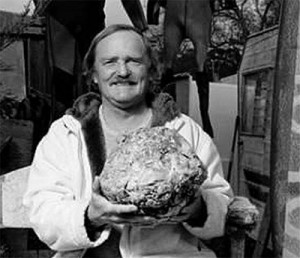
What he’s holding represents what’s at stake. Hint: It’s not a rock
Time now for a very, very important question every writer needs to face:
Do you know how your story ends?
You come up with an idea, then proceeded to develop, shape, and organize all the stuff that happens in the middle, which eventually has led us to the where we find ourselves now: the big payoff. What the whole thing’s been about.
Everything your characters have been doing have been leading up to this. In theory, your first two acts have been about the protagonist’s world undergoing some drastic changes, how they dealt with it and now it looks like the bad guy’s going to win.
Which brings us to the grand finale that is Act Three, where our hero must somehow find a way to overcome these seemingly insurmountable odds, defeat the antagonist and hopefully come out of the experience a different person than the one they were way back when we first met them.
That being said, there’s still more to it.
-Your protagonist has a physical goal (what they want) and an emotional one (what they need). They can achieve both, just one or neither. Which applies to yours, and have you effectively steered the action to ensure that result? Can we see the changes they’ve undergone?
-Working with a subplot or three? If they haven’t wrapped up by now, better make sure to do it soon. Do you really want the reader to wonder “Hey! What happened to the part about ____?”
-Even a supporting character needs an arc to complete. Have you given each of them enough attention throughout the story to make this happen, and does their story wrap up in a convincingly believable way?
One of the most valuable lessons I’ve learned about putting a story together is that the central question (“Will the hero achieve their goal?”) is raised with the inciting incident around page 10, and each subsequent plot point raises it again, albeit with the stakes a little higher each time.
What happens in Act Three is where you show us how the central question is answered.
-And now, the much-heralded return of Movie of the Moment! This time, a way overdue look at GODZILLA (2014).
Wow. Everything PACIFIC RIM should have been. Instead of non-stop giant monster action, we get only glimpses as the focus is directed at the human aspect of the story. A much more effective approach.
While it’s not hard to suspend disbelief when it comes to a movie about giant monsters rampaging/duking it out in the downtown area of the city where I live, perhaps the most amazing piece of cinematic fiction (as observed by both K and myself) was in the background of one scene where a garage sign read “All-day parking $15”.
Couldn’t make this any more Freudian without going NSFW
As the events of Act Three of the pulpy adventure spec outline slowly develop, it’s becoming more clear that retroactive edits/fixes/tweaks will be necessary for parts of Acts One and Two.
Act Three goes beyond making sure each of the main characters has something to do. The actions they take should be tied directly into the main story, represents them overcoming their own personal obstacles and wraps up their individual storyline, all in the most satisfying way possible.
Hence the need to go back and make those changes. The more I can set up and effectively reinforce each character’s storyline, the better the payoff will be, both for them and the overall story.
I’ve always stressed the importance of setups and payoffs throughout a script. Everything we’ve seen in Acts One and Two should come to its appropriate conclusion in Act Three.
I’ve read a lot of amateur specs where something is set up early on and ends up either totally forgotten, treated as an afterthought or pays off with less of an impact than it should.
This is what you’ve been building up to for the past 90-plus pages.
Because “Dude. Yorick. Bummer.” just doesn’t have the same panache
Oh, first draft. You teasing vixen.
I go over the story ideas in my head, everything coalesces and plays out like a well-oiled machine.
But try to transfer them onto the page, and it all discombobulates into a tangled mess on par with the cord on a pair of earbuds carelessly tossed into a gym bag.
Experienced writers know what I mean.
Although it took a while, I finally reached the end of Act Two in the revamping of the outline of the pulpy adventure spec. On one hand, I’m thrilled to have gotten here. On the other, I want to shrug my shoulders and mutter “eh, good enough” about the scenes and sequences that led up to this point.
They’re definitely far from perfect, and without a doubt will be totally different as future drafts come into play.
Let’s pause to consider the phrase “future drafts.” As in “there will be more”, emphasis on “will”. Not “might”. “Will”.
I recently connected with another writer on a networking site, and they ended our introductory correspondence by letting me know they had first drafts of their scripts available to read.
I sincerely hope not.
Unless you’re looking for feedback, don’t show your first draft to anyone. Ever.
The first draft is the attempt to put all your ideas into some kind of order. Know going in that it won’t be pretty, and will most likely be a big mess requiring a ton of fixes. Not a bunch of little edits, but huge, drastic steps. The end result should look totally different from what you started with.
Don’t regard rewriting as a chore or a slog. It’s something you have to do on a regular basis. It makes the script better and helps you become a better writer.
Consider the last script you wrote. How many drafts did it require to get to the point where you finally said it was done? And wasn’t each successive draft a little better, until the final draft turned out significantly improved compared to the very first one?
That’s what you should be going for. Every single time.



 Maximum Z