Ask a PAGE-winning Script Consultant!

Scott Parisien

The latest in a series of interviews with script readers and consultants who would be worth your while to work with if you want to get your script in shape. Today’s spotlight is on Scott Parisien, a mentor, analyst and writer with Script Reader Pro. He wrote the feature FOXTER & MAX in 2019, and his script INCISION was a Bronze Prize Winner in the 2013 Page International Screenwriting Competition.

1. What’s the last thing you read/watched that you thought was incredibly well-written?

There have been many movies this year I felt were actually quite well written. Sadly, most fell outside of the studio system or did not come to the big screen, and if they did, it was barely a blip on the radar. Movies like The Way Way Back, The Spectacular Now, Out Of The Furnace… these really focused on the characters and their journeys, and were filled with touching moments and emotional beats I really identified with. They had characters that were rounded and dimensional and deeply layered. This is what we don’t really get in the studio system any more. But two films that really hit that nerve in the system were The Fault In Our Stars and If I Stay, which were both adaptations, which explains why the characters were more able to be identified with. For me, it’s all about connecting with the characters on a deeper field. As far as the blockbusters, the only one I felt was well written, due to the intelligence of the script and the overall theme of the story, was Dawn Of The Planet Of The Apes. It had such heart, such an identifiable father/son struggle, and themes that worked on both the human and ape sides of the story. I found it quite powerful because of this, and the effects and action really did accent it rather than overwhelm it for me. I wish more blockbuster studio films managed to achieve the same.

2. How’d you get your start reading scripts?

Many years ago, I received a grade of Recommend on two scripts through what was then Script PIMP (now Script Pipeline). I began a great relationship with the guys who ran it and when they had a spot come open they gave me a chance to show what I could do, as I was working on my own consultant service on the side and had experience with this. I then went on to work quite successfully with them and was a senior story analyst, being there for over 5 years. I’ve been running my own service all along as well, and now work with ScriptReaderPro.

3. Is recognizing good writing something you think can be taught or learned?

I’m not sure it can be taught, or even learned. I believe certain people have an inert skill for identifying good stories and good writing, much like Simon Cowell has a knack for recognizing talent and potential in a singer’s voice. Certain people can see that special spark on the page, within that voice and writer. I don’t think just anybody can be a screenwriter. Not only does it have certain areas of craft that must be mastered and manipulated to a person’s style and form, but there’s also a very special art to it. Some people don’t believe there’s an art to screenwriting, that it’s just a blueprint for a movie, but the great writers truly do put together a masterful piece of art in their screenplays. Not everyone can do it, and that’s why 99% of screenwriters tend to fall short of becoming that professional writer we all strive to become.

4. What are the components of a good script?

This is tough because there are so many things that need to be in a script to make it really stand out and resonate above the piles of not so great stuff. Writers tend to focus so much on their “rules” like format and saving the cat: exact page beats and such. But the greats, they worry about layers and nuance and emotional connection. Things like character development, flaws, obstacles. For me, it’s all about the flow of the story, the pace at which it pulls me through the basic structure all screenplays have. That will really make me sit up and take notice. The best screenplays are the ones you never stop to see what page they’re on, or what act you may be in, because it has seamlessly pulled you deep into that world. And that happens very, very rarely.

5. What are some of the most common mistakes you see?

For me it’s not about spelling or grammar, or whether something should have been in CAPS or not. The biggest mistake I see is screenwriters not doing all they can to suck every last drop out of a scene. They are too soft, or too vague, or talking heads with no real substance. These screenwriters lay down the surface and don’t seem to take the time to really dig in and crack the surface to see what is really happening underneath.

6. What story tropes are you just tired of seeing?

I’m actually sick and tired of the main character’s motivation being a dead wife. So many scripts these days and pitches rely on the protagonist being driven toward his goal by the death of the woman he loved. Of course this creates a strong emotional connection as we’ve all lost a loved one in some way or another, but it’s now so cliché it just comes off flat and not interesting in any way.

7. What are the 3 most important rules every writer should know?

1) Take your time. If you’re writing a spec, you have all the time in the world, as well as only one chance to impress. Too many writers rush and don’t let a script really simmer and breathe before they stamp it complete.

2) Find your voice. Don’t write in every single genre because you have an idea you think is good. Choose your style and your voice. It’s hard to make your mark as a horror writer if you submit and they want more, and all you have is a children’s Christmas movie, a western and an emotional drama.

3) Choose your concepts and stories carefully. It’s hard to get read in this business as it is, but even harder if the idea you have isn’t something that will get people excited. The best way to think of it before you write your story is if you can see a movie poster. If the concept you can pitch will elicit a movie poster in our minds, we can see it as a movie. If it doesn’t, you may want to see what other ideas you plan to put 6-12 months into.

8. Have you ever read a script that was an absolute, without-a-doubt “recommend”? If so, could you give the logline?

I’ve only read one script I wish was my own. It was so good, so layered, so character-rich, and it was a heist movie as well about two bank robbers on their last run who steal a getaway car with a pregnant woman asleep in the back, so it had commercial appeal. But it had a deeper theme about human connection that ran through the entire story. The writer had a very special voice that was undeniable.

9. How do you feel about screenwriting contests? Worth it or not?

It all depends on the contest. Everything is so subjective. I won a midlevel contest and didn’t get a single request. I was a winner in one of the top 3 and the requests flooded in. It all depends on how a writer capitalizes on those wins or placements. Using them to pump up your credibility in a query can help it get noticed.

10. How can people get in touch with you to find out more about the services you provide?

https://www.scriptreaderpro.com/our-script-coverage-services/

11. Readers of this blog are more than familiar with my love/appreciation of pie. What’s your favorite kind?

Saskatoon Berry Pie. These little dark blue berries, like a blueberry but totally different, grow in central Canada and into Montana and North Dakota. These are little gems if you can ever get your taste buds on them, in a crust with a gratuitous pile of whipped cream on top.
Ask Two Savvy Script Consultants For the Price of One!*

ScriptChix_Logo copy

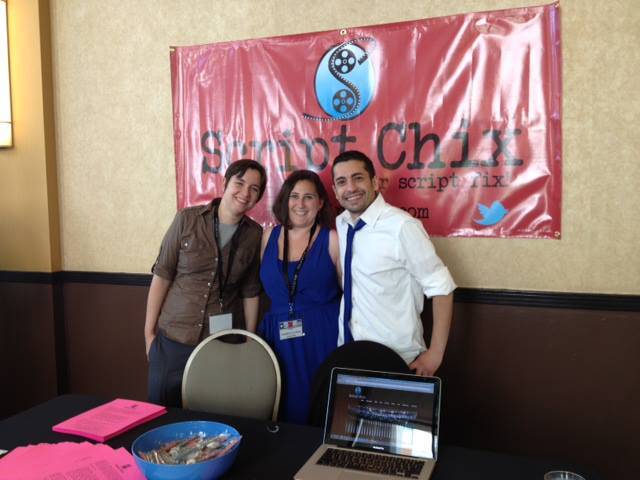
(L-R) Miranda, Sandra & budgeter/scheduler extraordinaire, Hosam, who is not part of this interview
(L-R) Miranda, Sandra & budgeter/scheduler extraordinaire Hosam, who is not part of this interview

*And considering this doesn’t cost you anything to begin with, that’s the best deal you’ll get today.

The latest in a series of interviews with script readers and consultants who would be worth your while to work with if you want to get your script in shape. Today’s spotlight is on Miranda Sajdak and Sandra Leviton of Script Chix.

1. What’s the last thing you read/watched that you thought was incredibly well-written?

WINTER’S BONE

BUTCHER HOLLER by Daniel Shea

2. How’d you get your start reading scripts?

M – Started off as an intern in Hollywood doing the typical script-reading duties. Moved on to being an assistant and continued to do coverage there. Eventually found myself reading for friends and family on the side, and realized (around the same time as Sandra did) that it was a good idea to monetize some of this so as not to just be doing it in my free time. Ended up simultaneously being asked to read for various studios/companies, and turned all that experience around into Script Chix!

S – I believe I read my first script in college, though as a kid, I liked to watch movies and transcribe them. It took hours, but I loved it. The internet wasn’t really a thing yet, so there was no easy access to them. However, professionally, I started reading as an intern doing short coverages for executives during staffing season. My subsequent jobs at an agency and a cable network had me reading all of the time – for potential clients, development, and show staffing. Giving notes to clients, friends, and others who needed feedback was part of my daily life. When I decided to leave my network gig and go out on my own, doing it professionally seemed like a natural transition. As soon as friends at another cable network heard my news, they offered me a spot as one of their book readers. Around the same time, Miranda and I teamed up, and the rest is Script Chix history.

3. Is recognizing good writing something you think can be taught or learned?

M – Somewhat. The biggest thing here is to read as much as possible. We see scripts from writers who clearly don’t read screenplays regularly. The more you read, the more you’re able to recognize. Some of it is likely innate – and it should start early, before you get to Hollywood and decide you want to make movies – but, sure, recognizing what works just comes from reading more.

S – Reading is both objective and subjective. When we give notes, we try to focus on the objective. Even if we personally don’t like a character, a plotline, or concept, we can recognize that it written well, and it’s just not our personal taste. So yes, being able to recognize good writing can be taught; some things are obvious like formatting. However, it takes years of learning and practice to be able to both identify what is good and to be able to separate your own opinions/ taste from it.

4. What are the components of a good script?

S & M – There’s a number of things, but most importantly, a compelling story with multi-dimensional characters. Believable moments that still feel fresh. Strong narrative voice. Imagination and marketability. We would also include formatting in this list. It’s not a sexy component, but it is an important one. The story can be amazing, but if the formatting is off, it’s distracting, and most readers won’t be able to pay attention to greatness of the script.

5. What are some of the most common mistakes you see?

S & M – The biggest one we see, by far, is lack of formatting and proofreading. Bad character introductions. Lazy concept. Writing from experience, but instead of dramatizing the “true story that really happened” to the writer, it’s a regurgitation. Not understanding the difference between edgy and outright offensive or mean. One-dimensional or non-existent women and minorities. Some of these are not necessarily mistakes, but they’re all definitely problems we encounter often.

6. What story tropes are you just tired of seeing?

M – Refrigerator women. Lack of women and minorities. One-dimensional women.

S – Stories about Hollywood, writers, and nights out with the boys. Every writer at some point writes a script about being a struggling writer in Hollywood or their lead male protagonist is a sensitive writer that gets their heart broken. Also behind the scenes of reality TV – this is starting to become a thing. People tend to write what they know and unfortunately, all they know is trying to make it in Hollywood. Unfortunately for them, no executive wants to read this and no audience wants to see it. So if a writer must write this story, do it, get it out of your system, and move on to something more original. Draw from life experience – get out there and enjoy the world, feel heartbreak, and get into trouble (but not too much). The “night out/ retail job with the boys picking up women” is also the most common one we see in fledgling comedy writers. It’s another case of writing what you know. These stories don’t work because they are usually re-tellings of actual experiences that are not particularly dramatic or funny to anyone outside of the people who experienced it. Additionally, the humor only comes from insulting women. Just because making fun of a woman was hysterical to you and your boys in the moment doesn’t make it funny or appealing to anyone else.

7. What are the 3 most important rules every writer should know?

M – Write. Read. Revise.

S – Persistence, practice, and patience.

8. Have you ever read a script that was an absolute, without-a-doubt “recommend”? If so, could you give the logline?

M – Yes! And it just finished shooting! “A teenage con artist tricks a desperate mother into hiring her as a live-in companion for her autistic daughter.”

S – I agree with M. That script is amazing. Honestly, it’s tough to give a blanket “recommend” because each company and client we work with has their own specific mandates of what they are looking for, so it needs to be tailored to their needs. A script that I loved recently, like goosebump-inducing loved is “With the help of a crotchety old neighbor and his garden, a young woman’s world comes alive.” It sounds a bit generic, but it was beautifully written and full of magic with a hint of surrealism.

9. How do you feel about screenwriting contests? Worth it or not?

S & M – Absolutely worth it, but not all of them. Do your research. See which contests have a track record of success for the writers who’ve won. Look at what the prizes are. If the only prize is that you won the contest, it’s probably not that worthwhile (unless it’s a big name like Nicholl or Page). And look at things like fellowships, as well. If they want you to pay but aren’t giving you anything WORTHWHILE in return, it’s not worth it.

That said… if you’re starting out and still sending out queries and you haven’t won anything or been published or produced – enter contests. Get some prestige next to your name, even if it is just “winner of miscellaneous contest.” It helps in general, but it mostly helps if the contest is considered reputable.

10. How can people can get in touch with you to find out more about the services you provide?

www.scriptchix.com/services or drop us a line at info@scriptchix.com

We also blog about writing, life in Hollywood, and host networking events, so be sure to poke around a little: www.ScriptChix.com.

11. Readers of this blog are more than familiar with my love/appreciation of pie. What’s your favorite kind?

A man after our own hearts!

M – Boston cream

S – Apple or chocolate cream

Ask an Ubiquitous* Script Consultant!

Danny Manus
*Seriously. The guy’s, like, everywhere. Podcasts, social media, online articles, you name it.

The latest in a series of interviews with script readers and consultants who would be worth your while to work with if you want to get your script in shape. Today’s spotlight is on Danny Manus of No Bullscript Consulting.

Danny Manus is the former Director of Development for Sandstorm Films (The Covenant, 8MM2) and Clifford Werber Productions (Cinderella Story, Just Add Water), where he sold “To Oz” to United Artists. He’s the author of “No B.S. for Screenwriters: Advice from the Executive Perspective” and was ranked one of the Top 15 “Cream of the Crop” script consultants in CS Magazine. He was also named one of Screencraft’s “25 People Screenwriters Should Follow on Twitter.”

1. What’s the last thing you read/watched that you thought was incredibly well-written?

The best written things I’ve watched lately have been on TV. There are movies I’ve really enjoyed – Chef, Planet of the Apes, Guardians of the Galaxy, Fault in our Stars, Bad Words, etc. – but none this year yet that I thought were OMG fantastic writing. To be fair, I haven’t seen Boyhood yet. But for me, TV is where the best material is these days. My favorite new comedy is You’re the Worst on FXX. I also really enjoyed The Last Ship on TNT and Masters of Sex on Showtime this summer. I’m sure there are wonderfully written books out there, but I don’t get to read them.

2. How’d you get your start reading scripts?

My first start was as an intern about 13 years ago at Columbia Tri-Star in TV Development and 20TH Century Fox Feature Casting. I was charged with reading everything that came in and doing coverage on them. But I used to go through their archive library and just read as many as I could, especially at Tri-Star. My coverage was liked by the VPs I worked under so much that they loaned me out to the SVP (Sarah Timberman at the time, who would not remember me if you paid her) and then the President at the time. Those gigs gave me enough coverage samples to land my first assistant job after I graduated.

3. Is recognizing good writing something you think can be taught or learned?

Recognizing bad writing is something anyone can do. Recognizing great writing is something that can be taught and learned with time and experience. As a first year assistant and intern, I could tell you what was written poorly. But it took a few years of reading hundreds and hundreds of scripts to TRULY understand good writing. And many thousands of scripts later, I’m still learning.

You can’t read a book on screenwriting and think you’re suddenly able to be a professional consultant or reader or writer. There is no checklist given to new readers, it’s learned on the job – that’s why it’s SO important for writers to READ. Though I actually did develop a checklist I used to give to my interns. It was 110 items long. But if you’re a great reader, they are all just in your head and you notice them naturally.

4. What are the components of a good script?

There are basic elements everyone agrees on – a concept and hook that sparks a reaction and has potential to lead somewhere intriguing; compelling, three-dimensional characters who make you want to follow them; dialogue that feels sharp and precise yet natural and flows; enough growing conflict and high enough stakes to keep ones interest; and a plot that progresses throughout the script in interesting ways. Every script should have strong setups, executions and payoffs. But to make it go from good to great, it’s about the X-factor. Some of that is voice, but some of it is just the right writer writing the right story in the right way at the right time. That’s when true brilliance strikes. And it doesn’t happen often.

5. What are some of the most common mistakes you see?

I see them all. I mean, the biggest mistakes are that writers are writing stories that aren’t MOVIES. They’re just not strong enough ideas or hooks to be movies in the current studio or indie marketplace. Or that the writer doesn’t know the hook of their idea. Or that the writer uses too many COINCIDENCES or serendipitous moments to create plot.

Actually, you know what the #1 mistake I see is? The use of YOU’RE and YOUR! I mean, WTF people – it’s not that hard to know the difference. Thinking that typos and grammar and format don’t matter – they do!

The biggest non-craft mistakes writers make is not doing their research and not knowing ANYTHING about the actual business. And secondly, submitting projects LONG before they’re ready to be submitted. Querying and pitching on a first draft or before a script is even written, entering contests with a first draft, posting their second drafts on websites. The biggest mistake I see is desperation and impatience outweighing common sense and good judgment.

6. What story tropes are you just tired of seeing?

I could go the rest of my life without seeing another Geek to Chic Teen story. Or the Christmas tale of someone losing their Xmas spirit until X happens. Or the story of the struggling writer trying to break into Hollywood and X happens. The Screenwriter protagonist CAN work – but 98% of the time it doesn’t and I like to play the odds. In terms of character, if I never have to read about another female rape victim or domestic abuse victim, I’d be okay with that too. Those are so common in scripts it’s lost its meaning. But in the end, what I always say is – Don’t run from the cliché, just make it seem NOT cliché. That’s a writer’s job.

7. What are the 3 most important rules every writer should know?

-It’s not called the artist colony, it’s called the Film Business. So treat it like one. And if you want this to be a career, treat it like one.

-Writing is rewriting and if you can’t take notes and really truly rewrite, you’ll never have a lasting career.

-Your first draft and first script is SUPPOSED to suck. If you think your first script is going to sell and make you rich, you’re living in a dream world. Just. Keep. Writing.

8. Have you ever read a script that was an absolute, without-a-doubt “recommend”? If so, could you give the logline?

Absolutely. But most were already projects in development written by top notch writers. I have had a number of clients whose projects were Recommends – but none were like that on the first draft. I can’t really divulge the loglines though.

9. How do you feel about screenwriting contests? Worth it or not?

There are about 15 contests out there that are completely worth it that I highly recommend, and about 250 contests out there that aren’t. If you win a major, prestigious contest it can definitely start your career and get you noticed. But if you’re continuously a quarterfinalist or not even making the quarters, then you’re not ready yet. Or your script isn’t. Contests are absolutely worthwhile IF your script and writing is at a level where you can be in the top 100 writers out of 8,000. If you can’t say that, then you’re probably wasting $40. Keep in mind – the Top 10 contests get about 45,000 submissions total. And they give out about 150 prizes to finalists and winners. So, those are your chances. Your script has to be REALLY fucking good. But as someone who has had multiple major contest winners and finalists as clients, that’s what I’m here for.

10. How can people get in touch with you to find out more about the services you provide?

You can always check out my website and services at www.nobullscript.net and follow me on Twitter @Dannymanus (I was named one of Screencraft’s 25 People Screenwriters Should Follow on Twitter).

And if interested, I’m running a 4-week online course “Creating More Compelling, Castable Characters” which starts Sept 26th and it’s going to be a great class. So, I encourage everyone to check out details at www.compellingcharacters.eventbrite.com

11. Readers of this blog are more than familiar with my love/appreciation of pie. What’s your favorite kind?

I’m an apple pie guy, though a good chocolate cream pie with the chocolate mousse and whipped cream…nom nom nom.

Semi-regular post with a joke in it

Don't forget to tip your wait staff
Don’t forget to tip your wait staff

The past few days have been all about sending out a disproportionately large amount of query letters, so I’m a little tired and not exactly motivated to write something of an inspirational nature.

So instead, here’s one of my favorite jokes. You’ve probably heard it, but bear with me.

-Three morons were getting ready to hike across the desert.

The first one said, “I’m going to bring a canteen full of water.”

“How come?” asked the other two.

“In case I get thirsty, I can drink it.”

The second one said, “I’m going to bring a bag of food.”

“How come?”

“In case I get hungry, I can eat it.”

The third one said, “I’m going to bring a car door.”

“How come?”

“In case I get too hot, I can roll down the window.”

Thanks. You’ve been a great audience. I’m here all week.

Here’s the windup…

lincecum
I admit it. Local bias.

Interesting discussion the other day with a professional hyphen (writer HYPHEN director HYPHEN script consultant) about my western.

They wanted me to pitch them the story, but without notes. Pretty much without any preparation whatsoever.

This way, they explained, it comes across as “more natural” and “less rehearsed”. I don’t necessarily agree, especially because I despise those momentary pauses which make you rely on saying “um” while your brain races to come up with the next words out of your mouth.

Despite not really having thought about the story that much over the past few months, I did my best to work my way through it and think I did okay. Maybe B-plus/A minus territory. Not fantastic, but not bad operating with pretty much no prep time whatsoever.

I made sure to include key story points and not go into too much detail, and tried to sound excited and upbeat while describing the high-octane action.

After I’d finished, there was a dread-inducing silence that grew with each passing second (maybe 3 in total, but felt more like neverending).

“Hmm,” came the reply. “Not bad.”

Not exactly a standing ovation, but I’ll take what I can get.

They listed what they liked and what could use a little work. Surprisingly, they felt the ending was a little ‘soft’ and their explanations why, to which I calmly disagreed and gave my explanation why.

Even more surprisingly, they then revealed they’d only read up to page 15 and wanted to hear my pitch to see if the rest of the story warranted continuing.

(Just to set things up, this person claims to have given 3 pages of notes just on the first page alone for other scripts. Apart from a few comments about the dialogue, they didn’t really have any for mine, and that when they usually get to around page 10, they jump ahead to the middle, then to the end. But mine they wanted to keep reading. Make of that what you will.)

After hearing my rationalization for the ending, they admitted that they should “probably read it to see if they agree.” In theory that will be happening this week, but we’ll see.

Our discussion then turned to my experience and some of my other scripts, 2 of which they requested to read. A victory, no matter how you slice it.

Looking back, I could have done a much better job at pitching my story – if I’d known I was going to have to do it. Still, if I’m going to be sending out queries about it, I should be prepared to talk about it in a moment’s notice.

So while I while away upcoming hours engaged in the rewrite of the mystery-comedy spec, I’ll try to make the most of potential down-time and re-read the western and maybe put together some kind of FAQ/cheat sheet in case this kind of situation arises again.

And it probably wouldn’t hurt to do the same for those other two – just for good measure.