How does “gamut” make you feel?

emotions
Somewhere in here

No matter what your screenplay is about, or what genre it is, it really comes down to one thing: telling a story about the characters and what happens to them.

While some may put more emphasis on the latter part with its vast number of variables and possibilities, it’s equally important to put a lot of effort into developing the former.

You want your characters to be relatable. Let us see ourselves, or at least part of ourselves, in them. How they act and interact. What they do. Even if it’s within a completely ridiculous or unbelievable scenario.

A good example: the works of Judd Apatow. “Comedies with heart,” is often used to describe them. By injecting emotion into what might otherwise be just something silly, he adds that extra layer of humanity. Notice you never heard the phrase “wacky hijinks ensue”? Because it’s about the emotion within the comedy, not just going for the cheap laugh.

Nobody only experiences one emotion, and neither should the fictional population within your pages. If a character’s happy, sad, or angry, show us why. Don’t hold back. Put it there for us to see.

Do they act like a real person? Is this how they would act in this kind of situation? Is it a real reaction or a “movie” reaction? Getting your characters to act using their emotions makes them come across as more realistic, which makes for a better story.

“The characters are too one-dimensional,” or “He/She’s just a one-note character.”  Heard those before? If your character only acts one way, or remains static and never changes, or doesn’t even react accordingly, that’s what the response will most likely be. And you don’t want that.

A savvy writer knows how to use emotion without being blatant about it. Maybe it’s a subtle action, or a turn of phrase, or the subtext within a line of dialogue.

Find the way that works best to develop and advance the character both within their own story and the story overall.

All that on a single piece of (digital) paper?

bad 1st impression
It can only go downhill from here

You only get one chance to make a good first impression. And that also applies to a screenplay. If your first page doesn’t make us want to keep going, why should we? Chances are the rest of it is exactly the same.

The first page is your golden opportunity to start strong straight out of the gate. Show us from the absolute get-go you know what you’re doing. A lot of the time, I’ll know by the end of the first page what kind of ride I should be expecting.

Just a few items to take into consideration.

-First and foremost, how’s the writing? No doubt you think it’s fine, but face it. You’re biased. You want a total stranger to find it fault-free, so look at it like one. Is it easy to follow and understand? Does it flow smoothly? When I read it, do I get a clear mental image of what you’re describing? Does it show, not tell?

-Is there a lot of white space? Are your sentences brief and to the point, or do they drone on and on with too many words?

-Do you point the reader in the right direction and let them figure things out, or at least get the point across via subtext, or do think it’s necessary to explain everything, including what a character is thinking or feeling? Yes, that happens on the first page.

-If your protagonist is introduced here, are they described in the way you want me to visualize them for the next 90-110 pages? Does a notable physical characteristic play a part in the story? Are they behaving in such a way that it establishes the proper starting point for their arc? Are they doing something that endears them to us, making us care about them?

-If your protagonist ISN’T on the first page, does it do a good job in setting up the world in which the story takes place? Do the characters introduced here play any kind of role later on in the story?

-Are there any mistakes regarding spelling or punctuation? Are you absolutely sure about that? SPELLCHECK IS NOT YOUR FRIEND. A team does not loose a game, nor do I think they should of won either. Two glaring errors that your software will not recognize. But a reader will.

-Does it properly set up the genre? If it’s a comedy, should I be prepared to have my sides ache from laughing too hard? If it’s a horror, should I make sure the lights are on, even if it’s 12 noon? If it’s a drama, should I have a box of tissues within arm’s reach to dry the expected river of tears?

-Do your characters sound like people saying actual things, or are they spouting nothing but exposition and overused cliches?

Not sure about any of these? Read it over with as critical an eye as you can muster, or get help from somebody within your network of savvy writing colleagues. DO NOT go to somebody who doesn’t know screenwriting.

Think I’m being overly critical? Ask any professional consultant or reader, and I bet 99 out of 100 will say they know exactly what kind of read they’re in for by the end of the first page. And number 100 might also agree.

Then again, there’s also the possibility that the first page could be brilliant and it stays that way until FADE OUT.

Or the wheels could fall off anywhere between page 2 and the end.

Your mission, and you should choose to accept it, is to make that first page as irresistible as you can, grab us tight, and not let go. Make us want to keep going. Then do the same for page 2, then page 3, page 4, etc.  Make us totally forget what page we’re on.

Take a look at the first page of your latest draft. Does it do what you and the story need it to?

-Didja notice the spiffy new look? Had to make some behind-the-scenes changes, and this is the result.

O, the joy of a southernly jaunt

gable colbert
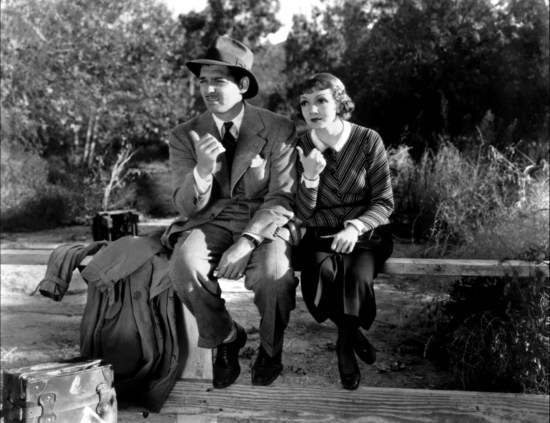
Fortunately, I didn’t have to resort to this

The suitcase is put away. The dirty clothes laundered. The thank-you notes sent.

All the result following your humble blogger’s recent trip to the land of potential future employment, aka Los Angeles, which continues to yield results and, hopefully, keep on doing so.

“Los Angeles? How in the world did that come that about?” you may ask, and probably just did.

I was invited. At the behest of a new media company (as in “new media” i.e. online content, not “a media company that is new”) called AfterBuzz TV that produces a myriad of programs about an even wider variety of topics – all entertainment-based.

This one in particular is called The Unproduced Table Read. As the title implies, after finding a heretofore unproduced script they deem appropriate, they assemble members of their core group of actors and do a table read of the script – first as livestream video, then viewable on Youtube. Following the read, there’s a brief q&a with the writer. Sometimes the writer’s there in person, or if they can’t make it in, done via Skype.

Seeing as how the City of Angels is an hour-long plane ride away, I opted to attend.

They’d found my fantasy-swashbuckler in the archives of the Black List website and thought it fit the bill. The producer contacted me earlier this year, and after some informative back-and-forth emails, it was all set.

Seizing the opportunity of being in town, I also went about setting up meetings of both personal and professional natures. Although the scheduling didn’t work out with a couple of potential representatives, I was able to have some very productive conversations with some exceptionally talented professional contacts.

Networking, people. Establish and maintain those contacts! SO worth it.

But getting back to the table read. It was great. And fun. The actors did a fantastic job, and as a bonus – they really, really liked the script on several levels. I’m quite thrilled with how it turned out.

Was it worth doing? I’d say so, and not just because it got an enthusiastic reception from the people involved. It’s probably a little early to see if it’ll contribute to the career-building aspect, but it definitely makes for a strong marketing tool.

If you ever get the chance for a table read to be done for one of your scripts, take it. You can even put it together yourself. It’s a great way to evaluate the material, plus the actors might provide some unexpected insight. All you need is a workable space and the ability and willingness to feed your performers.

While talking afterwards with the show’s producer and some of the actors, somebody asked what other scripts I had. I mentioned the western. “We haven’t done one of those,” was the reply. Thus raises the possibility of a return trip. Time will tell.

I have written, therefore I will edit

vintage woman office
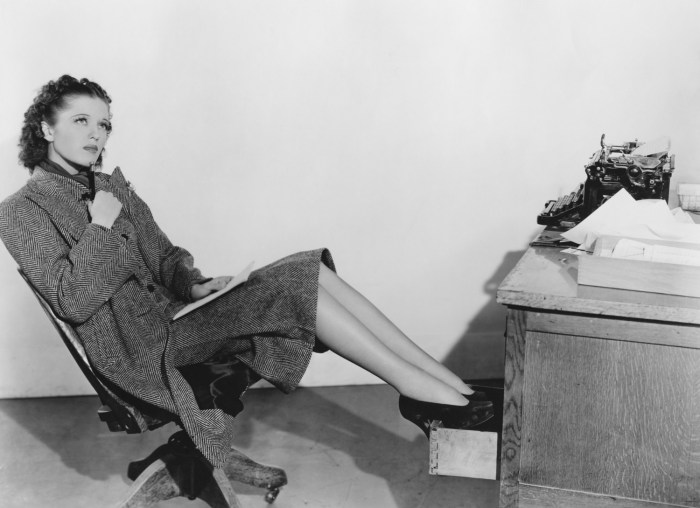
Hmm. What about…? Or maybe…? Possibly even…?

Well, it took a little longer than I’d wanted, but I’m happy to announce that the first draft of the pulp spec is complete; 116 pages of potential cinematic goodness.

So what now?

The usual. Take a little time off, then jump right back in with my trusty red pen, ready to have at it and let loose the dogs of editing. The script itself has already been printed out, along with a change to a line of dialogue.

Even though I kinda-sorta edit as I go along, once I initially write a scene, it’s done and I push forward. Sometimes there’s something about it that’ll nag at me afterward, so I go back and do the necessary touch-up work.

I was tempted to send the script as-is to some of my trusted readers, but at this point, I want to see what I can do to improve it before reaching out.

Also pretty important – it was fun to write. This definitely falls within the realm of “stuff I like to write”. Hopefully others will be as enthusiastic about it when they read it. In a recent email correspondence conversation with another writer, I’d expressed my anticipation about how the script would be received. Their response: “You’re a great writer. Don’t worry so much.” Their kindness was much appreciated.

So for the time being, I’ll be fighting the urge to jump into editing in order to put some space between “just finished it” and “round two underway”. I actually do have a few other projects standing by, so I might redirect my focus on one of those, and then come back to this one in a couple of days.

It was a good and productive couple of months, and I’m quite happy with how this one turned out. I stuck to around 90 percent of what was already in the outline, but as usual, would occasionally come up with a different idea for a scene or sequence. I’d say the changes were definitely for the better.

The hardest part is out of the way, so now begins the next-hardest part: making it better.

Let the ensuing commence!

mountain climber 2
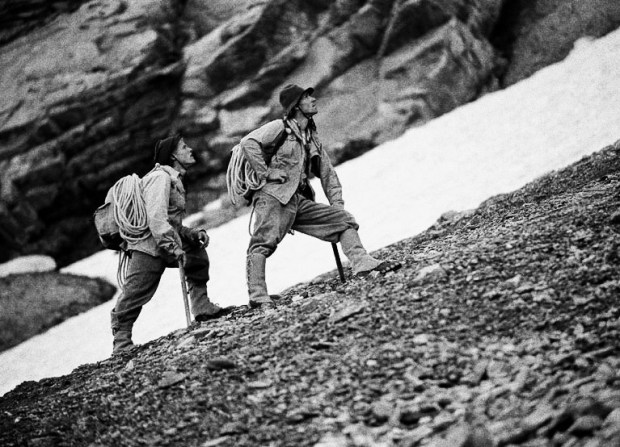
That was when our heroes realized things were about to get a lot tougher from here on in…

When I write out a scene, I have a pretty solid idea of what needs to happen in it; how to make it follow the one before it, and lead into the one after it.

Sometimes it ends up the way I intended, and sometimes it needs a little more punching-up.

And a lot of the time, that punching-up involves making things more complicated, which does a simultaneously effective job of upping the conflict, which was already a necessity.

This whole process most recently came into play while working on a scene in the pulp spec. I’d planned out what was supposed to happen, and on the surface, it seemed okay.

And then I wrote it, but it wasn’t the same as I’d envisioned. It was still missing a vital component, and I couldn’t determine exactly what.

Did it successfully connect the scenes before and after? Was there conflict? Did it advance the necessary elements?  Yes on all counts, but it still seemed off.

I read through it again. It was tight and efficient, and did what it was supposed to. But this second read also revealed the hidden problem that was nagging at me.

It was too tight and efficient. The protagonist accomplished what they were supposed to, but it needed to be tougher for them to do so.

So back I went to the planning-out stage, tossing in a few more wrinkles to make it that much harder for my hero. Although they still achieve their goal within the context of the scene, this time I made sure they really earned it.

Plus, the new complications really emphasized the overall nature of the story, which is always good.

This isn’t to say that every scene has to have some kind of monumental obstacle to your protagonist, but the journey towards their goal shouldn’t be an easy one. It might not even be a physical thing; maybe your hero has to overcome an internal or emotional problem.

It may be easier for you to keep things simple and straightforward, but unfortunately that makes for dull storytelling. Making things more complicated for your protagonist may complicate things for you in putting it all together, but it will definitely make for a better story while also improving your skills as a writer.

Don’t hold back. Put both yourself and your protagonist through the wringer. You’ll both be better for it.