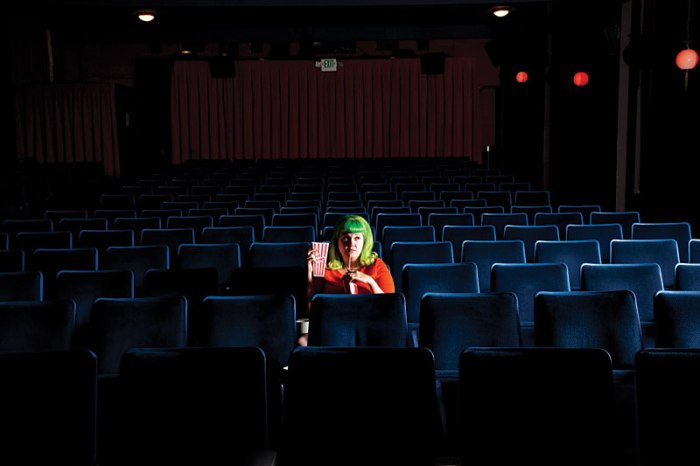
Best seat in the house

alone in theatre
The next person who comes in will sit directly in front of me. Guaranteed.

I recently had the opportunity to revisit the outline for my pulpy adventure story after having not looked at it in several months, and wanted to see what was needed in order to get me a little closer to being able to start on pages.

Time was limited, so I was only able to get through the first half. It was a pleasant surprise to discover that a lot of it still held up, plus an added bonus of some small inspirations resulting in tweaks that strengthened a few of the subplots and tied a few them together in a better way.

And of course, some of these new developments were a total change from how I’d always imagined them. This happens a lot for me.

But what was really the most positive experience out of this was how easy it was to “see” the story play out. It was as if I was in a private theatre, watching my imagination come to life on the big screen, complete with surround-sound. It definitely reinforced the kind of story I’m trying to tell.

When you’re putting your story together, or writing it, or even just reading it, how easy is it for you to visualize it? Do you “see” it as if you’re watching it in movie form? Is it a smooth transition from coming up with the idea to putting it on the page so it reads how you originally imagined it?

And therein lies part of the challenge. It’s just not an easy task, or at least isn’t for a lot of writers. It takes time to find the right words.

You might know what you want to say, but can’t find the exact way to say it, so you tinker around with it, trying and trying until something takes hold. Or maybe after writing it down, actually seeing it on the page makes you realize “this might not have been the best way to do it,” so you jump back in to come up with something new.

Sometimes I even go so far as to narrate aloud while acting out what’s happening for that particular part of the story (or as much as I can while sitting at my desk), which really helps, despite how silly it might look to somebody else.

As writers, the gears of our imaginations are always turning. Always. You could be doing something totally ordinary or mundane, and then, like a bolt from the blue, come up with a solution so perfect and now-obvious that you can’t understand why you didn’t realize it before.

So you work and work, making your writing better to the point that anybody reading your story will eventually be able to “see” it the way you want them to.
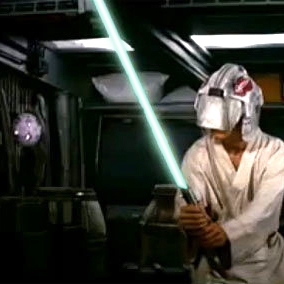
 

The unscientific term would be “gut reaction”

trust your feelings
Learn to trust your feelings. Even with the blast shield down.

I’ve had the experience of working with some writing, both my own and other people’s, that required a second opinion. For some of them, I was the second opinion, while the others involved my work being reviewed.

An experienced professional asked me to take a look at another writer’s script, accompanied with their excitement and enthusiasm about it. Upon reading it, I found it severely lacking in a lot of screenwriting fundamentals (bad structure, shoddy character development, etc.), and said so as part of my notes of what was needed to improve.

I like to read a script twice before giving notes on it, and it took a lot of effort to get through each one – especially the second time. That whole time I was wondering “Where is this enthusiasm coming from?” This person knows what a good script looks like, and this one, to me, didn’t meet any of the necessary criteria. And if they felt this way about this script, could I trust their judgment on others?

Last week I’d been given the offer to have my query letter reviewed. I put it together with the elements I considered vital: quick one-sentence pitch, logline, reputable contest results. As fast a read as possible.

The response read like something churned out by a machine. Their recommendation was to follow “their blueprint”, which involved a lot of fill-in-the-blanks, how it’s similar to successful films (the more recent, the better!), telling the story from only the main character’s point of view, and concluding with “why I think this will be a hit” OR the underlying theme. The end result is several big unappealing blocks of text.

All of this felt totally and absolutely wrong. If I were the intended recipient, I might start reading, but would most likely lost interest very quickly and be very hard-pressed to want to continue, let alone finish it.

(With no intention of ever actually using a letter written following their guidelines,  I put one together and submitted it for review, just to see what they would say. Their follow-up comments reinforced my doubts, but that is a topic for another day.)

As you probably guessed, I’ll be sticking with my original format.

The takeaway from both of these experiences is that a writer must not only develop their writing and storytelling skills, but also the ability to trust their instincts. Know what works, not only for you, but in an overall sense.

Don’t always assume the other person is in the right. Sometimes they’re not.

Everybody will have an opinion about something. You might agree wholeheartedly or think the other person has no idea what they’re talking about. It takes time to learn how to determine which is which. You will make mistakes and bad choices along the way, but make the effort to learn from them so you don’t do it again.

Like with writing itself, the more you work at it, the better at it you’ll become.


The significance and heartbreak of almost

Tim Love/Hellmanns Recipe shoot.
You celebrate your way. I’ll celebrate mine.

Well, that’s that. The results are in, and it looks like it was mighty close. Practically a photo finish. One that will be debated by scholars far and wide long after the fact.

Actually, I have no idea what the results were.

All I know is that the 2015 Screencraft Action/Thriller contest announced its Grand Prize winner and First Place winner, and my western was neither.

(I almost said it failed to get either, but opted not to. More on that in a sec.)

It did, however, place among the top ten finalists, so I guess that’s something.

An honor to be part of this elite group? Most definitely. All ten finalist scripts are being distributed to Screencraft’s network of industry contacts, so all I can do now is hope for the best (while working on new scripts, of course).

That being said, how can I not feel pangs of frustration from not achieving either of the top two? Could the script have been better? Probably. Is it solid enough now? I like to think so. For all I know, it came in third.

I totally get how this is part of the process and should be thrilled the script made it this far. Believe me, I am. Very much so. But I’d be lying if I didn’t say I, along with every other writer who entered the contest, wasn’t entertaining daydreamy thoughts of being proclaimed the winner. But that’s not how it worked out.

Honestly, it hurts. Or maybe stings is more fitting. Either way, it feels like “I tried my best, but it still wasn’t good enough.” This sensation will linger for about a day, eventually fading but not totally disappearing. By that time I’ll have dusted myself off, ready to jump back into my normal routine of full speed ahead. I’ve got a few irons in several fires, plus a few projects I prefer to keep on the QT. For now, at least.

I mentioned being tempted to say the script failed to win. True, it didn’t win, but maybe “fail” is too harsh a word. The script did exceptionally well, which I suppose is a reflection of my writing ability and how it’s developing. This is the third consecutive year I’ve had a script place in some manner in a contest, so I must be doing something right.

So for now I’ll keep in mind that sage piece of wisdom uttered after all competitions:

Just wait ’til next year.

How does your script move?

AMC Pacer
Not that kind of pacing

When you’re reading a script, are you able to notice how time is passing while you’re reading?

Have you zipped through a significant amount of pages without even realizing it? Or does it feel like this thing is just dragging on forever, and that even turning the page is going to require every last ounce of strength you’ve got?

A key factor in writing a script is establishing its pacing, or “how the story moves”. This is one of those skills that takes time to develop.

A script might be overwritten, or at least have too much going on that it distracts you from concentrating on the story. Or maybe it’s written in a flat, almost-monotone kind of way, which makes it tough to stay interested.

Who hasn’t read scripts containing scenes like all of these? And it’s probably reasonable to assume if the script has one scene like this, there are going to be a lot more just like it throughout the whole thing.

So what can you do about it?

The best advice is a two-parter.

The first is a quote usually attributed to David Mamet and/or William Goldman:

Get in late, get out early.

Get to the point of each scene as soon as possible, then get out and move on to the next one. Anything else is unnecessary and will slow things down, and you don’t want that.

The second is a universal rule of storytelling:

Don’t be boring.

Write so it holds our interest. Don’t overdo it, but don’t settle for the bare minimum either.

Get that momentum going, and do your best to keep it that way.

Looking back (and a peek ahead)

sleeping
Me around 10:30 on New Year’s Eve

As the end of the year gets closer, one can’t help but be a little reflective of how the past 12 months have gone, and in this context, it’s all about the screenwriting and its related subjects.

-My western. A labor of love finally put to bed once and for all. This script has gone through A LOT of changes, and both I and it could not have gotten to this point without the sage feedback received from many of my trusted colleagues.

-Other scripts. Over the course of this year, I completed a first draft and two outlines (with a third in its final stages), all for separate scripts. I may not be as productive as I’d like, but think this is still pretty good. I’m hoping that at least two of these will be completed scripts by this time next year.

-Establishing a career. I’ve always said that each draft of every script gets me a little closer to accomplishing that dream of being a working writer. 2015 saw some strong progress on that front. My writing’s getting better, I discovered I’m pretty good at pitching, and found out the hard way what should and shouldn’t go into a query letter. It’s an ongoing learning process, but I’m getting there. Hopes are high of moving to the next level or two in 2016.

-Networking. The number of writers I’ve connected and interacted with has definitely grown by leaps and bounds. Some have been in person, while most have been via social media, but the benefits have been tremendous all around. From exchanging script notes to being a sounding board for ideas to plain old moral support, you couldn’t ask for a more helpful bunch of folks. Hopefully they got as much out of it as I did. Highly recommended.

-Running. After involuntarily taking a year off, I got back into the habit of going for runs and took part in four half-marathons this year. Didn’t set any new records, but stayed within my realm of expectatins. Really glad I did them and already looking forward to the ones next year. How does this relate to screenwriting? Well, apart from the standard quote of “It’s not a sprint, it’s a marathon (or half-marathon, in my case)”, it’s about determination, endurance, perseverance, and setting a goal and working towards achieving it. All necessary elements involved in writing a script.

-The blog. This year saw the wrap-up of my series of interviews with scripts readers and consultants. I still keep in touch with a lot of them, and happy to say that a lot of those posts continue to get hits. Thanks to all of you for that. In the meantime, no big changes planned for what you read around here, but I’ve got a few ideas.

Thanks for reading, happy new year, and may we all get some kickass writing done in 2016.