Ask a Decidedly Ingenious Script Consultant!

Ryan Dixon

The final installment in a series of interviews with script readers and consultants who would be worth your while to work with if you want to get your script in shape. Today’s spotlight is on Ryan Dixon.

Ryan Dixon is a writer, producer and the founder of Tartan Valley Ventures,  a Los Angeles-based creative development consulting firm that works with writers, producers and financiers. As a screenwriter, Dixon has written projects for studios including Disney, Amazon, Universal and WWE Films. Dixon has also worked in film/TV creative development at such companies as Paramount, MGM/UA, IMAX,  Good in a Room, The New York Times and Tribune Media.

1. What’s the last thing you read/watched that you thought was incredibly well-written?

EX MACHINA’s screenplay was masterful. It reminded me of a sci-fi version of those great meta-thriller plays of the 1970s, like DEATHTRAP and SLEUTH. P.T. Anderson did an extraordinary job with INHERENT VICE. His adaptation added a layer of depth and Los Angeles historicity that was missing in Pynchon’s fun, but flawed and rather juvenile novel.

2. How’d you get your start reading scripts?

As a movie-obsessed child, I used to buy shooting scripts at the late and belated Suncoast: The Movie Store. In college at Carnegie Mellon’s School of Drama, reading scripts was part of the curriculum. My first job in Hollywood was interning for Tom Cruise’s former company CW Productions, so from that point on, I’ve been reading and covering scripts professionally in one form or another.

3. Is recognizing good writing something you think can be taught or learned?

I think it’s a matter of taste. Of course, one must have a certain degree of training and skill in order to fully recognize and appreciate any craft. A classically trained musician or a fine arts scholar is better able to pinpoint the minutiae of Beethoven or Picasso. At the same time, taste is a separate sort of knowledge and instinct. A layman can find beauty if they’re a person who can digest and appreciates art for art’s sake. Nickelback’s members are studied musicians, Lisa Frank is a trained artist, and both are wildly successful in their fields. Study can hone and illuminate the elements of a craft but that can only take you so far.

4. What are the components of a good script?

The basic elements (structure, character, theme) must be superiorly executed. Next, there should be something special in the piece. Even if it’s basic genre fare, the script should include elements that make the reader sit up and say, “Wow! I haven’t seen that before.”

5. What are some of the most common mistakes you see?

From young writers it’s always basic mistakes: mechanics, too much dialogue and/or scene direction. Sadly, these mistakes are also the easiest to avoid. What they reveal is that that writer hasn’t bothered to learn the fundamentals. This is fascinating because I can’t think of any other vocation where a similar incident would occur. If one were serious about learning to cook, a cookbook would be the first purchase. If you wanted to scuba dive, you’d take lessons before jumping head first into the ocean. While all the fundamentals are usually outstanding in the work of veteran writers, there is often a lack of courage and conviction in terms of content, as if they’re afraid to try something different for fear of being tossed out of another development meeting. If you are going to make the huge time commitment needed to write a spec script, swing for the fences. The creative dilution process can come later, once the script’s been optioned.

6. What story tropes are you just tired of seeing?

One is when characters (particularly female characters) are described solely on their looks. It tells you nothing about who a character is and often times a bit too much about the writer’s psyche.

Another is the oversaturation of beautiful people playing everyday characters. Even if you look at a movie from as recently as the 90’s, a man could be a regular guy with full chest and back hair and a woman could do a nude scene with a soft, everyday body. In contemporary films, everyone is sculpted, plucked and dyed to perfection. In this renewed Golden Age of Television, character actors are able to once again shine and it really strengthens the storylines and characters (Breaking Bad and Mad Men are obvious examples).

My wife is a screenwriter as well (and very opinionated to boot), so for better or worse, this is a constant discussion and analysis in our household. A big one for her is that men can have high-risk jobs and a strong drive, but if it’s a woman is in the same position, she needs a tragedy or a backstory. GRAVITY most recently did this—George Clooney is an astronaut because of his skill but Sandra Bullock is an astronaut because her kid died.

7. What are the 3 most important rules every writer should know?

-The believability of characters is often more dependent upon the execution of other elements in the script (e.g., plot, theme, dialogue) than anything else. A trap writers (myself included) often fall into is to confuse “believable” with “realistic.” Thus the ever-present tendency to write characters who are mill workers, teachers, office drones, etc. While there’s nothing wrong with this if that’s what your script dictates, it’s also important to remember that some of the most believable characters in cinematic history were also some of the most unrealistic: E.T., Yoda, Kermit the Frog, Mickey Mouse, Bugs Bunny, etc. They’re believable not because you could see them walking down the street, but because the creators of those characters did an amazing job of creating the world in which they existed.

-Master the art of writing a “skimmable” script. We all dream of studio execs, producers, agents, etc sitting down in a quiet space and focusing fully on our script, but the truth is that they are often read in a rush during limited time frames. This is why it’s important to craft your script in a way that a decision maker can easily understand it if they are forced to skim it. You want your script to FEEL like a movie. That means, a reader should be able to zip through it in about 90 minutes. If a first time reader can’t do that, they won’t be able to envision you script as a movie no matter its other strengths.

-This is stolen but golden: “Amateurs sit and wait for inspiration, the rest of us just get up and go to work.” (Stephen King, a favorite author, from ON WRITING). Lightning doesn’t just strike and no one will just hand you anything in Hollywood. Nothing comes easy in writing and you have to work yourself to the bone to get success. I track my time using my iPhone timer and a writer’s log. I make sure to always get in 6 to 8 hours of writing a day. If I’m blocked, I take a brainstorming walk. I’m not perfect. I can procrastinate with the best of them and it took a few years to build to that point. But like any exercise, it works if you keep working at it and pushing yourself.

8. Have you ever read a script that was an absolute, without-a-doubt “recommend”? If so, could you give the logline?

Elizabethtown by Cameron Crowe. I read the script while it was in development and was never so moved or in awe of a piece of screenwriting. In the end however, the final lesson I gained from the experience was that great scripts don’t always make great movies. For whatever reason, the alchemy needed to successfully transform material from page to screen failed. This specific incident was doubly disappointing since the writer directed the piece himself and has shown time and again that he’s an immensely talented director.

9. How do you feel about screenwriting contests? Worth it or not?

There are only a handful of contests that will have an impact on your career if you are a top finisher. I’m hesitant to state that all the others aren’t worth it if only because placing high can be a great confidence boost to any young writer (if they have the money to spend). But if you are cash-strapped, go for the big guns and ignore the others.

10. How can people get in touch with you to find out more about the services you provide?

Go to my website for Tartan Valley Creative Ventures.

11. Readers of this blog are more than familiar with my love/appreciation of pie. What’s your favorite kind?

Boston Cream. As a writer and eater, I like synergy and mixing genres. There’s no pie that does this better.
Working well within my wheelhouse

Hang on. This is going to be quite a ride.

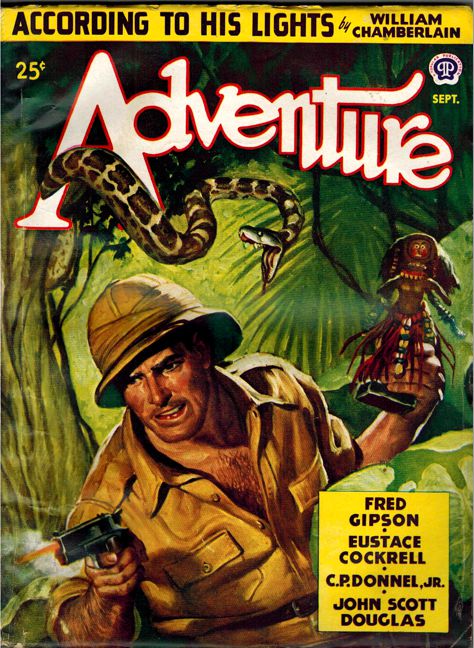
Hard as this may be to believe, but I’m actually surprised at my progress with the outline for the pulpy adventure spec.

It’s coming along much faster than I expected, and the more I work on it, the more I see things that can be tweaked/adjusted/modified so as to improve on the overall story. I’m definitely not saying it’s easy; just easier than it used to be.

Having previous drafts to work with has been a significant plus, and once I fully embraced the notion of “anything can change”, it just took off from there.

But the biggest boon to this whole thing has simply been the pure enjoyment of working on it.

I don’t make any attempt to hide my love and appreciation of the pulp style of writing, so when I work on these kinds of stories, I make a sincere effort to really put it on the page.

The swashbuckling-ness of the fantasy. The rootin’-tootin’-ness of the western. And now the spectacle and wonder of science fiction.

I really do live for this stuff. One of my mantras since the beginning has been “Write something I would want to see,” and all of these definitely fall into that category.

Some may argue that writing material like this is counter-productive to getting a career going. “Nobody’s going to take a chance on something like this from an unknown writer!”, that sort of thing. If all I end up getting out of this is a solid writing sample, that’s fine by me.

Is it wrong to think somebody could read it and say “There’s no way I could get this made, but I really like the writing. Would you be open to working on ____?”? Hopefully not.

I’m taking my time with this, and in no rush to finish. All the work I’ve done on previous scripts is paying off in terms of knowing what to do, figuring stuff out and making the story (and the eventual script) better.

I’ve said it many times before: I am having an absolute blast writing this story, and hopefully those who read the end result will too.

Ask an In-the-Director’s-Chair Script Consultant!

Jeff Richards

The latest in a series of interviews with script readers and consultants who would be worth your while to work with if you want to get your script in shape. Today’s spotlight is on writer-producer-filmmaker Jeff Richards.

Jeff Richards is a story consultant, filmmaker, and writer with over twenty projects either optioned, produced, or sold. His clients range from award-winning novelists to creative writing professors to screenwriters working for major studios. His own writing includes feature films, TV series, graphic novels, and short stories, as well as writing for children’s animation and computer games. His background includes information technology, a decade as an opera singer, and he is an honorary member of the Takaya Wolf Clan of the Tsleil-Waututh First Nation.

1. What’s the last thing you read/watched that you thought was incredibly well-written?

The Karla trilogy by John Le Carré, and if you ever need a lesson that character is king, look to those. The books are often very low on action; they largely consist of dialogue (most of which is people recounting events, as you’d expect in a book about counter-intelligence) and the characters are so magnificent you don’t care that you’ve just spent hundreds of pages essentially listening to people talk. The protagonist for two of the books, Smiley, often isn’t even doing the talking; he’s merely listening. Yet it works.

As for watching, I’ve been re-watching Doctor Who, and “Blink” is possibly the best hour of television I’ve ever seen. Stunningly imaginative and original, incredibly atmospheric, and one of the very best examples of burying exposition I have ever seen in any medium. If I write something that good, I’ll die happy.

2. How’d you get your start reading scripts?

I spent several years as an independent filmmaker and although I did write most of the projects we were developing, I’d occasionally work with an outside writer and help them. That made me realize that I could apply what I’d learned as a writer to helping others with their scripts.

3. Is recognizing good writing something you think can be taught or learned?

Absolutely. The love of words is probably pretty difficult to instill in an adult, but if someone is already interested in it, then it is definitely possible to learn to recognize good writing. The secret is to read widely and actively, both good and bad material; once you’ve read and analyzed enough writing, and worked out why it works or doesn’t, you start to see the patterns very clearly, particularly in screenplays. Objectivity about our own writing? That’s trickier…

4. What are the components of a good script?

What’s most important, and what I don’t see enough of, is a unity of character, plot, and theme. People talk about “character-driven scripts” or “plot-driven scripts” when, in reality, they should driven by the same engine.

As for the rest, it’s about what you’d expect; an active protagonist, strong pacing, dialogue with subtext, an original concept, rising stakes, good conflict, a surprising but inevitable ending… all that sort of thing. However, the only absolute must-have is that it is interesting. For every other must-have you’ll see on a checklist, you can usually think of a great script that didn’t have it. Passive protagonists are death… unless you are talking about The Graduate. Or Being There. But these are scripts by master writers; you need to be very sure why you are going against the grain, and how it makes your story better. (And, as you can tell by the age of the examples, rule breaking isn’t that popular anymore in Hollywood.)

5. What are some of the most common mistakes you see?

Going back to the previous point, a disconnect between character, plot, and theme is common. This usually causes protagonists with unclear goals and flat second acts. However, the most common thing I see is on-the-nose dialogue. Characters who say exactly what they feel and think, or who sum up the central conflict in a speech. If you ever read “You know what your problem is?”, then that’s probably a bad sign.

6. What story tropes are you just tired of seeing?

I think I’m almost unique in that my answer is “none”. Every trope is ready for a great script to make it fresh. Amnesia is the most tired device in writing, yet The Bourne Identity comes along and is fantastic. There’s always room for a great script.

The thing that tires me isn’t story tropes, but clichéd dialogue. Don’t have lines from other movies in your movie. Be original.

7. What are the 3 most important rules every writer should know?

-Read widely; lessons are everywhere, and most of them are outside your genre and format. So if you’re a sci-fi feature film writer, read historical fiction. Read detective comics, manga, sitcom scripts. Expand your brain.

-Writing is rewriting; every first draft is a huge bundle of problems waiting to be solved. So solve it. And not by editing, but by rewriting. Changing words in action or dialogue is just editing. Changing characters, plot points, deleting or adding scenes, that’s rewriting. Do multiple passes, focusing on a different thing each time. One pass (or several, more often) for plot, one for each major character’s dialogue, one for action lines… if you’re building a shelf, you don’t sand and paint at the same time.

-Don’t get hung up on systems. Read how-to books, sure, but pick and choose your advice. Being a slave to a particular checklist is usually indicative of poor writing. If I can tell that you’ve read Save the Cat by reading your draft, then there’s probably too much Snyder and not enough you in your script.

8. Have you ever read a script that was an absolute, without-a-doubt “recommend”? If so, could you give the logline?

Unfortunately, I can’t share loglines due to confidentiality. But for me, “recommend” can’t focus too much on the logline. Concept is important, sure, but the writing is what matters, what makes it a “recommend”. I’ve had writers with straightforward concepts come to me and, after we hone the execution, they get jobs at major studios or get 10 on The Black List. That doesn’t come from the logline, but the execution, how they wrote (and, as per rule 2 up there, rewrote!) Chinatown’s logline doesn’t set the world afire, yet it is generally regarded as one of the great scripts. So a logline wouldn’t really illuminate why I feel a particular script is great. Loglines only show whether something is the type of script an exec should read (e.g. it’s high concept sci-fi and that’s what they’re looking for). The logline gets you the look; the writing gets you the job.

9. How do you feel about screenwriting contests? Worth it or not?

I personally don’t do them very often. I have in the past and placed well, but I never found the contest actually led to a job; what worked for me was my personal networking. However, every path is different and obviously you hear success stories. What is important is that you put in the time, both into the writing (mostly) and into building your career, whether that’s contests, pitchfests, networking… Whatever seems to be working for you, do that. If nothing’s working (and the writing is genuinely where it needs to be!), then change things up.

10. How can people get in touch with you to find out more about the services you provide?

Jeff is no longer actively seeking clients, but is still open to receiving requests via his website at strangeborders.com. He also suggests connecting with him on Twitter.

11. Readers of this blog are more than familiar with my love/appreciation of pie. What’s your favorite kind?

Pumpkin, no question. With fresh whipped cream. A great pumpkin pie will turn me into the seven-year old kid who eats so much he feels sick. It is inevitable.

I probably need help.