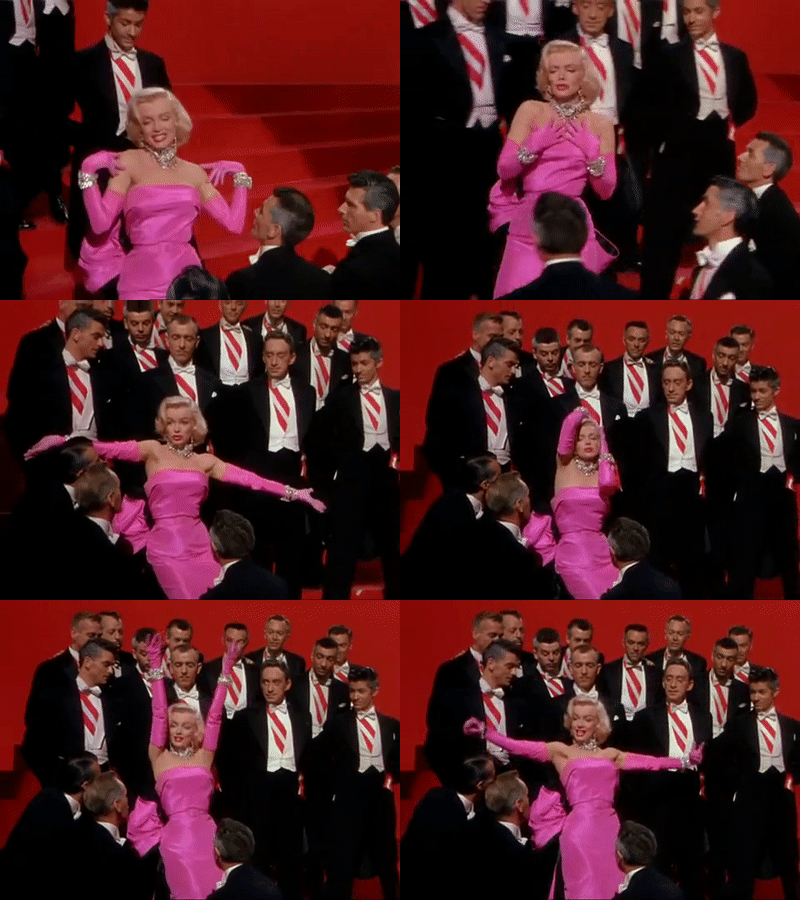
Past You would be really impressed

Ask any screenwriter how their most recent draft compares to, say, their very first one, by which I mean THEIR ABSOLUTE VERY FIRST ONE, it’s probably a sure thing they’ll say something along the lines of “It was awful!” or “An absolute mess!”, or maybe even “I don’t even want to think about it it was so bad.”

Taking a look at some of my first attempts, I can say the exact same thing. Scenes that drag on. Flat action lines, or ones that were way overwritten. Big chunks of text on the page. On-the-nose dialogue that’s pure exposition. Spoonfeeding story details to the reader to make sure they understand what’s going on.

Nothing to be ashamed of. There are vomit drafts, and “looks like my printer vomited words all over the pages” drafts. You gotta start somewhere, and the important part is YOU GOT IT WRITTEN.

Nowhere to go but up, right?

So you start working on getting better. You get feedback. You start to understand why things aren’t working and what you can do to fix them. You learn, and all this new knowledge helps shape the next draft to better than the one that came before it.

You put in the time and the effort and it becomes more noticeable how your writing is getting better. All of those newbie mistakes are a thing of the past. Your script seems more polished. There’s still room to improve, but it doesn’t seem as daunting now, does it?

Multiple drafts and seemingly neverending rewrites are par for the course. It happens to even the most experienced screenwriters. The hardest part is getting that first draft written. Accomplish that and you’re already ahead of the game.

There will most likely be a ridiculous amount of rewriting in your future, and the end result may be totally different from what you started with, but think about how far you’ve come. You probably had no idea when you were just starting out that you’d be so willing to put yourself through all of this, over and over again.

And that might even be for just one script.

Sure, you might be a little embarrassed when you look at your earliest scripts, but look at your most recent draft or the pages you wrote last weekend. As if they’d been written by two entirely different writers. Because that’s exactly what they are.

Past You was just starting out and made a lot of mistakes. Present You knows what’s needed and does it.

And just imagine the skills that Future You is going to have.
Just a little escapist fun

Despite the recent frustration of figuring out how a sequence should play out, I’ve been having a good time with the rewrite of the sci-fi adventure spec outline.

I’ve been working on this off and on for a while – this is probably the sixth or seventh draft of it. While some of the details have changed, a lot of it remains the same. The core concept of it all was what appealed to me from the start.

I get a certain charge out of coming up with these crazy scenarios and high-octane action sequences, not to mention coordinating and laying out all the pieces of the puzzle that is the plot. I always tell writers to “write something you would want to watch”, and this one definitely falls into that category.

Although my stories tend to lean more towards the fantastical, I try to make sure the characters and situations feel real and relatable – or at least as much as they can within the world of the story. Despite the extraordinary goings-on, it’s still about how somebody reacts to what’s going on around them.

I’m currently at the midpoint, so there’s still a ways to go, but like I said, I’ve got a lot of previous drafts from which I can cherry-pick material. There’ll probably be a few more rounds of rewriting, revising, and reorganizing, but I’m still enjoying it.

It’s quite easy to get burned out from working on a story by working longer than you expected to, but I’m fortunate not to have hit that point yet. If anything, I’m more jazzed about it probably because it really feels like it’s finally all coming together.

Not setting up a definitive deadline for having a completed draft, but if I can maintain this pace and output, there’s a strong possibility it could be by the end of the calendar year. Hoping so.

In the meantime, still having a grand old time with it.

Hope your writing this weekend is chock-full of the same sensation.

Only we can answer

After an unexpected break, work has recommenced on fine-tuning the outline of the sci-fi adventure spec.

I don’t know how other writers organize their outlines, but mine tend to be a scene-by-scene breakdown on a Google doc. (Hats off to the users of index cards). Each scene is planned out in terms of what happens, sometimes what dialogue might be involved, and an underlying mindset of “what’s the conflict here?”

Even though I know what I need the scene to accomplish, I may not have all the information I need, so I’ll jot down a note or question in ALL CAPS as part of it (to help me not overlook it). The note or question is something that needs to be addressed, but can’t be answered just yet.

Things like:

-DOES HE KNOW ABOUT THIS? IF NOT, HOW TO DO THAT?

-WHAT CAN SHE DO HERE TO DEMONSTRATE WHAT KIND OF PERSON SHE IS?

-NEED 3 VARIATIONS ON THIS (SEE PREVIOUS DRAFT FOR LIST)

-POSSIBLE CLUE OR HINT HERE TO BUILD UP TO BIG REVEAL

You get the idea.

I find it better to write these down in the outline instead of something separate. I don’t trust myself to be that organized, and my desk/working area is quite a mess. It’s just easier to keep it all in one document.

It’s more helpful to take the extra time to deal with all of these now, rather than jump into pages and have to hit the brakes each time one of these needs to be addressed.

Dealing with these sorts of issues can also prove beneficial because while you’re handling the initial thing, it may also offer a new or at possibly an unexpected solution that can cover a few other things, or add a new detail that adds to or helps the story. It’s happened before.

For the most part, the outline is pretty solid, story-wise, so once all of these notes and questions are covered, it’ll be off to the races. I don’t think it’ll take too long, and shooting for another end-of-the-year finish in terms of completed drafts. One would be nice, two would be better.

It’ll get there, slowly but surely.

-Contest news! My animated fantasy-comedy made Second Round for comedy features with Austin. Another long-time goal achieved, so…yay.

Congrats to all the other amazing writers whose work also made it. I’ll be there to celebrate. How about you?

-As the writers strike continues, it’s taking a toll on the people involved. One of those people is friend-of-the-blog Jenny Frankfurt, who runs the Finish Line Script Competition. She could use whatever help you can provide, so please donate here if you can.

From the archives: Guilty as charged

lardner mugshot
I did it. I’m glad I did it. And I’ll do it again. As many times as necessary.*

Got some excellent notes and pro feedback on the latest draft of the animated fantasy-comedy. Some of the suggestions involved totally cutting out some scenes I loved. It was heartbreaking to do it, but it was about what was best for the script, not the writer, so away they went.

Which leads to this classic post from yesteryear – Sept 2017, to be exact. Time has passed, but the sentiment and mindset remain the same. Enjoy.

The clock’s ticking down to the final deadline for an upcoming contest, so almost all of my energies are being directed at getting the pulp sci-fi in as tip-top shape as possible. Overall, I’d say it’s coming along nicely.

As you’d expect, there have already been some big changes made, with more than a few more on the way.

A major part of some of these changes has involved cutting material that I previously considered untouchable, or at least to do so would have constituted a crime against all that is good and wholesome.

Otherwise known as “killing one’s darlings”.

As you edit/polish/rewrite your scripts, changes will (and should) occur within the context of the story, so you have to deal with the consequences and ramifications of making those changes. And that means gettin’ rid of the stuff you love.

Did I really, really like this line of dialogue or that scene? Most definitely.

Did I cut it without a moment’s hesitation because it just didn’t work anymore? Yep.

Any regrets? Not really. Why should I? It’s all about making the script better, right?

A lot of writers won’t cut something because they hold it too close. To them, their ego takes precedence over the material. If a producer or director says something doesn’t work, and says it’ll have to be cut, what are they going to do? Say no?

It’s very rare that the final draft of a screenplay is exactly like the first draft. Changes will always be necessary, whether you want to make them or not. Much as you might hate it at the moment, make those changes. Chances are you’ll barely remember what was there before anyway.

A screenplay-in-progress is the raw material, and your job as the writer is to continuously work with it and shape it in order to get it to the final version – the one that tells your story in the best way possible.

If that means discarding something for something new, so be it. Even more so if the new something is even more effective.

*that’s no random mugshot. It’s Academy Award-winning screenwriter Ring Lardner, Jr. during the Red Scare.

Seeing some shine on that diamond in the rough

Even as I was getting the latest book ready over the past few weeks, I still made an effort to split time among a few other ongoing projects.

On that list: a severe edit of the animated fantasy-comedy spec.

The previous draft had clocked in at 120 pages, which admittedly is kind of long, especially for an animated story.

So it had to not only be tightened up in regards to what’s on the page, but also the actual number of pages. Fifteen to twenty, while seemingly excessive, felt appropriate.

Armed with some exceptional notes and a strong idea of all the issues that needed addressing, I set to it.

The phrase “kill your darlings” played a significant role during this process. Several scenes I loved were, as pointed out by an extremely savvy reader, more of a distraction from the main storyline and were actually slowing down the read.

Highlight, delete, mourn their demise, move on.

A good number of scenes underwent a major overhaul, including severe tightening up, rephrasing of dialogue, and a whole lot of moving stuff around. Sometimes a change would be made that I didn’t realize needed to be made. That’s always a surprise.

All of this combined ended up cutting 14 pages, bringing the grand total down to 106. Not too bad.

From my perspective, what ended up being the biggest accomplishment was that the whole thing seemed stronger than before; more put-together. It’s been a while since I’ve felt this positive about a draft.

It’s been sent to the latest batch of readers, and I’ve no doubt they’ll do a bang-up job in finding faults and spotlighting what needs work. As they should, and that’s fine with me.

It’ll help the next draft be even better.