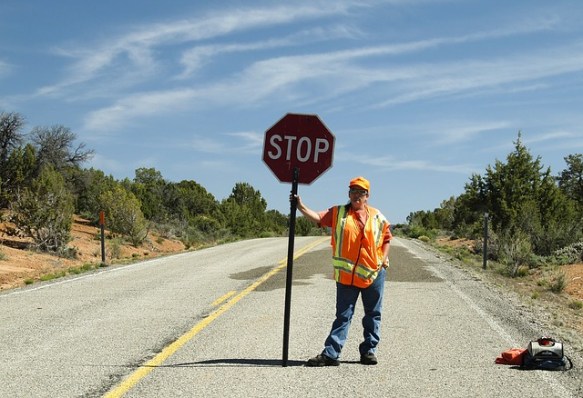
Avoiding the dreaded unfilmable

flagman
Don’t go this way!

I recently had the pleasure of giving notes on a friend’s script. It was an early draft, so it had some of the usual problems that were easily fixable.

But the one thing that really stood out to me was their use of unfilmables.

“Unfilmables?” some might ask. “What are those?”

I’m glad you asked. Here’s an example:

“EXT. PORCH – DAY

Jane sits on the stained deck chair her father bought for her birthday last year.”

If you saw that onscreen, you know what you’d see?

A woman sitting on a chair.

In other words, HOW DO WE KNOW it was a birthday present from her father? We don’t. How can you let us know? Maybe we see the father giving it to her. Or another character asks about it, and she delivers a one-line explanation.

If there’s an important detail to your story, you need to find a way to include it as part of the story, and preferably in the most organic way possible.

What’s on the page is what we see and hear.

Unless there’s a line of dialogue or some kind of action somewhere in there that reveals these kinds of things, the audience has no way of knowing them.

Here’s another:

“INT. KITCHEN – NIGHT

Kevin washes dishes. He thinks about that time he and his high school girlfriend crashed her mom’s car.”

What’s on the screen? A guy washing dishes.

HOW DO WE KNOW that’s what he’s thinking about?

Maybe we see the accident take place. Or hear Kevin talking about it. Maybe the story involves how the accident leads up to him washing dishes.

In my old writing group, one writer was insistent about leaving these sorts of things in. When pressed on why they were so adamant about not being willing to take them out, they’d launch into a long-winded explanation of why it was necessary to include them.

“So if we were watching this, you’d be there explaining things, rather than working them into the story and showing them on the screen?”

I’m not sure if they got the point.

Hopefully you do.

What’s stopping you?

handyman
The ultimate DIY project (film division)

I had the recent pleasure of connecting with a screenwriter who’s working on a feature script, but is also investigating the logistics of developing a short out of it, which includes them having begun connecting with other writers and filmmakers in their area.

I thought that was a great idea, and tossed out the suggestion that maybe they try to make it themselves, as in “just you”. Especially now that most smartphones can double as camera equipment, and film editing software is easily accessible (if not already installed on your computer).

They’d considered this, adding “But I’m just not tech-savvy”.

But you can learn.

If you’re reading this, you’re more than likely interested in screenwriting and/or filmmaking. When you first started out, it’s probably a dead-on certainty that your early works were awful, right?  Looking at some of my first scripts makes me cringe from how bad they are.

But we kept at it, learning and improving along the way. How does your most recent effort compare to that first one? Worlds apart, I’d imagine. You try something, you make mistakes, you learn from those mistakes, and try again.

There’s no reason you couldn’t apply the same logic to making your own short. Sure, there’s a lot more to it than simply pointing your phone and hitting ‘record’, but you gotta start somewhere.

Give it a go and write yourself a short script. Nothing fancy (but do try to make it a good sample of the genre). Anywhere from one to five minutes, spread out over one, possibly two scenes. Two characters, three at best. Try to keep it limited to one location.

Now look at it from the filmmaker’s perspective. Could you feasibly make this yourself? Like how a first draft of a script reads, the end result will not be pretty. At first, you’ll be thrilled at having done it. Then reality sets in and the flaws become that much more obvious.

But you will have done it. A short film, written and produced by YOU.

What you do with it now is up to you. Hopefully, you’ll embrace the learning experience and know what not to do the next time around.

My friend mentioned that once the short got made, which it sounds like they are very intent on making happen one way or another, plans are already being discussed about next steps, which included posting it on YouTube and/or submitting it to some film festivals.

Even though our conversation was solely via email, there was a certain tone to their words that indicated they were quite psyched about jumping into this new venture. I wished them the best of luck and asked to be kept updated as to their progress.

I think they’re off to a pretty good start.

Trying to unlock a key moment

skeleton-keys
One of these HAS to be it

I was hoping to wrap up the polish/revision of the comedy spec this week. Everything was going quite smoothly until I hit a bit of snag when I got to the end of Act 2 – only one of the most important parts of the story. Where things are definitely at the lowest point possible for our hero.

The general consensus of my readers was that the hero was too passive, and therefore needed to be much more active and stand his ground, yet still end up failing. Some suggestions were made, and I’ve been working on making it stronger and more effective.

Which brings us back to right now. As it reads, it’s just not working.

And that’s kind of frustrating.

I know there’s a solution to this, and my creativeness has been working constantly to come up with one that not only works with the context of the story, but seems plausible and believable.

As I said to one of my readers, I tend to overthink this kind of thing. To which they responded with “Remember, this is a story that’s supposed to entertain.”

And that’s pretty important, too.

Hopefully when all is said and done, it’ll do all of it.

-I ran the Giant Race half-marathon on Sunday. Got a small rock in my shoe around mile 7 or 8, but opted to keep going rather than sacrifice the time to remove it. The rock eventually was a non-issue and I managed to just beat my ongoing goal of 1:55 by one whole second – 1:54:59.

One scene, three points

trident
Careful not to get stuck on any of them

After some thorough self-imposed analysis, the revising of the comedy spec is underway. It’s getting easier to spot trouble spots.

There’s one scene in particular that’s giving me some trouble. It’s a pivotal scene involving the main character and offers a revealing glimpse into his backstory. The problem was in figuring out how to best do that.

After much drumming of fingers, rubbing of chin, and a whole lot of attempts, a potential solution may have presented itself. It’s still in the development phase, but for now, quite workable.

One of the first things I learned about screenwriting was what each scene needs to accomplish:  advance the plot, the character, and the theme.

Regarding plot, does the scene move things forward? Does it fall neatly into place in terms of how the overall sequence of events plays out? If you took it out, would it totally mess things up?

I’ve read a lot of scripts where something happens and I don’t know why. Maybe it’ll pay off later? Sometimes it does. Other times, well…

Another handy tip when it comes to advancing the plot in a scene: do it quickly. Get to the point of the scene as fast as you can, then get out. Don’t wait around. Just get out now. Too many times I’ve seen a scene drag on much, much longer than it needs to.

Regarding character, does each scene show them changing a little bit more from when they were first introduced? This doesn’t just apply to the main character. Every character needs to grow/develop. Wouldn’t it be kind of boring to read a story where nobody changes?

And tying it into the advancement of plot, every situation the character experiences should help move their own development along.

Which brings us to theme. The message of your story. This can be a little tricky.

Each scene should tie into the theme, or have it on display in some manner. I recently worked with a writer having trouble tying everything together. We discussed the story and the main character’s internal and external goals. What was the message they wanted to convey? Based on those discussions, we were able to come up with a theme that worked for both the story and as it applied to all of the characters.

One of my favorite examples of a theme in use is BACK TO THE FUTURE. Early on, Marty says “History’s going to change.” And boy, does it. We get a ton of set-up in the first act, and then everything does indeed change in the second act as all of those setups are paid off. Amazing.

Take a look at your latest draft. Does each scene advance the topics in question? If not, do you have a way to fix that so it does? The more you get in the habit of doing this, the easier it’ll get and the faster it’ll become second nature to do it all the time.

An education most painful

scared
Please don’t make me watch that again!

Once again, your stalwart author makes the necessary sacrifices so you don’t have to.

This time around, I had the misfortune of watching an extremely bad large-budget movie from the semi-recent past. It was painfully obvious that a larger percentage of the budget should have been diverted to hiring quality writers, rather than on everything else. A pipe dream, I know.

But trust me. It was bad.

What made it so bad, you may ask?

Oh, where to begin.

My biggest problem was that too much of the story felt glossed over, with vital elements explained in a very lazy and haphazard way, if they were even explained at all. It felt like they were trying to force events to match how they wanted the story to play out, rather than deftly setting things up.

Reasons why something would happen, or were supposed to have happened, seemed to have simply been thrown against the wall, and whatever stuck, that’s what they went with. Did it matter if it fit within the context of the story?

Nosireebob.

Once again, there were too many questions raised that were never sufficiently answered. When this happens, it simply takes away from the movie-watching experience. The only reason I knew the film had to have been around the midpoint area was because of its running time, and NOT because of what had transpired over the course of the story.

I could say I had a vague inkling of what was supposedly going on, but was just never sure, since the story was being told in a very sloppy and unorganized way. It irked me to no end to be see such terrible writing so prominently displayed. And apparently I wasn’t alone in my opinions. The film was a major flop at the box office.

So what silver linings can we extract from this pitch-black cumulonimbus that stole away just under two hours of my life?

-Write a story that’s easy to understand. Keep it simple. This doesn’t mean dumb it down. Keep us informed, unless withholding that information is absolutely necessary.

-Let the story play out organically. Don’t try to force it because that’s what you want to happen. It’s easy to tell when that happens, and it ain’t pretty. If you didn’t put in the effort to figure it out, why should we?

-Have things happen for a reason. “Because it looks cool” is not one of them. Would it drastically change things if it didn’t?

-Set up, pay off. If something happens, we want to see what happens as a result. Don’t leave us hanging. And counter to that, don’t suddenly spring something on us out of thin air. It reeks of desperation. Audiences don’t like that, either.

One of the things I always strive for in my scripts, be they big or small budget, is to respect the intelligence of the intended audience. That is one lesson I believe the writers of this abomination should have kept in mind.