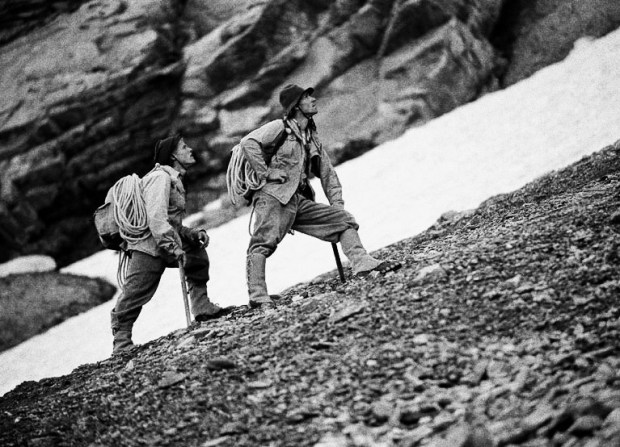
Let the ensuing commence!

mountain climber 2
That was when our heroes realized things were about to get a lot tougher from here on in…

When I write out a scene, I have a pretty solid idea of what needs to happen in it; how to make it follow the one before it, and lead into the one after it.

Sometimes it ends up the way I intended, and sometimes it needs a little more punching-up.

And a lot of the time, that punching-up involves making things more complicated, which does a simultaneously effective job of upping the conflict, which was already a necessity.

This whole process most recently came into play while working on a scene in the pulp spec. I’d planned out what was supposed to happen, and on the surface, it seemed okay.

And then I wrote it, but it wasn’t the same as I’d envisioned. It was still missing a vital component, and I couldn’t determine exactly what.

Did it successfully connect the scenes before and after? Was there conflict? Did it advance the necessary elements?  Yes on all counts, but it still seemed off.

I read through it again. It was tight and efficient, and did what it was supposed to. But this second read also revealed the hidden problem that was nagging at me.

It was too tight and efficient. The protagonist accomplished what they were supposed to, but it needed to be tougher for them to do so.

So back I went to the planning-out stage, tossing in a few more wrinkles to make it that much harder for my hero. Although they still achieve their goal within the context of the scene, this time I made sure they really earned it.

Plus, the new complications really emphasized the overall nature of the story, which is always good.

This isn’t to say that every scene has to have some kind of monumental obstacle to your protagonist, but the journey towards their goal shouldn’t be an easy one. It might not even be a physical thing; maybe your hero has to overcome an internal or emotional problem.

It may be easier for you to keep things simple and straightforward, but unfortunately that makes for dull storytelling. Making things more complicated for your protagonist may complicate things for you in putting it all together, but it will definitely make for a better story while also improving your skills as a writer.

Don’t hold back. Put both yourself and your protagonist through the wringer. You’ll both be better for it.
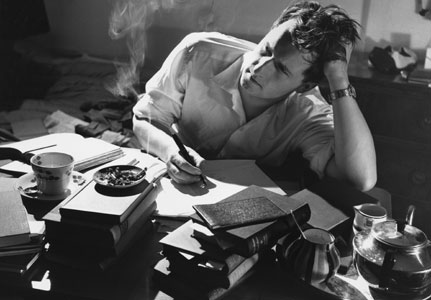
The goodness of just over 50 percent

writer
That was just the warmup

A most pleasant update to report regarding progress on the pulp spec: the point of no return has been reached (and even slightly surpassed).

Something incredibly significant has just happened to my protagonist, and everything between here and the end of the story is not only about answering the central question and everything connected to it, but also dealing with this important new development, which is also tied in to the main storyline.

From here on in, the stakes are consistently rising and my protagonist’s situation will continue to get more and more difficult.

As it should be.

Fortunately, a lot of these details were mapped out during the outlining process, which has once again proven to be extremely helpful. But even that’s not written in stone; one big sequence was deemed too similar to another, so the relevant elements of both were combined, which actually helped tighten things up on several levels.

To be perfectly honest, there’s not much I can gripe about regarding working on this script. It’s in a genre I love; this was always “something I would want to see.” I’ve made a real effort to make this an exciting read, both in terms of story and how it actually reads.

Like with some of my previous projects, I’m continuing to have a fantastic time writing it, and hopefully that excitement and enthusiasm will be evident on the page.

Sure, the ongoing plan of 2-3 pages a day has been slightly off, so it’s taking a bit longer than originally anticipated, but that’s par for the course for me. But every writing session, no matter how long or short, gets me a little more further along.

Today, the midpoint. Next up – pushing my way forward to the next plot point, which is about halfway through the second act of Act Two.

Words properly arranged

typist
Behind that disarming smile lurks the constantly-devising mind of a creative genius

Jumping back to focus on the pulp adventure spec, along with a return of that certain ZING! one gets when quite psyched about a story. Yep, still going strong.

Gotta say, this whole “break down each scene to its individual elements” thing is really working out nicely. It’s tremendously easier to have a line-by-line description of what happens rather than trying to figure it all out on the fly.

The most recent wrinkle has been manipulating the events that lead up to and just after the midpoint of the story. I originally had the antagonist explaining their sinister plan, but seeing as how it sounded a lot better in the outline than it does on the page, there’s been some extensive editing, rewriting, cutting and pasting going on over the past couple of days.

And this was just for a couple of pages’ worth of material.

Among the pleasant surprises:

-discovering that a line or action in one scene could easily be relocated, thereby making the new scene that much stronger. All the elements were in place; it was just a matter of finding the right order in which to put them.

-being reminded of the concept of “less is more”. Some scenes as originally written turned out to be simply overly complicated – just too much going on. By eliminating everything EXCEPT what’s necessary in that scene naturally tightens things up, but also really moves things along and gets the point across that much faster.

-figuring out a way to present details of the plot without being so blatantly obvious about it. Implying seems to be much more effective.

It took a while, but the changes that have been made have proven to be most satisfying. No doubt there will be more of this sort of thing in future drafts, but for now it works.

Fine-tuning in progress

lady-scientists
Aha! Almost missed that extra “the” in that sentence!

As of this writing, the early bird deadline for the Nicholl is about a week away. After some back-and-forth, I decided that, yes, I’ll take the plunge and once again submit my western.

Last year it made it to the top 15 percent, which isn’t bad, but I know it can do better.

And that’s what the next couple of days are all about: taking what I consider to be a pretty solid script and doing a little more editing/tweaking/polishing to make it even stronger.

For a long time I was convinced there was nothing else to be done on this script. Now I’m thrilled to have been so completely wrong. It doesn’t need a lot, but probably just enough to make a significant difference.

Earlier this year, I got some really good professional notes on it that raised some questions I hadn’t considered before. Implementing the suggested fixes really would make a difference.

So that’s what I’m currently in the process of doing. Nothing major, but some little tweaks, modifications, and minor rewriting here and there. And as is usually the case for me, these aren’t as insurmountable as I’d expected.

Part of this also involves going through the entire thing line by line, red pen in hand, just in case anything catches my eye as if to say “CHANGE ME!” Surprisingly, there have been quite a few of those.

I couldn’t say the last time I actually read through the script, but it’s definitely been a while. And it’s probably safe to say that this long stretch of not looking at it has definitely helped in enabling me to identify what needs editing/fixing.

And not to toot my own horn, but gosh this is a fun read.

In retrospect, I probably should have done this before submitting the script to PAGE, but if all this helps it do better with the Nicholl, who am I to complain?

Why, and why now?

studying
A pair of questions to study thoroughly

An associate of mine is in the early stages of developing a low-budget film. Call it pre-pre-pre-production. The script is part of that (as in “about to be written”), and I was asked to take a look at the outline and offer up my two cents on it.

It wasn’t bad. The structure was a little wobbly, but not too far gone, and a few other minor issues, but overall, I’d call it a fairly solid attempt.

I totally got what kind of story they’re trying to tell, but reading this outline definitely raised some important questions.

Two, to be specific.

First: why is this happening?

I don’t mean this is in a negative way, like “why are you even bothering?” Quite the opposite.

More of a “does what happens in this scene adequately follow what’s come before it, and does it do an equally good job leading into what comes next?” sort of thing.

As it reads now, it felt more like a lot was happening because the story required it to, rather than letting it all unfold smoothly and organically. There wasn’t enough setting things up in order to pay them off later. Almost like each scene is saying “This MUST happen HERE, logic be damned!”

A should lead to B, which leads to C, and so on, but then you also find out that not only did A lead to B, but it also resulted in H.

Second: why is this happening now?

This applies more to the primary storyline. Things are taking place, but I never really got a sense of how or why it all started. A lot happens after whatever event triggered it all, but there’s no indication of exactly what that trigger was. When I asked the writer about it, even they admitted they didn’t know and were having trouble trying to come up with something.

A writer needs to know every part of their story; what things were like before it started, how it started, what happens, and how it ends. Sometimes you can even throw in what happens next. No matter what approach you take, all of these elements play a key role in the telling of that story. If one of those elements isn’t there, it just gums up the whole works and you’re left with an incomplete story.

The writer was very appreciative of my comments and was looking forward to finishing the latest draft in order to provide answers to the questions I’d raised. It’s probably safe to say we’re both quite interested to see how it all turns out (although I suspect I come in a close second).