Feeling triumphant, if only for a few minutes

By the time you finish reading this sentence, I'll already have gotten back to work
By the time you finish reading this sentence, I’ll already have gotten back to work

Well, it’s done. I got to type in those glorious words “Fade Out”, thus bringing to a close the massive rewrite of the western.

The script now clocks in at a respectable 114 pages. No reason a few more can’t be trimmed with some diligent editing and polishing.

Normally this would be the part where I’d say how long this has taken, but to be honest, I really don’t know. I haven’t been keeping track. Two months, maybe? Something like that.

But the important thing is that I got it done. What a grand feeling of accomplishment. It’s quite nice.

All that work and effort has paid off, resulting in a pretty solid piece of material to show for it (if I do say so myself).

As much as I’d like to sit back, rest on my laurels and enjoy the moment a little longer, there’s still a lot of work to be done. Once this latest round of editing is done, the call goes out to friends and trusted colleagues for feedback, which will no doubt result in more editing and polishing. And then it’s on to shelling out some bucks for professional notes.

From there? I don’t know. Contests? Query letters? That stage is pretty far down the line, so not too worried about it just yet. Right now it’s all about making the script as bulletproof as it can be.

During this entire time, when the opportunities present themselves, work resumes on the low-budget comedy, the mystery-comedy and possibly the pulpy adventure. Feeling confident at least one, possibly two, could be done by the end of the year.

All part of the never-ending process.

That moment of clarity

Don't you love when these show up?
Don’t you love when these show up?

I’ve always said that with each draft of every script I work on, my writing gets a little bit better. Definitely a “learn as you go” scenario.

If you looked at my earlier work, you’d probably say it was pretty basic. Very straightforward. Average. With the later stuff, you’d see improvement. Better, but still some room to grow.

Among the helpful comments I received regarding the previous draft of my western was “give us more flair in the prose…make the details a bit more colorful.”

This can be a trap a lot of writers fall into. You want your writing to be vivid and descriptive, but it’s easy to overdo it and before you know it, the storytelling overshadows your actual story.

Since I started the rewrite, I’ve been doing my best to maintain an equal balance of both so the story is told in an entertaining way and easy for a reader to visualize what’s happening. If they feel like they’re actually there, experiencing it along with the characters, then I’m doing a good job.

Working on an action sequence earlier this week, I was struggling to come up with the best way to describe the events as they played out. Ordinary words weren’t cutting it, and the ever-present thesaurus wasn’t offering much help either. I knew what I wanted to say, but couldn’t come up with the right way to say it.

You can describe how something happens, but is it strong enough to hold somebody’s attention? Is there a “more colorful” way to say it? How could you add “more flair”?

If I were reading this, what would make me want to keep going? What would compel me to want to know what happens next?

Since this is, at its heart, my take on a pulp story, I decided to embrace that aspect and run with it. I mean really run. Let loose and color those words in the perfect shade of purple.

To say it made a difference is putting it mildly.

Words and descriptions that refused to make themselves known before were sprouting up left and right. This was exactly how I imagined the sequence and exactly how it should be written.

A key point to remember in all of this is that this is what works for me. Your writing and your style are totally your own, and only you can find the best way to do it.

I won’t say that everything from here on in for me will be as easy or productive, but it’s definitely a change for the better, and I for one am looking forward to seeing the end result.


Run at your own pace

It's the total opposite of a sprint
It’s the total opposite of a sprint

For the past couple of days here at stately Maximum Z HQ, yours truly has been doing everything possible to fight off a nasty viral infection (Note to self – invest heavily in Kleenex and Halls cough drops) because I’m doing my first half-marathon in over a year this weekend. I do expect to be well enough to run. Fingers firmly crossed hoping to at least break the 2-hour mark.

As a result of being sick, I’ve been home from work the past couple of days, which means a little more time than usual to work on the western rewrite. Latest update: page 38.

When I have a lot of time to write, I’ll give myself a short break after reaching a milestone, such as the end of a scene, or x number of pages written or after a certain amount of time (this also helps prevent premature burnout). Sometimes break-time involves perusing social media or screenwriting forums, just to see what’s going on out there.

What’s been going on this week has been a flurry of activity among my peers. One got a manager. Another finished their latest draft. Another had an agency request their script after a pitch.

And there’s me, filling a wastebasket with snotty tissues, coughing up things of a color not found in nature, and hoping to get to the bottom of the next page before the day is done. Slightly disheartening, to say the least.

But, like when I run a race, I remember that it’s different for everybody. I’ve been working on this rewrite for quite a while, and have confidence that it’ll be done sooner than I think.

I’m also overseeing all of the “Ask a…!” interviews, and have now added this into the mix.

Oh yeah, and training runs.

When you finish a race, you get a medal, and you wear it with pride. You’ve earned it. You finished an hour behind the winner? Big deal. Chances are you didn’t do it to win. You did it to test yourself, to see how you could do with this self-imposed challenge.

When you write a script, yes, you are going up against every other writer out there, but you do it the way that works best for you. You can only manage 30 minutes a day? That’s fine. You tell yourself you’re going to write at least 3 pages a day, and you actually do? Fantastic.

Will others get done before you, or accomplish things faster than you? Of course, but that’s nothing for you to worry about. Focus on you, not them.

I think it’s absolutely phenomenal that these other writers have each reached a certain point with their writing and careers. And so will I. Maybe not as fast, but it’ll happen.

Just gotta keep working at it.

See you at the finish line.

Am I wrong, or just stubborn?

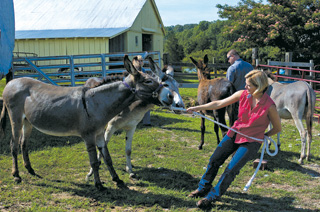
Sometimes you're the puller, and sometimes you're the pullee
Sometimes you’re the puller, and sometimes you’re the pullee

Ever since I started working on the western, a lot of comments have been made pertaining to the belief that certain aspects of it are just not believable (including the always-popular “It’s not historically accurate.”). Therefore, the story doesn’t work.

But I didn’t let that stop me from writing it. In fact, a majority of the notes on the previous draft were quite complimentary and enjoyed the originality and execution of how it all played out.

Jump to the present. I’ve recently become involved with an online writing group. Despite some negative experiences in the past, this one came recommended, so I’m just starting out with them.

Since I don’t have pages for the western rewrite yet, I sent in a revised version of the logline. In all honesty, I don’t really like it. It feels very lacking and incomplete, hence my need for help.

So far, only two people have commented on it, each saying they cannot get past the number of ways this idea can’t work.

Argh.

This kind of response has always bothered me. As writers, our imaginations are the biggest tools in our arsenal. The possibilities of what we can come up with are endless. Just because it’s not how you would do it means my way is wrong; we’re just taking different approaches.

I’ve never been one to use “because I say it does” as a counter-argument, and will never, ever say “you just don’t get it”. I prefer “I can make it work,” and will spend a lot of time and effort figuring out how.

Which pretty much sums up how I’ll deal with this for now.

Like I said to them, there’s a solid logline out there somewhere. It’s finding it that’s the hard part.

Beginning anew

blackboard
The next necessary step to moving forward


Hi there. Nice to be back. And to all you new readers out there – welcome! Feel free to take a look around.

When last we spoke, I was about to embark on a major rewrite of two outlines.

One of them is just about finished, while the other is somewhere in the early parts of Act 2.

Neither has been easy.

The toughest obstacle to overcome has been hanging on so tightly to that which has come before. Significant changes have to be made, or there’s no point to the rewrite.

This isn’t to say I’m totally disregarding what I’ve already written. For example, in a previous draft, a character is killed in a certain way. In this new one, the same method of killing is used, but for a totally different character in a different scenario, and it now holds a lot more significance in terms of the overall story.

While you can’t force yourself to come up with new ideas, you can challenge your creativeness by simply asking “What’s already here is good, but what’s another way this could happen?” There are always options and choices. Don’t limit yourself. Have fun with it.

Another benefit to these rewrites is since I have a fairly strong grasp of how the stories are supposed to play out, I can now concentrate on building up character development (something pointed out and recommended by several note-givers), which also allows for some beneficial quiet and revealing moments between rousing action sequences.

As much as I enjoyed coming up with a lot of those sequences, several have been cut in order to focus more on the characters. I’ll miss them, but they had to go (and could be possibly be resurrected for future use, as mentioned above).

Results so far have been encouraging, but I won’t really know until actual pages get written.

Corny as it may sound, letting yourself develop new ideas and approaches really is quite liberating. And the more you do it, the easier it gets.