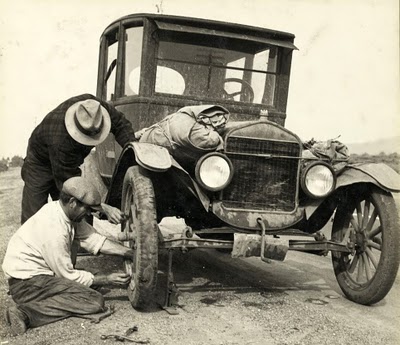
Tire, meet nail

flat-tire
You don’t expect it, but it’s good to prepared for when it happens

There I was, happily churning out pages for the pulpy adventure spec. The daily output was respectably above average.

(Gotta say, this new practice of writing out/establishing the beats of each scene has proven invaluable.)

If I could maintain this kind of pace, dare I even contemplate the possibility of having a completed draft, if not by month’s end, then maybe by mid-February?

But like the man who operates the guillotine might say, let’s not get too far ahead of ourselves.

Story-wise, things are still pretty solid, save for a previously unforeseen wrinkle: I need to do some emergency revision regarding exactly where and how a supporting character is introduced.

What was in the outline is completely different from what ended up on the page, so looks like I’ve given myself a few options:

  1. Leave it as is, but come up with how to tie everything together. A few possible solutions here. Not crazy about it.
  2. Go back and rewrite so it plays out as originally planned. It may lack some of the punch I was hoping to start with, but that sequence already has a significant amount of “attention-grabbing oomph” to begin with.

Some alternate approaches are currently under consideration, as are those of a drastically different nature. It’s also being discovered that implementing some of these changes could actually assist in reducing the number of pages, which was going to happen anyway. Only now it would be sooner. Not a bad result.

No matter which I choose, there’s some serious editing and rewriting in my immediate future.

This whole scenario definitely falls under the “kill your darlings” category because even though I really like what I’ve already written, as we all know, fixing the story takes precedence over placating the writer’s ego.

Keeping with the metaphor of this post’s title, what initially felt like a major problem is, after some careful analysis, evaluation, and plain old level-headedness, slowly developing into more of a bump in the road.


Good or fast? Pick one.

hurdles
Careful! All too easy to end up flat on your face.

As some of you may recall, earlier this year I had to get a script done in order to send it to somebody who’d requested to read it. Seeing as how I had all of eight pages written, I wanted to finish it and sent it out as soon as possible.

It took a grueling 10-day writing marathon, but somehow I managed to do it. I got a draft written, polished it up and sent it out.

It was quite an experience, and the end result could best be described as…adequate. I’ll be the first to admit the script still needs a ton of work.

My sole objective was simply to get it done to the best of my ability in as short a time as possible. Would I have benefited from more time? Of course, but at the time, it wasn’t an option.

Fast forward to the beginning of November. My goal: have a completed draft of the latest project by the end of the month. Sadly, I wasn’t able to get as much writing done as I’d hoped, so I’m heading into December with a script that’s right at the halfway point and the intention to have the whole thing done by the end of the year.

Sure, I could push myself through that exhausting process of cranking it out just to get it done, but by working with a slightly longer timeframe, I can take it slow and spend more time fine-tuning the script. In theory, this increases the likelihood the end result will be more acceptable and not require as much extensive follow-up (i.e. rewrites).

Would I love to be done with this draft sooner rather than later? Again, of course. But I’m also willing to be patient and focus on a few pages at a time. If that means it takes me until the end of the month/year to have a quality script ready to go, so be it.

Everybody writes at their own pace. Some are extremely prolific, some aren’t. It doesn’t matter how many pages you write. The important thing is that you’re actually writing.

This whole process can seem excruciatingly long at times, and we all want to produce lots and lots of quality work. But it already takes time to learn how to do it properly, let alone effectively. Patience is one of those things that gets easier the more you work on it.

There’s nothing wrong with churning out a draft in record time, but be aware that focusing on quantity rather than quality will definitely be reflected in those pages. I went through this firsthand, and definitely see it as a positive learning experience. I know I can write something quickly, but also know it’ll require a lot of cleanup work.

But given my druthers, I prefer to take my time. It’s less exhausting.

Pacing & page numbers

number-line
Looks like there’s a lot going on up ahead

When you start reading a script, you tend to recognize pretty quickly whether or not the writer knows what they’re doing. Their mastery of the craft (or lack thereof) will become soon apparent.

Bad formatting. Misspelled words. Unfilmables. On-the-nose dialogue. Cliches as far as the eye can see. Quite a checklist.

Find one or more of these early on, let alone just on the first page (which does happen), and there’s not much hope of improvement. You’re left with no choice but to force yourself to push forward. Maybe once in a while, you glance up at the upper right corner of the page/screen.

Your shoulders sag. “I’m only up to page ____? This is taking forever!” you exclaim. Making it to the end has suddenly become a question of “if”, rather than “when”.

Now let’s examine the other side, where the writer is in total control.

You encounter writing so sharp and descriptive, you can easily “see” what’s happening. Dialogue that’s not just crisp, it practically crackles. Characters who feel and talk like real people. All of it taking place in original and entertaining situations.

You become so wrapped up that you can’t wait to get to the bottom of the page so you can move on to the next one. And maybe once in a while, you sneak a glance at the upper right corner.

Your eyebrows shoot up. “I’m already at page ____? Wow, this is just zooming by!” you exclaim. You eagerly dive back in, more than ready to continue because you simply can’t wait to see what happens next.

Now here’s the big question for you, the writer:

Of the two experiences listed above, which do you want the reader to have when they read your script?

Do you want them to be bored and see reading your script as a chore that ranks up there with cleaning out the cat’s litterbox or listening to a timeshare presentation?

Or do you want them to be so involved, their attention so riveted to the tale being told in your script, that nothing short of a major crisis or natural disaster could tear them away? (Not to diminish the intensity or significance of major crises or natural disasters, but you get the idea)

It’s tough to be that objective when it comes to reading your own material. You think it’s good (“How could anyone not like it?”), but every reader has their own criteria for what works and what doesn’t. The challenge is crafting together a script so rock-solid that not liking it is not an option. Not sure if yours is? Seek outside opinions. Rewrite with the mindset of “how can I make this better?”.

As screenwriters, our primary goal is to tell an entertaining story. The last thing we want is for someone to be easily distracted by something/anything else when they’re supposed to be reading (and in theory, enjoying) our scripts.

Expiration date: NEVER!

arthur dent
Don’t throw in the towel just yet, Arthur

A friend emailed me earlier this week to vent his frustration regarding the latest development for pitching his TV pilot. Suffice to say, it didn’t go the way he’d hoped.

“Writing is hard work for me, and to have a project like this dismissed completely deflates me. I think I need to set a deadline (end of 2016?), and if I haven’t gotten a sale or at least representation by then, exit, stage left.”

I can totally sympathize. Who hasn’t been in that boat before? You try and try, feel like you’re making no headway and going nowhere fast.

But setting up a deadline of when you’ll stop once and for all?

Um, no.

As we all know, this is not an easy thing to do. The odds are already stacked against us, and it takes an extraordinary amount of effort, determination and perseverance to keep moving forward. And that’s just to get your first break.

I of all people can attest to feeling like nothing good is ever going to happen for me, and why again am I putting myself through the agony of all of this?

Because we’re writers. WE WRITE BECAUSE WE LOVE DOING IT.

For a writer willing to give up writing is, to quote the late, great Vizzini, inconceivable. As crazy as it sounds, I’d rather write and continue to fail than not write at all. (But in theory would be improving after each failure, thereby resulting in an inevitable success.)

DON’T GIVE UP. You never know when things will work out for you, so continuously having at it will always increase your odds.

Continue to work on getting better. Even if only a handful of people read your stuff and like it, that’s still a victory. And they do add up.

IT’S A MARATHON, NOT A SPRINT. It takes a very, very long time to get to the finish line, let alone at your desired pace. And even then, you’re always striving to improve on it. Take this from someone who writes screenplays AND does half-marathons.

Believe me, there will be shitty days. Lots of them. You will be angry and frustrated. You will see others succeed while you feel like you’re going nowhere. It happens. But that’s the price you pay for setting off on this seemingly impossible journey.

But also keep in mind that you’re not alone. There are lots of us out on a similar path. Feel free to make the occasional turn so your path intersects with somebody else’s. It can help make the journey a bit easier.

My friend responded with a note of thanks and gratitude, which included “I’m ultimately a storyteller, a writer. This is what I exist to do, even if my audience is a small one. I will work hard to find it and share my stories.”

Couldn’t have said it better myself. Hang in there, chums.

How does your script move?

AMC Pacer
Not that kind of pacing

When you’re reading a script, are you able to notice how time is passing while you’re reading?

Have you zipped through a significant amount of pages without even realizing it? Or does it feel like this thing is just dragging on forever, and that even turning the page is going to require every last ounce of strength you’ve got?

A key factor in writing a script is establishing its pacing, or “how the story moves”. This is one of those skills that takes time to develop.

A script might be overwritten, or at least have too much going on that it distracts you from concentrating on the story. Or maybe it’s written in a flat, almost-monotone kind of way, which makes it tough to stay interested.

Who hasn’t read scripts containing scenes like all of these? And it’s probably reasonable to assume if the script has one scene like this, there are going to be a lot more just like it throughout the whole thing.

So what can you do about it?

The best advice is a two-parter.

The first is a quote usually attributed to David Mamet and/or William Goldman:

Get in late, get out early.

Get to the point of each scene as soon as possible, then get out and move on to the next one. Anything else is unnecessary and will slow things down, and you don’t want that.

The second is a universal rule of storytelling:

Don’t be boring.

Write so it holds our interest. Don’t overdo it, but don’t settle for the bare minimum either.

Get that momentum going, and do your best to keep it that way.