Ask a PAGE-winning Script Consultant!

Scott Parisien

The latest in a series of interviews with script readers and consultants who would be worth your while to work with if you want to get your script in shape. Today’s spotlight is on Scott Parisien, a mentor, analyst and writer with Script Reader Pro. He wrote the feature FOXTER & MAX in 2019, and his script INCISION was a Bronze Prize Winner in the 2013 Page International Screenwriting Competition.

1. What’s the last thing you read/watched that you thought was incredibly well-written?

There have been many movies this year I felt were actually quite well written. Sadly, most fell outside of the studio system or did not come to the big screen, and if they did, it was barely a blip on the radar. Movies like The Way Way Back, The Spectacular Now, Out Of The Furnace… these really focused on the characters and their journeys, and were filled with touching moments and emotional beats I really identified with. They had characters that were rounded and dimensional and deeply layered. This is what we don’t really get in the studio system any more. But two films that really hit that nerve in the system were The Fault In Our Stars and If I Stay, which were both adaptations, which explains why the characters were more able to be identified with. For me, it’s all about connecting with the characters on a deeper field. As far as the blockbusters, the only one I felt was well written, due to the intelligence of the script and the overall theme of the story, was Dawn Of The Planet Of The Apes. It had such heart, such an identifiable father/son struggle, and themes that worked on both the human and ape sides of the story. I found it quite powerful because of this, and the effects and action really did accent it rather than overwhelm it for me. I wish more blockbuster studio films managed to achieve the same.

2. How’d you get your start reading scripts?

Many years ago, I received a grade of Recommend on two scripts through what was then Script PIMP (now Script Pipeline). I began a great relationship with the guys who ran it and when they had a spot come open they gave me a chance to show what I could do, as I was working on my own consultant service on the side and had experience with this. I then went on to work quite successfully with them and was a senior story analyst, being there for over 5 years. I’ve been running my own service all along as well, and now work with ScriptReaderPro.

3. Is recognizing good writing something you think can be taught or learned?

I’m not sure it can be taught, or even learned. I believe certain people have an inert skill for identifying good stories and good writing, much like Simon Cowell has a knack for recognizing talent and potential in a singer’s voice. Certain people can see that special spark on the page, within that voice and writer. I don’t think just anybody can be a screenwriter. Not only does it have certain areas of craft that must be mastered and manipulated to a person’s style and form, but there’s also a very special art to it. Some people don’t believe there’s an art to screenwriting, that it’s just a blueprint for a movie, but the great writers truly do put together a masterful piece of art in their screenplays. Not everyone can do it, and that’s why 99% of screenwriters tend to fall short of becoming that professional writer we all strive to become.

4. What are the components of a good script?

This is tough because there are so many things that need to be in a script to make it really stand out and resonate above the piles of not so great stuff. Writers tend to focus so much on their “rules” like format and saving the cat: exact page beats and such. But the greats, they worry about layers and nuance and emotional connection. Things like character development, flaws, obstacles. For me, it’s all about the flow of the story, the pace at which it pulls me through the basic structure all screenplays have. That will really make me sit up and take notice. The best screenplays are the ones you never stop to see what page they’re on, or what act you may be in, because it has seamlessly pulled you deep into that world. And that happens very, very rarely.

5. What are some of the most common mistakes you see?

For me it’s not about spelling or grammar, or whether something should have been in CAPS or not. The biggest mistake I see is screenwriters not doing all they can to suck every last drop out of a scene. They are too soft, or too vague, or talking heads with no real substance. These screenwriters lay down the surface and don’t seem to take the time to really dig in and crack the surface to see what is really happening underneath.

6. What story tropes are you just tired of seeing?

I’m actually sick and tired of the main character’s motivation being a dead wife. So many scripts these days and pitches rely on the protagonist being driven toward his goal by the death of the woman he loved. Of course this creates a strong emotional connection as we’ve all lost a loved one in some way or another, but it’s now so cliché it just comes off flat and not interesting in any way.

7. What are the 3 most important rules every writer should know?

1) Take your time. If you’re writing a spec, you have all the time in the world, as well as only one chance to impress. Too many writers rush and don’t let a script really simmer and breathe before they stamp it complete.

2) Find your voice. Don’t write in every single genre because you have an idea you think is good. Choose your style and your voice. It’s hard to make your mark as a horror writer if you submit and they want more, and all you have is a children’s Christmas movie, a western and an emotional drama.

3) Choose your concepts and stories carefully. It’s hard to get read in this business as it is, but even harder if the idea you have isn’t something that will get people excited. The best way to think of it before you write your story is if you can see a movie poster. If the concept you can pitch will elicit a movie poster in our minds, we can see it as a movie. If it doesn’t, you may want to see what other ideas you plan to put 6-12 months into.

8. Have you ever read a script that was an absolute, without-a-doubt “recommend”? If so, could you give the logline?

I’ve only read one script I wish was my own. It was so good, so layered, so character-rich, and it was a heist movie as well about two bank robbers on their last run who steal a getaway car with a pregnant woman asleep in the back, so it had commercial appeal. But it had a deeper theme about human connection that ran through the entire story. The writer had a very special voice that was undeniable.

9. How do you feel about screenwriting contests? Worth it or not?

It all depends on the contest. Everything is so subjective. I won a midlevel contest and didn’t get a single request. I was a winner in one of the top 3 and the requests flooded in. It all depends on how a writer capitalizes on those wins or placements. Using them to pump up your credibility in a query can help it get noticed.

10. How can people get in touch with you to find out more about the services you provide?

https://www.scriptreaderpro.com/our-script-coverage-services/

11. Readers of this blog are more than familiar with my love/appreciation of pie. What’s your favorite kind?

Saskatoon Berry Pie. These little dark blue berries, like a blueberry but totally different, grow in central Canada and into Montana and North Dakota. These are little gems if you can ever get your taste buds on them, in a crust with a gratuitous pile of whipped cream on top.

Getting my fair share of yays and nays

Always the case
Reactions will always be mixed

Details about the low-budget comedy have been kept under wraps because I wanted to develop the story some more before pitching it to my final-say editor. If she liked it, then it’s good to go.

She did. Quite enthusiastically.

So now it’s all about coming up with potential scenes and sequences, then reorganizing them to tell the story in the best and funniest ways possible.

I’ve gone back and forth about how much information to disclose, but realize it would be better to at least offer up some minimal details.

So here it is.

Working title: An Angel Walks Into A Bar…

“After literally dying onstage, a caustic comedian’s only shot at afterlife redemption is to fix three of the many lives he’s ruined.”

This stems from the “What if…?” question of “What if a Don Rickles-like comedian was your guardian angel?”

I like the concept, think it’s pretty original and see lots of potential within the story. I’ve got a primary storyline and three subplots, all of which are inter-connected. It’s a bit of a challenge to put together, but that’s part of the appeal.

Just to test the waters, I posted the logline on a few online forums. Comments ranged from “Sounds fantastic!” to “Who are these three people? Why them?” Some read like they’re ticking items off a Screenwriting 101 checklist (“You don’t have ____, so it’s no good.”)

The one that really threw me was the claim that you could replace “comedian” with another occupation and it would still be the same story. Everyone’s entitled to their opinion, but I heartily disagree. A proctologist, maybe, but not much else.

It all comes down to either you like the logline and it makes you want to see the movie, or you don’t and it doesn’t.

Honestly, I really need to stop posting on these forums. I’ve got a pretty solid network of trusted writer colleagues with more experience and whose opinions I put more value in than the anonymous members of the internet community.

So it looks like I’ll be keeping busy for the time being with this and the rewrites of the western and the mystery-comedy.

Updates as things develop.

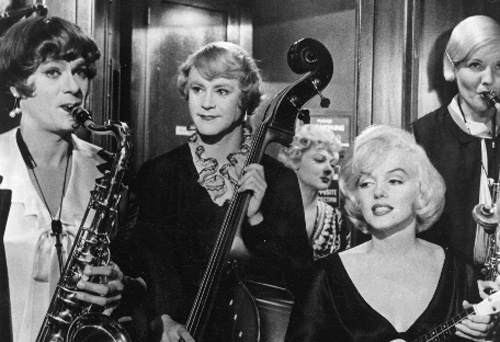
Moose, squirrel, and two guys in drag


rocky & bullwinklesome like it hot

It’s been a very long time since I attempted to write a script that did not involve the phrase “rollercoaster ride” as part of the description.

So while I wait for notes on the western and mystery-comedy, I’m taking my time in figuring out the story of what is shaping up to be a low-budget comedy.

Which also means it has to be funny, yet another mountain to conquer in itself.

Funny is subjective.  Something somebody else considers hilarious might make me shrug and say “I don’t get it.”  But I know what makes me laugh, so that type of humor is what I’ll attempt to incorporate into my story.

For me, a very important part of this is re-educating myself in how the jokes work and how they’re constructed. As I figure out the story, I’ll also be watching and learning from some prime examples of how it’s done.

Among them: episodes of ROCKY & BULLWINKLE and SOME LIKE IT HOT.

Part of what I like about them is how the jokes feel organic AND smart. The humor comes from the situation and how the characters react, rather than feeling forced.

Each also does a great job of gradually setting up punchlines, and not just going for a rapid-fire bombardment of one-liners.

Something else to keep in mind: both are over 50 years old and still hold up – further proof of their durability. The subject matter may be a bit dated, but the jokes still work, and that’s really what matters.

Random thoughts, general musings, that sort of thing

Nothing to do with today's post. I just love their chemistry.
Nothing to do with today’s post. I just love their chemistry.

-My western failed to make it through the first round of Scriptapalooza, which makes me 0 for 4 so far this year. I’m not counting the top 20 percent ranking for the Nicholl; that’s like getting Honorable Mention. At this point, I’ve pretty much written off its chances for Austin.

My problem was overconfidence in the script. I thought it was solid enough, but apparently not. It’s not the first time this has happened to me, but I’ll be more careful about it in the future.

I still believe in this script, which is why I’ve been so gung-ho about rewriting it. The past two weeks have been all about making it better. After completing the latest round of edits, it’s now 8 pages shorter, and still some further fine-tuning to do, which hopefully won’t add more than 2-3.

-Never realized how much my characters repeat things in dialogue. “I need you go to the store.” “The store? Why?” Must be the influence of listening to so much old-time radio. Cutting all of those probably amounted to at least half a page.

-I cut at least 5(!) separate situations where the Wilhelm Scream could be used.

-Had a great lunch-chat with one of my working writer pals yesterday. While he was very supportive and encouraging, he also reminded me of the almost insurmountable task of a new, unproven writer breaking in with a high-budget script.

“Your chances improve when you offer something that won’t cost a lot to make. A lot more people can get something made for under $5 million, rather than $50 million, let alone $100-200 million.”

As it should have, it got me thinking. Do I have any stories like that? It took the bike ride home and digging through some old flash drives to discover I did. Maybe about 5 or 6, all of them just a logline and not much else.

It’s a start.

-Movie of the Moment: GUARDIANS OF THE GALAXY (2014). Loved it. Great story, great characters (and their development). Maybe my only complaint was the bombardment of exposition in the first 20 minutes. Other than that, a lot of fun.

Biggest pleasant surprise: Dave Bautista as Drax.

Biggest almost-catastrophe: Adam Sandler as a potential voice for Rocket. Somebody thought this was a good idea?

It’s really impressive how much of an effort Marvel puts into their stories and characters. I sincerely hope DC and Warner Brothers can take a lesson from this.

The fastest route out of Sore Loserville

Get out and get out fast

There’s been a disturbing trend on some online forums regarding the results of some recent high-profile screenwriting competitions. While the writers who advance receive and exchange congratulatory messages, some of the ones who don’t seem to be looking for some kind of explanation as to why their script didn’t do better.

“They don’t like this genre.” “They’re only looking for stuff they can market.” “They just didn’t get it.”

Hate to break it to you, but that’s not it.

This is: you and a few thousand other people entered the same competition, so the odds were already against you. Chances are pretty good that some of those scripts are better than yours. It happens. Accept it.

And this may come as a shock, but maybe your script just isn’t as good, let alone as perfect, as you think.

So rather than gripe, complain and avow “Those rotten bastards are never getting my money again!”, use this as motivation to make your script better. Rewrite it. Get feedback from your inner circle of trusted colleagues. Pay for one or two sets of professional notes. Some contests offer feedback for an additional fee, so maybe that’s something you might want to consider.

I was disappointed my western didn’t do better in some of these competitions. Frustration and depression were the dominant moods for a couple of days. That’s when reality smacked me in the face and said “You want to do better? Then get to work.”

So that’s what I’m doing. I’ve completed the initial edit, so the script is now 6 pages shorter. There’s still some work to do, but it already feels better and tighter than it was before. I’ll be following my own advice (more rewrites, feedback from friends and pros, etc.), all while planning ahead for next year.

What about you?