Just the pep talk I/you/we need

pecan pie
Where else could you find comfort, reassurance, and tranquility, all on the same plate? 

(Author’s note – I wrote a lot of this earlier in the week, but circumstances of a confidence-instilling nature have occurred since then. I considered scrapping it and starting over, but thought the content was still relevant, so opted to stick with it. Enjoy.)

Let’s face it. Trying to make it as a screenwriter is an almost impossible task.

Emphasis on “almost”.

It can be done. Remember, every single writer whose name is up on there on the screen had to go through a lot of the same things you and I have. Probably even more.

The sad truth is that you will have to endure a lot of frustration before you start to even come close to achieving the results you want. And that frustration can easily lead to anger and depression and feeling like you’re wasting your time and this is never going to work out.

I say this because I’ve been that writer. Many times. This week was no exception. Several writer colleagues had some truly awesome things happen for them, and deservedly so.

Still, I can’t help but feel a slight pang of jealousy about it, but that’s all on me. In no way would I ever intend to divert the spotlight away from their success. They earned it, so they are more than entitled to enjoy it.

As for me, sure, I might wallow in self-pity for a little bit, but time and experience have helped me “get over it” faster, but the hurt does tend to linger.

Writing might be the last thing I want to do, but it’s actually been pretty therapeutic. Shifting your attention to another project – maybe one you haven’t worked on in months – helps with the emotional recovery process. Sometimes I’ll vent to another writer; usually someone who’s been through the exact same scenario.

Once I get all of that out of my system, the drive to succeed once again takes over, I get back on the horse and pick up where I left off – because the only way I’m going to make it is to keep trying, and that the only person who can make it happen is me.

That’s how it is for all of us. You’re not alone.

There will be so many situations where things don’t go your way. In the beginning, it feels like somebody’s stomping on your soul. But you eventually learn to accept that it happens, which helps toughen you up for the next time, of which there will also be many.

So on that note…

There will be a lot of times you just want to give up, or feel like the only word you ever hear is “no”, or have it seem like you’re the only writer on the face of the Earth not making progress.

Corny as it may sound, the best piece of advice I can offer is to keep at it. You will definitely hear “no” a thousand times before that one significant “yes”, but you won’t get it at all if you don’t keep going.

This is not a career path for the easily-defeated or the thin-skinned. I’ve had people tell me my story ideas were stupid and my writing was awful. One memorable character even thought my script was so terrible they were certain it was some kind of practical joke. Comments like that sting, but only temporarily. You learn to ignore them to the point they don’t even faze you anymore.

I’ve had the good fortune to make lots of connections with very talented people, many of whom have been more than willing to help me get closer to that goal.

I’m still here, still trying, determined as ever. And I sincerely hope you do the same.

What you want VS what the story needs

838-02491755
Sometimes it takes a little more evaluation

Over the course of several drafts, the core elements of my scripts remain more or less the same. There might be a few changes here and there, but to me, the end result is pretty darn close to what I originally intended.

As part of the development of those drafts, I get notes from trusted colleagues and professional analysts. Everybody has their opinions, of which there were many, and I can pick and choose which ones to use.

I was still presenting my stories the way I wanted to tell them, but is that the way they should be told? Was I falling into the trap of “I’m the writer, so what I say goes! End of discussion!”?

I recently got notes on one of my scripts that offered up some keen insight regarding the antagonist’s storyline. This included the reader’s frustration about what they perceived as a lack of knowing the character’s goal and the reasoning behind it.

At first, that was pretty surprising to hear. But as is usually the case, I took a step back and looked at the big picture, trying to be as objective as possible. Was it really not as apparent as I thought?

And as is also usually the case, their comments were spot-on. I had never made any big changes to how that storyline was written because I saw it as being “just fine the way it is”, which also happened to be the way I wanted it to be.

Which was counterproductive to how the story needed it to be. It wasn’t working within the context of the story itself.

Was it my writer’s ego that prevented me from seeing this through all the previous drafts? Maybe a little. I’ve seen this kind of thing before in other scripts, but just couldn’t see it within my own material.

I knew the script wasn’t perfect, but there’d always been this nagging thought in the back of my mind that it still needed work. Something had to be changed, but I couldn’t identify what. This could also explain why I always felt compelled to keep working on it.

But with those notes, I now had a much firmer grasp of what the reader was talking about, and could begin to rectify the situation.

It took a little time to work through it, including some significant edits and rewrites. It  also entailed cutting some scenes that absolutely broke my heart to see them go, but were totally necessary. All part of the process.

I know I’ve said all of this before, but looking through the latest draft, the script really does seem different now – in a better and much stronger sense. The characters, especially the protagonist and antagonist, feel more developed. The story reads as more concrete. I’m very happy with how it turned out.

Once I was able to put what I wanted aside and focus on what was best for the story, it all came together a lot better than I expected. My hope is that this kind of self-analysis will be a bit easier for me to figure out for future drafts of other scripts.

Can’t wait to give it a try.

Change is inevitable. Embrace it.

edited page
All that red is a really good thing

A few more sets of script notes have come in. Comments in general are favorable (Thanks, everybody!), along with lots of suggestions about potential fixes. Nothing too drastic, but just enough to slightly alter things and still achieve the same results. Nevertheless, it’ll require a fair amount of rewriting.

Which is totally fine by me.

As much as I like what I’ve written, as do a lot of my readers, both sides know it can always be improved – especially my side. As the writer, it’s not as easy for me to recognize what those improvements could be and where they should go, which is why I ask for feedback. The readers start with only what’s on the page and use their knowledge and experience to deduce what works and what doesn’t, and then pass it all back to me for analysis and selective implementation.

A less experienced writer might be hesitant or even reluctant to do anything drastic that could change anything about their script.

Me, not so much. I know what the story is, and if somebody points out something that doesn’t work or suggests a different way to present it, I’m not going to say no. In fact, I’d probably be grateful for it. I might not always agree with what somebody says or suggests, but I still appreciate it and can totally see why they said it. Sometimes it might even inspire a totally new approach. Whatever works.

Used to be I would dread having to rewrite, but due to an effort of trying to write on as regular a basis as I can, which also involves rewriting, I’ve gotten to the point where I now actually look forward to it. (Helpful tip – the more you write, the easier it gets – albeit to a certain degree. Overall, it’s still tough.)

Will later drafts of my scripts be exactly the same as the first? Of course not. That’s the whole point of rewriting: to make it better than it was before. And that requires making whatever changes are necessary.

I recently got to sit in on a friend’s script review group where a new writer received some pretty brutal notes about their script (which I believe was also the first draft). If they wanted it to be better, they had a lot of work to do. They had this somewhat annoyed look and said “Guess that means I’ll have to rewrite most of the script.”

Well, yeah. This is no “one-and-done” kind of operation.

If you think the first or second draft of your script is perfect as is and doesn’t need any more work, then good for you, but I sincerely hope you never, ever show it to a writer with more experience because you will be severely disappointed with what they have to say.

As for me, I’ll be keeping busy with the usual hacking, slashing, and overall rehashing of my scripts. And enjoying every second of it.

-If you’re a fan of sci-fi adventure, then please consider contributing to writer/producer Marc Zicree’s crowdfunding project Space Command: Redemption. Among the cast of sci-fi luminaries are Doug Jones (HELLBOY), Robert Picardo (STAR TREK: VOYAGER), Bruce Boxleitner (TRON, BABYLON 5) and Bill Mumy (LOST IN SPACE), Space Command: Redemption is “a bold, new sci-fi adventure with a retro feel and an optimistic view of the future.” Donate if you can!

A small matter of interpretation

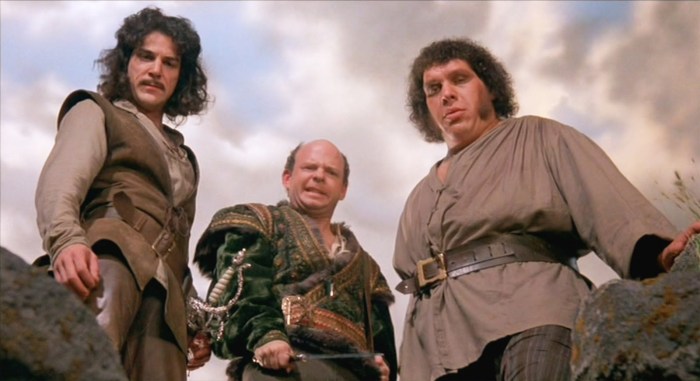
princess bride
“You keep using that word. I do not think it means what you think it means.”

Amidst all the hubbub currently surrounding my ongoing rewriting efforts, I’ve been extremely fortunate to have received some high-quality feedback on each of them.

(Incidentally, concurrently working on three scripts may be a good exercise in productivity, but it sure is an exhausting one.)

Among this trio of projects is a round of notes on the pulp sci-fi.

Some great stuff being provided by my legion of savvy readers, which includes a comment made by more than one person.

But first, a little background…

As I mentioned, I refer to this script as “pulp sci-fi”. To me, it’s reminiscent of old-timey adventure (Flash Gordon, Doc Savage, etc), which is the kind of story I enjoy reading. It’s also the filter through which I wrote it, and had a great time doing.

What’s been extremely interesting is how people interpret that phrase.

A few readers tended to share my same opinion/viewpoint, and felt the story and script reflected that. Others thought calling it a “pulp” story indicated it would be somewhat darker and grittier (which it really isn’t). And there’ve also been some who weren’t sure if what’s on the page was supposed to be taken at face value or if I was intentionally satirizing the genre.

Quite a wide variety of opinions and reactions, all of which are perfectly valid. But the responsibility falls squarely on my shoulders to provide the story with the tone I find the most applicable.

Don’t underestimate the importance of tone. This may not be the best explanation, but I see it as the story’s attitude; how it presents itself. The writing should reflect not only the components of the genre, but also the emotions the story seeks/needs to invoke in the reader.

So while I offered up what I considered to be a fun romp of a tale through the fantastic, maybe with tongue slightly pressed against cheek, that’s not what how others saw it.

Admittedly, I probably could have cleared up a lot of the confusion at the outset by adding something like “It’s pulpy sci-fi in the vein of MEN IN BLACK, HELLBOY, and THE ADVENTURES OF BUCKAROO BANZAI,” as opposed to leaving it open to interpretation. For all I know, someone saw “pulp sci-fi” and thought, “Oh, like BLADE RUNNER.” Which it most definitely is not.

Laying down that kind of foundation lets the reader know what to expect before they start, but then it’s up to the writer to consistently maintain that tone for the entirety of the script.

What would Miss Manners think?

20a.tif
Treat them the way you’d want to be treated

Believe me. I get it.

You want to be a working screenwriter more than anything. ANYTHING.

So much that you find yourself occasionally succumbing to lapses in good judgment and common sense, resulting in actions that might initially seem sound and sensible, but in retrospect, become more of a “what the hell was I thinking?”

You want to make a good impression, and overstepping the boundaries of courtesy is a surefire way to have that NOT happen. Sadly, too many aspiring writers tend to ignore that and just plow forward, not taking into consideration the fact that they’re most likely sabotaging their own career before it even gets started.

So presented with the best of intentions, let’s go over a few of the basics:

-This is all on you. You want to be a working writer? Then you need to do the work. All of it.

There are no shortcuts.

The writing, editing and polishing.  Researching reps, producers and production companies on IMDB Pro. Networking. Making and maintaining connections. DO NOT approach a total stranger either online or in person and have the first thing you say be “Hi. Can you help me?”

Be patient and courteous. Everybody’s got stuff going on in their lives, so they might not get to your script right away. Much as you want a fast turnaround, you’re not a priority to them. DO NOT be pushy and bombard them with constant “Did you read it yet?” emails. Send it, give it 4-6 weeks. If you haven’t heard anything by then, send a friendly reminder (“Hey. Just wondering if you’ve had a chance to read MY SCRIPT. Thanks.”)

-Once you do get the comments back, send a thank-you note. If you agree with what they say, or think it makes some good points, say so. If the comments are negative, or at least not what you want to hear, DO NOT respond by arguing why they’re wrong. “You just don’t understand my genius” is never a good idea. They’re doing you a favor and providing their honest opinion. Just say thanks.

Rememeber: there are a lot of other writers in the exact same situation as you, and each and every one of them is spending just as much time figuring out some kind of plan to help them reach that goal.

Use your head while being polite and considerate to help you make a better impression.

-I’ve written about some of these topics before. Feel free to give ’em a look-see.

Psst! Your desperation is showing

You don’t know me, but can you help me?

Make Emily Post proud