Crafting a tale to thrill, astonish, and exhilarate

mad-scientist
Those fools at the film academy dare call me mad? I’ll show ’em! Mwahaha!

2017’s writing got off to a pleasantly rousing start with the commencement of the first draft of my latest project: the pulpy adventure spec.

Yep. After years of working on the outline, I finally decided to take the plunge and write the damned thing.

Seeing as how this is a genre near and dear to my heart, I dove into the opening sequence headfirst and just had at it, surpassing the original goal of completing at least 2 pages a day by two and a half times that amount. Add to that the 4 pages for yesterday, and that places me further ahead than anticipated. It’s not expected to maintain this kind of output on a daily basis, but no complaints so far.

That being said, upon reflection, the latest scene still leaves a little to be desired, so an impromptu rewrite is already being planned out and will be implemented straightaway.

A few alterations have also been made in regards to the overall writing process.

First, even though the outline needs to be rock-solid before starting on pages, the scene descriptions are sometimes a little vague. “Big fight happens!”, that sort of thing.

When that happens, the focus shifts to plotting out the beats of that particular scene. How do things play out so it tells the story and moves things forward? Is it accomplishing what it needs to? It’s quite helpful, and helps prevent a lot of frustration in trying to think up stuff on the spot.

Another is fully embracing the whole “just get it done” attitude. Write it down and move on. There’ll be time for all that fancy-pants editing and polishing stuff later. It’s also been noticed that sometimes the first idea is still the best.

And in what may be the most important development, seeing as how this is at its core my interpretation of the old pulp novels, I’m doing what I can do to really make it read that way. One could even argue that writing the western was just a warm-up exercise. The writing in this script might be a little more over the top than usual, but that could be exactly what it needs.

Even though it’s a screenplay, I take a certain pleasure in coloring things a slightly stronger shade of purple.

There’s no specific target deadline for completing this draft, but hopefully it won’t take too long. For now, I’m just enjoying the ride.
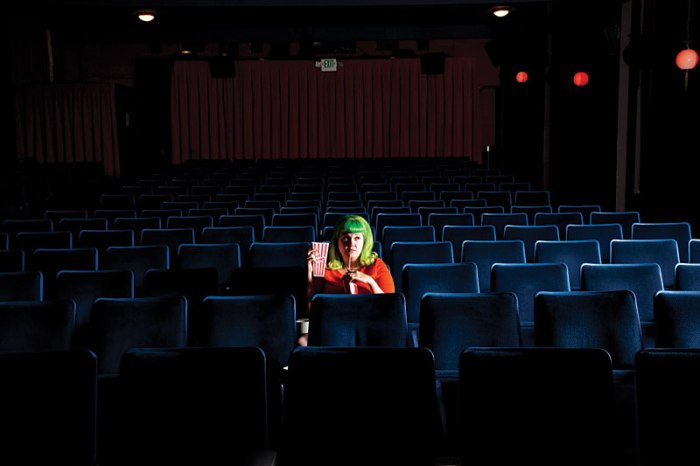

Best seat in the house

alone in theatre
The next person who comes in will sit directly in front of me. Guaranteed.

I recently had the opportunity to revisit the outline for my pulpy adventure story after having not looked at it in several months, and wanted to see what was needed in order to get me a little closer to being able to start on pages.

Time was limited, so I was only able to get through the first half. It was a pleasant surprise to discover that a lot of it still held up, plus an added bonus of some small inspirations resulting in tweaks that strengthened a few of the subplots and tied a few them together in a better way.

And of course, some of these new developments were a total change from how I’d always imagined them. This happens a lot for me.

But what was really the most positive experience out of this was how easy it was to “see” the story play out. It was as if I was in a private theatre, watching my imagination come to life on the big screen, complete with surround-sound. It definitely reinforced the kind of story I’m trying to tell.

When you’re putting your story together, or writing it, or even just reading it, how easy is it for you to visualize it? Do you “see” it as if you’re watching it in movie form? Is it a smooth transition from coming up with the idea to putting it on the page so it reads how you originally imagined it?

And therein lies part of the challenge. It’s just not an easy task, or at least isn’t for a lot of writers. It takes time to find the right words.

You might know what you want to say, but can’t find the exact way to say it, so you tinker around with it, trying and trying until something takes hold. Or maybe after writing it down, actually seeing it on the page makes you realize “this might not have been the best way to do it,” so you jump back in to come up with something new.

Sometimes I even go so far as to narrate aloud while acting out what’s happening for that particular part of the story (or as much as I can while sitting at my desk), which really helps, despite how silly it might look to somebody else.

As writers, the gears of our imaginations are always turning. Always. You could be doing something totally ordinary or mundane, and then, like a bolt from the blue, come up with a solution so perfect and now-obvious that you can’t understand why you didn’t realize it before.

So you work and work, making your writing better to the point that anybody reading your story will eventually be able to “see” it the way you want them to.


The fine art of interpreting notes

Not those kinds of notes
Oops. Wrong kind of notes.

It still needs some work, but the latest draft of the outline for the pulpy adventure is done, so it’s headed to the back-burner for now as focus shifts to rewriting/polishing the western.

I’ve been very fortunate the past few weeks to have received some high-quality notes for it, which includes a wide spectrum of suggestions of how it could be improved.

As expected, some have merit and some don’t (and this includes some professional comments), as well as a few changes not even originally considered. Each one gets serious consideration, but it all comes down to what I think works best for the story.

When I first started, I would assume every note I got was coming from somebody who knew better than me, but then there’d be so many changes/edits that the script was getting away from what I wanted it to be.

You and only you know what your script is supposed to be like. There will be many notes accompanying each subsequent draft. Don’t automatically think each one is right, but don’t immediately dismiss it either.

Ask yourself “Does this note help make my script better?” If so, how? If not, why not? If you’re not sure, look at it from both sides. Don’t rush just to get it over with. This requires a lot of thought, patience and attention.

It’s also important to not let your pride get in the way of the story. What’s more important – keeping your ego intact or making the story as good as it can be?

It took a while, but I eventually learned to trust my instincts to the point that I can now identify what I consider good notes and not-so-good notes, which has really made a difference in helping both me and my writing improve.

Something awfully familiar about this – OR – Already seen it

Not exactly the same, but mighty darn familiar
Whoa.

I was THIS CLOSE to being done with the latest version of the outline for the pulpy adventure spec when my writer’s sense starting tingling.

“Something’s still not right!” screamed out my internal editor.

What? That couldn’t be possible, could it? I’d spent the past few weeks being oh-so-meticulous in reorganizing sequences, working out subplots and connecting story points. How in the names of Walter Gibson and Lester Dent could there be a problem?

I looked at the outline with a more critical eye.

Opening sequence – check.
Intro of hero, establish his world – check.
Hero’s world drastically changes while raising central question of the story – check.
Complications ensue – check.
Midpoint where hero becomes fully committed to achieving his goal (accompanied by reminder of the central question) – check.

Wait. Back that up a little. To right between the “Complications” and “Midpoint” parts.

Hokey smokes, there it was. Cue the flashing red light bulb (with optional klaxon).

Two consecutive sequences just way too similar to each other. This is what’s been bothering me.

No doubt about it. One of ’em has to go. Probably the first one. You’d think it would be no big deal to just go in and change it.

And you’d be kinda/sorta wrong.

The events that happen during these two sequences are vital to the story, so the outcome needs to stay the same. The tough part now is figuring out how to change the “what happens” in that first one so not only is it unique enough unto itself, but also falls neatly into the overall structure of the story.

As always, a daunting task. For now. But potentially solvable given some time and exploration of possible alternatives.

I cannot stress enough the importance of why you should outline your story before even considering starting on pages, and being extremely thorough about it while you do. This is where you get all the heavy lifting done by figuring everything out. Where it’s a lot easier to identify the cracks in the foundation. Where it might take you a few passes to realize what works and what doesn’t.

Then again, this is how I do it, so your approach may be totally different. But speaking for myself, I prefer to go back in and fine-tune a couple of scene descriptions consisting of one to two sentences, rather than labor my way through several pages, then have to totally junk them because they’re not working.

So my focus for the time being is fixing this, then going through the whole outline a few more times, making adjustments where necessary, until I think it’s done/ready for conversion into pages.

-Got to see JURASSIC WORLD and INSIDE OUT last week. Both very enjoyable, but for very different reasons. Of the two, I’m more interested in seeing INSIDE OUT again, mostly for the writing and storytelling aspects.

Regrettably, still haven’t seen MAD MAX: FURY ROAD yet. Of all the summer releases, this feels like the one that must be seen on the big screen. Will do what I can to rectify that.

A whole lot of something out of an almost-nothing

An apt metaphor if ever there was one

A bit of a snag had developed in the rewriting of outline for the pulpy adventure spec. A certain aspect of the story had proven to be too simple, as in “not complicated enough” or “lame half-assed, last-second placeholder”.

It was also falling short in terms of overall pulpy-ness.

Seeing as how this is supposed to be a rousing tale sprinkled with elements of mystery and intrigue, it just wasn’t happening.

I won’t totally jettison a story, but rather see what changes, small or drastic, can be implemented in order to get things back on track.

I don’t know how it is for other writers, but sometimes I’ll go over a previous draft, hit a word or phrase that originally didn’t hold much significance, and all of a sudden it triggers a whole new realm of possibilities. Call it the “How did I not see that before?” syndrome.

In this case, it was a character’s name. This set off the auto-immediate response of “Hmm. What if…?”

Cue the heavenly chorus.

Suffice to say, now it’s back for yet another take on the draft, but this time going into it armed with a whole new batch of ideas.

-Time for a couple of book plugs!

Friend of the blog Justin Sloan has a new book coming out this weekend – Military Veterans in Creative Careers: Interviews with our Nation’s Heroes. Some great stuff in there, including quality interviews with men and women who’ve served in the armed forces and are now working in creative fields.

If you’re looking for a little guidance on your journey to becoming a working writer, then take a look at Notes to Screenwriters by Vicki Peterson and Barbara Nicolosi, who also run the Catharsis script consulting service.