A support staff of one

multitasking
At least you’re a shoo-in for Employee of the Month

When it all comes down to it, you know who’s going to do the most to help you and your career?

That’s right. You. Nobody else.

Sure, there will be others who might be able to give you a helping hand now and then, but the responsibility of getting stuff done falls squarely on your shoulders.

This goes beyond just writing and honing your craft. You need to build up your network. Establish connections. Get to know people. Chances are a majority of these will be online and via social media.

Seeking representation or someone who might be receptive to your script? Do your research. Find out who’s looking for what. (And for crying out loud, DO NOT take the “Does somebody have a list I could use?” route.)

“But I’ve got no time to do all that!” you might protest.

Of course you do.

The key element here is time management. You already set aside time to write, don’t you? Well, you have to do the same for everything else. If you can devote part of your day to work on your script, then there’s no reason you can’t dedicate a few minutes to focus on your career.

A surefire way to give yourself more time – stay away from casual websurfing, or at least ration it. So much online material is nothing but a big time-sucking rabbit hole. “Just five more minutes” can easily turn into “Where’d that hour go?” Funny videos are all well and good, but probably won’t do much to help you get your career going.

On Twitter? Connect with 5 people a day. Interact with them. Ask about their projects. Make it about them, not you. If they ask about you and yours, keep it simple. Don’t overwhelm them with details.

Part of some online community forums? Take part. Ask questions. Start discussions. Get to know the other members. A lot of these folks will probably have more experience than you, so learn as much as you can. Very important – don’t be a troll.

Is there a professional writer out there whose work you admire? Send them a note saying just that. DO NOT ask for any favors right out of the gate. Establish a relationship. You’ll eventually know if they’re open to helping you. Sometimes they might even offer it without you asking. It happens.

All of these are going to take time to not only accomplish, but also to develop. Be patient. It will take time. You wouldn’t rush through getting your script done, so apply that same logic to developing and advancing your career.

It’s all on you, so make the most of it.


Returning to the sprucing-up stage

painting
It’s going to take just a little bit more than a new coat of paint

It all started with a “Scripts Wanted” listing.

A small prodco with an even smaller budget was looking for a particular kind of script. I felt that one of my earlier efforts was a perfect match, so I sent it in.

A few days later came the response “Just not what I’m looking for.” A bit disappointing, but that’s the way it is. No big deal. I’ve moved on.

It was at this point I realized it had been quite a while since I’d actually read the script. As far as I could remember, it was in good shape.

So I read it.

The result? It’s better than I remember, and a lot of the jokes still work. But what it really needs is just a good, solid edit/polish. There’s definitely some fat in need of trimming, and a lot of that is just extra and/or unnecessary words.

The draft I’d been using for years was 109 pages, which is a little excessive for a comedy. I’ve completed the initial edit, which brought it down to 105. A more thorough red pen edit is underway, and after going through the first third, another page has been cut out, bringing the current total to 104. The hope is to cut out at least another 2-3 pages.

There are at least two sequences (so far) that need rewriting to accommodate some of this editing, and the solution to one of them (a key part of the story) came to me a lot faster than I was expecting. That’s always nice. There’s no reason I couldn’t be done with a much more presentable draft in a week or less, which is also nice.

Since this script is from way back when, it was quite the experience to look at how I used to write with the advantage of having all the knowledge and skill I’ve acquired since then.

Go through your own catalog of completed scripts. Almost-completed and first drafts are allowed. When was the last time you looked at one of your earliest efforts? How does it compare to your most recent project?

I bet it’s super-easy for you to spot the differences between then and now. You might be surprised at how much you’ve improved, or possibly even laugh at how bad you used to be. Happens to everybody.

Whenever I would pass this script along to another writer, I would always precede it with the caveat “This is one of my earlier scripts, so the writing’s not as good.”

After this edit/polish, I don’t think I’ll be saying that anymore.

Knocked down, but not staying there

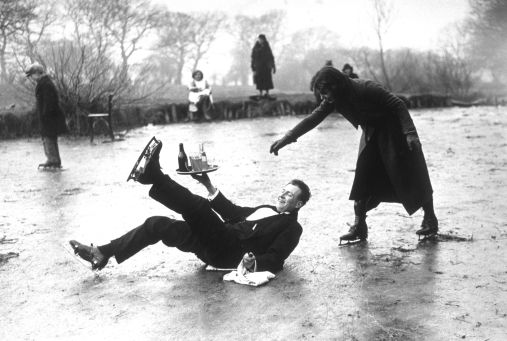
Skating Waiter
Just give me a sec to get back on my feet. Bonus – drink remains unspilled

The Chinese restaurant script got the standard “Just isn’t what I’m looking for” response from a producer.

Years of experience has taught me how to properly respond to this kind of situation.

“Well, that sucks. Okay. Moving on.”

Thus the struggle continues to gain a new foothold on this constant uphill climb. But I’m in it for the long haul.

Sure, it’s frustrating to get yet another “no” about a script, but getting upset about it won’t do me any good.

And what better way to get over it than by working on something else with the intent of making this one that much better? And there are plenty of something elses to keep me occupied.

A revamping of the outline of an older script continues, with pleasantly productive results (along with some phenomenal feedback on the logline). More insightful notes have come in for the comedy spec. Setting up a few more get-to-know-you meetings with other local writers*.

(*A meeting last week with one writer about her current project resulted in me being able to offer up some suggestions to another writer feeling frustrated about his. He, in turn, felt very encouraged with a renewed sense of hope, and was excited about some possible new avenues to try. I’m just happy to help.)

Hearing “thanks, but no thanks” still stings, but only for the briefest of moments. It’s taken a very long time for me to get to this point.

A few months ago, all that pressure I’d been putting on myself just went away. And I’m a lot better for it now.

And patient.

Success will happen when it happens.

But having it happen sooner rather than later would still be much appreciated.

New steps on an old path

road
A return journey to a long-ignored route

Over the past couple of days, as notes for the low-budget comedy spec were being compiled, I considered jumping right in to the rewrite, but instead opted to take a break and put it on the back burner for now. It’s been the focus of my attention for a while, and I didn’t want to risk burning out on it.

No big deal. All of the material will still be there when I get back to it.

So what now? Work on another script, natch.

But which one?

I just didn’t have it in me to work on the few that were still in plot-development stage, nor did my brain feel totally ready to tackle assembling the pieces of the jigsaw puzzle that is the mystery-comedy.

Since I’ve been on a bit of a low-budget kick, I delved into my stash of long-ignored stories to see if there was a suitable candidate.

And I found one. A comedy I haven’t worked on for a good number of years that would make for another great low-budget production.

It had gone through several better-than-I-remembered drafts of the outline, each one with elements similar to the others, but also with its own uniqueness. Looking them over, there’s a lot of material to work with and develop into a new version.

Plus, it’s a fun story, which is always enjoyable.

(Moral of the story – never throw anything away.)

Working on the previous comedy spec also helped boost my confidence regarding my comedic writing skills. It’s not perfect, but better than it was. There were already some good jokes among these earlier drafts, and coming up with new material is still somewhat of a challenge, but not as daunting.

So the next couple of weeks will be all about combining, editing and fine-tuning this story, and then cranking out some actual pages.

Exciting times, chums.

Not everybody’s going to like it

pie
Astonishing as it is, some people actually don’t like pie. Heathens.

Notes and comments continue to come in for the comedy spec. I’m seeing some very insightful stuff that will prove most beneficial for the next draft.

Reactions range from “I loved it!” to “I was very disappointed with this.” The author of the latter even started things out by saying “I wanted to like it, but just couldn’t. I guess our senses of humor are just too different”.

And you know what? They’re right, and that’s totally fine. Comedy is subjective. Everybody likes different things. If it’s not for you, it’s not for you.

Would I have preferred they liked it? Of course. But they didn’t, and that’s all there is to it. I still value their opinion and will continue to ask them for feedback in the future.

But I also shouldn’t totally disregard what they had to say. They made some valid points and suggestions in their explanation of why it didn’t work for them, a lot of which could potentially be applied to the aforementioned rewrite.

Nor should I take one person’s rejection as the final word. They didn’t like it, but in no way does that mean everybody else will have the same opinion. For all I know, this one dislike is the exception to the rule.

This is one of those things that a lot of writers, especially newer ones, fail to grasp. You slave away on a script, and then you send it out, convinced it’s a work of genius. And you don’t get the reaction you were hoping for. PASS. Thanks, but no thanks. We’re working with something similar.

Heartbreaking, ain’t it? “How could they not have liked it?” you cry out to the writing gods. It’s just the way it is. Remember – it’s not about you. It’s about the script.

So you’ve got two choices. Obsess over the rejection, or accept it, put it behind you, and keep pushing forward. Maybe figuring out why their reaction was negative could help.

But don’t let that negative slow you down. Do what you can to turn things to your advantage. Like with practically everything connected to screenwriting, it won’t be easy.

Start by making sure you like it, and then take it from there.