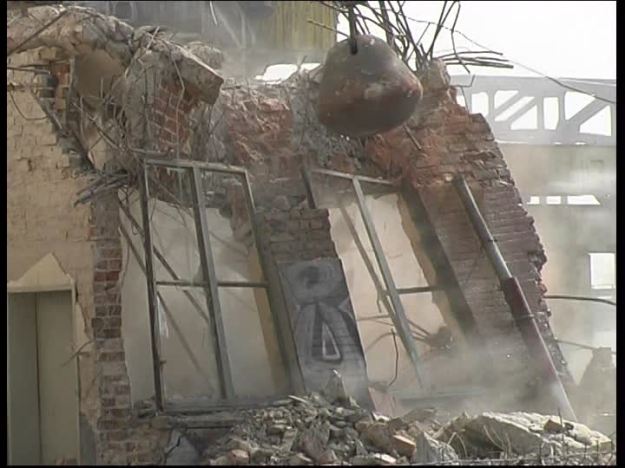
Out with the old…

wrecking ball
Just clearing away some stuff I don’t need anymore…
Seeing as how I’ve designated this latest go-round with the comedy spec as an “overhaul”, it’s only fitting that that’s what actually happens.

I’d decided I was absolutely not going to use the previous draft as reference material. This approach was going to be more than just the slapping on a new coat of paint and rearranging the furniture.

Granted, there were some select parts that survived the trip from the previous draft to the new one, but only because they’re vital components of the story, which makes them still relevant. Everything else, however, would be fresh and new.

And as you’d expect, that’s been slightly tougher. Tough, but not impossible.

Developing changes in a rewrite can really test one’s mettle and determination. Sometimes I’ll feel stuck and think “How’d I do it before?”, but then I fight the temptation to dig up the previous outline, reminding myself I’m in overhaul mode. Looking at the previous draft would counteract what I’m working towards now – to try something new.

There’s always a different path to where you’re trying to go.

I suppose part of it is the occasional lazy writer approach of considering what’s come before as “good enough” and not really changing it that much, but if it were “good enough” to begin with, I wouldn’t be working so hard on changing it this time, right?

Some days I’ll produce a wonderfully long sequence in no time flat, while some will yield a meager handful of bullet points of important moments that need to happen within the context of that scene or sequence, and took a dreadfully slow hour just to come up with.

Despite all of this, the results so far have proven encouraging, with work about to begin on a totally-from-scratch sequence. Forward progress is slow, but steady – as it should be.

I suspect the end result will be significantly and pleasingly different from its previous incarnation. And I wouldn’t have it any other way.

-two new items posted to the Maximum Z Bulletin Board!

-Screenwriter Kay Tuxford, director Prathana Mohan, and producer Edward Timpe have launched the crowdfunding project for The MisEducation of Bindu, a new and original take on the typical high school film. The script was a Nicholl semifinalist, so you know it must be some high-quality stuff. Donate if you can!

-Starting today and running until September 30th, screenwriter Max Adams is offering up a limited time half-off special on script consultations. Go to the contact link on the website to email her for details.

That’s not the question you should be asking

classroom
Class, who can tell me what “familiar, but different” means?

I see variations on this question a lot throughout many online forums:

What kind of script should I write?

Seriously?

And I say that in the least condescendingly way possible.

It amazes me that somebody who wants to write a script has to ask what they should write. Shouldn’t you already know? Isn’t that why you’re doing this in the first place?

Then again, I’ve always been a writer, so it was never a question of “What do I write?”, but more of “Which one do I write now?” and “How do I write this so it’s good?”

But back to the topic at hand…

My immediate response to the question in question is “Write something you would want to see.” But that’s my approach. Others may take a different stance.

One caveat – make sure whatever you write is as original a story as you can come up with that contains original characters and situations. Do whatever you can to make it your own. Readers will instantly recognize if you’ve “borrowed” something.

I recently read a script that was a blatant rip-off of a well-known franchise. Did the writer know this when they wrote it? I don’t know, but the actual concept behind their story seemed unique unto itself, with lots of possibilities, so it was actually kind of surprising and disappointing to see them follow that well-trod path instead of seeking out something new.

Something else to keep in mind – using well-known characters not created by you is a very, very bad idea. A writer friend has a connection at Marvel Studios who handles the non-stop influx of unsolicited spec scripts. No doubt your Spidey spec is brilliant, but you’re seriously fooling yourself and wasting your time.

Wouldn’t you rather your script be known for offering up something new and unique?

A lot of newer writers see what’s hot at the box office and think “I can crank out something like that in no time!” Also a waste of time. Trends come and go very quickly. What’s hot today could be ice-cold tomorrow. And you probably think you’re the only one to come up with some variation on that current big idea.

You’re not. It’s even money deals involving clones of that idea will be announced in the near future, all while you’re still churning out pages.

DON’T CHASE TRENDS. You’ll never catch up.

A writer I’ve exchanged notes with concluded our most recent email conversation with “Also wanted to pick your brain. I want to write a script about ____ . It’s an idea I’ve had for several years, but I don’t know if anyone would want to see it.”

Their concept seemed good with lots of potential, but also sounds very similar to a recent series on Netflix, which I thought increased the chances of inevitable comparisons between the two. But if it’s a story that’s been percolating for that long and they feel really passionate about it, then by all means, have at it.

As a spec writer, you have the freedom to write whatever you want. I suspect a lot of us are inspired by the films we grew up watching up to the ones we enjoy now.  Start there and see where it takes you.

Strive for originality, chums.

Start with similar, venture into different

path
With one you can play it safe, while the other offers up more of a challenge

In the handful of times I’ve helped out as co-writer or script polisher on somebody else’s project, there have been variations on the following conversation:

ME: And then THIS happens!

THEM: Oh, we can’t do that. ACTUAL MOVIE did the same thing.

ME: Not exactly. ACTUAL MOVIE did THIS, and what I’m suggesting is maybe at the very foundation the same concept, but if we did it THIS WAY so THIS HAPPENS, it would be entirely different.

THEM: But won’t people think we’re just ripping off ACTUAL MOVIE?

ME: First of all, ACTUAL MOVIE has been out for a while, and you’re at least a year away from having this thing done, so I highly doubt the first thing anyone’s going to think is we’re ripping off ACTUAL MOVIE. Second, this is exactly why I think THIS is how it should happen. True, both use the basic concept, but we’re putting our own spin on it so it doesn’t resemble ACTUAL MOVIE at all. They’re similar, if you could even call it that, but still different.

THEM: (thinks it over). Well, okay. We’ll give it a try.

And…scene.

I’ve read about this in articles and seen it firsthand while reading scripts, both times usually associated with newer writers. Somebody really likes how something happens in a film or a script, so then they go and have the EXACT SAME THING happen in theirs. I get that you liked that original, but why, oh why would you want to use it practically verbatim in yours?

Doing the screenwriting equivalent of a “copy, cut, and paste” will do you no good because it’ll be painfully obvious that’s what you did. You’re trying to tell an original story, and THIS is what you do?

If anything, people will definitely think you ripped off that original thing and berate you for your total lack of originality. Was that your goal? Probably not.

Time to get analytical. What was it about that particular something that really got to you? Why do you feel the need to have the same thing happen in your script? That’s the angle from which to approach it.

But this is also where the challenge begins. Once you identify that core detail, it’s up to you, the writer, to figure out a new way to use it in such a way that not only does it serve the purpose you need, but also pays homage to what inspired it in the first place.

You know where things are going, or at least where you want them to go, but now you need to tweak how they get there. Work those muscles of creativeness! Try something new! Don’t hesitate to jump off the beaten path into new territory! If anything, you might come up with an entirely new idea that accomplishes exactly what you needed, but just a totally different way.

Sure, there’s a very slight chance it could potentially remind somebody of ACTUAL MOVIE, but they’ll definitely remember that it came from yours.

Pacing & page numbers

number-line
Looks like there’s a lot going on up ahead

When you start reading a script, you tend to recognize pretty quickly whether or not the writer knows what they’re doing. Their mastery of the craft (or lack thereof) will become soon apparent.

Bad formatting. Misspelled words. Unfilmables. On-the-nose dialogue. Cliches as far as the eye can see. Quite a checklist.

Find one or more of these early on, let alone just on the first page (which does happen), and there’s not much hope of improvement. You’re left with no choice but to force yourself to push forward. Maybe once in a while, you glance up at the upper right corner of the page/screen.

Your shoulders sag. “I’m only up to page ____? This is taking forever!” you exclaim. Making it to the end has suddenly become a question of “if”, rather than “when”.

Now let’s examine the other side, where the writer is in total control.

You encounter writing so sharp and descriptive, you can easily “see” what’s happening. Dialogue that’s not just crisp, it practically crackles. Characters who feel and talk like real people. All of it taking place in original and entertaining situations.

You become so wrapped up that you can’t wait to get to the bottom of the page so you can move on to the next one. And maybe once in a while, you sneak a glance at the upper right corner.

Your eyebrows shoot up. “I’m already at page ____? Wow, this is just zooming by!” you exclaim. You eagerly dive back in, more than ready to continue because you simply can’t wait to see what happens next.

Now here’s the big question for you, the writer:

Of the two experiences listed above, which do you want the reader to have when they read your script?

Do you want them to be bored and see reading your script as a chore that ranks up there with cleaning out the cat’s litterbox or listening to a timeshare presentation?

Or do you want them to be so involved, their attention so riveted to the tale being told in your script, that nothing short of a major crisis or natural disaster could tear them away? (Not to diminish the intensity or significance of major crises or natural disasters, but you get the idea)

It’s tough to be that objective when it comes to reading your own material. You think it’s good (“How could anyone not like it?”), but every reader has their own criteria for what works and what doesn’t. The challenge is crafting together a script so rock-solid that not liking it is not an option. Not sure if yours is? Seek outside opinions. Rewrite with the mindset of “how can I make this better?”.

As screenwriters, our primary goal is to tell an entertaining story. The last thing we want is for someone to be easily distracted by something/anything else when they’re supposed to be reading (and in theory, enjoying) our scripts.

Could it get made today?

psycho-house
“Another “boy and his mother” story? Pass.”

Originally, this post was going to be about the multiple changing of protagonists in PSYCHO (which is another great potential future topic), but the more I read about the film and thought about the impact it’s had since being released way back in 1960, it triggered a totally different train of thought.

Every once in a while, when a classic film is brought up in some context or another, the phrase “That could never get made today” will get thrown in. After the recent death of Gene Wilder, his talent was lauded via the mention of several of his most well-known roles. Willy Wonka. The Waco Kid. Victor Frankenstein (“That’s Fronken-steen.”). His performances were vital parts of each film, which no doubt contributed to making them “classics”.

But, as always, it starts with the script. (Incidentally, I don’t think Wilder gets enough credit for co-writing YOUNG FRANKENSTEIN.)

Examining the stories being told, each one has something truly unique about it, and then some. The writer (and subsequently the filmmaker) wasn’t afraid to take a chance and try something completely new and different. Sadly, the studios today aren’t as open to it. Better to play it safe then take too big a chance, which is why we’re seeing so many remakes and re-imaginings. Of course, that doesn’t always work out either (e.g. 2015’s PAN, the recent BEN-HUR remake).

While there are always original and innovative scripts floating around, it’s a lot of time, effort and money to make a film. The only recent original film I can think of is SWISS ARMY MAN, which I admit I haven’t seen yet.

Who hasn’t read a “truly original” script or about one getting a lot of attention, but a lot of the time the writer will go on to work on other projects while the script that started the whole thing gathers dust?

The best exception to this that I know of is Travis Beacham’s spec A KILLING ON CARNIVAL ROW, which drew a lot of heat when it sold in 2005, then continued to garner praise while it languished in development for years before ultimately becoming an upcoming series on Amazon – at last check, anyway.

Budgets are getting higher, and the gap continues to grow between microbudget features and mega-budget tentpoles. It’s getting harder for original material to get noticed, let alone something that screams out “NEW!” It also doesn’t help that the chances decrease if the script isn’t based on pre-existing material. This could be why today you’re more likely to see an original film that’s a low-budget independent, probably written by the filmmaker themselves.

Before that, your best bet of seeing something groundbreaking would have been at the hands of established filmmakers, only because they had that kind of leverage (and the budget) to get their projects made. An unknown writer doesn’t have that kind of luxury. All we can hope for is to connect with somebody who likes the script (and our writing) so much that they’re actually excited to help us take things beyond the “Sure, I’ll read it” stage.

That’s our objective as writers: to write something that’s not only compelling and involving, but so eye-openingly original that the reader is compelled to the point that they need to see this as a movie. Doable, but definitely not easy.

Homework time! Part one – find a script you really consider a game-changer for the same genre as yours and give it a read. Can you identify what made it so unique? What really stands out for you? Plot? Story? Characters? A little of everything? Another option is if that script has been produced, then watch the film and follow along with the script. Are they the same? Totally different? Do you think the changes add or take away from the script?

Part two – without blatantly copying the style of that script, work on applying a similar originality to yours. Did reading that script inspire ways for you to make yours really stand out?

Don’t be afraid to take chances. Strive to offer up something we’ve never seen before. The results might surprise you, too.

-Special offer just for you!

course-discount-maximumz

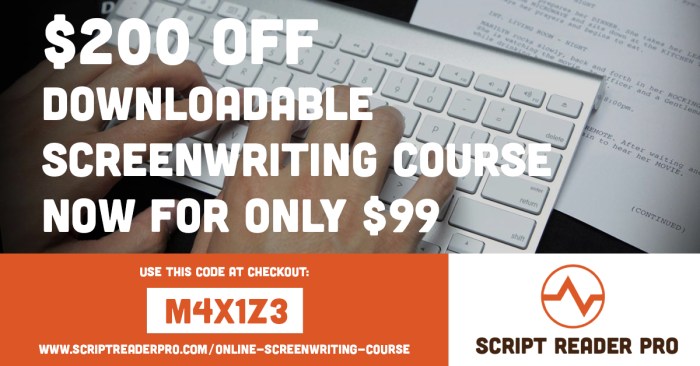
The fine folks at Script Reader Pro are running a discount for Maximum Z readers on their downloadable screenwriting course Script Hackr.

Forget all the confusing and vague “fluff” found in most screenwriting courses, coverage and books. Script Hackr will skyrocket your screenwriting skills by utilizing rarely talked about hacks and hands-on practical exercises to de-mystify theory.

The course retails at $299, but you can get it for just $99 by using the coupon code M4X1Z3 at checkout.

You can check out more details on the course here: