Three and a half scripts. No waiting.

Keep your pants on. These things can't be rushed.
Everybody else, though, will have to wait. These things can’t be rushed.

Despite a few weeks to go, it’s safe to say that 2014 didn’t work out the way I’d hoped. I didn’t do that well on the contest front, and I no longer have a manager.

I’ve gotten over the thankfully-brief “woe is me” phase, and am now firmly planted in “How can I make this better?”

Like any smart and savvy writer, I’m thinking ahead and making plans.

-As much as I love my western, it still needs work. Beaucoup thanks to the legion of note-givers who offered up a lot of insight that really helped me out.

There’s a hill near where I went to elementary school. At the time, it felt like taking on Everest. Now, not so much. The idea of rewriting this script feels incredibly daunting right now, but as is usually the case, probably won’t be a problem.

A few ideas for changes have already popped up, with the hard part now to let go of what’s already in there, but that’s another blogpost.

-Another group of notegivers had some fantastic things to say about my mystery-comedy, and provided similarly helpful feedback. They liked the concept, pointed out what in the story needed work and had some great suggestions for potential fixes.

This one is going to be especially tricky (due to that whole mystery angle), but again, I’ll work my way through it.

Can’t explain why, but for some reason, listening to 50’s jazz and drinking a glass of quality red feel like they would be extremely conducive to working on the outline. I’ll let you know how that goes.

-As for the low-budget comedy, the story’s being kept under wraps until the first draft is finished. The big hurdle here is to just keep writing and not obsess over each joke. Darn my perfectionist nature.

-It’s been a while since it’s been mentioned, or even thought of, for that matter, but I don’t want to ignore my pulpy adventure. I managed to crank out a workable outline, but it definitely needs more fine-tuning. It’s more of a “whenever I get to it”, rather than a “I have to finish this!”.

So there you have it. My projects for the coming year. How many will actually be completed? Hard to say right now, but 3 seems like a reasonable number.

At this point, I’m not even entertaining the notion of contests. It’s really all about writing, editing, rewriting and polishing. Any money I would have spent on contest fees will go towards professional feedback.

I’ll admit I was hoping to have made some significant progress this year in terms of establishing a career, and in some ways I have, but you know what I mean.

If continuing to improve as a writer and honing my skills means a slight delay in getting representation, making a sale, and getting assignment work, then so be it.

I’m a patient guy.

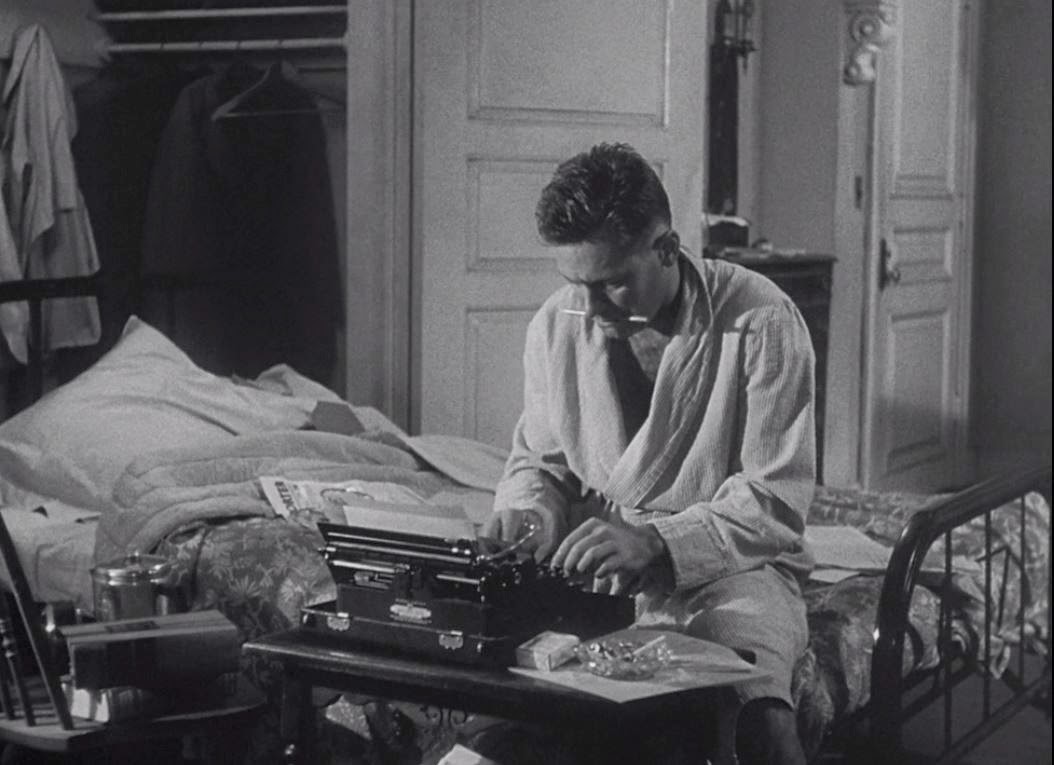
Getting a feel for the tactile experience

That's not ink. It's writer's blood (or at least it sure feels that way).
That’s not ink. It’s writer’s blood (or at least it sure feels that way).

The early drafts of my western spec all clocked in at 132 pages. “Way too long!” I was told.

Tips and suggestions on how to tighten things up were provided and implemented. 126 pages. “Still too long! Cut more!” they demanded.

Sleeves were rolled up. Knuckles were cracked. The pounding of computer keys continued. 122. “Keep going!” was the response.

I slaved, toiled and labored until I couldn’t take it any more. 117. “Almost there!”

Feeling rather drained, I took the most effective step of all: I printed out those 117 pages, armed myself with the almighty red pen and got to work.

For some inexplicable reason, when I edit a script on paper, it’s much more effective than working with a digital copy. Lines of text I’d always ignored would suddenly pop as something to cut, modify or move around.

I’ll scribble out an alternative line of dialogue. Try out an impromptu reorganizing of the scene. Cross something out, then change my mind and write ‘keep’ over it. Use my finger to literally block out a line to figure out if the scene still works without it.

Just the other day I cut out half the dialogue in a scene with no significant impact. Would I have been able to do that if I wasn’t working with actual pages? Hard to say, but I’m inclined to believe “probably not.”

As I worked my way through the script, I found more and more opportunities to cut or edit. Of these 117 pages, there’s at least one red mark on just about every page, which includes the plentiful use of red lines through words and/or sentences, and lots of circles and arrows (as in “move THIS to HERE”).

Exhausting as it was, the red pen portion of the process is now complete.

Unfortunately, I won’t be able to digitally apply these edits for a couple of days. The US is currently in the middle of a big holiday weekend, which means extra work shifts for me. Love the holiday overtime, but it’s also less writing time.

I’m not concerned. It’ll happen soon, and I’m looking forward to seeing what the new page total will end up being, as well as the subsequent responses.

It goes without saying that “Yes!” would be ideal.

Reflections on this day in particular

One of my heroes. Master of comedic timing, and eternally 39.

Taking a little break from the script reader/consultant Q&A series today for something of somewhat significant importance. At our house, anyway.

Today is my birthday, which makes a person a little reflective of their life so far and what they’ve accomplished.

Have I achieved everything I’ve set out to do?

Not yet, I like to say, but I’m getting there.

Obviously, I’m not making a living as a screenwriter – yet. But with each script I crank out and each subsequent draft that follows, it gets me a little closer. Reassurances of “you’ll make it” from friends and trusted colleagues is always nice to hear.

Has it been frustrating? Without a doubt. But as I’ve said on many an occasion, to give up in any manner would simply be too devastating. Like many of us, I am compelled to write and hone my craft, mostly because it’s the only way I’ll get better, and maybe a little bit of daydream-laden hope that somebody will eventually be eager to pay me for the finished product.

I am, as they say, in this for the long haul. All the rewrites, the reads and notes from friends, the discussions with consultants, all of it helping steer me towards this much-desired goal.

When I read about another writer making a sale or getting representation, I’ll admit to being a little jealous. Especially if it’s somebody I know or at least am casually acquainted with. I’m actually quite happy for them – they’ve earned it – but there is that little part of me that thinks “Hope it’s my turn soon.”

In the meantime, I prevent myself from getting too melancholy about what I haven’t been able to do by reminding myself what I have done, which is have written some potentially kickass scripts (after lots of fine-tuning, of course), and what I can do, which is keep writing more kickass scripts, keep trying and not giving up.

Have you no imagination?

"You'd have turned down Gone With The Wind." "No, that was me. I said, "Who wants to see a Civil War picture?""
“You’d have turned down Gone With The Wind.” “No, that was me. I said, “Who wants to see a Civil War picture?””

It’s still an uphill climb with a few gaps here and there, but the overall story for the low-budget comedy is coming together.

I’m making a point of not rushing through it and being extra careful – almost to the point of meticulous – about how all the pieces interconnect.  The more I work on it, the more the phrase “French farce” comes to mind, so lots of interweaving storylines, the intersecting of character paths, and the ramifications of each character’s actions on the others. At least that’s my interpretation.

A challenge, to say the least, but it’s been a fun ride so far.

A last-minute surprise factor was this response to the logline on an online forum:  “It’s so straightforward now it’s hard to believe you could sustain interest through 100 pages.”

I’d like to thank that person for throwing down the gauntlet in making me work even harder than I already was. Never underestimate the motivational power of “Oh yeah? Just you wait and see what I can do.”

But back to the bigger issue. Statements like these always make me wonder about the person who says/writes them.

I never cared for the “I don’t see how this could be a story” line of reasoning.  That tells me you lack vision and creativity. Just because you think it won’t work doesn’t mean it won’t. Nobody thought GUARDIANS OF THE GALAXY would do well and look what happened.

Side note – My western received a handful of reader responses along the lines of “This isn’t factually or historically accurate, so I just couldn’t get into it.” They’re entitled to their opinions, but I feel bad about their inability to just sit back and enjoy an old-fashioned ripping yarn. Although one person was gracious enough to admit at the end of their comments “It would be better if you just ignore everything I’ve just said.” Consider it done.

Always remember the sage advice of William Goldman: Nobody knows anything.

I’m all for encouraging other writers. If your idea interests or excites me, I’ll tell you. If it doesn’t, I’ll explain why not and make suggestions of potential fixes. The last thing I want to do is discourage you or give you a lecture, and you sure as hell don’t want to hear one.

My criteria is pretty simple: If I read somebody’s logline or hear their story pitch and can instantly imagine the potential within that story, and more importantly, if it sounds like something I would want to see, then they’ve succeeded and gotten over the first hurdle.

Of course, having the actual script live up to or possibly even surpass expectations is another thing.


Ask a Nicholl-winning Script Reader!

1465249_10202485687454053_1139689699_n

The first in a series of interviews with some script readers who would be worth your while to work with if you want to get your script in shape.

Today’s spotlight on: Doug Davidson!

Not only is Doug Davidson a Nicholl Fellow, but his script LETTER QUEST has the distinction of being the only animation script to ever achieve that honor.

1. What’s the last thing you read/watched that you thought was incredibly well-written?

DAWN OF THE PLANET OF THE APES. The most compelling character to hit the movies in a while is an ape. Caesar is a textbook protagonist. An extraordinary individual doing extraordinary things under extraordinary pressure. When you can end a movie by zooming in on the lead character’s face, and not have it feel cheesy, you know you’ve done something right.

2. How’d you get your start reading scripts?

I started in a screenwriting group, a large group that lasted several years. Early on, we agreed on always giving each other formal written feedback, because if you don’t have to write your feedback down, then you don’t think nearly as hard about it. When you put your feedback in paragraph form, you realize you have to make sense, you have to be consistent and you have to justify what you say. It gave me the discipline to write constructive, reasoned feedback instead of just tossing out opinions.

3. Is recognizing good writing something you think can be taught or learned?

Recognizing perfect writing is easy and intuitive. Anyone can do it. Recognizing the potential in a promising script that isn’t quite working yet, that takes more experience. And it takes a writer’s mentality. You need to study the craft for years. There are rules that are easy to memorize, but how to apply them, that’s much more difficult. Blindly applying the rules doesn’t lead to good writing, or good feedback.

4. What are the components of a good script?

The craft has to be there, and then there has to something else, a plus one. It could be funny comedy. It could be insight. It could be a new idea. That’s the “talent” part. You might think it’s this “plus one” that’s missing from most scripts, but I find the opposite to be true a lot of the time. Often a script has this amazing unique element, but the nuts and bolts of the story just aren’t in place yet. That’s when making the extra effort to put all the craft elements together really pays off.

5. What are some of the most common mistakes you see?

One of the most common mistakes I see is writers thinking a plot point (or character trait or thematic element) is clear on the page when in actuality it’s really not. At least not clear enough. It happens all the time, even to seasoned writers. That’s why feedback is so important. It’s not about saying your vision is wrong. It’s about saying your vision isn’t quite visible. Yet. The trick is to make sure everyone can see it.

6. What story tropes are you just tired of seeing?

Just about any story idea could work with the right execution. That said, I’ve come across a surprising number of scripts about screenwriters writing screenplays. Autobiography finds its way into most scripts, but it really helps to disguise it just a little.

7. What are the 3 most important rules every writer should know?

(1) Don’t (2) Give (3) Up.

8. Have you ever read a script that was an absolute, without-a-doubt “recommend”? If so, could you give the logline?

Nothing is absolute, but I’ve read more than a dozen really excellent unproduced scripts that I would recommend. I won’t go into the loglines here, but they’ve spanned just about every genre. I love to stay in the loop with the scripts I’ve read, especially the great ones. Several are optioned, several have placed very well in major contests and two have well known actors attached. Many of the writers of these scripts have secured representation as well. It requires some grit, but first-rate work will eventually get you places in this industry.

9. How do you feel about screenwriting contests? Worth it or not?

Screenwriting contests are absolutely worth it. It’s not the only path to success or a guarantee of success, but I know a fair amount of writers who have benefited greatly from contest placements. If you get an opportunity to read for a contest, I recommend that too. I’ve done it and learned a lot from the experience.

10. How can people get in touch with you to find out more about the services you provide?

My website is www.fourstarfeedback.com. I have a screenwriting blog there based on my experiences in the industry (and the numerous mistakes I’ve made). I’m also happy to answer specific questions via the email listed on my site.

11. Readers of this blog are more than familiar with my love/appreciation of pie. What’s your favorite kind?

I love pie too! I like to bake my own key lime pies. They’re pretty easy to do. I also love coconut custard, blueberry and anything with peanut butter. But my favorite would have to be . . . pecan. A great pecan pie has a sludgy quality – an intensely sweet sludge – balanced by a nutty crunch. Thanks for thinking of me, Paul! We’ll have to get together sometime for some coffee, and pie.