There’s gold in them thar dumpster fires!

Saw a great quote the other day that was along the lines of “Being a writer is like having homework for the rest of your life.”

From a certain perspective, that definitely has a negative connotation. Emphasizing the ‘work’ part of the word indicates drudgery and toil. Like, strictly dullsville, man.

The obvious solution is to make it a positive experience.

I know. Easier said than done, but bear with me.

(Writing should never seem like work anyway, but that’s another post.)

To be a better screenwriter, you need to read scripts and watch movies. You can see how the pros did it and figure out how that could potentially influence your work.

While watching your favorites and the classics can definitely help, I also suggest watching really shitty movies as well.

Hard as this might be to accept, there’s something be gained from it.

What was it that made them bad?

The possibilities are numerous, but a good percentage of the time – it’s the script.

As a writer, you can use that to your advantage.

Painful an experience as it might be, watch that bad movie from a writer’s perspective. Is it the writing that sucks? The story? The characters (and not the actors)? Is there a coherent sense of structure? Is there any structure at all? Does the story flow naturally, or do things happen because it seems like the story needs them to?

Maybe it feels like the writer didn’t take any chances, or worse, went for the very easy and cliched (i.e. expected) solution. Does anything in your script feel that way? If so, think about what changes you could make that would produce the same results, but get you there in a totally different way.

It may be 90-110 minutes of your life you’ll never get back, but at the very least you’ll get a better idea of what NOT to do when it comes to developing your script.

And that is a worthwhile lesson for any screenwriter.
A verbal solution for a writing problem

Even despite a temporary lapse, output on the sci-fi adventure rewrite was progressing at a decent pace.

I already knew there’d be more work to do once it was done, but something still felt off. A piece of the puzzle was missing, and it felt weird to keep pushing forward. Like building a house with incomplete blueprints.

Although my original intent was to finish the rewrite, I wanted to take care of the missing puzzle piece. This in itself was quite challenging.

Once again, my network of savvy writing colleagues comes to the rescue.

I’ve been doing more one-on-one Zoom calls with writers I’ve only known through social media. It’s a great opportunity to get to know them as people, as well as talk a lot of shop about screenwriting.

Such was the case earlier this week. Another writer and myself were discussing some of our current projects, and the sci-fi adventure came up. Despite my stumbling through the “pitch”, my friend got really into the concept, prompting them to ask a lot of thought-provoking questions about the story and the characters. Some I had an answer for, some I didn’t.

(side note – I used to be embarassed about not having all the answers when it came to my stories, but have since embraced it and am now willing to say “I don’t know” or “no idea” because this usually leads to a discussion where everybody involved helps me come up with an answer.)

This led me to realize that some aspects of the story weren’t as defined as I thought. That, in turn, had a ripple effect on the rest of the story. The same story of which I had just passed the halfway mark with rewriting.

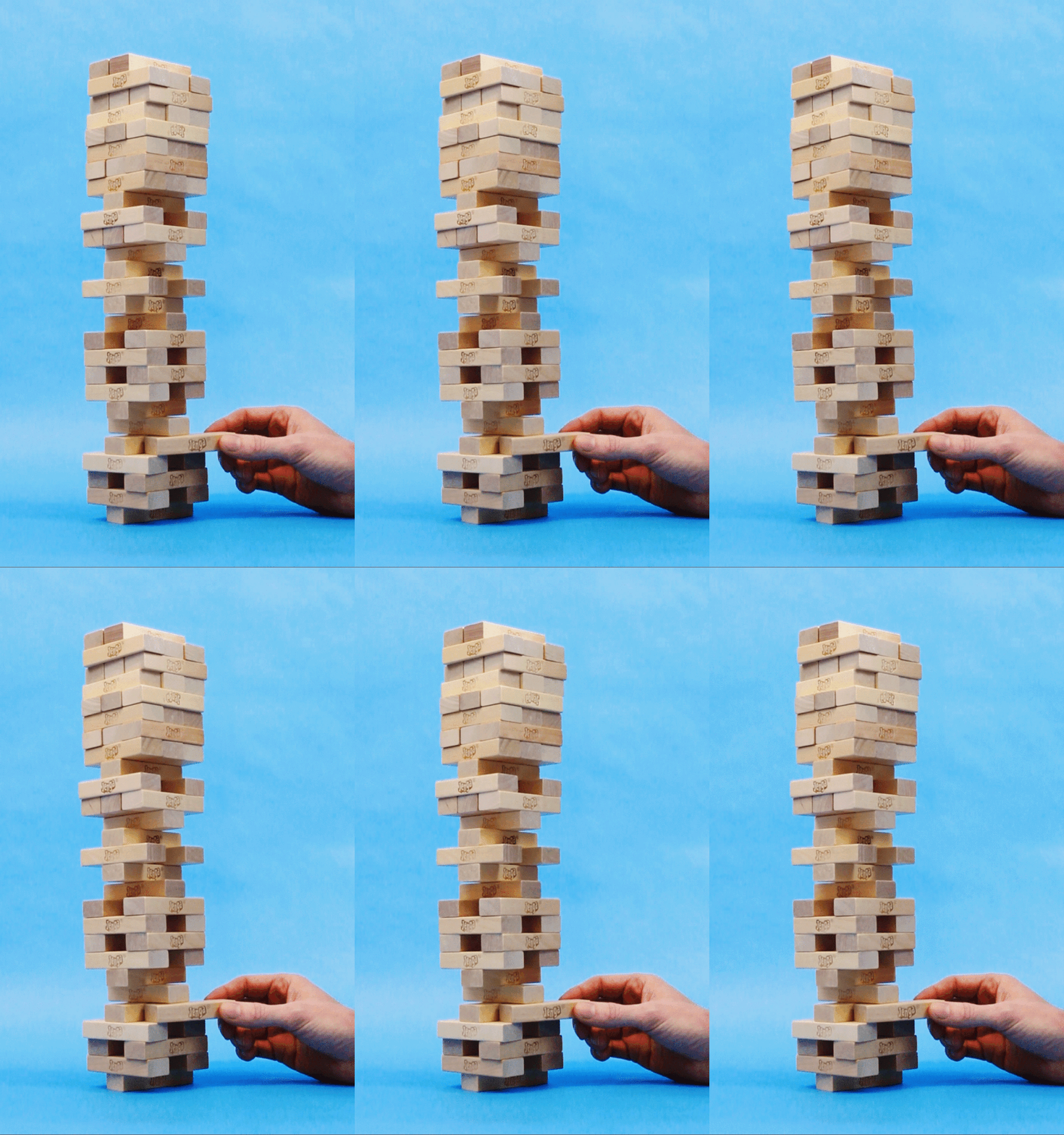
It was like taking a piece out near the bottom of the tower in a game of Jenga. Not that everything came crashing down; more like things got a whole lot more wobbly.

We talked things through some more, and did some impromptu brainstorming, all of which which helped point me in the right direction.

Long story short: the rewrite’s on hold and the reset button’s been pushed. But like I mentioned during the discussion, once those fixes are worked out and implemented, it shouldn’t be too difficult to get back on track.

While I originally hoped to be done with the rewrite around now, or at least mighty close to it, I don’t mind making another trip to the drawing board to take care of this. I’m already looking forward to taking this on and seeing how it goes.

Bonus – the chance to make any other fixes in the 50+ pages I’ve already written.

Yet another reason to be active and interactive within your personal writing community.

The final chapter in the Indiana Jones series opens today. The characters and storytelling have been a huge influence for me and my writing, and I can only hope that my scripts can someday be compared to them.

I also hope the movie’s good.

The possibility of successfully navigating an asteroid field is approximately 3,720 to 1

During a recent break from the writing, I saw a few posts on social media celebrating the 43rd(!) anniversary of the release of THE EMPIRE STRIKES BACK.

I was around for that. Proudly so.

I decided to give it another watch, mostly for nostalgia’s sake.

Even though I’ve seen it numerous times, this time felt a little different. I found myself watching it from a writer’s point of view.*

It made for a very different experience, involving continuously making mental notes and asking questions.

“How did this look on the page?”

“Wow, that dialogue gets right to the point without being on-the-nose”

“What an incredibly tight scene”

“Pay attention to how the characters are shown changing over the course of the story”

Just seeing how smooth the story flows, how tight the whole thing is, and how all the subplots are laid out really struck a chord for me.

THIS is how I want my scripts to come across.

I’ve already said that this current draft of my sci-fi adventure is all about getting pages written and holding off on editing/revising until it’s complete. That still applies.

But when I do get to that point, I’m already anticipating looking at each scene and trying to figure out what changes could be made to achieve that same level of tightness, structure, and efficiency.

And it’s just a coincidence about my script being a similar genre; this approach would help no matter what I was working on.

This is all just further proof that a writer’s education never truly stops, watching well-written films can benefit your own writing process, and that there’s always an opportunity to learn how to improve your writing.

*Full acknowledgment to credited writers Leigh Brackett, Lawrence Kasdan and George Lucas*

Implementing course correction

Got a hard lesson in humility and a hearty dose of reality these past few weeks.

I’d thought my animated fantasy-comedy spec was ready to set loose on the world, so had submitted it to contests of note, plus a few other genre-centric ones.

Initial results have been trickling in, and those results have been drastically less than desired.

Naturally, it raises doubts about ability and lots of second-guessing on several fronts.

I’d sent it out to some trusted colleagues for feedback, and almost all of them were very enthusiastic and encouraging about it. There were even words of praise from writers of exceptional quality, which added to my growing feelings of confidence.

Note I’d said “almost all”. There were a few that didn’t care for it. They weren’t fans of animation, fantasy, or comedy, or the script was too light-hearted for them. No matter what, it just wasn’t for them.

I get that. Not everybody’s going to like everything.

But it was the comments about why it wasn’t working that really struck a nerve – at first in a negative way, but like with many notes, the hidden positives and takeaways soon came to light.

Questions were asked and about story details, characters, the world it’s set in, and so forth.

When several people ask the same question or have the same concern, then that’s something that needs to be addressed.

So after a brief period of “sheesh, I must be a really shitty writer”, I took those notes and started figuring out how to make the appropriate fixes.

As you’d expect with a rewrite/revision, darlings had to be killed. Painful, but necessary. On the upside, the replacement material seems to be working; some beyond expectations.

I’ve already written off this year’s contest season. If anything positive happens, that’ll be great, but just seems highly unlikely at this point.

It’s frustrating that this is how things worked out, but it’s just the way it is. Putting in this new round of work is helping restore confidence levels for myself and the material.

Everything from this point forward is all about getting the script into better shape – and to be ready for next year.

What’s new, missing, or different?

It happens to every writer. You start the rewrite of your latest draft, and you need to figure out what needs to be cut or changed. Sometimes it ain’t that easy, and sometimes you hack and slash with wild abandon.

Part of my recent focus has been rewriting the fantasy-comedy spec, which has involved a little bit of both.

It already needed some trimming – at least 5-10 pages’ worth, so that’s just one of the many things taken into consideration as I work my way through it.

I’ve been told my writing is pretty sparse to begin with, so finding material to tighten, let alone cut, has been somewhat tough.

Tough, but not impossible.

There’s the small stuff. A widow/orphan word here, a snippet of dialogue there. Finding some way to get those three action lines down to two, or one if you can swing it.

Then there’s the big stuff. One noteworthy item was a particular story detail that had been around almost since the story’s inception that wasn’t syncing as well with the story as it was now, so that had to be changed. This caused a domino effect on all the things it impacted, which meant making sure all those connections had to be adjusted so everything still meshed in a smooth and organized manner. It was a bit of a pain to deal with, but it had to be done.

The big stuff also has its fair share of little stuff. A scene or sequence that needs a major overhaul – already dealt with a few of those, as well as a few half-page scenes that I hated to cut. Then there was a character I initially loved that proved to be ultimately unnecessary, so out they went.

If I maintain this amount of cutting, there’s no reason the finished draft couldn’t fall within the target range of the aforementioned 5-10 pages. If it ends being more than that, great (but at this point seems highly unlikely). If it’s just a few pages shorter, that’s still okay, and I’ve no doubt my beta readers will have plenty of suggestions that I probably never even considered.

No matter what gets cut or changed, it’s all for the benefit of the story. As long as the script is a tight, succinct and solid read, that’s a win.

(Turns out I’ve written about this before, waaaay back in 2013. A lot of it is still applicable, except for the part about my time in the half-marathon. Those days are long past.)

Friendly reminder: my book Go Ahead And Ask! Interviews About Screenwriting (And Pie) Volume 3 officially comes out on October 7th (two weeks from today), and the final setup of the links on Amazon and Smashwords is just about done, in case you’d like to purchase it slightly ahead of schedule. Signed copies will be available. Just let me know.