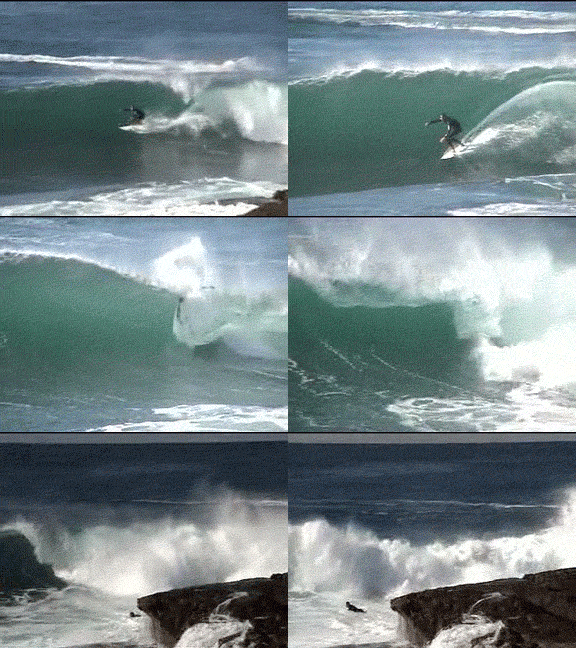
It worked before, so why not again?

This year’s contest season is pretty much over for me, with some not-too-bad and better-than-expected results.

My animated fantasy-comedy took 3rd Place in Family/Animation at StoryPros, was a quarterfinalist in PAGE and Emerging Screenwriters Animation, and made Second Round at Austin and the ISA Fast Track Fellowship.

Still waiting to hear from a few smaller contests, but none worth mentioning.

Quick note: I’ll be attending Austin this year. Hope to see you there.

I’m quite proud of how this script turned out, and even though I’m rewriting another script, as well as developing a new one after that, there’s still a chance I’ll go back and do another draft.

But I’m not in any rush. Taking my time seems to work well for me.

A few years ago, I opted to skip the contests and just focus on making the scripts better. It was a good decision.

So I think I’ll do it again.

For the time being, no contests for me for the 2024 season. I’d much rather focus on getting these scripts into decent fighting shape.

This is where I’d also add a mention of how much money I’d be saving by not doing any contests. Those fees really add up, don’t they? That’s still the case, to a certain extent. I’m giving serious consideration to redirecting the money spent on contests to one or two sets of professional feedback.

I’m also very fortunate that I have an amazing network of writers who will happily provide feedback on these scripts. A lot of them will be entering contests, and I’ll be the first to cheer their victories and console their defeats.

I won’t say it’s like a heavy load’s been removed from my shoulders, but it definitely feels like the right choice. The contests will always be there, and I’d rather take the time to really hone these scripts so they’re as good as they can be.

Only we can answer

After an unexpected break, work has recommenced on fine-tuning the outline of the sci-fi adventure spec.

I don’t know how other writers organize their outlines, but mine tend to be a scene-by-scene breakdown on a Google doc. (Hats off to the users of index cards). Each scene is planned out in terms of what happens, sometimes what dialogue might be involved, and an underlying mindset of “what’s the conflict here?”

Even though I know what I need the scene to accomplish, I may not have all the information I need, so I’ll jot down a note or question in ALL CAPS as part of it (to help me not overlook it). The note or question is something that needs to be addressed, but can’t be answered just yet.

Things like:

-DOES HE KNOW ABOUT THIS? IF NOT, HOW TO DO THAT?

-WHAT CAN SHE DO HERE TO DEMONSTRATE WHAT KIND OF PERSON SHE IS?

-NEED 3 VARIATIONS ON THIS (SEE PREVIOUS DRAFT FOR LIST)

-POSSIBLE CLUE OR HINT HERE TO BUILD UP TO BIG REVEAL

You get the idea.

I find it better to write these down in the outline instead of something separate. I don’t trust myself to be that organized, and my desk/working area is quite a mess. It’s just easier to keep it all in one document.

It’s more helpful to take the extra time to deal with all of these now, rather than jump into pages and have to hit the brakes each time one of these needs to be addressed.

Dealing with these sorts of issues can also prove beneficial because while you’re handling the initial thing, it may also offer a new or at possibly an unexpected solution that can cover a few other things, or add a new detail that adds to or helps the story. It’s happened before.

For the most part, the outline is pretty solid, story-wise, so once all of these notes and questions are covered, it’ll be off to the races. I don’t think it’ll take too long, and shooting for another end-of-the-year finish in terms of completed drafts. One would be nice, two would be better.

It’ll get there, slowly but surely.

-Contest news! My animated fantasy-comedy made Second Round for comedy features with Austin. Another long-time goal achieved, so…yay.

Congrats to all the other amazing writers whose work also made it. I’ll be there to celebrate. How about you?

-As the writers strike continues, it’s taking a toll on the people involved. One of those people is friend-of-the-blog Jenny Frankfurt, who runs the Finish Line Script Competition. She could use whatever help you can provide, so please donate here if you can.

You win some, you lose (or don’t place in) some

Another screenwriting contest season come and gone, at least for yours truly.

My western’s record with PAGE extended to 0-6, and didn’t make it to the quarterfinals in the Nicholl. After last year’s debacle with Austin, I opted to skip it this year.

(Side note 1 – I don’t pay to get the reader/judge notes, so don’t know why the script fared how it did for either contest. The Nicholl used to offer notes after the top 5 were announced, but not sure if they’re doing that this year or you had to pay upon registering.)

(Side note 2 – A very hearty congrats and good luck to the 359 writers who made it to the Nicholl QFs. I wholeheartedly applaud the Academy’s decision to limit submissions to one script per person. Other contests should follow their lead.)

My initial reaction to the news from both competitions was “I must be a really shitty writer to keep failing like this.”

But as my ever-supportive wife, a few friends who are also consultants, and several other trusted colleagues in my writers’ network reminded me:

It’s a really good script.

You’re not a bad writer.

IT’S ALL SUBJECTIVE.

This script has also done moderately well in some smaller contests, so it can’t be that bad.

I know a writer whose script advanced in the Nicholl after several years of bupkis. I also know another writer who made it to the top 50 one year, then the same script didn’t even make the quarterfinals the following year.

And as a few others pointed out about the prestigious contests and the scripts that do well in them: it may be a good script, but would it be a good movie? I’ve read some contest winners (and some top vote-getters on The Black List); some were very well-written, and some just didn’t do anything for me. One or two even made me question why they did as well in the contest as they did.

Furthermore – did any make me eager to shell out the cost of a ticket if it were available on the big screen?

Not really.

But again, that’s just my take – i.e. SUBJECTIVE.

At the very least, reading these scripts could be helpful in a “developing your craft” kind of way.

So where do I go from here? I’m rewriting a pair of newer scripts, and haven’t decided if either will go the contest route. Possibly, but right now I couldn’t say.

I’d rather focus on getting them in decent shape. If that means skipping contests next year, that’s fine by me.

From the archives: If only you could eat a bad script

pineapple upside down cake
Let the metaphors commence!

Author’s note: got some other stuff that requires my attention, and a recent discussion about pineapple upside-down cake reminded me I did a post involving it a few years ago, so hope you enjoy this blast from the past from July 2016.

“Before we get to the gist of today’s post, let’s address the elephant in the room: my western did not advance to the quarterfinals of the PAGE contest.

Honestly, I was a little surprised; I thought it would have done better. After a brief wallow in disappointment, I shrugged my shoulders and moved on. It’s just another one of those things over which I have no control. I still have a ton of confidence in this script and might submit again next year. Also waiting to see how it fares in Austin and the Nicholl.

True, it was a rather lousy way to start the weekend, but over the next couple of days, I managed to redirect my focus, which included a nice long run that involved traversing the Golden Gate Bridge, and attempting something I’ve always wanted to try:

Making a pineapple upside-down cake (from scratch, naturally).

Guests were coming over for dinner, and I’d made pies for them before. But this time,  I wanted to try something entirely new and preferably a little challenging. I’d say this falls into both categories.

I scoured the internet for an ideal recipe, found one to my satisfaction, and followed the directions to the letter. The result? It looked like it was supposed to, and that’s where the similarities end. A little too sweet and the center was still kind of goopy. Nevertheless, my guests still liked it, and K & I split the last piece after they left. Not bad for a first attempt.

Why did it not turn out the way I expected? A lot of reasons. The oven’s a piece of junk. It didn’t bake long enough. The ingredients and the amount of them probably need to be tweaked. No matter what, I know now that I can adjust all of these next time and get closer to the results I seek.

Except for the oven. It will forever remain a piece of junk until it dies. Which can’t happen soon enough. But I digress.

Notice all of the comparisons you could make between baking and writing a script? Trying something new and long-sought-after. Seeking advice and guidance. Following the guidelines. Doing what I was supposed to. An okay-but-was-hoping-for-better initial result. Planning ahead on what to fix/adjust for next time.

If a less-than-determined baker ended up with the cake I made, they’d probably denounce the whole process, give up entirely and probably buy pre-made stuff at the supermarket. But we’re made of sterner stuff. We hit a snag or some kind of unforeseen development, and we compensate as best we can. We learn what not to do next time. Sometimes you end up with something jaw-droppingly amazing, and sometimes you end up with something totally inedible.

With this whole experience behind me, I can now focus on projects of the immediate future, which includes another round of editing and revising a script, and making a pie or two for a dinner party this coming weekend.

It’s my intention to have the results of both of these undertakings be totally and utterly irresistible when they’re done and ready to serve.”

Words that need to be heard

It takes a lot of determination and persistence to make it as a screenwriter.

A LOT.

And since so many other people are trying to accomplish the same things (more or less) as you and I, the difference between good days and bad days is a vast one indeed.

We learn to take the hits and the disappointments to the point that we chalk it up to “them’s the breaks”, and move on to the next thing. It is vital that we toughen up our skin to help us survive the journey.

But let’s go back to the good days thing.

When something positive happens for us, we do not hesitate to trumpet it from the rooftops – a rooftop in the form of some kind of social media platform.

And when that happens, our network of peers and associates is just as quick to join in the celebrating. We’re practically deluged with “congrats!”, “that’s awesome!”, “well deserved!”, and the like. Speaking for myself, I really appreciate it, and make a point of returning the sentiment when appropriate.

As writers, we live and breathe using words as our craft. We write something and hope it has the desired effect. Sometimes it does, sometimes it doesn’t, and sometimes it makes a much bigger impact than you could have ever expected. (Those are particularly pleasing.)

Don’t underestimate the power of what you write. Not just for your latest script, but also when it comes to how you present yourself to the rest of the writing community.

Are you always there with a positive message? Do you think “telling ’em like it is” is the way it should be?

Sure, somebody who does well in the Nicholl or Austin is going to get all sorts of congratulatory messages, but what about somebody who came in second or made the quarterfinals in that small contest you’ve never heard of? Are you just as enthusiastic for them? Do you let them know that?

When I was just starting out, I naturally had the novice’s daydreams of “they’re going to love it!”, which of course didn’t happen. Just about every response from my queries would be along the lines of “thanks, but no thanks” (if there was a response at all), and the contest updates that most of the time start with “Unfortunately…” It’s just the way the business is. You take your lumps, move on, and try to be a better writer so you do better next time.

Anybody who’s reading this knows exactly what I’m talking about. We’ve ALL been there.

I’ve recently read the lamentations of a novice writer who hasn’t had much luck in their efforts. They’re convinced that this can only mean that they’re a terrible writer, their family isn’t supportive of them even trying, and are thereby doomed to fail no matter what, so why even try? With as much sympathy and understanding I can put into text on a screen, I (and others) have tried to explain to them that everything they mentioned, from not placing in a contest to getting a pass from a query to them feeling completely alone in this, is not unique to them. Making any kind of progress on any of those fronts won’t happen overnight.

If ever there was a time that words could make a difference for the better, this was one of them. Hopefully my comments had at least the start of the desired effect.

We’re all busting our asses trying to make it however we can in this crazy business, and any outside offering of hope or encouragement is always welcome.

So as you skim your way across the turbulent waves in the vast ocean of social media and see someone’s comment, good or bad, about how they or their writing are doing, take a second to respond.

Let them know you’re rooting for them and hoping for continued success.

You’ve been where they are and hope things get better.

You’re thrilled for them.

You’re sorry.

You’d be amazed at how effective words, especially yours, can be.