Taming the beast we all must face

lion 2
Intimidating at first, but eventually, just a big ol’ pussycat

When I was part of a writing group last year, each week we would read and critique a few members’ sets of pages. Some were just starting out, some had a few scripts under their belt, and some had been doing this a while. You can probably figure out which category I fell into.

Simply put, some of the writing just sucked. Really sucked. Like painful-to-listen-to sucked. To my credit, tempted as I was, I never actually expressed my thoughts that way.

I fully understood that not everybody had a firm grasp on the basics, and I, along with a few others, made a sincere effort to explain what would help improve their work. While a majority were appreciative of our comments, a select handful got defensive, some even to the point of flat-out dismissive, of any kind of comment that didn’t reinforce their belief that their writing was fine just the way it was.

This was one of the things that helped me decide to leave the group.

One of the universal truths about being a writer is that not everybody’s going to like what you’ve written, and just about everybody will have a suggestion as to how it could be better.

While there’s nothing you can do about the first part, the great thing about the second is that it gives you options. A lot of them. You like what this person said? Use it. Don’t like what that other person said? Ignore it.

Some people will make suggestions based on how they would do it, which is all well and good, but what’s more important is how you would do it. Do you agree or disagree with what they’re saying?

You’ll be bombarded with a wide variety of opinions, but don’t feel like you have to incorporate every single one. And while you may be the final word on what works and what doesn’t for your story, you shouldn’t dismiss every suggestion either. Some of them may be more helpful than you realize. There are a lot of  writers out there with more experience than you, so their opinions should be at least taken into consideration. But it’s okay to disagree with them, too.

Speaking from experience, it takes time to learn not to take criticism of your material personally. The comments you receive may sting at first, but you have to remember they’re about the material, not you. Read them with a “How can I use these to get better?” frame of mind. That’s the only way you’re going to improve.

One last thing – make sure to thank the person for giving you notes, even if you totally disagree with everything they’ve said. Doesn’t matter if you asked them to do it or they offered. They took the time to help you out, and the least you can do is acknowledge that and express your appreciation for it. And it’s the polite thing to do. Manners still count.

Shakin’ things up so much it registers on the Richter Scale

richter scale
Brace yourself

I recently took part in a group conversation with some other writers, and naturally, the topic came around to “So what else are you working on?” I always enjoy this sort of thing. So many great ideas out there.

When it was my turn, I mentioned some of what’s been occupying my time, which included the Christmas-themed mystery-comedy.

“A Christmas mystery-comedy? What’s that about?”

I launched into my 30-second elevator pitch. “LA Confidential with an all-elf cast.” The seedy underbelly of the world of Santa’s workshop. Guns. Sassy dames. Tough-talking gangsters. Intrigue. Double-crossings. The whole gin-soaked ball of wax.

While most thought it sounded like a lot of fun, one person looked absolutely horrified.

“Oh no!” they exclaimed. “My kids and I love Christmas. It’s supposed to be sweet and wonderful! I can’t believe you’d want to write something like that.” (All that was missing was them sprawled on a fainting couch, claiming to have the vapors while frantically fanning themselves.)

How could I not want to write this? Sweet and wonderful doesn’t make for good storytelling. I love this kind of story, and think it would make a great script.

This person makes it sound like trying something new is a bad idea because it messes with the comfort of the familiar. Yet one of the most common tenets is “Familiar, but different.” A story you’ve seen before, but told in an entirely new way. It’s what we should all work towards.

Everybody’s looking for something truly original and unique. Why in the world would you want to write something that doesn’t offer up anything new?

Every script you write is a golden opportunity to push your creativity to the limit so you really catch ’em off-guard. You know the story you want to tell, but it’s on you to truly surprise your reader/audience. Take things in an entirely different direction. They may think they know what’s coming, but you know better and look forward to how they’re going to react.

No matter what genre your story falls into, there will be certain expectations that come with it. The challenge of every writer is to not just meet those expectations, but toss them out the window and offer up a totally new and unexpected way of telling that story. Some people may not like it, but it’s most likely they’re in the minority, and therefore not your target audience.

Think about it. What kind of script are you more likely to take notice of and remember? One that goes for new and original, or one that plays it safe with the tried, true and predictable?

I know which one I’d pick, and will be waiting over by the window for your answer.

The sound I needed to hear

Oh so worth it
Oh so worth it

It’s been a very long time since I felt my heart beating that fast.

It was the weekly meeting of the writing group, where volunteers offered up ten pages of their material for a read-through and critiquing. The time was right to take the low-budget comedy out for its first road test.

Despite my confidence in my own writing ability, anxiety was coursing through me. What if they didn’t like it? What if my attempts at jokes fell flat? Worst of all – what if they thought it wasn’t funny? These meetings are held at a small cafe, so the strongest drink in the house was coffee, so I couldn’t rely on a stiff drink to steady my nerves.

To make things that much more nerve-wracking, the moderator (who knows and likes my writing) had me going last. This may have been deliberate on his part.

We worked our way through the other three sets of pages, and then finally it was my turn.

I took a deep breath, stood up, and began distributing pages (complete with assigned parts), explaining the concept behind the story. Upon reflection, the chuckles and comments of “Oh, that’s good” and “I like it” were harbingers of what was to come.

Even so, I had to force myself to take deep breaths and calm down as the read-through commenced.

Also working in my favor: the person portraying the main character was spot-on.

They got to the first joke.

And they laughed.

To say I felt a sense of relief is a severe understatement, but it was exactly the reaction I was hoping for.

The read-through continued, with laughs in the places they were supposed to be. As expected, some jokes hit better than others, but it wasn’t that much of an issue.

A few minutes later, it was over, and we transitioned to the feedback stage.

Overall, it was very positive. Comments were made about what worked, what needed work, and potential changes. Some of the suggestions had merit and worth considering, but for the most part (and keeping in mind that a few members of the group are not the greatest writers – based on reading their work), I smiled, nodded and thanked each person for their thoughts.

Once again proving it’s all subjective, one person said my character descriptions were “too much” and maybe “too flashy”, but the person sitting to my left interjected and heartily disagreed, saying “a lot of the writing in other scripts is just dry and kind of dull, but this really pops off the page and paints a great mental picture.” A few nods around the table supported the latter position. If your work sparks contrasting opinions, then it must have something going for it.

The evening came to a close, and I left, feeling just the slightest bit triumphant.

For now, I’m still working my way through the first draft, and a lot of the jokes probably need a ton of work, but at least I can say I got past this first hurdle.

Should be interesting to see how things go from here.

-Shameless self-promotion! The Great American Pitch Fest is only two weeks away, so there’s still time to register. Save yourself a nice chunk of change by using the code MaximumZ20 to get 20 percent off. I’ll be there, and hope to see you too.

Ask One of the Great Brains Behind the GAPF!

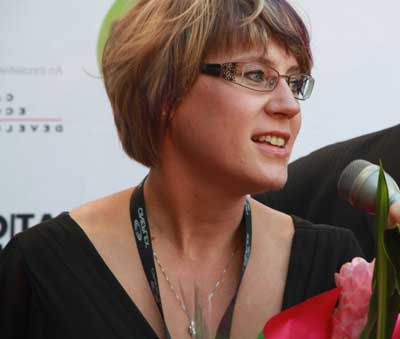
Signe Olynyk

The latest in a series of interviews with script readers and consultants who would be worth your while to work with if you want to get your script in shape. Today’s spotlight is especially significant for writers ready to pitch their material, as it features an interview with ScriptFest/Pitchfest co-founder Signe Olynyk.

Signe Olynyk is a writer/producer, as well as the co-founder of ScriptFest and www.pitchfest.com, which includes the Great American PitchFest, the Great British PitchFest, and the Great Canadian PitchFest.  She is also the co-founder of the Ultimate Logline Contest, and Your Career In A Day industry workshops. She lives in Canada, and runs the highly regarded Sooke Writers Retreat from a secluded, oceanfront home, where dozens of select writers join her each year for their personal writing retreats. In addition, Signe has written and produced a number of television pilots, series, documentaries, and feature films, and works in the industry. She has professional credits on more than 120 productions, including her two latest feature films, Below Zero and Breakdown Lane. Her work has been seen around the world on the CBC, Discovery Channel, Scream Channel, Fox, the BBC, and various others.

1. What’s the last thing you read/watched that you thought was incredibly well-written?

Great first question. There are so many. The ‘smartest’ movies I can think of right now include Christopher Nolan’s The Prestige, and The Disappearance of Alice Creed, which was incredibly smart and well written. These two films were dramatic thrillers, but I actually feel that comedy is some of the most difficult to write – it has to be smart and well-written, and generally, a brilliant mind must be behind a comedy to successfully pull it off. Creating original characters, situations, and dialogue that makes us laugh, and that we haven’t seen before, is an incredible feat.

2. How’d you get your start reading scripts?

I got my start reading scripts by writing scripts. For years, I was writing and sharing my work with others in my writing groups. At the time, I didn’t understand the value in reading, but the group I joined took turns reading a screenplay each week for a film that had been recently produced. Reluctantly, I started to read other screenplays. I just wanted to create new material and share script notes by reading each other’s screenplays, not spend my time reading the screenplays for movies that had already been produced. I thought it was going to be a waste of time when I could just watch the films. But that was when my world changed.

When you read scripts, you learn a rhythm and start to see the style in which a writer puts their words on the page. You see how evocative language and onomatopoetic words like ‘sizzle’ and ‘slap’, make your script come alive visually on the page, and in your mind’s eye. When you read other scripts, you discover and absorb lessons that you automatically start applying to your own work. And you are a better writer because of it, thanks to the work of other writers. It’s invaluable to your own development as a writer.

3. Is recognizing good writing something you think can be taught or learned?

Physical limitations are an interesting thing. I love to play soccer, but I know I’m not the best player on the field. My coach can make me run drills, and practice for hours, but my skill level is only going to get me so far compared to others, because there are others who are simply more skilled and talented than I am.

Writing is the same way. Same with math, with physics, with music, art, or sports, or anything really. Someone’s physical brain or body has developed in such a way that they are stronger at a certain skill than someone else.

What really matters is attitude and perseverance. Good writing can be taught or learned, but there has to be a certain level of natural ability and talent in the first place. And then there has to be a passion behind whatever skill you have to really drive success at anything.

As an aside, I have been very frustrated by some of the ramblings of some who like to criticize consultants and say that ‘those who can’t, teach’. What a hugely unfair, offensive and dismissive thing to say. I am the founder of the annual screenwriting conference ScriptFest, which is held each year in Los Angeles. We have had hundreds of speakers teach at the conference, and they are educated, brilliant, and generous people who give back to the community and help writers become better at what they do. Since when did we decide it was okay to criticize teachers? It is not an easy task, and great teachers are a huge gift to those of us who are still learning – which is all of us, isn’t it?

Yes, teaching can be taught. I’m incredibly grateful to all of those who have mentored me in my life. It is the moral obligation of each and every single one of us to share what we have learned with others, so that we can all learn from one another.

4. What are the components of a good script?

I want to see characters I care about in situations I haven’t seen before overcoming outrageous obstacles in the singular pursuit of their goals. I want to feel something, and root for them to achieve their goals. I want to go on a ride with them, and experience an emotional journey as they give everything they have towards reaching their goals, being beaten down and nearly defeated as they pursue an eventual triumph. That doesn’t mean a character must always reach their goal – and by triumph, I mean they’ve learned something meaningful that has changed them forever, for better or worse.

5. What are some of the most common mistakes you see?

Many writers write characters and stories they think people want to see, hear, or read. They cling to stereotypes, which does nothing to create originality or anything of interest to an audience. Finding your own voice as a writer is something that develops the more you write, because your confidence grows as you do.

I also see many writers fall in love with their first script or book, then spend years and years rewriting and tweaking it, and doing rewrite after rewrite. If you want to be a professional writer, you must generate new work. This is important not only because you are creating a body of work, but because you get better with everything you write.

6. What story tropes are you just tired of seeing?

Cats leaping out at people in horror stories. The guy who develops a cough, dying part-way through the story. Girlfriends who go after the girl their boyfriend cheated on them with – how stupid is that? Go after the ass who cheated on you! I want to see characters pushed as far as they can in directions and towards goals I haven’t seen before, and making decisions that are real for that character and that people can relate to. I want to see characters overcome their obstacles by making choices that only they would make. Story comes from your characters. Make your character’s reactions realistic for who they are, and have them respond in ways that only they would. Just as each of us has our own backstories, and these experiences shape who we are, our characters need to be developed the same way. Then you create characters and situations that are as real as each of us.

7. What are the 3 most important rules every writer should know?

-First, don’t miss out on your life because you feel a need to be writing or working all of the time to create success. You must have a life in order to be a great writer. Every experience you have helps to shape you, and you need those experiences to shape your characters and their worlds.

-Second, take care of your health. Watch your posture and get a good chair to support your back. Go on long walks so your characters can speak to you, and you’ll be amazed how ideas will come to you when you’re least expecting it.

-Third, go to every event you can and constantly educate yourself on your craft. You never know who you will meet, or what you will learn that will inspire you, enlighten your work, and help you to create your best work.

8. Have you ever read a script that was an absolute, without-a-doubt “recommend”? If so, could you give the logline?

I’m still seeking that script. I find lots of screenplays that are ‘recommends’, sure. But even then, rarely do you find any script that doesn’t need work, or still has tweaking or ideas, characters, or dialogue that need to be finessed a bit more. There are tons of loglines I read that make me smile and that I get super excited about, and keep visualizing the various scenes, and putting my producer hat on to think about logistics. Although I can’t give a logline exactly, what I can tell you is that they all have certain things in common:

  *TITLE: The title of the script captures the full essence of the story. We know what it is about, just from the title, and the theme of the story is also hinted at. JAWS. UNBROKEN. WILD. UP.

  *CHARACTER: They have a protagonist who is interesting to me, relatable, but who is someone I haven’t seen before. They pursue goals in a way that only they can do, and their backstories make their actions real and believable.

  *PURSUIT OF A CLEAR, IMPOSSIBLE GOAL: They have a goal that seems impossible, and the journey of following this character as they pursue that goal becomes irresistible to me. I must watch them pursue their goal.

  *OBSTACLES: They overcome increasingly serious obstacles in pursuit of their goal. The stakes get more serious as the story progresses.

  *NEMESIS: they have a formidable foe. A Goliath for every David. Goliath keeps putting obstacles in David’s way

  *LESSON LEARNED: the character is different by the end of the story than who they were at the beginning. By going on this journey with them, I am also changed in some way. It is the magical, emotional moment in a movie when your character becomes who they were meant to be, regardless of whether their goal is achieved or not.

9. How do you feel about screenwriting contests? Worth it or not?

Anytime you have an opportunity to get your work in front of someone who can make a difference to your career is worthwhile. It’s always a bit of a crapshoot whether your work will resonate with a particular judge. However, a lot of industry people find scripts by judging contests, and really, it’s a matter of the right script finding the right producer at the right time. If that’s the situation, then it behooves any writer – especially without an agent – to get their work out there and in front of as many eyeballs as possible.

Writers may also want to really examine the prizes. What is the real opportunity? Is it just to win a cash prize? Or is it industry exposure? What is more meaningful?

10. How can people get in touch with you to find out more about the services you provide?

I would encourage writers to check out ScriptFest and the Great American PitchFest. It’s an annual, 3-day conference with more than 40 classes, panels, and workshops offered. Writers who’ve written a book or screenplay can pitch it to more than 120 agents, managers and production companies. Visit www.scriptfest.com to learn more.

11. Readers of this blog are more than familiar with my love/appreciation of pie. What’s your favorite kind?

That’s like asking my favorite ice cream! So many kinds, so many flavors! Lemon meringue, pumpkin, butter pecan, coconut cream, banana cream, apple with cheddar…If I have to choose only one kind, I would probably say blueberry-rhubarb. I like the sweet with the tart (kind of like my favorite movies).

Ask a Most Excellent Script Consultant!

Wayne McLean

The latest in a series of interviews with script readers and consultants who would be worth your while to work with if you want to get your script in shape. Today’s spotlight is on Wayne McLean of Wayne’s Movie World.

-update on May 4, 2018 – Wayne passed away on April 30th from congestive heart failure. He provided me with some great notes for my western, and enjoyed getting my updates regarding its progress. He was very savvy when it came to writing advice, extremely generous with offering it, and overall just a very nice guy.

1. What’s the last thing you read/watched that you thought was incredibly well-written?

The Imitation Game, Nightcrawler, Whiplash.

2. How’d you get your start reading scripts?

I fell into it by accident. I was in a writers’ group. One of the guys was produced and went to Toronto for a pitchfest. He brought back 95 or 100 scripts. I read them all and called each writer to give input. No charge. After about 90 phone calls I said, “I can do this.” My 25-year career in broadcasting really helped. That was about 10 years ago.

3. Is recognizing good writing something you think can be taught or learned?

I work with writers and their scripts to provide the focus necessary to perfect the skills required for the CRAFT of screenwriting in relation to their scripts. Then, through a careful process, the writers and I work together to develop their talents to enable them to become proficient in the ART of screenwriting.

4. What are the components of a good script?

Amazing writing with a unique point of view. Compelling, riveting characters. Crackling dialogue. Powerful subtext on all levels. Scenes and situations that are fresh. Marketable.

5. What are some of the most common mistakes you see?

Clichés. Sending out a script that isn’t ready for the market.

6. What story tropes are you just tired of seeing?

Characters waking up from a dream. Fragmented concepts. Two-dimensional characters.

7. What are the 3 most important rules every writer should know?

I don’t ascribe to the idea of ‘rules’. I prefer to see a writer following guidelines and principles. The script must be entertaining, entertaining and entertaining.

8. Have you ever read a script that was an absolute, without-a-doubt “recommend”? If so, could you give the logline?

I cannot disclose loglines. All materials submitted are confidential and conform to my rules of privacy. I do have some clients with million dollar concepts.

9. How do you feel about screenwriting contests? Worth it or not?

If a writer can afford it, enter as many contests as possible. Use them as an opportunity to develop writing skills and ask if there is input available from the judges.

10. How can people get in touch with you to find out more about the services you provide?

(See note above. Wayne’s website & email have been shut down.)

Check out my website waynesmovieworld.com or email me at wayne@waynesmovieworld.com.

11. Readers of this blog are more than familiar with my love/appreciation of pie. What’s your favorite kind?

Pumpkin.