A pause for some important announcements

town crier
Hear ye, hear ye!

Once again, today’s post is about promoting the projects of a few savvy creative types, each one definitely worth checking out.

-Writer/author/script consultant Howard Casner‘s crowdfunding project for his short film 14 Conversations in 10 minutes is in its final week, and the goal is in sight! Donate if you can! For screenwriters, Howard is also offering his new service – $20 to review the first 20 pages of your script.

-Filmmaker Scotty Cornfield‘s crowdfunding project for his short film Goodbye, NOLA has been extended another 3 weeks. They’re about a third of the way there, so every little bit helps! Production on location wrapped earlier this week, and word of mouth is that it’s shaping up to be a great film. Donate if you can!

-Author/playwright/screenwriter M. Pepper Langlinais‘s short script St. Peter in Chains won the Short Grand Prize in the 2012 Table Read My Screenplay competition, and now she’s expanded it into her 6th novel – The Fall and Rise of Peter Stoller. She’s an accomplished author, having also written three Sherlock Holmes books. Some great choices, especially with summer reading season upon us.

Got your own project you’d like to promote? There’s always room on the bulletin board, so let me know.

A tentpole frame of mind


kids-movies
My objective. Every single time.

Here in the US, we are heading into what’s known as Memorial Day weekend, where we honor those who have given their lives in the service of our country. It’s also considered the kickoff of the summer season, even though summer doesn’t officially start for a few weeks.

Once upon a time, Memorial Day weekend was when the summer movie season kicked into high gear, with each weekend seeing the release of a potential blockbuster. It has since crashed through the barrier of time limitation, with some summer-appropriate fare being released as early as late March.

I was fortunate enough to have come of age when each summer saw its fair share of films that could be categorized as prime examples of not only filmmaking, but also of storytelling.

Definitely storytelling.

RAIDERS OF THE LOST ARK. GHOSTBUSTERS. BACK TO THE FUTURE. ALIENS. ROBOCOP. DIE HARD.

Each one has made its indelible mark on me, making quite the impact on my psyche and personality, and severely influencing the way I write. I make no secret about loving to write these kinds of stories.

(Author’s note – I’m no fool. Nobody’s going to take a chance on a mega-budget script from an unknown. Hopefully once I establish a foothold with my smaller scripts, I can eventually bring out the bigger ones.)

Some may see a summer release as Big Dumb Fun, which admittedly some of them are, but I make a point of treating the audience as intelligent people and want to give them a story that goes beyond simplistic expectations.

I strive to write material that entertains more than just the eyes and ears; I go for the brain, too. It takes a lot of effort to put together a story that stimulates the viewer on more than just a sensory level, but when it’s done in a smart and efficient way, the satisfaction of seeing it pay off is well worth it.

Will I ever get paid to write these kinds of stories? I like to think so. It doesn’t hurt to at least daydream about it.

Imagining that sometime in the relatively near future, a trailer will come up that features snippets of characters and dialogue, all of my creation, all culminating with those words laden with the excitement of anticipation:

“Coming this summer to a theatre near you”

A big smile and chills up my spine, believe you me.

Returning to the sprucing-up stage

painting
It’s going to take just a little bit more than a new coat of paint

It all started with a “Scripts Wanted” listing.

A small prodco with an even smaller budget was looking for a particular kind of script. I felt that one of my earlier efforts was a perfect match, so I sent it in.

A few days later came the response “Just not what I’m looking for.” A bit disappointing, but that’s the way it is. No big deal. I’ve moved on.

It was at this point I realized it had been quite a while since I’d actually read the script. As far as I could remember, it was in good shape.

So I read it.

The result? It’s better than I remember, and a lot of the jokes still work. But what it really needs is just a good, solid edit/polish. There’s definitely some fat in need of trimming, and a lot of that is just extra and/or unnecessary words.

The draft I’d been using for years was 109 pages, which is a little excessive for a comedy. I’ve completed the initial edit, which brought it down to 105. A more thorough red pen edit is underway, and after going through the first third, another page has been cut out, bringing the current total to 104. The hope is to cut out at least another 2-3 pages.

There are at least two sequences (so far) that need rewriting to accommodate some of this editing, and the solution to one of them (a key part of the story) came to me a lot faster than I was expecting. That’s always nice. There’s no reason I couldn’t be done with a much more presentable draft in a week or less, which is also nice.

Since this script is from way back when, it was quite the experience to look at how I used to write with the advantage of having all the knowledge and skill I’ve acquired since then.

Go through your own catalog of completed scripts. Almost-completed and first drafts are allowed. When was the last time you looked at one of your earliest efforts? How does it compare to your most recent project?

I bet it’s super-easy for you to spot the differences between then and now. You might be surprised at how much you’ve improved, or possibly even laugh at how bad you used to be. Happens to everybody.

Whenever I would pass this script along to another writer, I would always precede it with the caveat “This is one of my earlier scripts, so the writing’s not as good.”

After this edit/polish, I don’t think I’ll be saying that anymore.

Take us along for the ride

roller coaster.jpg
Hang on tight.

Here’s a two-part question for you. Pencils at the ready, please.

Up first – Are you enjoying the actual process of writing your script?

Sure, we all like “having written”, but what about getting there?

Do you get a thrill from figuring out your story? Mapping out the plot? Developing characters and crafting dialogue?

Do you get so engrossed and involved in your writing that when you check the time, you discover a lot more time has passed than you thought?

If you’re really excited and enthusiastic about your script, you’re going to feel that way even before you start writing it.

Now for the second part of the question:

Is all the aforementioned excitement and enthusiasm evident on the pages of your script? Could someone read it and think “Wow, they really like this stuff.”?

While it’s often said that you can gauge a writer’s grasp of the craft just by looking at the first page, you can also tell if they’re really into their story by how it reads.

Does it grab you from the get-go? Is the tone of the writing a solid match for the tone of the genre? This is not a case when “good enough” will cut it. What would you think if you read a horror that was “sort of” scary, or a comedy where all the jokes fall flat?

Exactly.

You want the reader to be as thoroughly entertained as you were in putting it together. You want them to be as compelled to keep turning the page as you’d be if you were reading it yourself.

A lot of the time you’ll hear a writer wrote something because “they had a story they had to tell”. That story was so strong and powerful inside them, they had no alternative but to write it out.

As creative types, that level of excitement and enthusiasm exists in all of us. We’re all eager to tap into it, but need to take the time to learn how to do it properly so it can be done in the most effective way possible.

Pencils down.

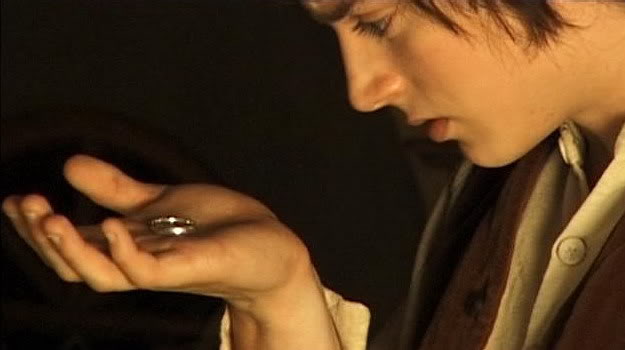
One question to rule them all


frodo
An epic adventure based on the fate of a piece of jewelry

I recently had the pleasure of giving a friend some notes on his script (a drama). It was a great take on a familiar subject, but I had some trouble determining what kind of story they were trying to tell.

One of my suggestions was to streamline the story so it was more focused on the primary storyline as indicated by the central question. He asked me to elaborate.

I put it this way:

The inciting incident raises the central question of the story, and everything after that revolves around answering it – which takes place in the climax/showdown part. Anything that’s not connected to the central question doesn’t need to be there and should therefore be cut.

This isn’t to say you can’t have subplots, but even those should be in some way tied to the central question.

What would you say are the inciting incident and central question in your story? We, the reader/audience, want to know; we’re constantly asking that central question and want to see how the answer comes to be.

To put it in perspective, albeit from an action-adventure approach, in THE LORD OF THE RINGS films, after some necessary exposition, we learn the central question as “Will Frodo get the Ring to Mt Doom?”

Notice how everything after that revolves around that question in some way. Each scene continues to ask the question and gets us a little closer to finding out the answer, even if it might seem like the scene isn’t connected to it and about something else entirely.

On top of all of that, since you need conflict, the hero’s journey to achieve their goal is going to be rife with obstacles that would otherwise prevent them from doing that. Every time they encounter one of those obstacles and the hero reaching their goal is put in jeopardy, the central question is once again raised.

Hope this helps.