Enjoying that microsecond of contentedness

cannoli
True, normally I’m a pie kind of guy, but I’ve really been craving these for a while…

Happy times around these parts, chums. The November writing project was a success. The first draft of the low-budget comedy is complete.

I listen to Pandora for white/background sounds while I write, and – this is absolutely true, swear to God – Handel’s Hallelujah Chorus was playing as I typed in “The End”. A pretty solid good omen, if you ask me.

So the draft is done, and now gets tucked away for a couple of weeks. It’ll definitely need a lot of work when I come back to it, but it’s great to know I have a completed draft to come back to.

This is that feeling that every writer should savor when they achieve a specific milestone like this. A lot of would-be writers start a project, then abandon ship when it “just gets too hard” or “don’t have time”. It’s those of us who are truly dedicated that toil away no matter what. You’ve had a long day at work. Stuff around the house needs to get done.

Through it all, we find the time and make the effort. Even if it’s only 30 minutes or one page a day. We do it not just because we want to, but because we have to. We consider not writing unthinkable.

There are good days and bad days, but you learn to work your way through both. You have a goal in mind, and do what you can to get there. And once you do, there’s nothing that can compare to that feeling of accomplishment.

Enjoy it. You’ve earned it. The first of what will probably many rewrites awaits, but it can wait just a little bit so you can reward yourself in a small but appropriate manner.

A friend told me that whenever they finish a first draft, they celebrate with scotch. Scotch really isn’t my thing, but I wouldn’t say no to a cannoli from this great Italian bakery down on the Peninsula…(diet be damned)

Have a great weekend, and get some great kickass writing done.

A thought that never truly goes away

Just a little self-evaluation to pass the time
Just indulging in a little self-evaluation

I posted this just about a year ago, and after recently receiving some very supportive and encouraging script notes, think it’s still relevant.

Am I getting better?

One of the sad truths about trying to make it as a screenwriter is that it’s an extremely frustrating process.

On certain days, the frustration feels like it extends to the uppermost part of the outer edge of the stratosphere. To the nth degree.

What is it about screenwriting that people who don’t do it think it’s easy? If you’re reading this, it’s more than likely you’ve given it a go, or at least know somebody who has, so you know full well that it most definitely is not.

We even try to warn those who think hammering out a first draft in a few weeks is a guaranteed million dollar paycheck. This is a long and arduous road, we say, but they don’t let that stop them. A legion of the truly unaware who will discover the scary truth soon enough.

Those of us who are fully committed (an apt phrase if ever there was one) finish the latest draft, then edit, rewrite and polish it so many times it enters well into double digit territory, hoping our writing and storytelling skills are improving with each new attempt.

But how do we know if that’s even happening?

We ask friends and trusted colleagues for feedback. We pay for professional analysis. The script gets reworked yet again.

We hope this newest draft is light years ahead of all of its previous incarnations in terms of quality, but sometimes it’s tough to be able to recognize if that’s the case. At least for me, anyway.

Whenever I send somebody a script for critiquing, I always say “Thanks for taking a look. Hope you like it.”

I know the script isn’t perfect – maybe even far from it, which is why I ask for help. Part of me knows it’s good, but can be better. It’s being able to identify the latter that gives me trouble. I’m so deeply embedded in a story that it’s tough to step back and be objective. Maybe I can not look at it for a few weeks, but even then it’s tough to look at it with fresh eyes.

Follow-up notes will tell me what they liked and what they feel needs work. There will be a fair mix of stuff I should have already figured out and some “How could I have missed that?” surprises.

So back I go into rewrite mode, hoping for improvement for both the material and myself, still not knowing if that improvement is there until I undergo the entire process all over again.

Or at least somebody tells me.

Is your story worth fighting for?

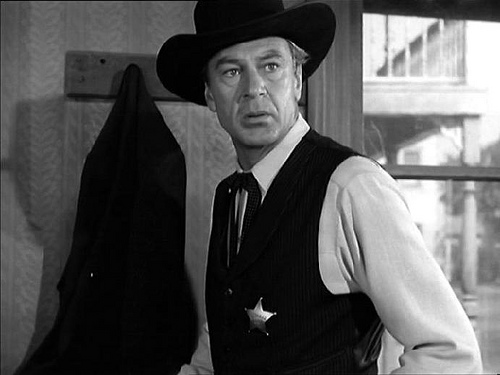
Will Kane knows what it's like to feel like one against everybody else
Follow Will Kane’s example (except without all the shooting and stuff)

The rewrite of my mystery-comedy has been put on hold because I’m teaching myself how to write a mystery, or at least how to be better at writing one. I bought a book and everything.

But I also don’t want to not be writing, so I’ve also decided to return to the low-budget comedy. It’s been a while since I’d read the outline, but it holds up more than I thought. Sure, it needs work and there are some spots where it says something like “SOMETHING FUNNY HAPPENS!,” but overall, I like it (hold onto that statement for just a bit).

Several months ago, I’d had the opportunity to have a brief chat with a writer who specializes in comedy. He asked what I was working on, so I pitched him the idea. He liked the concept, but was quick to poke holes in the story vis-a-vis the logline (which has since been rewritten), and didn’t care for how I had the story play out (as delivered in my thumbnail presentation).

“X should happen instead of Y! Having THIS CHARACTER connect with THAT CHARACTER is all wrong!” Plus some additional words to that effect.

Gosh.

I wasn’t expecting a standing ovation, nor did I expect it to be proclaimed a work of genius, but if this guy didn’t care for what I had, did that mean it was doomed before I even started?

Nope. Quite the contrary.

Several key things I had to remember:

-this was his opinion. One person, which is not a majority.

-his sense of humor and comedy stylings could be totally different from mine.

-it’s a work-in-progress in its very early stages. The end result will most likely be very different from the starting one.

-I think it’s a good story. Always have, always will. I have no intention of abandoning it or making any significant changes so as to gain his approval. I’m not writing this for him.

Every writer spends a lot of time coming up with story ideas, and then developing them as far as they’ll go. Stick to your guns if you believe in your story, but don’t totally block out advice and suggestions. Use what you think works best. Remember – this is YOUR story. If you think it works, then by all means, do what you can to make things happen.

It’s great when you get encouragement, but you’ll also encounter a lot of naysayers (“I don’t get it/like it, so it must be a bad idea.”). It’s all subjective. Everybody likes different things. If you believe wholeheartedly in your story, you have to do your absolute best to get the rest of us to be just as interested in reading it.

Just make sure to tell that story in the most entertaining, original and professional way possible. That’s all.

Go for the hard turn

bullitt gif

I just finished reading a friend’s comedy script. It was okay. It needs work, but the one thing I couldn’t shake was how the story played out pretty close to how I expected it to. There weren’t any real surprises.

However, one of the things that really stood out about this story was that deep within it was the idea for the same kind of story, but from a totally different angle. Not only would this open up new and original ideas, but it also made me think that this new story would be one I don’t think I’d ever seen/heard of before.

How many times have you read a script and known what was coming? Don’t you love that feeling when you read something and get what you were totally not expecting? A story that keeps you eagerly wondering “what comes next?” is one to be thoroughly enjoyed. The more surprised we are, the better.

Cliches. Tropes. Clams. Old reliables. Whatever you want to call them, writers with less experience use them because they’ve worked before. It takes a lot of effort to NOT use them.

The challenge is to come up with a new way to present these old ideas. “Familiar yet different,” as the saying goes.

It can be a little intimidating to take those first steps into unfamiliar territory, but you want the journey the reader takes through the story to be memorable, right? So why not take that chance and head in a new direction?

Go through your latest draft. Are there elements to it that feel tired or overused? You’ll know them when you see them. Is there a different way to do or say the same thing?

You can even go so far as to imagine “What’s the least likely thing that could happen/be said here, but still takes the story in the right direction?”

Try it. You might be surprised. And if you’re surprised, chances are the reader will be too.

Let’s get those brains stimulated, people!

You mean movies can be smart AND good?

One of my favorite things to do as a parent is go to the movies with my daughter. It’s a nice feeling knowing I’ve instilled in her the appreciation of the whole moviegoing experience. It also helps that there’s a fantastic two-screen (one of a handful of similar small neighborhood theatres in San Francisco) a few blocks from us.

And as she’s getting older, our choices are growing in number. Strictly kid-based animation has given way to PG-13 fare, so we try to see what we can when possible.

Earlier this summer, we caught JURASSIC WORLD and INSIDE OUT within a week’s time. She really enjoyed the dinosaur flick. I thought it was fun, but felt it relied more on the nostalgia factor rather than smart storytelling (“Remember when we helped Grandpa fix that old car?”). I found the latest offering from Pixar to be pure genius, while she found it to be simply “okay”. I asked why she liked the first movie more than the second.

“I think I like movies where you don’t have to think too much.”

Gasp.

I won’t go so far as to say it was a dagger in my heart, but you can probably understand my being taken somewhat aback.

I could easily chalk it up to that she’s still relatively young and hasn’t latched on to my love of the movies to the extent that I have. Like I said, the list of what she’s seen is somewhat limited. I’ve done what I can, and hopefully can continue to contribute to it.

But as a writer, what’s my biggest takeaway from this?

Obviously I want to write scripts for films that will be embraced by the general public, which means they’d have to be simple enough that anybody could follow along, but also written in a way that the reader/audience doesn’t feel insulted or talked down to.

All this talk about needing to appeal to the lowest common denominator has always bothered me. It makes it sound like there’s no point in trying to write something smart.

I beg to differ.

Getting the reader/audience to really think about the story gets them more involved. You hooked with them with the beginning, kept them intrigued throughout the middle, and now they’re compelled to find out how it all ends. Isn’t that what it all comes down to?

I love it when I read a script where it’s obvious a writer knows what they’re doing when it comes to telling a story. Setups and payoffs. Multi-dimensional characters. Plotlines where I know what the endpoint is, have no idea how we’re going to get there, and am getting a real kick out of taking the journey.

This is the kind of writing we should all strive to create.

It’s easy to write something that doesn’t try to challenge the reader/audience, and the reaction will probably be similar. “Boring.” “Unoriginal.” “Meh.”

Push yourself to write something that offers up something new, or at least a new twist on an old standard. Give us something we haven’t seen before, or totally weren’t expecting. Not just one part. THE WHOLE THING. There’s something exhilarating about venturing into new territory. Take us there.

We’re writers. It’s what we do.