One question to rule them all


frodo
An epic adventure based on the fate of a piece of jewelry

I recently had the pleasure of giving a friend some notes on his script (a drama). It was a great take on a familiar subject, but I had some trouble determining what kind of story they were trying to tell.

One of my suggestions was to streamline the story so it was more focused on the primary storyline as indicated by the central question. He asked me to elaborate.

I put it this way:

The inciting incident raises the central question of the story, and everything after that revolves around answering it – which takes place in the climax/showdown part. Anything that’s not connected to the central question doesn’t need to be there and should therefore be cut.

This isn’t to say you can’t have subplots, but even those should be in some way tied to the central question.

What would you say are the inciting incident and central question in your story? We, the reader/audience, want to know; we’re constantly asking that central question and want to see how the answer comes to be.

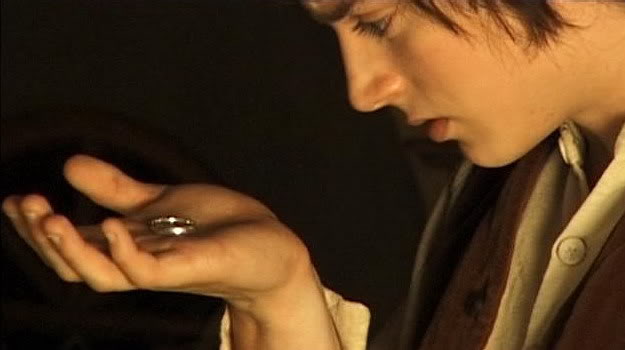
To put it in perspective, albeit from an action-adventure approach, in THE LORD OF THE RINGS films, after some necessary exposition, we learn the central question as “Will Frodo get the Ring to Mt Doom?”

Notice how everything after that revolves around that question in some way. Each scene continues to ask the question and gets us a little closer to finding out the answer, even if it might seem like the scene isn’t connected to it and about something else entirely.

On top of all of that, since you need conflict, the hero’s journey to achieve their goal is going to be rife with obstacles that would otherwise prevent them from doing that. Every time they encounter one of those obstacles and the hero reaching their goal is put in jeopardy, the central question is once again raised.

Hope this helps.

They didn’t say no

champagne
If you’re going to look at the glass as half-full, why not have it at least be something worth drinking?

An encouraging bit of news from the ongoing quest for representation.

A new management firm had contacted me, and asked to read some of my scripts. I sent the western and the fantasy-adventure, then worked really hard on not thinking about it. Refocusing my attention on other scripts proved to be the most effective.

A few weeks went by, and I sent the obligatory follow-up. “Haven’t got to them yet,” was the response. “Check back in a few weeks.” Back I dove into gettin’ stuff done.

A few more weeks pass. Another follow-up inquiry. “Halfway through the fantasy. Really like it. Will be in touch.” Nothing wrong with that.

Another few weeks, and another follow-up. “Battling a nasty head cold. Hard to read and stay focused.”

At this point, you’d think common sense would have prevailed and I should accept that this was all building up to a rejection. But for some reason, it didn’t seem that way.

The person was still responding, and I was making a point of not being pushy. Even after relaying this story to a few writer chums, the general consensus was “You’re just wasting your time. They’re just letting you down easy.” Again, this felt different.

I’m a stubborn sort, especially when it comes to getting a career going, so I waited another week and sent one more follow-up.

They explained things had been taking so long because they currently didn’t have any solid connections with prodcos doing family movies (which this script could be considered), and weren’t sure where else they could take it – for now. They also asked me to keep them updated if anything happens with it somewhere else.

They had high praise for my writing and firm grasp of story and structure, and added that they still had a big pile of other scripts to get through, so it might be a while before they got to the western. The message ended with “thanks for your patience”.

I wrote back, thanking them for the update (adding that the writing for the western is stronger than that in the fantasy) and that I’d be in touch several weeks down the road. They were cool with all of it.

While this didn’t exactly yield the results I was hoping for, it also didn’t end like the many that have come before it. The person liked my writing, and always got back to me, which is definitely more than has happened with others.

There were lots of times throughout this whole process I was convinced I would receive an email with the inevitable “thanks, but no thanks”, but that never happened. After all this, I’d still consider what happened as a positive thing.

It may not be quite “back to the drawing board”, but it reinforces my belief that good things are fast approaching. In the meantime, I’ve got a few more scripts requiring my attention.

-On a semi-related note, screenwriting consultant Bill Boyle will be holding his workshop How To Sell Your Screenplay From Anywhere on Wednesday April 27 from 7-10pm at Fort Mason in San Francisco. Among the topics to be covered will be Industry Access, Marketing Tools, Script Protection, and Legal Aspects. Registration is $75, and at last check there were only 12 slots left, so don’t delay! For more details, email Bill at bill@billboyle.net

-One more thing. I ran the SF Rock & Roll Half-marathon this past Sunday. Many hills were involved. 1:58:09.

It was good enough for Spielberg…

quint
“Eleven hundred men went in the water. Three hundred and sixteen men come out. The sharks took the rest.”

There’s a pivotal scene in my western where my main character reveals why she does what she does and what made her the person she is. Nothing too complicated. Just a couple of lines of dialogue.

It took a few passes to whittle it down so it got to the point fast and in as few words as possible. I think it works quite nicely.

It’s been suggested how this was a great opportunity to apply the “show, don’t tell” rule and make it a flashback. The logic being that since it’s such an important moment, showing it, rather than just her talking about it, would have a greater impact.

I’m not so sure about that.

I don’t have a problem with flashbacks, but have always tried to avoid using them. I guess I see them almost as a cheat; possibly even lazy writing. Like you can’t weave that information into what’s happening now, so you stop the action to show it. But once you interrupt the momentum of your story, it’s not easy to get things back up to speed.

And sometimes a flashback just isn’t necessary.

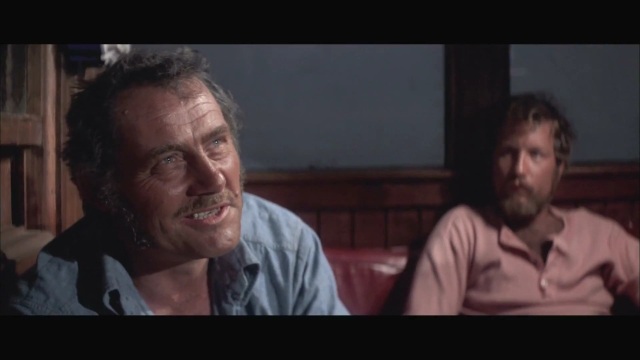
Consider the scene from JAWS pictured above with Quint’s story about the Indianapolis. Should we actually see what he’s describing? Highly doubtful. Part of why that speech works so well is how it’s delivered. You can see and hear what that experience did to him. How you’re imagining it is much more terrifying than anything they could show. The speech would lose its impact if we were concentrating on the action, rather than what Quint is saying.

Sometimes just a line of dialogue or two can be just as effective, if not possibly more so, as pausing the action for a flashback. This isn’t to say you shouldn’t use it. If you think it’s the most effective way to make your point, then by all means do it.

Just make sure it’s a solid fit.

Keepin’ it small

dogs
One might be a little easier to work with

When I first started working on scripts, I had sky-high ambitions to write the next Big Budget Blockbuster. So that’s the kind of stuff I wrote.

They may not have a chance of ever getting made, but I really like the stories they tell, and writing them definitely helped me improve as a writer.

Seeing as how it’s a lot easier to get a small-budget script made than a big one, it was recommended I scale things back a bit and write material within a more acceptable price range. It would be a challenge, but if it meant improving my chances, then that’s what I would do.

Used to working on Big Budget ideas, I downshifted my style to rely less on spectacle. It wasn’t easy. I don’t know if you’d say I stumbled through it, but it was a new approach and I did what I could.

It wasn’t the insurmountable obstacle I expected, and I might even go so far as to say I enjoyed it.

The end result – a script that could actually be made, and, producers take note, for a not-unreasonable amount.

Approaching a script with this kind of mindset has had quite an effect. Ideas for new stories seem to come easier, as does the developing and fleshing-out of said ideas. I’m not saying I can crank out a ready-to-go draft in record time, but the overall operation doesn’t take as long as it used to.

(Added bonus – this spec was a comedy, so hopefully my joke-writing has also benefitted.)

I was originally very hesitant to attempt writing something of a smaller nature, but working on these kinds of stories makes me feel like I’ve entered new territory.

Think I’ll stick around for a while.


The dreaded ensuing of wackiness

pie-in-face
Done right, this is comedy gold

As part of my work on the low-budget comedy spec, I’ve made an effort to read other comedies to help get a better understanding of how it could be done and hopefully some guidance I could apply to mine.

It’s always been tough for me to read comedy because my sense of humor doesn’t always align with others. Many’s the time I’ve read a script that garners universal praise for being gut-bustingly hilarious, but doesn’t do anything for me.

There is, however, one detail I’ve noticed that keeps popping up:

Unrealistic situations.

Things that seem to happen only for the sake of a joke, and not much else. These often feel forced and inorganic to the plot. Almost as if the writer thought “Hey, wouldn’t it be crazy if ____?”

In theory, potentially a good idea, but in execution – not really.

Some might argue that since it’s comedy, things don’t have to be realistic as long as they’re funny.

I beg to differ. If I don’t think something could actually happen, I will most likely not find it funny.

**side note – this doesn’t necessarily apply to slapstick or absurdist fare, which are two entirely different discussions**

Sure, there are comedies where the entire premise isn’t all that realistic to begin with, but even the humor in those should stem from the situation, rather than being a crazy assortment of wacky gags.

Going for the easy laugh or cheap joke doesn’t take much skill and shows a lack of sincere effort. If a writer does it once, chances are they’ll do it a lot. It also doesn’t offer anything new. Who wants a joke they’ve probably seen or heard a thousand times before?

Looking at comedies that would be considered strong, there are a lot of instances where the joke is an integral part of the scene, rather than feeling like something tacked on.

You’ll hear that the best comedy is the kind that makes you think. I prefer comedy that shows the writer did a lot of the thinking.