
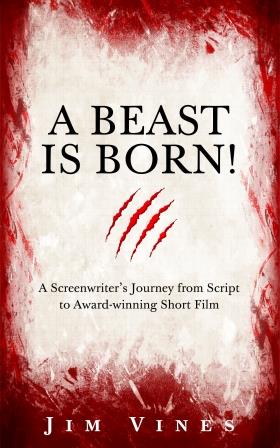
Jim Vines has been a screenwriter and script consultant for a number of years. His first produced film was THE PERFECT TENANT (2000), and his latest, DARK HAVEN, was filmed in 2020. He has optioned several of his scripts and has also been commissioned to write or rewrite scripts for numerous producers. He has written a play (staged in 2009), a web series (2009), a book of interviews with screenwriters (2006), and “indie-published” his first novel in 2015. His latest book, A BEAST IS BORN, was released in 2019.
Jim, who was born in New York City but grew up in Los Angeles, and currently lives atop a hill that affords a truly inspirational view of the Hollywood sign.
What was the last thing you read/watched you considered to be extremely well-written?
I kinda hate to say this, but I don’t watch TV per se, so if you asked me to name two or three top TV shows, well, I probably couldn’t do it. But a few years ago, I thought MAD MEN was great. (I should point out the reason I don’t watch scripted TV is that I’m an avid watcher of documentaries and interview shows found on YouTube.) As for theatrical movies, I haven’t been to a new release in about eight years. Actually, that’s not entirely true. Tarantino’s ONCE UPON A TIME…IN HOLLYWOOD got me back into a theater. I had high hopes for that one. All I’ll say is: I didn’t care for it.
I do a decent bit of reading and tend to go through a lot of biographies. A recent one was of Stanley Kubrick written by Vincent LoBrutto, which was pretty fascinating. I just did a re-read of Jack Kerouac’s excellent THE TOWN AND THE CITY. A few months ago I read Donna Tartt’s THE GOLDFINCH which I really enjoyed. I also finally read the Daniel Keyes novel FLOWERS FOR ALGERNON, which was pretty amazing. I just finished reading Anne Tyler’s rather poignant novel A SPOOL OF BLUE THREAD and wrapped up the audio-book of the classic TRUE GRIT, written by Charles Portis (who passed away recently).
As you can probably ascertain by these titles, I’m drawn to stories about people and their plights, their struggles, where they’re trying to understand where they fit in with the rest of the world. This is what I find interesting.
How’d you get your start in the industry?
It was 1994 and I had been writing scripts with the intent to sell for four or five years. I knew this low-budget producer – she really liked a thriller script I’d written, so she optioned it. She never did get the script off the ground, but at least I knew my writing was solid enough to garner interest from producers. I kept sending scripts out. A couple of years later another opportunity came my way in the form of a script assignment from a budding producer who had read some of my work a year or so before. There was no up-front money but he was pretty certain he could sell the script to a production company where he had connections. So, I wrote the script (based on his story)—and he actually got it sold!
It was a bit of a roller-coaster ride for the next few years, but the script was eventually produced and the movie did quite well on the cable TV circuit. It played constantly on cable and broadcast stations here in the United States and also around the world (I know this because I’d received some pretty decent foreign royalty checks, which was nice). Having this credit on my resume made getting meetings, script assignments – everything from page one rewrites to doctoring scripts- and optioning original scripts a wee bit easier.
What do you consider the components of a good script?
You need to have interesting and/or compelling characters that people will feel something for. Even if it’s a bad guy, you have to give him (or her) at least a smidgen of humanity. Look at Hans Gruber in DIE HARD. Sure, he was a cold-blooded killer – but c’mon, he had such a great sense of humor! You should have a story that continually moves forward and doesn’t get bogged down. I can’t tell you how many novice scripts I’ve read where ten pages goes by and NOTHING happens. It’s just dialogue or superfluous actions that might seem cool or interesting while you’re writing it, but has virtually nothing to do with the story being told.
What are some key rules/guidelines every writer should know?
-Write screenplays because you love to write and love telling stories, not because you think you’re gonna get rich and famous. (Quick, who won the Best Screenplay Oscar last year?)
-Writing is work—and if you’re not willing to put your rear end in a chair and your fingers on the keyboard on pretty much of a daily basis, you probably need to find another career path.
-Rules were meant to be broken, but first know these rules before you break them.
-Rewriting is your friend.
-Formatting isn’t what makes a script sellable. Sure, you need to get it all looking nice and proper, but the actual words you put on those 100 pages—this is what you need to focus on.
-There is no one particular way to write a screenplay. Your job is to discover the method that works best for YOU.
-Don’t rush things. Send your scripts out only when they’re ready. As they say, you only have one chance to make a first impression. If you send an agent or producer a script that’s still pretty rough, chances are they won’t want to read any of your future work.
It’s my opinion—and I’ve done over 200 critiques/evaluations—that about 99% of all novice screenplays are nowhere near marketable shape, so please, don’t write your first two or three screenplays intending to sell them; write them merely for the purposes of learning the craft.
What was the inspiration/motivation for your book A BEAST IS BORN?
For a long time I’ve wanted to chronicle the writing, marketing, production, and afterlife of one of my projects. I just never got around to it. But as the marketing phase of my short horror SUSIE’S BEAST script ground on, I realized I had plenty to write about: all the ups and down, all the gut-punching disappointment. I had personal journal entries (I’ve kept a daily journal since 2004) and emails relating to SUSIE’S BEAST, so I figured it was now or never. I pieced it all together and—voilà—A BEAST IS BORN!
I don’t think most pre-pro (i.e., novice) screenwriters realize how long it can take for a script to finally end up in front of a camera. Whether you’re talking about a 15-page short (which is what SUSIE’S BEAST was) or a 120-page feature, the script-to-screen voyage can take years and years. Sadly, that’s the rule and not the exception. I wanted the reader of my book to get a sense of that journey.
It took 11 years for your script to be produced, which must have really tried your patience. What was it that made you keep going?
It’s not like SUSIE’S BEAST was my entire world. I had a lot going on a personal level. As for my writing life, I was working on my first novel, writing and producing a web series, and had been getting script assignments—so I was keeping busy. Aside from all that, I knew this was a solid script that absolutely had to get made.
What were some of the takeaways/lessons you learned from the whole experience?
I’m not sure I learned much of anything I didn’t already know, but it definitely reminded me that in order to be a screenwriter you need to have a certain doggedness and faith in your own writing. I also realized I might be a little too lenient with people, giving them too much time to get things done or make up their minds. If I hadn’t been so indulgent, I probably could’ve shaved a year or two off that 11-year timeline.
Despite everything you endured trying to get SUSIE’S BEAST made, is writing (and
potentially making) a short film something you’d recommend to writers?
Getting a short film made typically will not do a whole lot for a screenwriter’s career. If the finished film makes any kind of a splash at film festivals, it might do something for the director, the actors, maybe even the director of photography. But for the writer – well, hopefully they get a fun and creative experience. That’s pretty much all I wanted out of it. Luckily, that’s what I got! But having your name on a produced short – especially if it wins some awards – can’t do you too much harm. So, yeah, go for it!
You’ve also written another Hollywood-based book—your novel LUIGI’S CHINESE
DELICATESSEN. What was the inspiration for that?
I figured my first novel should be about something I knew, so I wrote about a young guy going to Hollywood with the dream of becoming a screenwriter. The story is loosely – very loosely – based on some experiences I’ve had in this town. As I’ve mentioned in previous interviews: “The book is 97% a work of fiction—and no, I’m not telling you which three-percent is true.” It’s a fun ride, it really is. One review referred to it as a “cautionary tale,” which I think is pretty accurate!
How can people find out more about you and your work?
A BEAST IS BORN is available on Amazon. Check out Jim Vines Presents which is my “creative page” on Facebook, and my screenwriting blog The Working Screenwriter.
Readers of this blog are more than familiar with my love & appreciation of pie. What’s your favorite kind?
This is a very silly question, but an excellent one. Let’s see…I’ll have to go with pecan. I love pecan pie. Pumpkin’s also pretty great, especially when it’s topped with whipped cream. But pecan pie on its own – sooooo good!





 Maximum Z