Strong rope & solid knots required

rope bridge
As long as it leads somewhere

I’m a big believer in tying story elements together whenever possible. While this should already apply to key details within the story, sometimes it’s simply a matter of a setup and payoff, even if it seems like a throwaway item. Bonus points if it ties in to your primary storyline. Which it should.

Case in point: in the opening scene of CHINATOWN, Gittes is showing his client photos of the man’s wife’s infidelity. The man, heartbroken, tells Gittes “if there’s anything you ever need, let me know.” The scene ends, and we figure that’s that. This is what kind of guy Gittes is and what he does, and then we transition into the main storyline. Events play out, and Gittes finds himself cornered in a tough spot.

So how does he get out of it? He leads his pursuers to a house he claims has the answers. But when he knocks on the front door, who answers it? The guy from the opening scene. We’d totally forgotten about him, but it’s a perfect choice. It ties things together, works within the context of the story, and anybody else would have not worked.

Everything in your story should serve a function in helping move the story forward, no matter how small or insignificant it might seem.

Do you have characters or events in your script that are strictly one-time-only? What purpose do they serve? If you took them out, would it make a difference?

And if you do keep them, is there any way to change them around so that you have a solid setup and payoff that tie into the overall story? It might not be as tough as you think.

In the outline of my current project, I had some smaller scenes in the first act that were totally unconnected. Going through it a second time, I’ve been finding ways to connect them. Sometimes it’s about using a character making a return appearance, or having some key scenes take place in the same location. Again, it’s all about what works within the context of the story.

(Admittedly, I’m also working on this from the mindset of keeping the budget low. If having the same character appear twice, rather than it being two separate characters, or being able to use a location more than once means less money that needs to be spent, than so be it. It’s an influence, not a rule. But this is me. You may choose to take a different approach.)

Another benefit of tying elements together is that it shows how much thought and effort you’ve put into crafting this story together. The evidence is right there on the page. You’re proving that you’re actually thinking this through and not just randomly throwing things in and hoping something sticks. You’d be surprised how many writers do that.

Don’t be one of them.

Take us along for the ride

roller coaster.jpg
Hang on tight.

Here’s a two-part question for you. Pencils at the ready, please.

Up first – Are you enjoying the actual process of writing your script?

Sure, we all like “having written”, but what about getting there?

Do you get a thrill from figuring out your story? Mapping out the plot? Developing characters and crafting dialogue?

Do you get so engrossed and involved in your writing that when you check the time, you discover a lot more time has passed than you thought?

If you’re really excited and enthusiastic about your script, you’re going to feel that way even before you start writing it.

Now for the second part of the question:

Is all the aforementioned excitement and enthusiasm evident on the pages of your script? Could someone read it and think “Wow, they really like this stuff.”?

While it’s often said that you can gauge a writer’s grasp of the craft just by looking at the first page, you can also tell if they’re really into their story by how it reads.

Does it grab you from the get-go? Is the tone of the writing a solid match for the tone of the genre? This is not a case when “good enough” will cut it. What would you think if you read a horror that was “sort of” scary, or a comedy where all the jokes fall flat?

Exactly.

You want the reader to be as thoroughly entertained as you were in putting it together. You want them to be as compelled to keep turning the page as you’d be if you were reading it yourself.

A lot of the time you’ll hear a writer wrote something because “they had a story they had to tell”. That story was so strong and powerful inside them, they had no alternative but to write it out.

As creative types, that level of excitement and enthusiasm exists in all of us. We’re all eager to tap into it, but need to take the time to learn how to do it properly so it can be done in the most effective way possible.

Pencils down.

The dreaded ensuing of wackiness

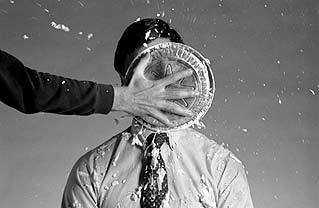
pie-in-face
Done right, this is comedy gold

As part of my work on the low-budget comedy spec, I’ve made an effort to read other comedies to help get a better understanding of how it could be done and hopefully some guidance I could apply to mine.

It’s always been tough for me to read comedy because my sense of humor doesn’t always align with others. Many’s the time I’ve read a script that garners universal praise for being gut-bustingly hilarious, but doesn’t do anything for me.

There is, however, one detail I’ve noticed that keeps popping up:

Unrealistic situations.

Things that seem to happen only for the sake of a joke, and not much else. These often feel forced and inorganic to the plot. Almost as if the writer thought “Hey, wouldn’t it be crazy if ____?”

In theory, potentially a good idea, but in execution – not really.

Some might argue that since it’s comedy, things don’t have to be realistic as long as they’re funny.

I beg to differ. If I don’t think something could actually happen, I will most likely not find it funny.

**side note – this doesn’t necessarily apply to slapstick or absurdist fare, which are two entirely different discussions**

Sure, there are comedies where the entire premise isn’t all that realistic to begin with, but even the humor in those should stem from the situation, rather than being a crazy assortment of wacky gags.

Going for the easy laugh or cheap joke doesn’t take much skill and shows a lack of sincere effort. If a writer does it once, chances are they’ll do it a lot. It also doesn’t offer anything new. Who wants a joke they’ve probably seen or heard a thousand times before?

Looking at comedies that would be considered strong, there are a lot of instances where the joke is an integral part of the scene, rather than feeling like something tacked on.

You’ll hear that the best comedy is the kind that makes you think. I prefer comedy that shows the writer did a lot of the thinking.

The silver lining of a bad movie

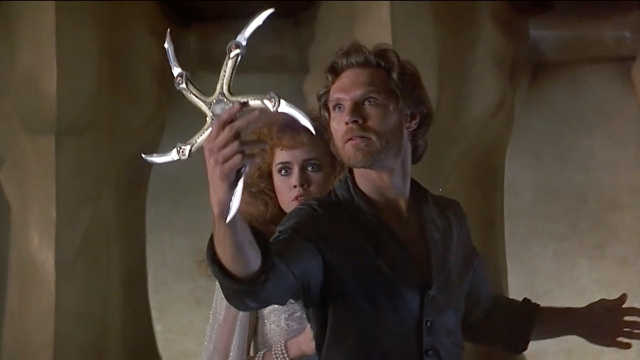
Krull
A definitive shining example (AND a prime candidate for a remake)

Since the screenwriter’s education is ongoing, there’s always something for you to work with or study to get a better grasp and understanding of what constitutes good writing, which can then be applied to your own.

Read scripts. Attend or take part in a table read. Watch movies.

While there are countless examples of exemplary writing and filmmaking to see it done properly and effectively, there are even more examples of crappy writing and lousy filmmaking to see it done poorly and ineffectively.

Nobody starts out with the intention of making a bad movie. What starts out as a great script can easily be messed up along the way to the point that there’s no salvaging it. It happens.

Is watching one waste of time? Not necessarily.

As enjoyable, informative and educational as the good stuff is, the bad stuff is actually just as good, possibly even more so. Because from these cinematic travesties you can learn what not to do with your own scripts. Lessons abound with all the glorious misfires regarding story, characters, and dialogue.

Regrettably, bad acting is a category all by itself and there’s nothing that can be done about it. Do what you can to ignore it (which can border on the impossible, depending on the quality of badness) and focus on the non-tangibles.

It’s especially helpful to work with something from the same genre as your script. See how they did it, then compare it to your own. Can you see why theirs didn’t work? Is it riddled with plotholes you could drive a truck through? Is the dialogue pure on-the-nose? Do the characters come across as unrealistic caricatures?

Look at it as a whole. Does it respect the reader/audience’s intelligence? Is the structure solid? Do you care about what happens to these characters over the course of the story?

Now bring your script into the equation – and be objective! How much of a similarity or difference is there between that story and yours? Did that other material open your eyes to some previously unforeseen flaws and potential problems within your script, so much that it made you realize “this needs work”?

Once you identify these problems, your writer’s mind goes to work, figuring out how to make sure your script doesn’t repeat the mistakes you just read or watched.

It may not be easy to endure having to watch a bad movie just for the educational experience, so just keep reminding yourself “It’s to help me become a better writer”.

Good luck!

Question time! What’s your favorite bad movie? Feel free to list it in the comments.

A few points about plot points

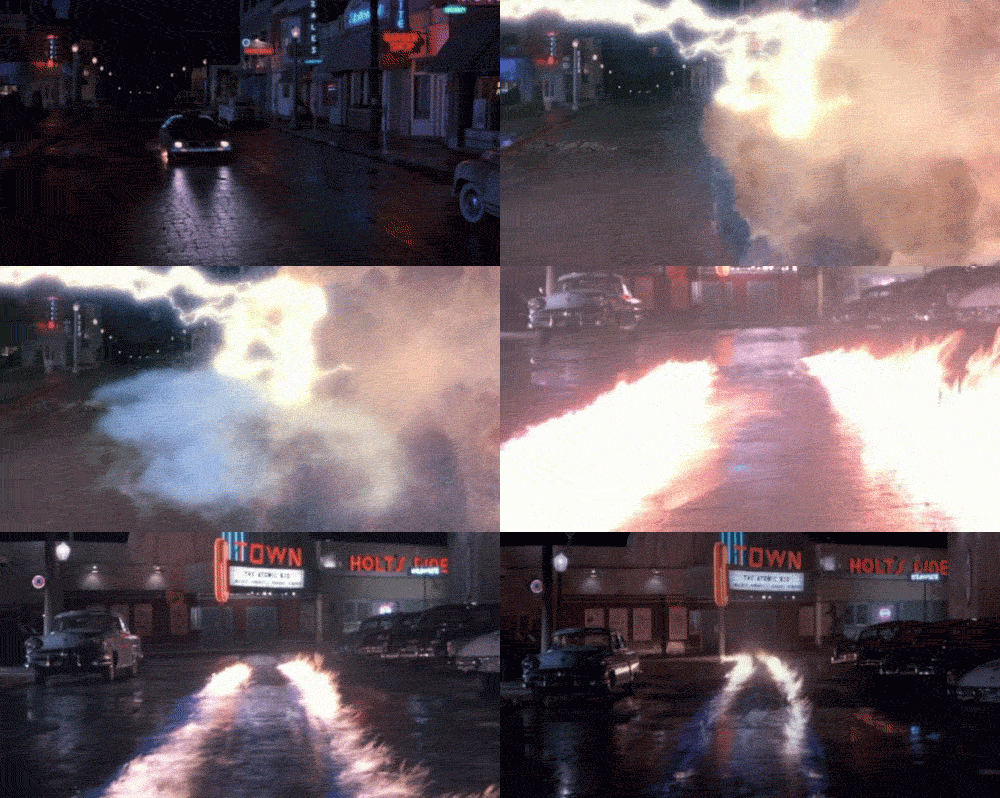
delorean

Time for a quick refresher course, chums.

Today’s topic: plot points. What they are and what they represent.

I’ve always seen plot points as pivotal moments in the story; events that change the situation for your protagonist, usually in a negative manner, and ask/reiterate the central question (Will your hero achieve their goal?).

Having solid plot points also helps establish your story’s structure. Without it, all you’ve got is a big convoluted mess, and who wants to read that?

Although this uses a 110-page script as an example, plot points don’t have to happen exactly at those pages. A few more or less is totally acceptable. I’ve also opted to use fairly recognizable examples to emphasize each plot point.

Pencils ready? Let’s begin.

Page 3 – statement of theme. What’s the overall message of your story? The theme should also be incorporated in some fashion into each scene throughout the course of the story. (“No McFly in the history of Hill Valley has ever amounted to anything!” “Yeah, well, history’s gonna change.”)

Page 10 – inciting incident. The event that shakes up you protagonist’s world, and asks the central question of the story. (Will Indy get the Ark before the Nazis?)

Page 17 – a twist to further complicate things for the protagonist. (“Alderaan? I can’t go with you to Alderaan!”)

End of Act One (page 25-30) – Your protagonist leaves behind their old world and enters a new one to achieve their goal. Also repeats the central question. (Marty arrives in 1955)

Page 45 – another twist to complicate things for the protagonist (Indy saves Marion, destroys her bar. “I’m your goddamned partner!”)

Midpoint/Point of No Return (page 55-60) – your protagonist becomes fully committed to achieving their goal (Brody decides to go after the shark after his son barely survives the latest attack)

Page 75 – yet another twist to really complicate things for your protagonist (Vader kills Ben as Luke & Co escape)

End of Act Two (page 90) – All is lost. Your protagonist is totally screwed with no apparent way out. Makes it seem like the answer to your central question is “no”. (The Nazis get the Ark).

Climax (page 95-100) – final showdown between your protagonist and antagonist. (Rebels attack the Death Star. Marty must hit the wire when the lightning hits. Nazis open the Ark. The shark attacks the Orca, eats Quint.)

Resolution (page 100-105) – Aftermath of the climax. Central question gets answered. (Rebels victorious. Marty returns to 1985. Brody & Hooper survive. Indy delivers the Ark.)

Denouement (page 105-110) – How your protagonist’s world is now different from what it used to be (but not necessarily better). (Marty’s family is successful. The Ark gets crated and goes into a warehouse. Luke & Han hailed as heroes. Brody doesn’t hate the water anymore.)

So there you have it. Do the plot points of your story match up with these? Just something to think about. And feel free to watch the movies represented here (or one of your own personal favorites, or one similar to yours) to see all those plot points in action.

It just might be some of the most fun homework you’ll ever have.