A few slight adjustments

baby driver

The latest draft of the sci-fi adventure is moving along at a pleasantly brisk pace. Still averaging about 4-5 pages a day. The whole process this time around feels a lot more organized. Much more so than in the past.

The previous draft was 118 pages, and one of my many objectives for this one is to get it down to somewhere in the 105-110 range. I’m just about at the end of Act One, and it’s already 9 pages shorter than where it was at this point last time. Seems like the odds are in my favor to hit that page count goal.

But it’s taken a good deal of work to get here, including some shifts in my approaches.

Among the highlights:

-being more diligent in applying the “get in late, get out fast” approach to each scene. Although somewhat unavoidable for action sequences, doing what I can to use this as often as possible.

-cutting unnecessary dialogue. Never realized how much more I used to put in before. It’s been a real effort (and steep learning curve) to get the characters to only say what needs to be said, but it definitely helps get to the point of the scene quickly as well as moves things along.

-not being so detailed with action descriptions – by which I mean “what the characters are doing”, and not the fast-paced, high-octane thrilling moments. Focus on the important stuff. Don’t clutter up the page. Is it absolutely necessary to be so step-by-step about it? Nope.

-In a very “why didn’t I think of this before?” kind of way, having a hard copy of the outline and the previous draft have proven to be exceptionally helpful. The outline tells me what needs to happen in each scene, and the previous draft shows me not only what I did before, but gives me a starting point for potential changes.

-Taking that last item one step further, seeing how a scene played out before, combined with the applying the question of “how does this scene advance the plot, theme and character?” has enabled me to totally rewrite some scenes which before had felt kind of flat, but now read as stronger and help reinforce those three important components.

I managed to crank out the previous draft in about a month, and hoping to accomplish that this time around as well. Of course, a few ideas for more changes have popped up.  Nothing too severe, and I’m going back and forth about implementing them right away, or waiting for the cleanup-polish phase.

Every writer puts their material together in the way that works best for them. It took me a while to find mine, and it continues to be a work in progress. But if the latest results are any indicator, it’s working out quite nicely.

Working my way forward

billion_dollar_limited

The process of writing actual pages for my pulpy sci-fi adventure is fully underway, averaging about 3-4 pages a day, which is just a smidge above average for me. I’m making a real effort to stick to this kind of output, and am hoping to keep it up for the duration.

There’s a lot of setup in the first act, and I was really concerned things would somehow get drastically out of hand and go on for too long , resulting in a script running something like 150 pages, but so far I’ve managed to keep it all in check. It’s all going according to plan. Still feeling confident to be able to keep it in that ideal target range of 110-120 pages.

And this is before any of the real editing begins. That comes after FADE OUT.

Speaking of editing, even though I was trying not to fall back into my habit of “write, edit, write some more”, there’ve been a few times when a few impulse decisions had to be made regarding whether or not something should be included. Since I was already concerned about too much material, many of them were cut.

In retrospect, they weren’t as necessary as I initially thought, so after they were cut, their absence had barely an impact on the story – if at all. Turns out they were in there more for my own benefit. I saw them as building up the key scene to which they were connected. I tend to overwrite during the outlining process anyway, so no big loss.

Working on both the outline and the pages has also made me realize that my talents seem to be a lot more suitable for this kind of thing. As much as I’d love to be a solid comedy writer, I feel much more at ease producing thrilling tales of adventure with some comedic moments thrown in.

They say you can tell a writer enjoyed writing the script because of how it reads. Like with all of mine that came before, that’s exactly what I’m hoping for with this one as well.

More work now, better results later

lalanne

It can be safely said the extensive overhaul of the outline for my pulpy sci-fi adventure story is just about wrapped up. Still have a lingering handful of small details in need of fleshing out, but I’m eagerly anticipating jumping into cranking out pages in the very near future.

Figuring all of this out – including several attempts on the beginning, and then working out the development of events over the course of the first act and the first half of the second act- took a lot longer than I expected, and definitely longer than I wanted. There were many times all I could think was “am I EVER going to figure this out?”.

A lot of writers feel that way while working on a project. We’re an impatient lot, and the ongoing struggle to find solutions doesn’t help. We want it already written. But learning how to do so effectively is necessary. How else will we improve?

It’s probably a safe bet to say that my development skills are stronger than they were – even compared to a couple of years ago, or else this overhaul wouldn’t be where it is now. Every story problem would require a lot of thought and mulling-over, and maybe I’d come up with a slapdash, roughshod placeholder of a solution – just to be able to move on.

A bad and counterproductive idea.

I like to put together stories with a lot of moving parts, and each one requires the same amount of attention in order to make the whole thing a smooth-running machine. If that means taking a little more time to do so, then so be it. I’d much rather make sure as I go along that everything works and connects the way it’s supposed to than have it come to a screeching halt because of something I overlooked or forgot about, or even worse, felt was “good enough for now”.

An added bonus to all the work on developing this story in the outlining phase is that since I’ve already written down what’s supposed to transpire in each scene, including the purpose and the conflict, it’ll make it easier (and in theory, a faster process) to transfer all of that to the actual pages.

Once I do start on pages, I can only hope to see a slight increase in my daily output. After having gone through the outline a few times, editing and tweaking as I go, I’m getting a stronger feel of flow for the story, seeing ways to incorporate more development for the characters, and just an overall sense of “I like the previous draft, but this one feels so much closer to what I set out to do”.

And I most definitely would not have gotten to this point if I hadn’t put in the time and effort to make sure every single part of it did exactly what I needed it to.

Perplexing puzzle pieces properly placed

puzzle

Hope you enjoyed the recent interviews (this one and this one). While I truly enjoy being able to promote another writer’s work, I admit to having somewhat selfish motives – progress on this outline overhaul had slowed, and I was feeling frustrated about it. Anything to get my mind off it was welcome, and those interviews fit the bill.

Don’t get me wrong, I’m extremely happy to have done them and am glad the interviews got the responses they did, but now it was time to turn my focus back onto myself.

When I took on this project just after the beginning of the calendar year, I figured this part of the process would be smooth sailing, and there was no reason I wouldn’t have been able to crank out a new draft by about this time.

Ha, ha! Silly writer.

When one sets out to completely redo a project, there’s a teensy-weensy chance it could take SIGNIFICANTLY LONGER than expected?

Shocking, but true. Exhibit A – yours truly.

The past few weeks involved deconstructing the story and attempting to put a new one together. Some similar elements, but many new ones. Every time I’d come up with an idea, I’d go about trying to incorporate it into what I had. End result – a lot more misses than hits.

This is where things started to get interesting.

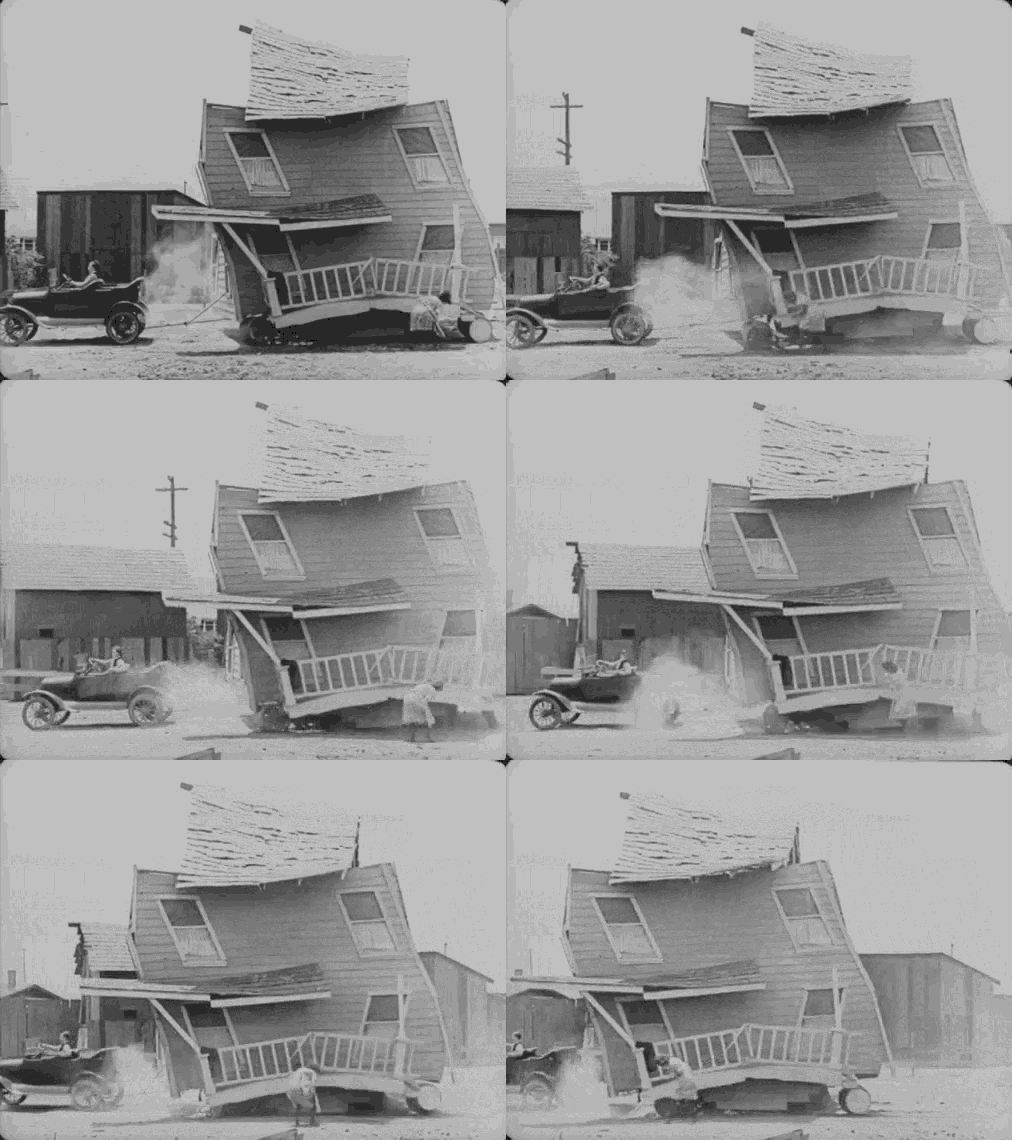
I realized I was still clinging to too many components of the previous draft; the screenwriting equivalent of a new coat of paint on a house in need of major repairs. So I brought in the wrecking ball and tore that thing right down to the foundation. I knew which details I wanted to keep, but now just about EVERYTHING needed to be drastically changed. Somehow.

To avoid falling into the trap of lingering previous draft details, I’d constantly ask myself that magical question of “How can this be totally different from what it was before?”.

I interpret the idea of “totally different” as “total opposite”. Any time things seemed too familiar, my internal editor would shout out “NO! Turn it around!”, and I’d go back and do a 180.

The story was THIS before? Well, now it’s more like THAT. That initial portrayal of the protagonist? You wouldn’t recognize them now.

The building blocks were being formed. Slowly, but steadily.

With the story gaining and building muscle, the same couldn’t be said for the characters. They didn’t feel developed enough. Why do they do the things they do, and how does it impact the story? Doesn’t matter who. From the protagonist and the antagonist to somebody who’s only in one scene, everybody’s a cog in this machine.

Just as an example, I already knew how the antagonist’s story ended, but still saw their “why they do this” and “how did they get to this point” as somewhat lacking, which created more obstacles.

Using those questions and this “total opposite” approach, I decided to do just that and work my way backwards. Start at the end and figure out what would have gotten us there, and what would have gotten to that, and so on and so on. For never having tried reverse-engineering a story before, the results were pleasantly surprising.

Then there was the protagonist. I knew what their external goal was, but the internal goal was a tougher nut to crack. I took a closer look at the emotional aspects of the story. How would this character react to what’s going on? Is it what I would do? Is it what somebody like them would do? Do their reactions and responses seem realistic (in the context of the story)?

I went through what I had of the story so far, and slowly began to see that I’d already set up important moments along their emotional journey, and what could potentially be part of it. A little fine-tuning and things really began to gel.

Tinkering. Rearranging of scenes. Gaps getting filled in. Long-discarded material finding reborn relevance. Unanswered questions (for both myself and the story) being answered. Ooh, I could spin this around, and the new version works even better than before!

A totally new draft of this script is taking shape right before my eyes, and on so many levels. I couldn’t be more psyched about it.

It’s been a while since I’ve felt that electric excitement of putting a story together. Didn’t realize how much I’d missed it.

Sure, it took me a lot longer than I wanted to get to this point (emphasis on A LOT), and I won’t even speculate as to how long until the outline’s done, but I’ve definitely made some solid progress over the past few weeks, and the momentum continues to build.

Full speed ahead, chums.

Little time. Lots of results.

838-02519997
So many options. Where to start?

Bit of a shorty today, and the subject itself is the reason why.

Let’s talk time management.

As much as I’d like to devote a big portion of my day to writing, that just isn’t the case. I’ve got other responsibilities, so I do what I can to make that limited timeframe as productive as possible.

A key part of this – planning ahead. Making a list. Designating time specifically for certain activities.

Think “achievable objectives”. Things you know you can get done.

Research.

Reading scripts (both professional and writers within your circle)

Providing notes.

Queries (including verifying recipient’s info)

Networking.

And of course, writing (includes outlining, editing and polishing).

(Imagine how much more is involved with the actual production of a film. For today, it’s all about the script and the things connected to it.)

You could do all of these each day, but that would be exhausting. I find three to be a safe and productive number. Results will vary.

The important part to remember is how a steady repetition of all these little things can eventually add up to big results.

If you can only manage one or two, that’s okay. Do what works best for you. You’re the one in control, and this is definitely not the sort of thing you want to rush through.

Another helpful tip – avoid social media/wandering around the internet. Or at least severely limit your participation. Allow yourself a few minutes, then redirect that focus back to your project.

A writer wears a lot of hats, always having to switch them out because there’s always something that has to get done. But if you stay calm and try to be organized about it, the switching out of hats will get a little easier as you go along.