
Is it really too much to just ask?

Show of hands for who'd want to read this based on the logline
Show of hands for those who’d want to read this based on the logline

While some people don’t have an issue posting their entire script online, I’ve always opted to offer up just a logline. If the script has had any kind of success in a contest, I mention that as well. That’s how it is on my Scripts page here, and on a few online community sites. Nothing against those who offer up the whole thing. It’s just a personal preference.

My hope is that this sample (for lack of a better word) piques somebody’s interest, which then would prompt them to contact me, saying “Hey, this sounds pretty cool. Could I read it?” In which case, I’m more than happy to send it along. This has happened a few times.

But last week, I got this response from a recent connection:

“…I read the synopsis on your four, all very interesting, but without a script to peruse, quite meaningless – let me know should you decide to upload any.”

Okay…

Like I said, I was hoping the small write-up would motivate you to get in touch with me asking for more, but I guess not. And responded with words to that effect (in the most polite way possible, of course.)

The response:  ” I don’t like to criticise (sic – international spelling) and how you conduct your scripts is your business, but so many writers here claim award winning scripts, wonderful reviews and the sun shines out off a certain orifice – I’m a great believer in put up, or shut up – yes, of course I can ask the writer to send a copy, then there is the pressure, real or otherwise, of a review and feedback – I like to read screenplays unannounced, if I like it I will say so, no hard feelings, no pressure – all of yours have a nice synopsis, I’m sure your scripts stack up.”

I honestly didn’t know what to say, so I never responded. The person seems set in their beliefs that the finished product won’t live up to the hype created by the author. Although I have to disagree with the part about “award winning scripts”, since most contest results are available online, therefore easily verifiable.

And maybe it’s me, but both responses seem to come across as just a little bit on the snarky side.

But back to the matter at hand.

No idea where the parts about “wonderful reviews” and “the sun shines out of a certain orifice” come from. I never post anything like that about my material, nor should anyone. It reeks of amateurishness.

If I want notes, I will come to you because I seek your opinion. If I don’t know how much experience you have as a writer, let alone who you are to begin with, what’s make you think I’m going to ask you for notes?

If somebody asks to read my script, I’ll send it along with this note: “Here’s the script. Thanks for asking. Hope you like it.” I might come back to them in a month or so to ask if they’ve had a chance to read it. A majority of the time, the response is “Oops. I kind of forgot about it/got sidetracked, but I’ll get to it soon,” which is totally understandable. It’s a real commitment to read a script, and it’s not always easy to find the time to just sit down and read it. Happens to me all the time.

Everybody has their own way of how they do things. You do what works best for you, which may be totally different from somebody else’s. That doesn’t mean either person is wrong.

But imply that your way is better than mine, and any credibility you may have had to begin with is now gone.

Random thoughts, general musings, that sort of thing

Nothing to do with today's post. I just love their chemistry.
Nothing to do with today’s post. I just love their chemistry.

-My western failed to make it through the first round of Scriptapalooza, which makes me 0 for 4 so far this year. I’m not counting the top 20 percent ranking for the Nicholl; that’s like getting Honorable Mention. At this point, I’ve pretty much written off its chances for Austin.

My problem was overconfidence in the script. I thought it was solid enough, but apparently not. It’s not the first time this has happened to me, but I’ll be more careful about it in the future.

I still believe in this script, which is why I’ve been so gung-ho about rewriting it. The past two weeks have been all about making it better. After completing the latest round of edits, it’s now 8 pages shorter, and still some further fine-tuning to do, which hopefully won’t add more than 2-3.

-Never realized how much my characters repeat things in dialogue. “I need you go to the store.” “The store? Why?” Must be the influence of listening to so much old-time radio. Cutting all of those probably amounted to at least half a page.

-I cut at least 5(!) separate situations where the Wilhelm Scream could be used.

-Had a great lunch-chat with one of my working writer pals yesterday. While he was very supportive and encouraging, he also reminded me of the almost insurmountable task of a new, unproven writer breaking in with a high-budget script.

“Your chances improve when you offer something that won’t cost a lot to make. A lot more people can get something made for under $5 million, rather than $50 million, let alone $100-200 million.”

As it should have, it got me thinking. Do I have any stories like that? It took the bike ride home and digging through some old flash drives to discover I did. Maybe about 5 or 6, all of them just a logline and not much else.

It’s a start.

-Movie of the Moment: GUARDIANS OF THE GALAXY (2014). Loved it. Great story, great characters (and their development). Maybe my only complaint was the bombardment of exposition in the first 20 minutes. Other than that, a lot of fun.

Biggest pleasant surprise: Dave Bautista as Drax.

Biggest almost-catastrophe: Adam Sandler as a potential voice for Rocket. Somebody thought this was a good idea?

It’s really impressive how much of an effort Marvel puts into their stories and characters. I sincerely hope DC and Warner Brothers can take a lesson from this.

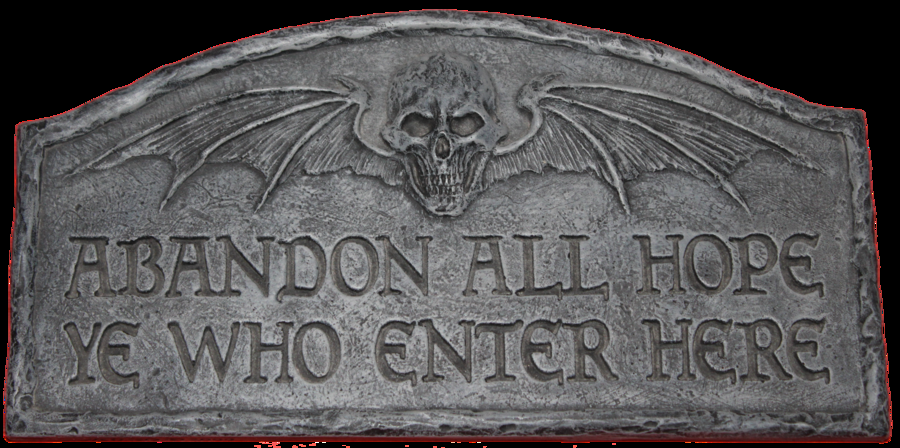
Just call me Dante, because this sure feels hellish

Seems pretty appropriate at times

I wanted to rework the logline for my mystery-comedy spec, so, never one to totally learn from previous experience and hoping for best possible results, I took the plunge and posted it on a few forums, seeking potentially helpful feedback.

Thus did the floodgates open.

It’s me and my story out there in the open, waiting for the world to let itself be heard.

And it did. Oh boy, did it.

One response was a literal interpretation of the words, and why it didn’t work. My assumption that certain details were implied was apparently incorrect.

Several focused on presenting the story in a way I repeatedly explained just didn’t apply. No matter how much I emphasized it was THIS kind of story, they just could not get away from thinking it was THAT kind of story.

Then there’s the omnipresent “I can’t see this being a story” and “It doesn’t sound solid enough.”

Well, I can and think it does.

My words, meet deaf ears. I got similar responses when I was starting the western, and that turned out pretty well.

It’s my sincere belief that everybody’s intentions are good, and they probably don’t mean for their comments to come across in such a “why don’t you know better?” and “THIS is the right (read: only) way to do it” manner.

Even if I totally disagree with somebody, I still appreciate the fact they made the effort to read it, analyze it and create what both of us hope is a helpful response. That doesn’t mean I have to take their word as gospel.

And unless I’ve actually met the person, I have no idea how much legitimate experience or expertise they have. For all I know, everything they say stems from reading SAVE THE CAT a couple of times.

Putting together a logline is an exhausting process. Some people are better at it than others.

As it so happens, I’m not one of them.

Why so hostile?

Angry voice!
Angry voice!

I’ve been making an effort over the past few weeks to build my network of writing acquaintances, which has involved connecting on assorted social media networks.

Several of these include groups of like-minded people that offer up the opportunity to ask questions, get feedback, etc.

One of them was about loglines.

Feeling fairly confident but open to suggestions about the one for my western, I typed it in, hoping somebody might have some helpful comments.

Within minutes, the response came in: “…or? What’s at stake? What are the consequences?”

Hmm. Well, her train’s been stolen, which…puts her livelihood at stake?  And it’s going to be used in a major heist, so the consequences are…widespread? I’ve always hated this part. Maybe I’m not giving enough information?

I wrote back: “open to suggestions.”

Past experience with logline feedback via online forums, while occasionally frustrating, has sometimes yielded positive results.

Sometimes.

A few minutes later: “I’m a producer and script consultant, not a psychic. If I knew what the story was about, knew the protagonist’s motives, knew what the antagonist was doing and why, and knew what was at stake and the consequences of certain actions, I would make a suggestion. However, with so little on offer, there’s little I can do other repeat what I’ve already said.

I’m not arguing anything after the word ‘psychic’. It’s not easy to get all of that across in a logline. It’s much harder than most writers realize.

(Side note – I love it when somebody backs up their comments with the proclamation of their qualifications. As expected, a quick internet search of this person’s “producer and script consultant” credentials yielded both jack and squat. It took a lot of effort to not ask them for more details.)

Desperately seeking resolution, I offered: “Would you be willing to take a look at the 1-page synopsis to get a better understanding of the story?

Soon afterward: “based on your logline, no”

And that was that.

While I didn’t have a problem with the actual advice, there just seemed to be this overall tone of angry condescension in their text. “Grr! I know what I’m talking about! My advice is infallible and you’re an idiot if you don’t listen to me! Grr! Argh!” Maybe I was just reading too much into it?

Honestly, it kind of nagged at me for the rest of the day. I always thought the point of these groups was to help each other. Sure, sometimes people just don’t get it, but I’m more likely to appreciate your comments if you seem willing/interested in actually helping me.

Later in the day, somebody with no connection to me whatsoever called this person out for being unnecessarily cruel (a bit harsh, but I understood where they were coming from). I made a point of staying totally out of what soon became a snippy back-and-forth of “I’m right, you’re wrong”.

So much for taking part in that group again.

Still seeking some kind of help, I tried again on a different forum, but approached it from a different angle.

I listed the logline plus some key story details that might help, adding how I was seeking some bolstering in terms of including stakes and consequences. (The original responder may have come across as an asshole, but I didn’t think their advice was wrong.)

There was a significant difference in the responses. A lot were not only helpful, but practical and encouraging, including this gem – “I love this logline. If I were a producer I’d want to read it. Hell, I still want to read it, just because it sounds like fun.”

I felt a little better, had what I felt was a stronger logline, and a few requests to read the script. Nice.

As part of that aforementioned back-and-forth, my original responder said they were just preparing new writers for the kinds of responses they should expect from the industry if they submit “subpar material”.

While I can understand that kind of thinking, it seems that people are more likely to heed your advice or suggestions if you actually come across as helpful, rather than sound like we’re wasting your time and the last thing you want to deal with right now.

But then again, I’m just a nice guy to begin with, so what do I know?

You mind running that by me again?


What we seek is somewhere between these two
Top choice is too much, while the bottom is too little

Pop quiz!

Pick any high-profile, mainstream popcorn summer movie from the past 10-15 years, and explain, in as few sentences as possible, how the story unfolds.

This doesn’t mean provide a logline; this is about having a plot that’s easy to understand.

Okay. Pencils down.

There’s been a disturbing trend of overstuffing a story and bombarding the audience with just too much information. It’s gotten to the point that a lot of the time, the details we need to know get lost in big expositional info-dumps, which makes us struggle to follow along, or at least keep up.

Who hasn’t had a lot of questions about the movie they just watched, but those questions are more along the lines of “What happened?”  You want somebody to want to watch your story again because they want to relive the great time they had the first time around, not because they seek answers.

I could list several recent major releases that had too many elements which simply made it less of an experience to watch them. Sometimes the details made no sense, or the explanations behind them weren’t adequate enough. If I have to go back and think about something from earlier on, then everything that came after that doesn’t have my full attention, which makes me not enjoy it as much.

Is it really too much to ask that a story be kept relatively simple to understand? This doesn’t mean to dumb things down.  It is possible to write a smart story with simple details. One of the many reasons certain older films still hold up is because they are smartly-written stories told in a simple, straightforward manner.

THIS is what has to happen, and THIS is how we get there. Of course you’re going to throw in complications, but that doesn’t mean you make it overly complicated.

It’s very tempting to want to show off your writing skills and keep adding stuff into your story, but that usually results in just too much going on.

There’s a big difference between throwing everything at the wall and seeing what sticks and carefully plotting out what happens.

Keep things simple when telling us what we need to know, and leave it at that.