Three and a half scripts. No waiting.

Keep your pants on. These things can't be rushed.
Everybody else, though, will have to wait. These things can’t be rushed.

Despite a few weeks to go, it’s safe to say that 2014 didn’t work out the way I’d hoped. I didn’t do that well on the contest front, and I no longer have a manager.

I’ve gotten over the thankfully-brief “woe is me” phase, and am now firmly planted in “How can I make this better?”

Like any smart and savvy writer, I’m thinking ahead and making plans.

-As much as I love my western, it still needs work. Beaucoup thanks to the legion of note-givers who offered up a lot of insight that really helped me out.

There’s a hill near where I went to elementary school. At the time, it felt like taking on Everest. Now, not so much. The idea of rewriting this script feels incredibly daunting right now, but as is usually the case, probably won’t be a problem.

A few ideas for changes have already popped up, with the hard part now to let go of what’s already in there, but that’s another blogpost.

-Another group of notegivers had some fantastic things to say about my mystery-comedy, and provided similarly helpful feedback. They liked the concept, pointed out what in the story needed work and had some great suggestions for potential fixes.

This one is going to be especially tricky (due to that whole mystery angle), but again, I’ll work my way through it.

Can’t explain why, but for some reason, listening to 50’s jazz and drinking a glass of quality red feel like they would be extremely conducive to working on the outline. I’ll let you know how that goes.

-As for the low-budget comedy, the story’s being kept under wraps until the first draft is finished. The big hurdle here is to just keep writing and not obsess over each joke. Darn my perfectionist nature.

-It’s been a while since it’s been mentioned, or even thought of, for that matter, but I don’t want to ignore my pulpy adventure. I managed to crank out a workable outline, but it definitely needs more fine-tuning. It’s more of a “whenever I get to it”, rather than a “I have to finish this!”.

So there you have it. My projects for the coming year. How many will actually be completed? Hard to say right now, but 3 seems like a reasonable number.

At this point, I’m not even entertaining the notion of contests. It’s really all about writing, editing, rewriting and polishing. Any money I would have spent on contest fees will go towards professional feedback.

I’ll admit I was hoping to have made some significant progress this year in terms of establishing a career, and in some ways I have, but you know what I mean.

If continuing to improve as a writer and honing my skills means a slight delay in getting representation, making a sale, and getting assignment work, then so be it.

I’m a patient guy.

Getting a feel for the tactile experience

That's not ink. It's writer's blood (or at least it sure feels that way).
That’s not ink. It’s writer’s blood (or at least it sure feels that way).

The early drafts of my western spec all clocked in at 132 pages. “Way too long!” I was told.

Tips and suggestions on how to tighten things up were provided and implemented. 126 pages. “Still too long! Cut more!” they demanded.

Sleeves were rolled up. Knuckles were cracked. The pounding of computer keys continued. 122. “Keep going!” was the response.

I slaved, toiled and labored until I couldn’t take it any more. 117. “Almost there!”

Feeling rather drained, I took the most effective step of all: I printed out those 117 pages, armed myself with the almighty red pen and got to work.

For some inexplicable reason, when I edit a script on paper, it’s much more effective than working with a digital copy. Lines of text I’d always ignored would suddenly pop as something to cut, modify or move around.

I’ll scribble out an alternative line of dialogue. Try out an impromptu reorganizing of the scene. Cross something out, then change my mind and write ‘keep’ over it. Use my finger to literally block out a line to figure out if the scene still works without it.

Just the other day I cut out half the dialogue in a scene with no significant impact. Would I have been able to do that if I wasn’t working with actual pages? Hard to say, but I’m inclined to believe “probably not.”

As I worked my way through the script, I found more and more opportunities to cut or edit. Of these 117 pages, there’s at least one red mark on just about every page, which includes the plentiful use of red lines through words and/or sentences, and lots of circles and arrows (as in “move THIS to HERE”).

Exhausting as it was, the red pen portion of the process is now complete.

Unfortunately, I won’t be able to digitally apply these edits for a couple of days. The US is currently in the middle of a big holiday weekend, which means extra work shifts for me. Love the holiday overtime, but it’s also less writing time.

I’m not concerned. It’ll happen soon, and I’m looking forward to seeing what the new page total will end up being, as well as the subsequent responses.

It goes without saying that “Yes!” would be ideal.

Isn’t this tuff enough already?

Proudly serving the public trust

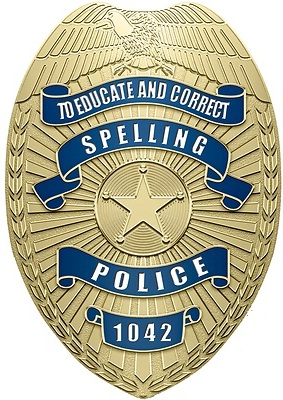
As a screenwriter, there’s a very long list of things to cover to make sure your script really works.

Story. Characters and their arcs. Theme. Plot. Dialogue. Action.

With awl of that going on, who has thyme to pay attention too such trivial things like weather or knot a word in you’re script is spelled correctly?

See what I mean? Misspelled words are distracting and unprofessional. And these are just homonyms. Getting into stuff like “loose-lose” is part of another issue altogether.

“No problem,” you say. “I’ll just use spellcheck to fix it.”

For the love of Ernest Lehman, don’t. Spellcheck is not a cure-all. It knows spelling, not context. As far as spellcheck is concerned, every word in that sentence above is as it should be.

One or two typos in a 110-page script are understandable, but you don’t want more than that. There are many out there more than willing to pass on your script if the number of misspelled words keeps increasing.

Not sure if your spelling is up to snuff? Ask a fellow writer. Nobody’s going to think any less of you for it. Chances are their editing/proofreading skills are what you need, and they’re probably more than happy to help. Just make sure to offer to help them with their material as well.

Not everybody is a good speller, but it’s something easily fixable. Truth be told, even some of my scripts, despite my vigilance, have contained (gasp!) the occasional typo.

Emphasis on “occasional”.

Finding the positive in a negative


Converting something acidic to tasty and refreshing requires a little bit of knowing how
Converting potentially acidic to tastily refreshing requires a little bit of knowing how

Notes on both my western and mystery-comedy specs have been flowing in steadily from friends and trusted colleagues over the past couple of months, and the results have certainly been a mixed bag of opinions.

The general message is “Love the concept, solid structure, but ____, ____ and ____ needs work.” The individual comments, of course, are much more assorted. Happily, none are of the “This sucks! Do the world a favor and give up writing!” nature.

Show the same material to half a dozen people, and you’ll end up with half a dozen different reactions. And as you would expect, each one is helpful in its own way, especially if it includes something you may not necessarily agree with.

But here’s where it gets even better – take all of those notes and use the ones that you think make the most sense. Apply them to your script. Does it immediately read better?

Now let’s take it a step further, but this time with those comments you don’t agree with. What is about them that doesn’t work for you? Give ’em another look. Maybe there’s something in there worth using.

I got some great notes on the western, and one of the suggestions was cutting or at least shortening some sequences in Act Two. Of course, my initial reaction was “Not a chance!”

But this was defeating the whole purpose of getting notes – to make the script better. And me being so obstinate about it wasn’t helping.

So I read it again, this time with a more open mind. Would this work? Would it accomplish what I needed it to? The suggestion started to make sense. I’d already cut 12 pages out of this thing, so there was no reason I couldn’t trim a few scenes down. It wouldn’t hurt the story, and could actually improve it in terms of moving things along.

You get notes to help point out what’s wrong with your script, or at least what needs to be fixed. You can use them however you want, but to totally disregard them isn’t doing you any favors.

Am I getting better?

Go ahead. Tell me the truth. I can take it.
How does it compare to last time?

One of the sad truths about trying to make it as a screenwriter is that it’s an extremely frustrating process.

On certain days, the frustration feels like it extends to the uppermost part of the outer edge of the stratosphere. To the nth degree.

What is it about screenwriting that people who don’t do it think it’s easy? If you’re reading this, it’s more than likely you’ve given it a go, or at least know somebody who has, so you know full well that it most definitely is not.

We even try to warn those who think hammering out a first draft in a few weeks is a guaranteed million dollar paycheck. This is a long and arduous road, we say, but they don’t let that stop them. A legion of the truly unaware who will discover the scary truth soon enough.

Those of us who are fully committed (an apt phrase if ever there was one) finish the latest draft, then edit, rewrite and polish it so many times it enters well into double digit territory, hoping our writing and storytelling skills are improving with each new attempt.

But how do we know if that’s even happening?

We ask friends and trusted colleagues for feedback. We pay for professional analysis. The script gets reworked yet again.

We hope this newest draft is light years ahead of all of its previous incarnations in terms of quality, but sometimes it’s tough to be able to recognize if that’s the case. At least for me, anyway.

Whenever I send somebody a script for critiquing, I always say “Thanks for taking a look. Hope you like it.”

I know the script isn’t perfect – maybe even far from it, which is why I ask for help. Part of me knows it’s good, but can be better. It’s being able to identify the latter that gives me trouble. I’m so deeply embedded in a story that it’s tough to step back and be objective. Maybe I can not look at it for a few weeks, but even then it’s tough to look at it with fresh eyes.

Follow-up notes will tell me what they liked and what they feel needs work. There will be a fair mix of stuff I should have already figured out and some “How could I have missed that?” surprises.

So back I go into rewrite mode, hoping for improvement for both the material and myself, still not knowing if that improvement is there until I undergo the entire process all over again.

Or at least somebody tells me.