Class is in session

All I need now is the magnifying glass

When I start on a new project, I make a point of reading scripts and watching films that are similar to the kind of story I’m trying to tell.

This time around, it’s a rewrite of my mystery-comedy, so among the works being studied are CHINATOWN, L.A. CONFIDENTIAL and WHO FRAMED ROGER RABBIT (comedy, remember?). There are a lot more to consider (suggestions are always welcome), but I don’t want to overdo it. As much as I love submersing myself into these stories, I would like to eventually get around to actually working on the script.

Putting myself through this has a double benefit: I get to see solid examples of elements of the story and genre, which forces me to come up with different ways of how to tell a similar story but with my my own stamp on it. I’ll also be the first to admit that my skills at putting a mystery together aren’t exactly the best, so studying these will hopefully help me get a better sense of how to develop that part of the story.

Since this also happens to be a story I’ve worked on before, a lot of it is already in place, but there’s still a ton of work to do, with lots of ideas and changes being considered. Luckily, I have a few previous drafts to mine for material. Almost like starting anew, but with something very familiar.

My hope is that studying these scripts and films will help me get a better understanding of how all the puzzle pieces fit together in those stories, which will in turn will help me figure out how to do the same with mine.

This is the kind of homework I actually look forward to having.

I’d wager this is you/me/us

The thrills and glamor of writing a screenplay
The thrills and glamour of writing a screenplay

Wouldn’t it be great if every single time you sat down to write, you produced something just flat-out jaw-droppingly incredible?

It would also be great if you could eat an entire pie by yourself and not get sick, but that ain’t gonna happen either.

You work hard and do the best you can, and that’s all you should ask and expect of yourself.

You know what you’re capable of. You set goals, and make the effort to accomplish them. You push yourself to keep getting better.

You might hit the target on the first try, or it might stretch into double-digit territory. Every victory moves you forward.

What separates you from someone who “has been thinking about writing a screenplay?” You are ACTUALLY DOING IT, and even though you know firsthand what a frustratingly aggravating and slow-as-molasses-in-January process it is, you soldier on.

Just finished a draft? You both dread and look forward to the inevitable rewrite.

You do not suffer writer’s block gladly. In fact, you challenge it. With a vengeance.

Faced with a seemingly insurmountable obstacle, you think your way through/around it to a solution. You practically thrive on your ability to keep going, despite how high the odds are stacked against you or when it feels hopeless.

You want this so bad it actually does hurt.

That spark of creativity burns blindingly bright inside you, and you fan the flames as often as possible.

You write because you can’t imagine doing anything else. Coming up with ideas, stories, scenarios and characters brings you a special satisfaction that only a select few can relate to.

A lot of us go into this with dreams of making a career of this. Some will succeed, many won’t, but we don’t let that deter us.

We all have a rocky road ahead, so make sure you keep doing whatever you have to in order to stay on it. The final destination is well worth it.

Happy travels, chums.

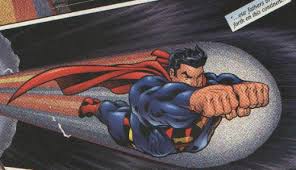
Not speeding-bullet-fast, but getting there

The cape helps.
The cape helps.

The edit/rewrite/polish of the western continues, and have to admit I’m actually surprised at how fast the process is moving.

Maybe it’s working with a pen and an actual hard copy of the script, which for some reason is always more productive than doing it on the computer.

Maybe it’s all the ideas stemming from the great notes and feedback I’ve received.

Or maybe it’s simply a culmination of the experience of having done this so many times before. Putting my money on this one.

I’d estimated the rewrite would take me maybe 5 to 6 weeks, schedule permitting. There are a few sequences that need some major work, some that need significant trimming, and plenty of minor tweaks and adjustments to be made. But just a few days in, and I’ve already passed the halfway point.

At this rate, there’s no reason I couldn’t be done within the next 2 weeks. After that, it goes out for one more round of professional feedback. I honestly didn’t think this would happen this fast.

I think maintaining a steady work schedule, a definite commitment to the craft and that internal drive/compulsion to succeed have all contributed to getting me to this point in my abilities. I’m more than willing (one might even say eager) to do the work, and the more I do it, the easier the whole process seems.

Of course there are days when I’m not productive, but even those are getting fewer and far between.

Hopefully you’re also able to devote some time each day to getting some writing done. Don’t be discouraged if it seems too hard or overwhelming right now. Keep at it. On top of that, get feedback and read scripts. Build up your knowledge and apply it to your work.

Before you know it, you’re done and ready to jump into whatever comes next (although it might take more than a single bound).

Something awfully familiar about this – OR – Already seen it

Not exactly the same, but mighty darn familiar
Whoa.

I was THIS CLOSE to being done with the latest version of the outline for the pulpy adventure spec when my writer’s sense starting tingling.

“Something’s still not right!” screamed out my internal editor.

What? That couldn’t be possible, could it? I’d spent the past few weeks being oh-so-meticulous in reorganizing sequences, working out subplots and connecting story points. How in the names of Walter Gibson and Lester Dent could there be a problem?

I looked at the outline with a more critical eye.

Opening sequence – check.
Intro of hero, establish his world – check.
Hero’s world drastically changes while raising central question of the story – check.
Complications ensue – check.
Midpoint where hero becomes fully committed to achieving his goal (accompanied by reminder of the central question) – check.

Wait. Back that up a little. To right between the “Complications” and “Midpoint” parts.

Hokey smokes, there it was. Cue the flashing red light bulb (with optional klaxon).

Two consecutive sequences just way too similar to each other. This is what’s been bothering me.

No doubt about it. One of ’em has to go. Probably the first one. You’d think it would be no big deal to just go in and change it.

And you’d be kinda/sorta wrong.

The events that happen during these two sequences are vital to the story, so the outcome needs to stay the same. The tough part now is figuring out how to change the “what happens” in that first one so not only is it unique enough unto itself, but also falls neatly into the overall structure of the story.

As always, a daunting task. For now. But potentially solvable given some time and exploration of possible alternatives.

I cannot stress enough the importance of why you should outline your story before even considering starting on pages, and being extremely thorough about it while you do. This is where you get all the heavy lifting done by figuring everything out. Where it’s a lot easier to identify the cracks in the foundation. Where it might take you a few passes to realize what works and what doesn’t.

Then again, this is how I do it, so your approach may be totally different. But speaking for myself, I prefer to go back in and fine-tune a couple of scene descriptions consisting of one to two sentences, rather than labor my way through several pages, then have to totally junk them because they’re not working.

So my focus for the time being is fixing this, then going through the whole outline a few more times, making adjustments where necessary, until I think it’s done/ready for conversion into pages.

-Got to see JURASSIC WORLD and INSIDE OUT last week. Both very enjoyable, but for very different reasons. Of the two, I’m more interested in seeing INSIDE OUT again, mostly for the writing and storytelling aspects.

Regrettably, still haven’t seen MAD MAX: FURY ROAD yet. Of all the summer releases, this feels like the one that must be seen on the big screen. Will do what I can to rectify that.

A whole lot of something out of an almost-nothing

An apt metaphor if ever there was one

A bit of a snag had developed in the rewriting of outline for the pulpy adventure spec. A certain aspect of the story had proven to be too simple, as in “not complicated enough” or “lame half-assed, last-second placeholder”.

It was also falling short in terms of overall pulpy-ness.

Seeing as how this is supposed to be a rousing tale sprinkled with elements of mystery and intrigue, it just wasn’t happening.

I won’t totally jettison a story, but rather see what changes, small or drastic, can be implemented in order to get things back on track.

I don’t know how it is for other writers, but sometimes I’ll go over a previous draft, hit a word or phrase that originally didn’t hold much significance, and all of a sudden it triggers a whole new realm of possibilities. Call it the “How did I not see that before?” syndrome.

In this case, it was a character’s name. This set off the auto-immediate response of “Hmm. What if…?”

Cue the heavenly chorus.

Suffice to say, now it’s back for yet another take on the draft, but this time going into it armed with a whole new batch of ideas.

-Time for a couple of book plugs!

Friend of the blog Justin Sloan has a new book coming out this weekend – Military Veterans in Creative Careers: Interviews with our Nation’s Heroes. Some great stuff in there, including quality interviews with men and women who’ve served in the armed forces and are now working in creative fields.

If you’re looking for a little guidance on your journey to becoming a working writer, then take a look at Notes to Screenwriters by Vicki Peterson and Barbara Nicolosi, who also run the Catharsis script consulting service.