A tentpole frame of mind


kids-movies
My objective. Every single time.

Here in the US, we are heading into what’s known as Memorial Day weekend, where we honor those who have given their lives in the service of our country. It’s also considered the kickoff of the summer season, even though summer doesn’t officially start for a few weeks.

Once upon a time, Memorial Day weekend was when the summer movie season kicked into high gear, with each weekend seeing the release of a potential blockbuster. It has since crashed through the barrier of time limitation, with some summer-appropriate fare being released as early as late March.

I was fortunate enough to have come of age when each summer saw its fair share of films that could be categorized as prime examples of not only filmmaking, but also of storytelling.

Definitely storytelling.

RAIDERS OF THE LOST ARK. GHOSTBUSTERS. BACK TO THE FUTURE. ALIENS. ROBOCOP. DIE HARD.

Each one has made its indelible mark on me, making quite the impact on my psyche and personality, and severely influencing the way I write. I make no secret about loving to write these kinds of stories.

(Author’s note – I’m no fool. Nobody’s going to take a chance on a mega-budget script from an unknown. Hopefully once I establish a foothold with my smaller scripts, I can eventually bring out the bigger ones.)

Some may see a summer release as Big Dumb Fun, which admittedly some of them are, but I make a point of treating the audience as intelligent people and want to give them a story that goes beyond simplistic expectations.

I strive to write material that entertains more than just the eyes and ears; I go for the brain, too. It takes a lot of effort to put together a story that stimulates the viewer on more than just a sensory level, but when it’s done in a smart and efficient way, the satisfaction of seeing it pay off is well worth it.

Will I ever get paid to write these kinds of stories? I like to think so. It doesn’t hurt to at least daydream about it.

Imagining that sometime in the relatively near future, a trailer will come up that features snippets of characters and dialogue, all of my creation, all culminating with those words laden with the excitement of anticipation:

“Coming this summer to a theatre near you”

A big smile and chills up my spine, believe you me.
A few points about plot points

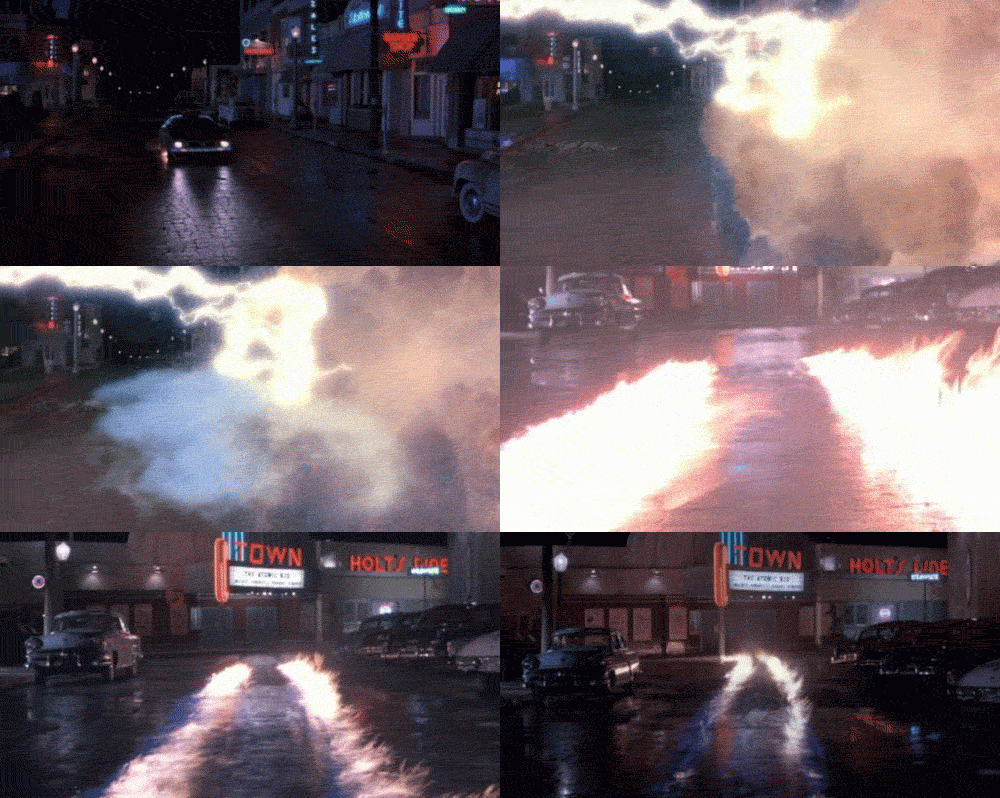
delorean

Time for a quick refresher course, chums.

Today’s topic: plot points. What they are and what they represent.

I’ve always seen plot points as pivotal moments in the story; events that change the situation for your protagonist, usually in a negative manner, and ask/reiterate the central question (Will your hero achieve their goal?).

Having solid plot points also helps establish your story’s structure. Without it, all you’ve got is a big convoluted mess, and who wants to read that?

Although this uses a 110-page script as an example, plot points don’t have to happen exactly at those pages. A few more or less is totally acceptable. I’ve also opted to use fairly recognizable examples to emphasize each plot point.

Pencils ready? Let’s begin.

Page 3 – statement of theme. What’s the overall message of your story? The theme should also be incorporated in some fashion into each scene throughout the course of the story. (“No McFly in the history of Hill Valley has ever amounted to anything!” “Yeah, well, history’s gonna change.”)

Page 10 – inciting incident. The event that shakes up you protagonist’s world, and asks the central question of the story. (Will Indy get the Ark before the Nazis?)

Page 17 – a twist to further complicate things for the protagonist. (“Alderaan? I can’t go with you to Alderaan!”)

End of Act One (page 25-30) – Your protagonist leaves behind their old world and enters a new one to achieve their goal. Also repeats the central question. (Marty arrives in 1955)

Page 45 – another twist to complicate things for the protagonist (Indy saves Marion, destroys her bar. “I’m your goddamned partner!”)

Midpoint/Point of No Return (page 55-60) – your protagonist becomes fully committed to achieving their goal (Brody decides to go after the shark after his son barely survives the latest attack)

Page 75 – yet another twist to really complicate things for your protagonist (Vader kills Ben as Luke & Co escape)

End of Act Two (page 90) – All is lost. Your protagonist is totally screwed with no apparent way out. Makes it seem like the answer to your central question is “no”. (The Nazis get the Ark).

Climax (page 95-100) – final showdown between your protagonist and antagonist. (Rebels attack the Death Star. Marty must hit the wire when the lightning hits. Nazis open the Ark. The shark attacks the Orca, eats Quint.)

Resolution (page 100-105) – Aftermath of the climax. Central question gets answered. (Rebels victorious. Marty returns to 1985. Brody & Hooper survive. Indy delivers the Ark.)

Denouement (page 105-110) – How your protagonist’s world is now different from what it used to be (but not necessarily better). (Marty’s family is successful. The Ark gets crated and goes into a warehouse. Luke & Han hailed as heroes. Brody doesn’t hate the water anymore.)

So there you have it. Do the plot points of your story match up with these? Just something to think about. And feel free to watch the movies represented here (or one of your own personal favorites, or one similar to yours) to see all those plot points in action.

It just might be some of the most fun homework you’ll ever have.

Roll up for the My Writing Process Tour!

Sorry, no walruses involved
Step right this way! Sorry, no walruses involved

I’ve been invited to take part in The My Writing Process Tour, which is kind of a blog/chain letter thing. One blogger asks another to take part and answer some insightful questions, then link to writers/bloggers we’d recommend.

I was nominated by Henry Sheppard, aka Adelaide Screenwriter, from the Australian metropolis of Adelaide. He’s always offering up some fantastic material, including articles, interviews and shorts. Definitely worth checking out.

As for me…

1. What am I working on?

Three items currently hold my attention: revamping the outline of a pulpy adventure spec, the rewrite/polish of a Christmas-themed mystery-comedy and resuming the hunt for representation.

2. How does my work differ from all others of its genre?

Even though I’ve written in several genres, the one thing I always try to convey is a sense of fun and excitement. It takes a lot more effort than people realize to really engage a reader that way.

I want you to enjoy the story beyond just “this is good writing” and more like that amusement park thrill ride you rush to get back in line for as soon you get off.

3. Why do I write what I do?

My formative years were the late 70s/early 80s, so I had the benefit of being heavily influenced by the likes of STAR WARS, RAIDERS OF THE LOST ARK and BACK TO THE FUTURE. To me, those are textbook examples of what smart storytelling should be, and it’s what I strive for in my own work.

I’ve stated before about being a fan of the genres I write, so not only am I trying to write something I’d want to see, but I try to create something I haven’t seen before.

4. How does your writing process work?

It all starts with an idea. Is there a story behind it? If so, what happens over the course of that story? How could I tell it in an original way?

Once I have a general idea about that story, including knowing how it starts and ends, I set up the plot points (statement of theme on page 3, inciting incident on page 10, etc), then fill in the gaps between them.

If it’s a genre-specific film, I try to incorporate elements that are part of that genre while trying to avoid tropes, or at least approach them from a different perspective.

I do a majority of my work in developing the outline, and it makes a huge difference. It gives me a better overview of the whole thing so it’s easier to keep track of character development, storylines, subplots, setups and payoffs. I won’t even consider starting on pages until I think the outline is solid.

Because of my schedule, I write when I can. When it comes to pages, I try to produce at least 3 a day. Sometimes it’s more. It’s gets easier the more you do it. They add up fast, and before you know it, you’ve got a completed draft to go back, edit and rewrite.

I’m also extremely fortunate to have several friends and trusted colleagues I can turn to for feedback. They pull no punches in telling me if something doesn’t work.

Lastly, I’ll rewrite and polish the script until I think it’s good to go.

Over there on your right is a list of blogs I think make for some excellent reading and advice. I’ve added three definitely worth checking out:

The Single Screenwriter by Christie LeBlanc

Writer of Fine Things by Evan Porter

The Screenwriting Process from James (don’t know his last name) in the UK

Bonus! If you’re looking for some reasonably-priced professional analysis for your script, you might want to consider:

-Doug Davidson’s Four Star Feedback. Doug is the only writer to win a Nicholl Fellowship with an animation script (2004), but he happily covers all genres.

-Andrew Hilton aka the Screenplay Mechanic. His services have garnered extremely high praise on the Done Deal Pro forums.

Thanks for reading!

I seek rewatchability

Never gets old. Never.

It goes without saying that any screenwriter is a movie buff. We have to be. It’s our love of movies that got us into this in the first place.

We’ve all got our favorites. Countless genres are spanned. Writers, directors or performers we can usually rely on for solid, quality work. Who hasn’t claimed to have seen a particular movie “over a hundred times”?

So what is it about them that makes us have no problem with watching them over and over, as opposed to seeing something once and being done with it, or maybe even abandoning ship around the halfway point?

A favorite film motivates repeat viewings. You’re enjoying the whole experience so much that when it’s over, you’re already looking forward to seeing it again.

Consider the films in your home collection. What is it about them that made you go so far as to want to own them?

For as much as I talk about STAR WARS, RAIDERS OF THE LOST ARK and BACK TO THE FUTURE, all of which I could watch over and over, I’m also perfectly content with something that doesn’t involve special effects, like TO KILL A MOCKINGBIRD, THE MAGNIFICENT SEVEN or SOME LIKE IT HOT.

What do all of these have in common? For me, it all boils down to fantastic storytelling with well-crafted three-dimensional characters, both of which also motivate and inspire me to be a better writer.

Which is what it all comes down to. The writing, which starts with us.

Not only are we striving to create a story, but we want to make them so amazing that they’re practically irresistible not only to the people who make the movies, but the movie-going public.

While working on that latest project, we imagine what the finished product would look like on the big screen and hope the audience is having such a blast watching it that they’ll want to come back for more.

But imagining is one thing. Actually making it compelling and involving is another.

We must continuously write, rewrite, hone and polish each individual piece of work to make it as involving and engaging as possible.

Not sure if yours is? Ask somebody. Writing group, trusted colleague, paid analyst. Doesn’t matter. Always be striving for greatness, my friends.

Our work is definitely cut out for us.  It’s hard enough to write a good script. It’s even harder to write one people want to continuously return to.

What it’s about, not what happens

bttf theme

A usual part of my daily routine is helping V with her homework. This week, they’re learning about how to identify the theme of a story.

Nothing like starting with the basics.

After reading the one-page story together, I asked her what she thought the theme was. Her response was more focused on one part of the story, rather than the whole thing, so I tried another approach.

“What’s the message of the story? What is it trying to teach us?”

That made things clearer to her, which made finding the theme of the next day’s story a little easier (with a little guidance from me).

This of course made me think about finding, or at least knowing, the theme of the story of your script.

Some writers start writing and figure out the theme later. I’m the total opposite of that. I don’t think I could even start on the outline if I didn’t at least have an idea of what the theme was.

A lot of the time it’s just a single word or a short phrase, but it still plays a key part in putting my story together.

Knowing the theme of your story is vital; it influences how the story’s told and what it’s about. If you don’t know what your story’s really about, how can you put the rest of it together? That would be like doing a jigsaw puzzle without knowing what the final picture is.

A great example of a theme on display is BACK TO THE FUTURE. Look at the dialogue exchange in the picture up top, which takes place just a few minutes in. Jump forward to Act Two, where, after all the setup in Act One, we get to see how history does indeed change, all thanks to Marty. (Just another reason why this is a phenomenally bulletproof script)

So as you work on your latest draft, take a look at each scene, even if it’s just a few lines long. Does it advance the story, the characters and the theme?

If so, great and keep up the good work. If not, take a moment to figure out what could be changed so it does.

Once you learn how to do this, hopefully your writing process will be just a little bit easier.